

About this worksheet
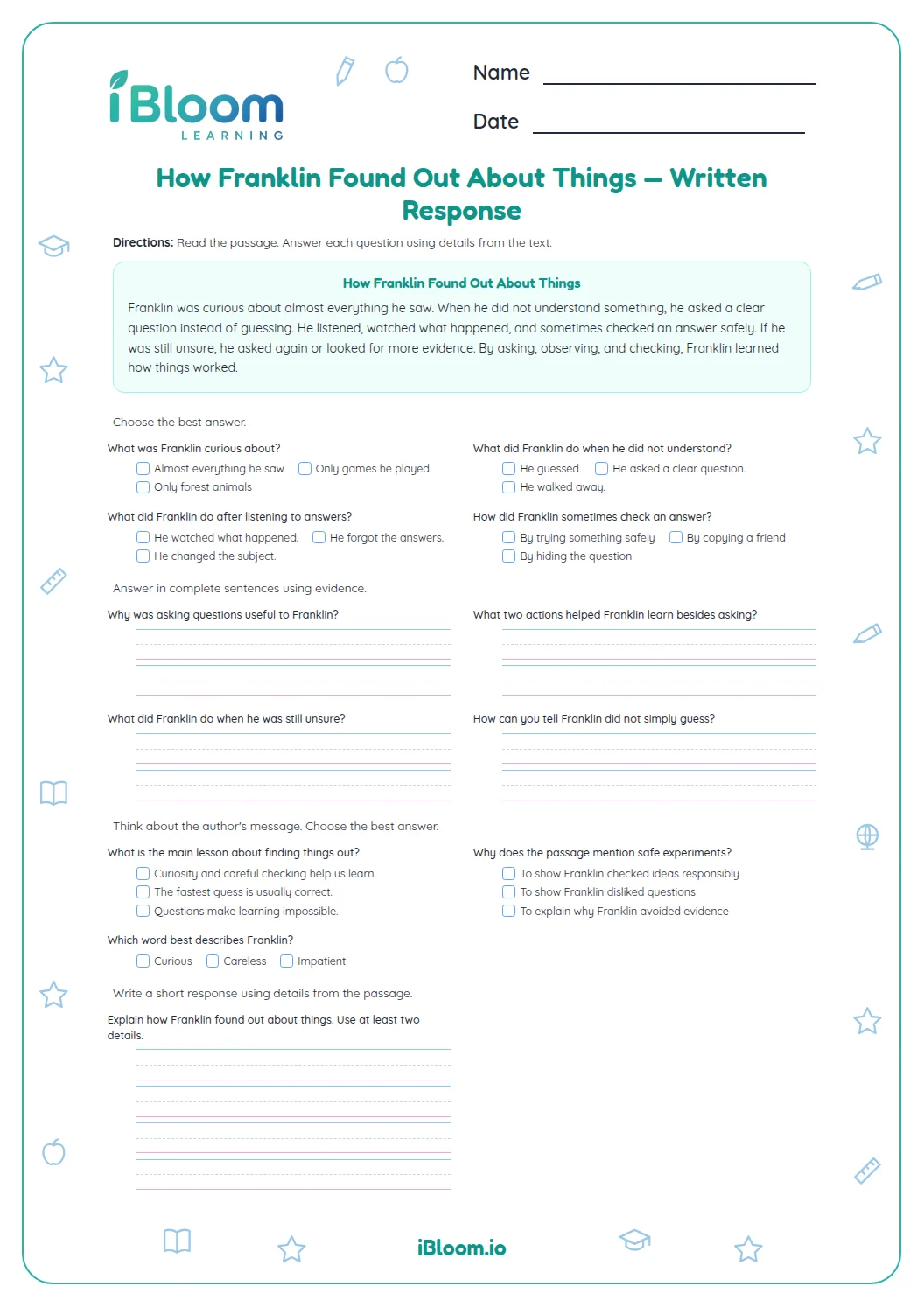
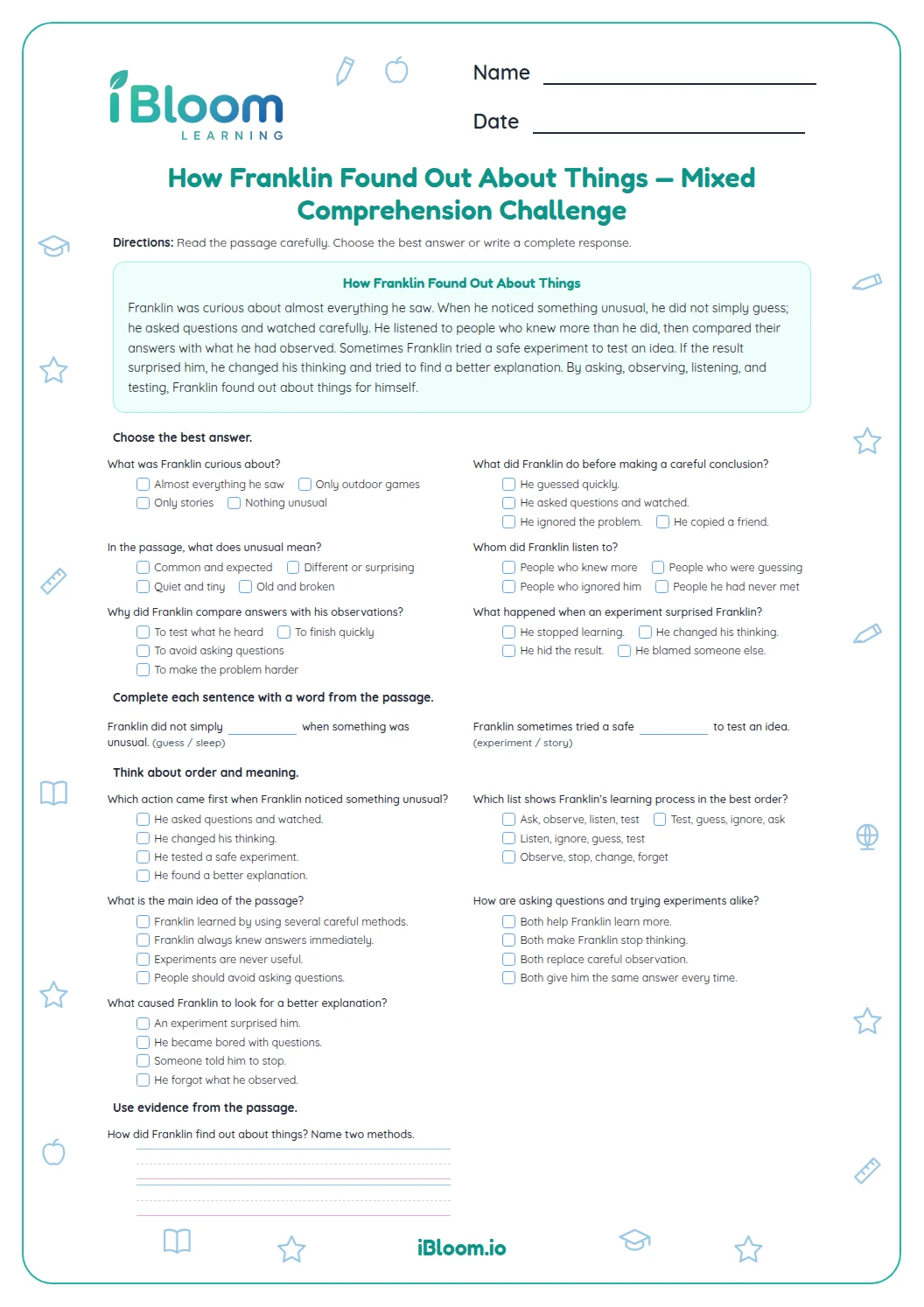
This free printable Grade 4 reading worksheet pairs an original retelling of the Franklin-and-ants story with fourteen title, vocabulary and passage questions. Begin with the title questions in Part B before reading the passage in Part A. Then answer eight passage choices in Part C and four short responses in Part D, including context clues and story details. Students practice Common Core L.4.4.a by using definitions and restatements in context. The separate answer key identifies each choice and gives sample written responses. The story keeps Franklin’s question, the suspended molasses jar and the ants’ return along the string.
Aligned to L.4.4.a
What should we do before reading the passage?
Read the story title and answer questions 1 and 2 in Part B first. The phrase “found out” suggests learning, and the title gives readers a reason to look for Franklin’s way of finding answers. Cover the passage temporarily if it helps the child focus on the title.
After that short title check, read Part A and complete Parts C and D. This order makes the title a useful starting point even though the passage is printed first.
Which words provide clues to suspended?
The passage places the jar above the floor and says it hangs by a string from a ceiling nail. Those details let readers replace suspended with hung. Question 11 asks students to find the clue phrase, then try the meaning in the sentence.
- 1He suspended the jar by a string from a nail in the ceiling.
- 2Clue: by a string from a nail in the ceiling
- 3Suspended means hung.
What version of the Franklin story is included?
The passage is an original retelling of the ants episode in Edward Eggleston’s Stories of Great Americans for Little Americans. Franklin wonders how ants share information, hangs a molasses jar from a string and watches one ant leave. Later, more ants arrive along the string.
The ending distinguishes an observation from an explanation: Franklin sees the ants return and still has a question about how they shared information. Questions 10–14 ask readers to connect those details with what Franklin wondered.
How to use this worksheet
- 1Read the story title and complete Part B before reading the full passage.
- 2Read Part A, pausing briefly at unfamiliar words.
- 3Answer the eight passage choices in Part C by finding nearby clues and checking story details.
- 4Write short responses to questions 11–14 in Part D, using a passage detail to support each answer.
- 5Check the key, then reread each vocabulary sentence with its meaning substituted.
Mistakes to notice and how to help
The mistake
Choosing a familiar meaning of suspended, such as removed from school.
The fix
Use the ceiling, string and jar to select the meaning hung.
The mistake
Treating route as an object the ant carries.
The fix
Follow the ant’s movement up the string and down the wall; route means its path.
The mistake
Giving a definition without the clue requested in question 11.
The fix
Return to the sentence with molasses and copy the words thick, sweet syrup.
Common Core alignment
Use definitions and nearby explanations to understand words in the Franklin passage.
On this sheet: The vocabulary choices and written responses ask students to use clues in the passage.
Show the official wordingHide the official wording
Use context (e.g., definitions, examples, or restatements in text) as a clue to the meaning of a word or phrase.
What to practice next
Make more practice
Further reading
Questions parents and teachers ask
What does this How Franklin Found Out About Things: Preview and Vocabulary worksheet practice?
It pairs focused reading comprehension practice with a short story written for this page. Children can reread the passage, point to a detail, and use that detail to support each answer in their own words. The questions move from direct details to explaining ideas.
Can a student use the passage while answering?
Yes. The passage stays available on the worksheet, so students can return to it as they work. Rereading a sentence or paragraph can help them check a detail before choosing an answer or explaining an idea. They can underline a clue before responding.
What is included in the answer key?
The key gives an answer for every question. For responses that can be phrased in different ways, it provides a sample; students may use other wording when it is accurate and supported by the passage. An adult can accept another clear answer with evidence.
How can an adult use the written responses?
Ask the student to point to the sentence or event that supports the response. A short oral explanation can help them connect the evidence to the idea before they write or select their final answer. This makes the reasoning visible without requiring a long response.
How long should the worksheet take?
Plan for about 20 minutes, with extra time if the student rereads the story or discusses an answer. The pace depends on reading fluency and how much explanation each response needs. Students can complete the questions independently or talk through selected items with an adult.