

About this worksheet
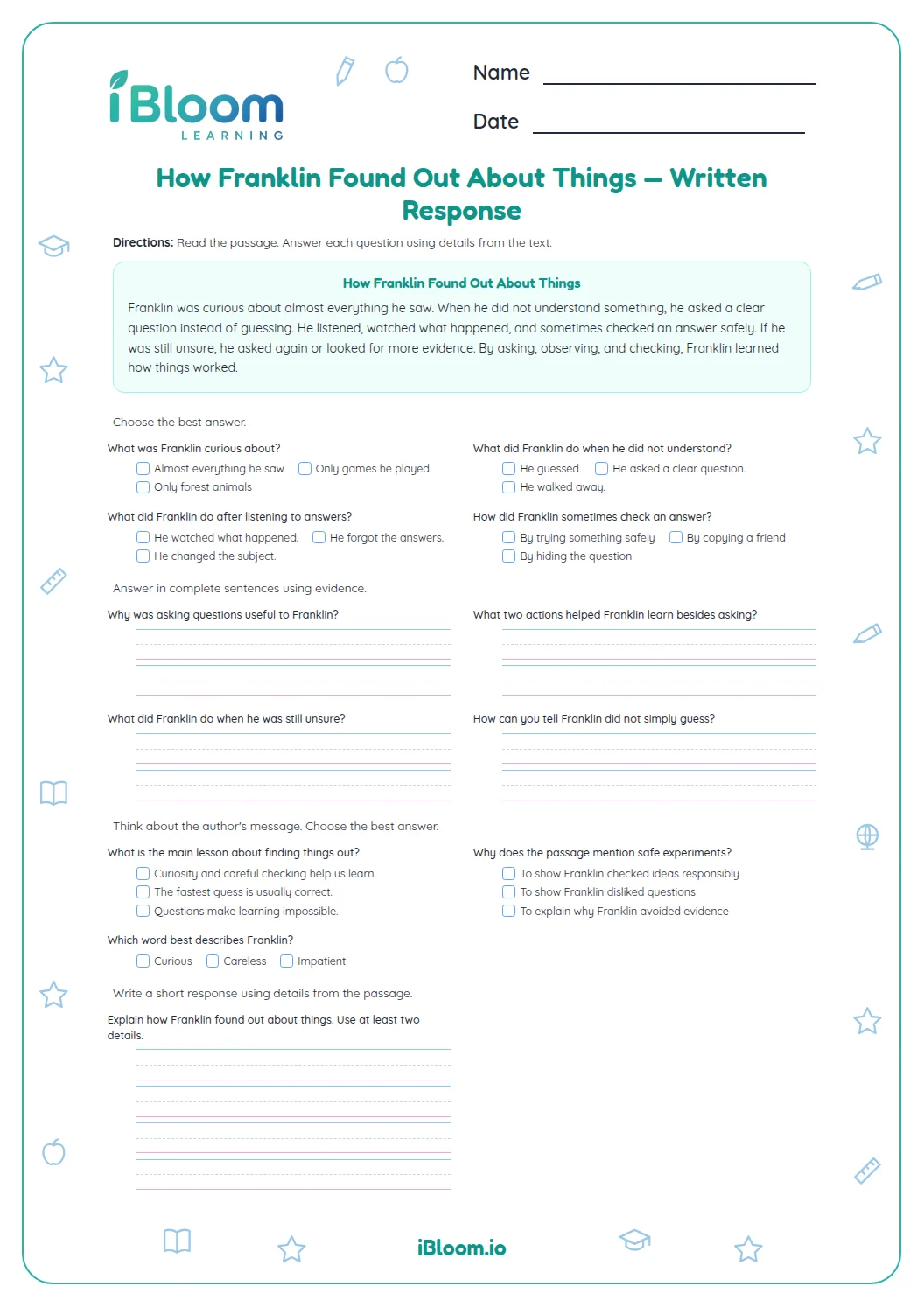
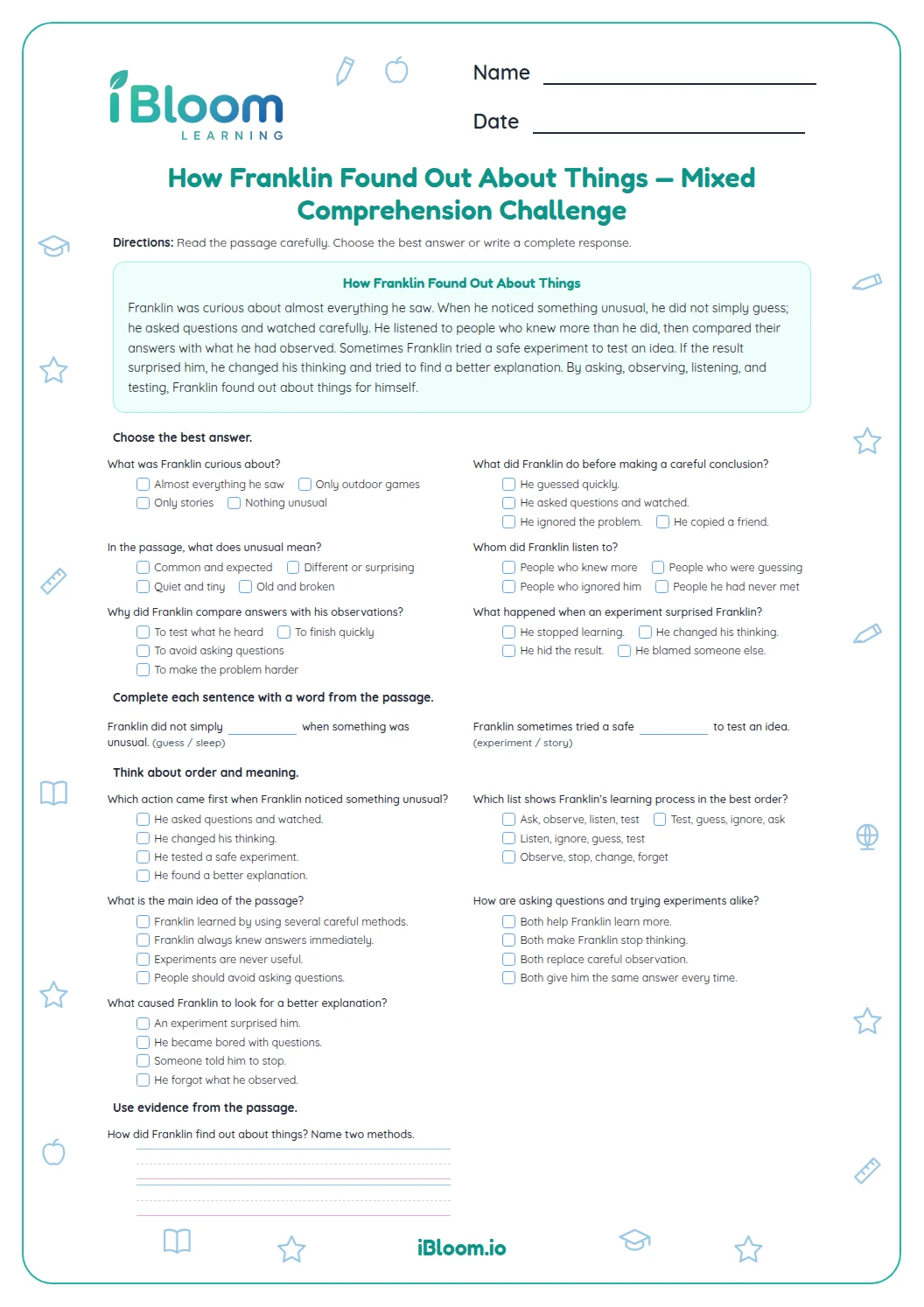
This free Grade 4 reading worksheet uses an original passage about Franklin’s curiosity and how he investigates a question about a kite. Students identify the central idea, select key details, follow the investigation, and explain a lesson with evidence. The practice aligns with Common Core RL.4.2, which asks readers to determine a story’s theme from details and summarize it. Fourteen multiple-choice and short written questions come with a separate answer key.
Aligned to RL.4.2
How does Franklin investigate the kite question?
Franklin wonders why a kite stays up. He watches leaves rise in the wind, asks a neighbor about the breeze, reads how a kite catches moving air, and tests tails of different lengths.
Question 4 points to the neighbor detail: Franklin asks about the breeze to learn from someone else. Question 8 shows what his test reveals: the longer tail helps the kite stay steady.
How can a reader write a useful summary?
Keep Franklin’s question, the important ways he investigates it, and what he learns. Leave out small details that do not change the main idea. Question 11 asks for those parts in one sentence.
What lesson do Franklin’s actions support?
Franklin observes, asks, reads, and tests instead of relying on a guess. Those actions support the lesson that careful questions and evidence can help a person learn. Use details from both the opening and kite investigation to explain the idea.
Read the passage once to understand Franklin’s question.
- 1Underline the actions Franklin takes before he names a cause.
- 2Answer detail questions by matching words in the passage.
- 3For theme questions, connect Franklin’s choices to a lesson.
- 4Write the summary with the problem, solution, and result.
Common mistakes and quick fixes
The mistake
Picking a single detail as the main idea.
The fix
Ask which statement includes the problem and the important response, not one isolated event.
The mistake
Choosing an answer that sounds possible but is absent from the passage.
The fix
Return to a sentence in the passage and check the exact detail.
The mistake
Writing a theme as a topic such as “kites.”
The fix
State a lesson, then point to an action that supports it.
Common Core alignment
This practice connects to RL.4.2 through the skill named on the worksheet.
Use story details to infer a theme and summarize the passage.
On this sheet: Questions connect Franklin’s choices and kite details to a lesson and concise summary.
Show the official wordingHide the official wording
Determine a theme of a story, drama, or poem from details in the text; summarize the text.
What to practice next
Make more practice
Further reading
Questions parents and teachers ask
What does this Franklin passage teach?
Franklin learns about the world by observing, asking questions, reading, and testing ideas. In the kite passage, he notices leaves rising, asks a neighbor about the breeze, reads about moving air, and tests different tails. The result helps him connect evidence with what makes the kite steadier.
How does the worksheet practice main idea and details?
Students choose an idea that fits the whole passage, then find details about Franklin’s kite investigation. Later questions ask them to summarize what happened and name a lesson supported by his actions. The key accepts short written answers that accurately use information from the passage.
What is the answer to question 4?
Franklin asks a neighbor about the breeze. This detail shows that he seeks information from another person before testing his ideas. The passage also says he watches leaves and reads about how a kite catches moving air, so students can compare several ways he investigates.
How should my child use the answer key?
Have your child read the passage and answer the questions before checking the key. For written responses, accept concise wording that includes an accurate detail. If an answer is missed, return to the sentence about the kite or Franklin’s earlier learning habits and find the evidence together.
What belongs in a one-sentence summary?
A useful summary names Franklin’s question about the kite, the important steps he takes to investigate it, and what he learns. It does not need every small detail. Question 11 gives practice combining the question and his observing, asking, reading, and testing into one sentence.