


About this worksheet
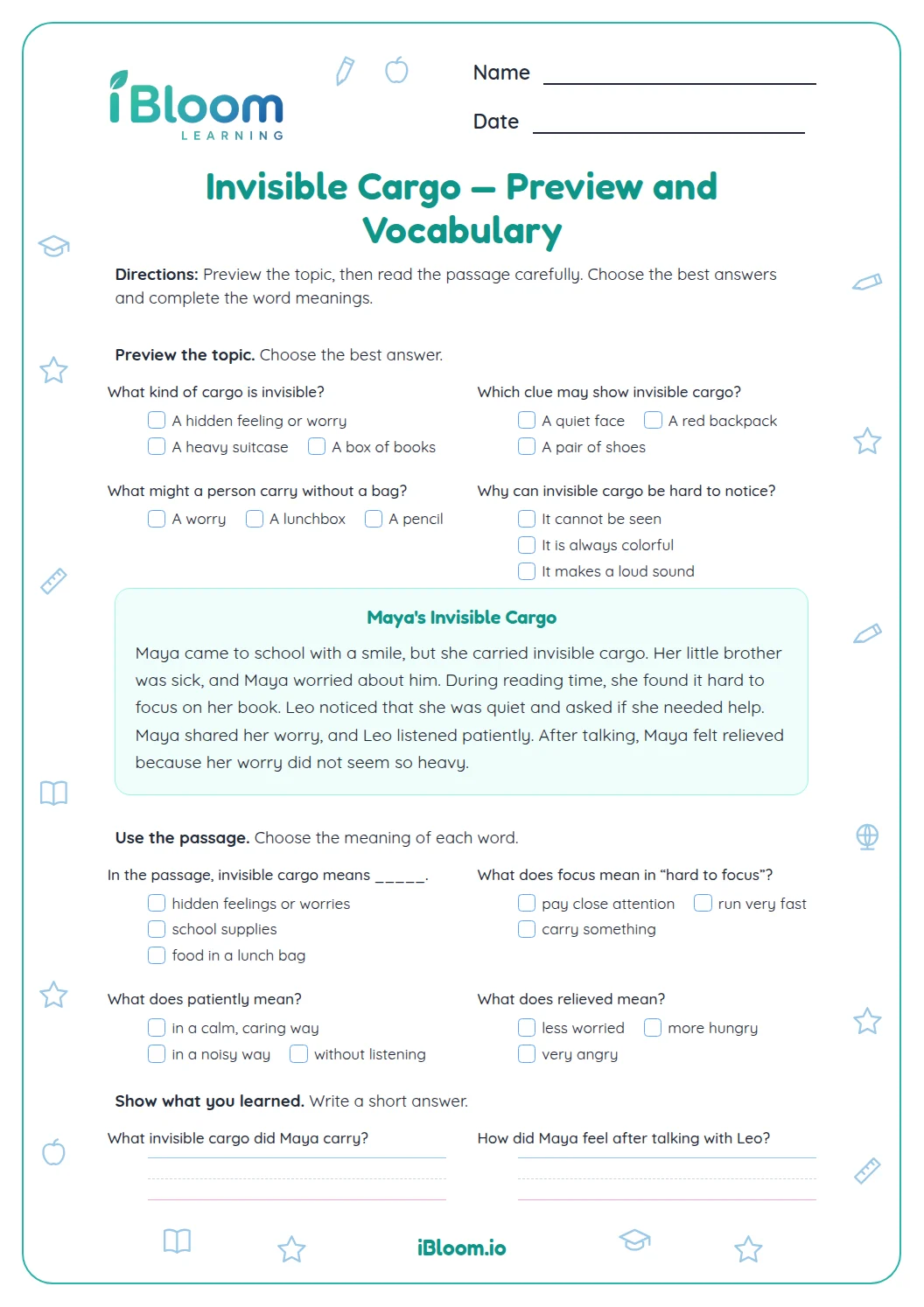
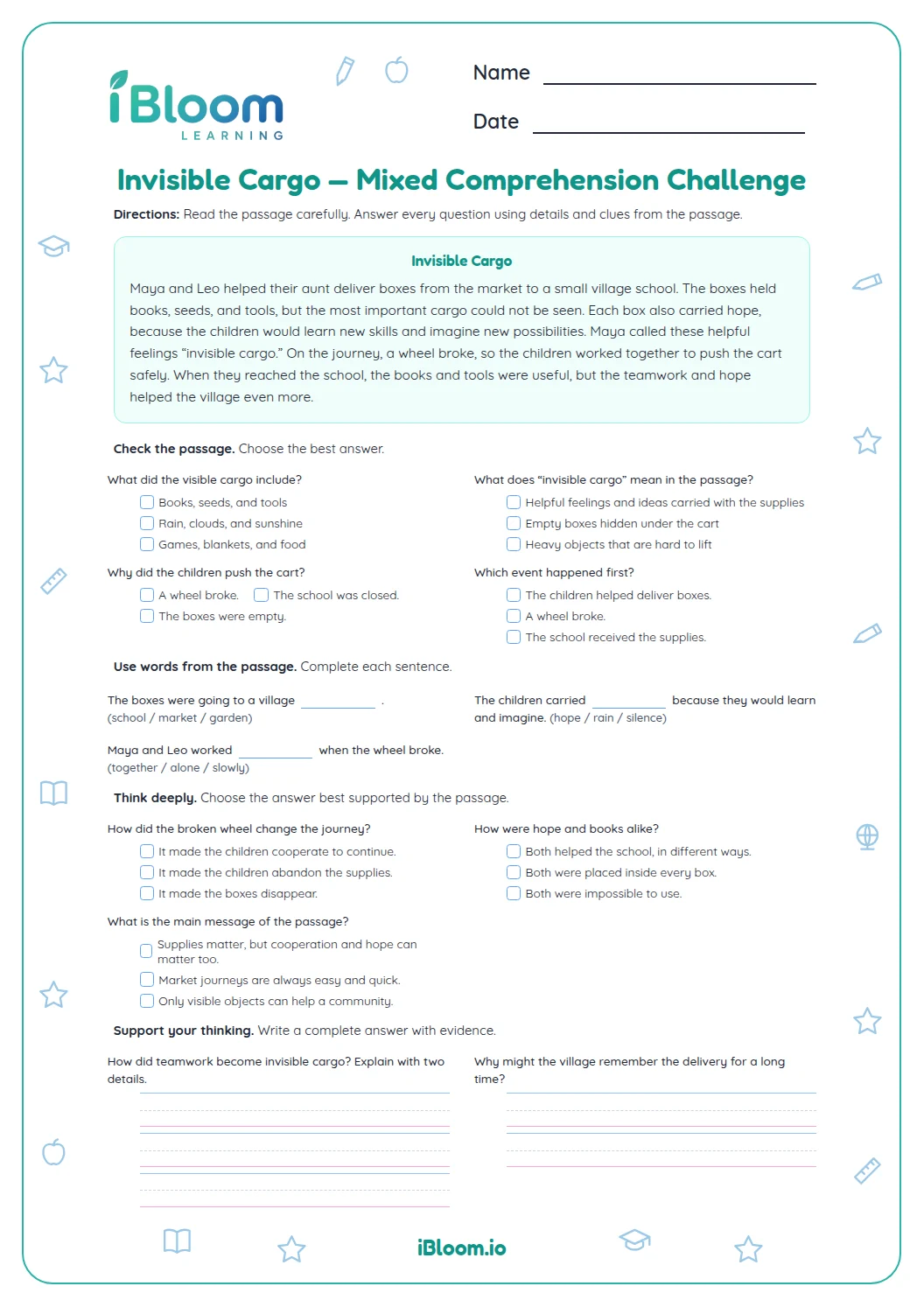
This Grade 4 printable pairs the Invisible Cargo story with 16 questions about inference and evidence. Children infer what the empty box represents, connect Maya and Leo’s actions to their worries, and identify details that support each idea. The answer key follows the story’s words and events.
Aligned to RL.4.1 and RL.4.3
What is on this worksheet?
The fable follows Mara as she brings warm bread to a ship in a covered cart. Questions ask readers to infer from clues, identify supporting evidence, and explain what the ending reveals.
A strong response names a clue from the story and explains how it supports the inference.
How should children work through the parts?
For q1, the box is labeled INVISIBLE CARGO, yet it has no objects. The passage later explains that each child places a worry on a card inside, so the “cargo” is what they carry in their thoughts.
- 1Clue: The box has no objects.
- 2Text detail: Each child places a worry on a card.
- 3Inference: The cargo is made of worries, not objects.
How can families review the answers?
Evidence questions ask for details such as the sailors cheering or Mara securing the cover. In the final explanation, use both actions named in the answer key as examples of her planning.
How to use this worksheet
- 1Read the fable once to follow Mara’s delivery.
- 2Reread when a question asks for a clue or evidence.
- 3Separate what the text says from what you infer.
- 4For an inference, connect a specific clue to your idea.
- 5Check written explanations against the passage and key.
Common mistakes and quick fixes
The mistake
Stating an inference without pointing to a clue.
The fix
Name the passage detail that led to the idea.
The mistake
Repeating a detail without explaining what it suggests.
The fix
Add how the detail supports the inference.
The mistake
Treating a guess as a fact from the story.
The fix
Use “the text says” for evidence and “this suggests” for an inference.
Common Core alignment
Use details and examples to support inferences about characters and events.
On this sheet: The questions directly practice this reading skill.
Show the official wordingHide the official wording
Refer to details and examples in a text when explaining what the text says explicitly and when drawing inferences from the text.
Explain Mara’s actions and the story events using specific details.
On this sheet: The questions directly practice this reading skill.
Show the official wordingHide the official wording
Describe in depth a character, setting, or event in a story or drama, drawing on specific details in the text (e.g., a character’s thoughts, words, or actions).
What to practice next
Make more practice
Further reading
Questions parents and teachers ask
How many questions are included?
The sheet has 16 questions in four parts: six inference questions, six evidence questions, and four explanation questions. The final item asks how Maya and Leo respond to their worries. The answer key gives concise responses grounded in the passage.
What grade is this for?
The fable and questions are written for Grade 4 readers. Students can read the passage independently, then return to particular sentences to find evidence. An adult may model how to tell a stated detail apart from an inference before the child starts.
How long should it take?
Plan for about 15 minutes, with extra time for rereading, careful editing or handwriting practice. Children can pause between parts, rest their hands, and return with fresh attention. Let the learner set a comfortable pace. Take a brief pause between parts, then finish with a review together.
Is an answer key included?
Yes, the printable includes a separate answer key. It lists the expected response for each item so adults can review the page quickly and focus help on a tricky clue or sentence together. Open it after independent practice and use it to notice strong clues, sound matches or clear letter forms.
How can I help if an answer is difficult?
Have the child underline or point to a clue in the passage, then explain what that clue suggests. If the answer is only a detail, ask what it tells the reader. If it is only a guess, ask which words in the story support it.