



About this worksheet
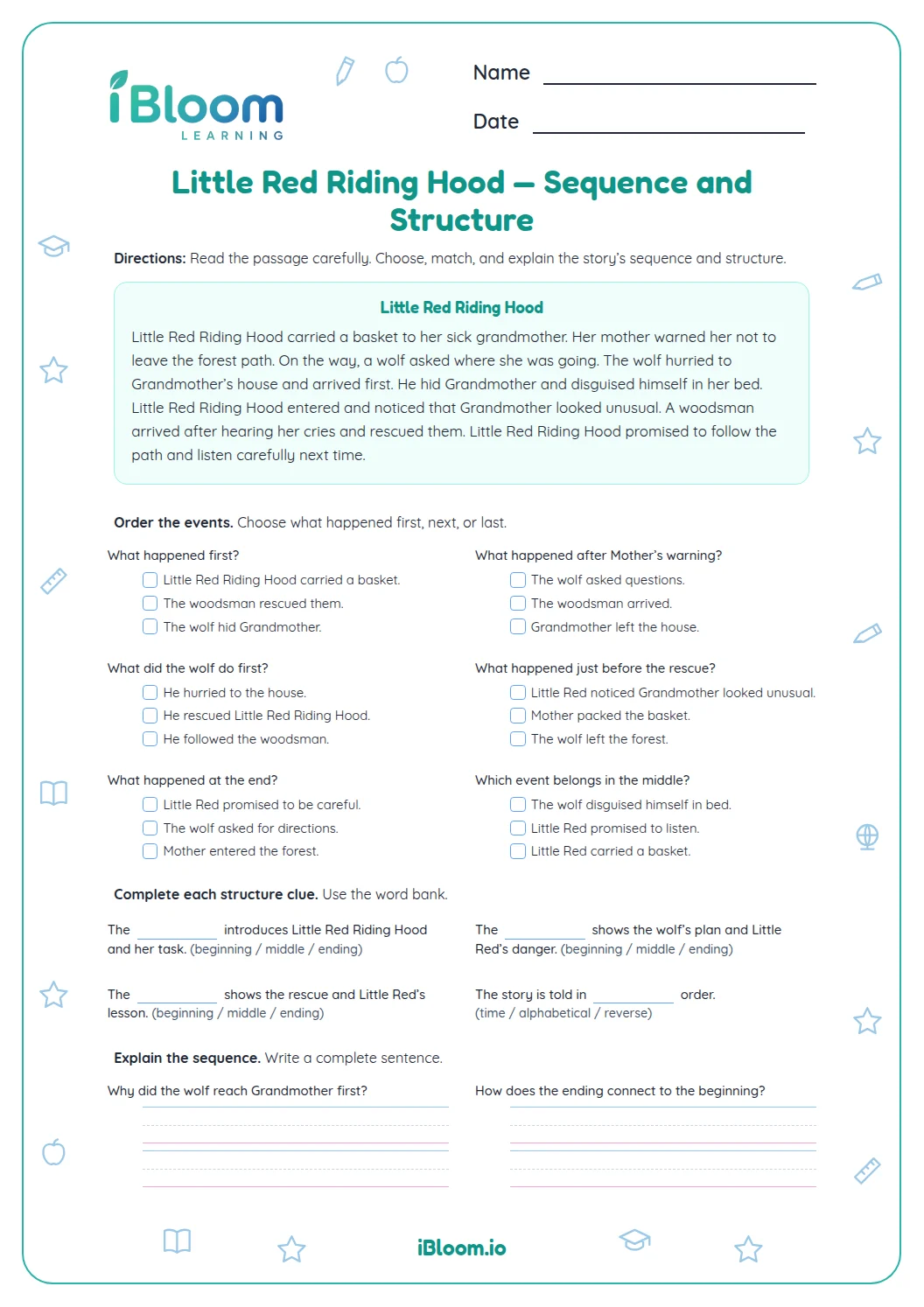
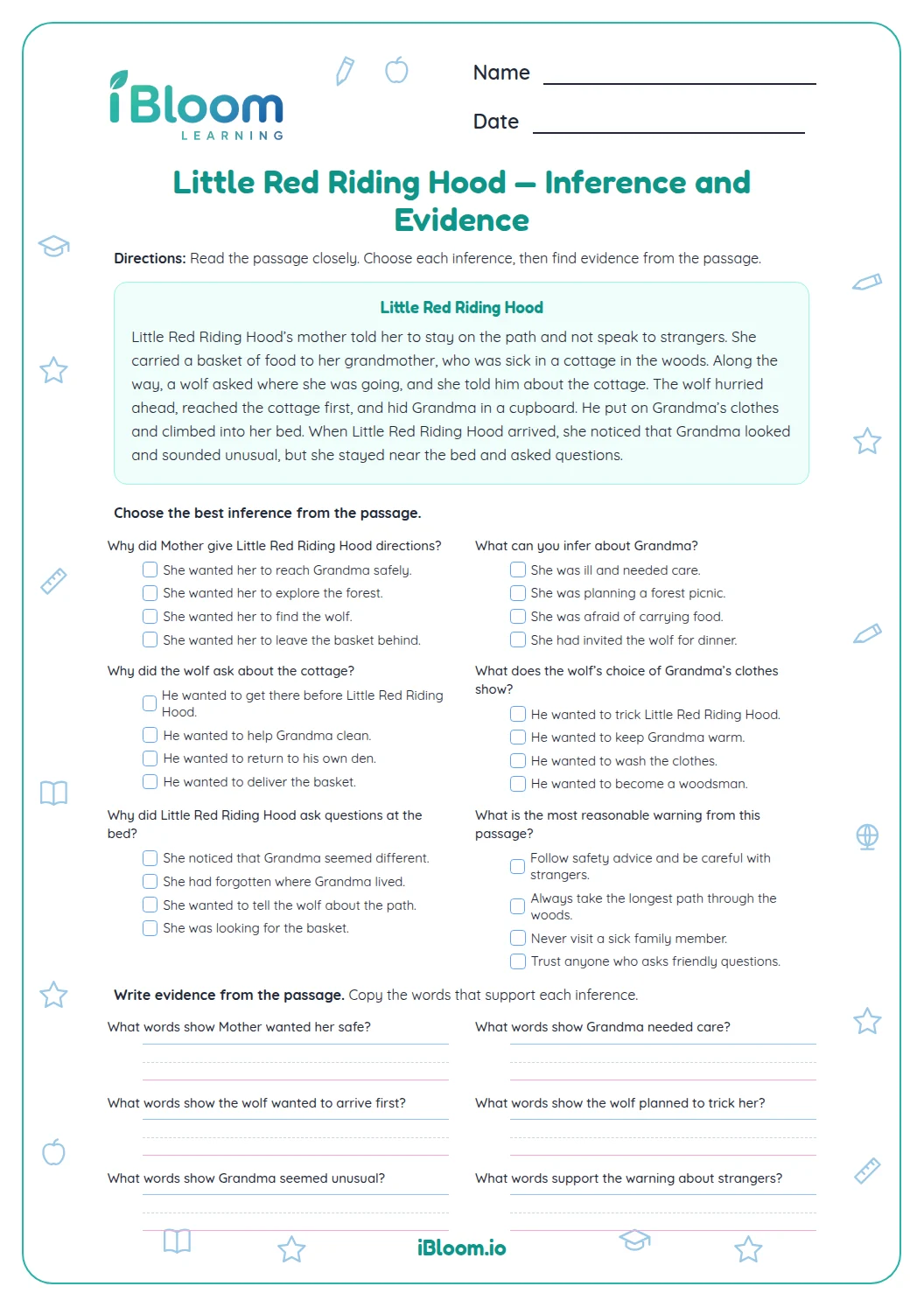
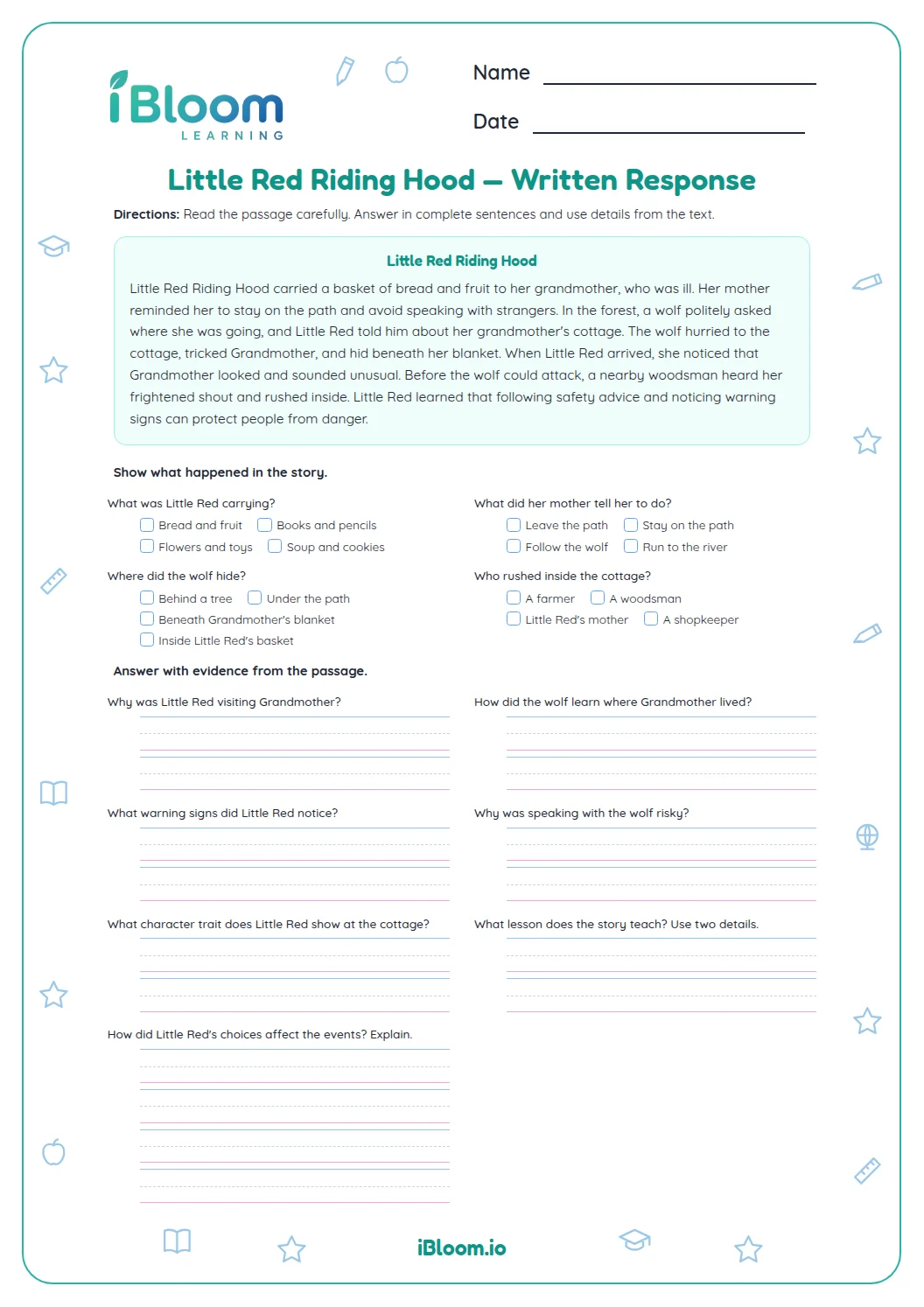
This Grade 5 worksheet pairs an original Little Red Riding Hood retelling with 14 questions. Learners recall details, sequence events, use context for vocabulary, and support inferences with story evidence. The questions practice Common Core RL.5.1 by asking readers to refer to details and examples when explaining what a text says and when drawing inferences.
Aligned to RL.5.1
How can readers support an inference?
A strong response gives an idea and a detail that supports it. When Red pauses at the cottage, connect her grandmother’s unusual appearance and voice to Red’s decision to stop.
For sequence questions, track what happens first and how one event leads to another. For the ending, connect Red’s choice to stay on the path with what she learned.
How can context explain a word?
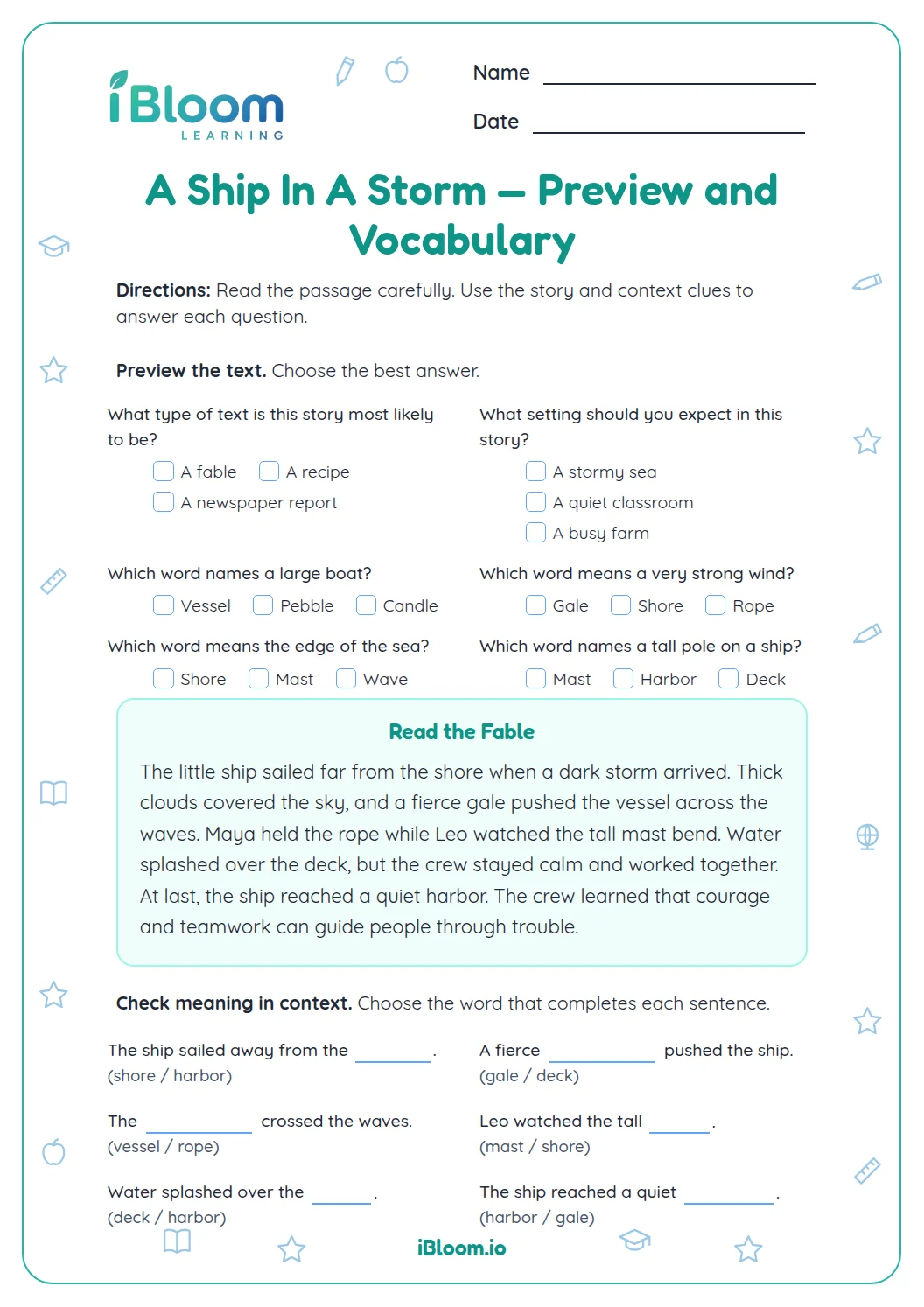
Read the sentence around an unfamiliar word and notice what the characters do next. The wolf uses a shortcut to reach the cottage first, so the surrounding action helps explain the word.
How to work through the sheet
- 1Read the direction at the start of each part.
- 2Work from the first example in the part and keep units or place value visible.
- 3Pause after each answer to check whether it fits the question.
- 4Use the answer key after finishing a part, then correct any missed step.
Use evidence from the passage
The mistake
Giving an inference without a story clue.
The fix
Add a detail from the passage that supports the idea.
The mistake
Retelling every event instead of answering the question.
The fix
Choose the one detail or event that directly addresses the prompt.
The mistake
Confusing a character’s opinion with the passage’s main idea.
The fix
State a lesson supported by actions across the beginning and ending.
Curriculum alignment
The questions ask readers to refer to story details when explaining ideas and inferences.
Use details from the retelling to explain ideas and support inferences.
On this sheet: The problems move from direct practice to applying the same skill in context.
Show the official wordingHide the official wording
Quote accurately from a text when explaining what the text says explicitly and when drawing inferences from the text.
What to practice next
Make more practice
Further reading
Questions parents and teachers ask
Is this the familiar story or a new passage?
The worksheet contains an original retelling of Little Red Riding Hood. It keeps the familiar characters but uses its own wording and events, including Red’s basket of bread and pears, the wolf’s flower suggestion, and Red’s decision to stay on the path on the way home.
How many questions follow the passage?
There are 14 questions after the passage. They ask about literal details, sequence, vocabulary, inference, character change, and the main idea. Several prompts invite a complete written response, and the answer key gives sample responses for those items.
What does a strong inference answer include?
A strong inference combines a reasonable idea with a detail from the story. For example, a response about Red pausing should mention that her grandmother looks and sounds unusual. The evidence explains why Red stops instead of moving closer.
How can readers figure out “shortcut” from context?
Look at what the wolf does after suggesting flowers. While Red gathers blossoms, the wolf reaches the cottage first by a shortcut. This sequence shows the word means a quicker route to a destination, and the events explain why he wanted Red distracted.
What should a main-idea response say?
A main-idea response states an idea that fits the passage as a whole and connects it to events. A suitable answer explains that Red learns to follow safety advice and think carefully about sharing information with a stranger.