


About this worksheet
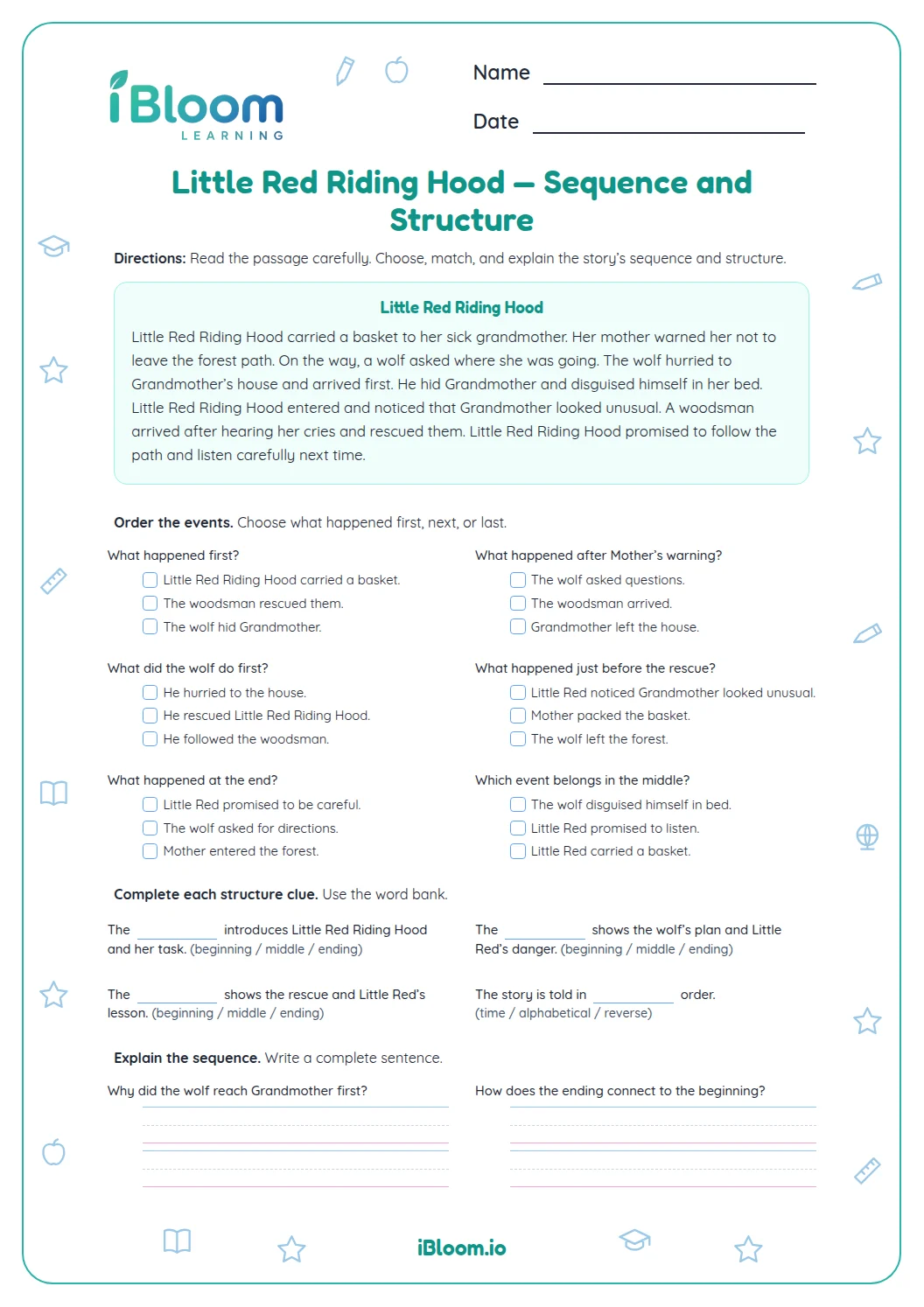
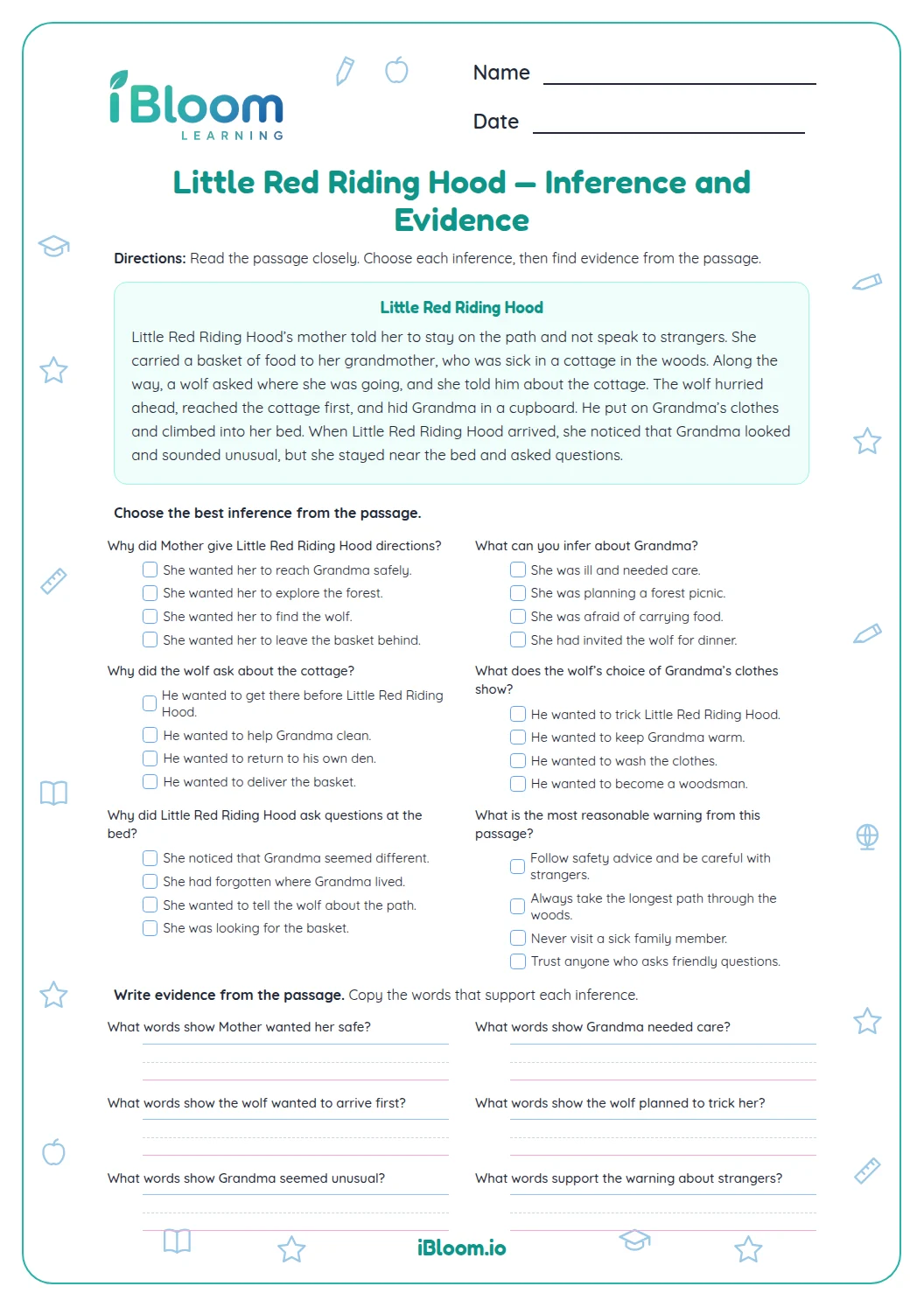
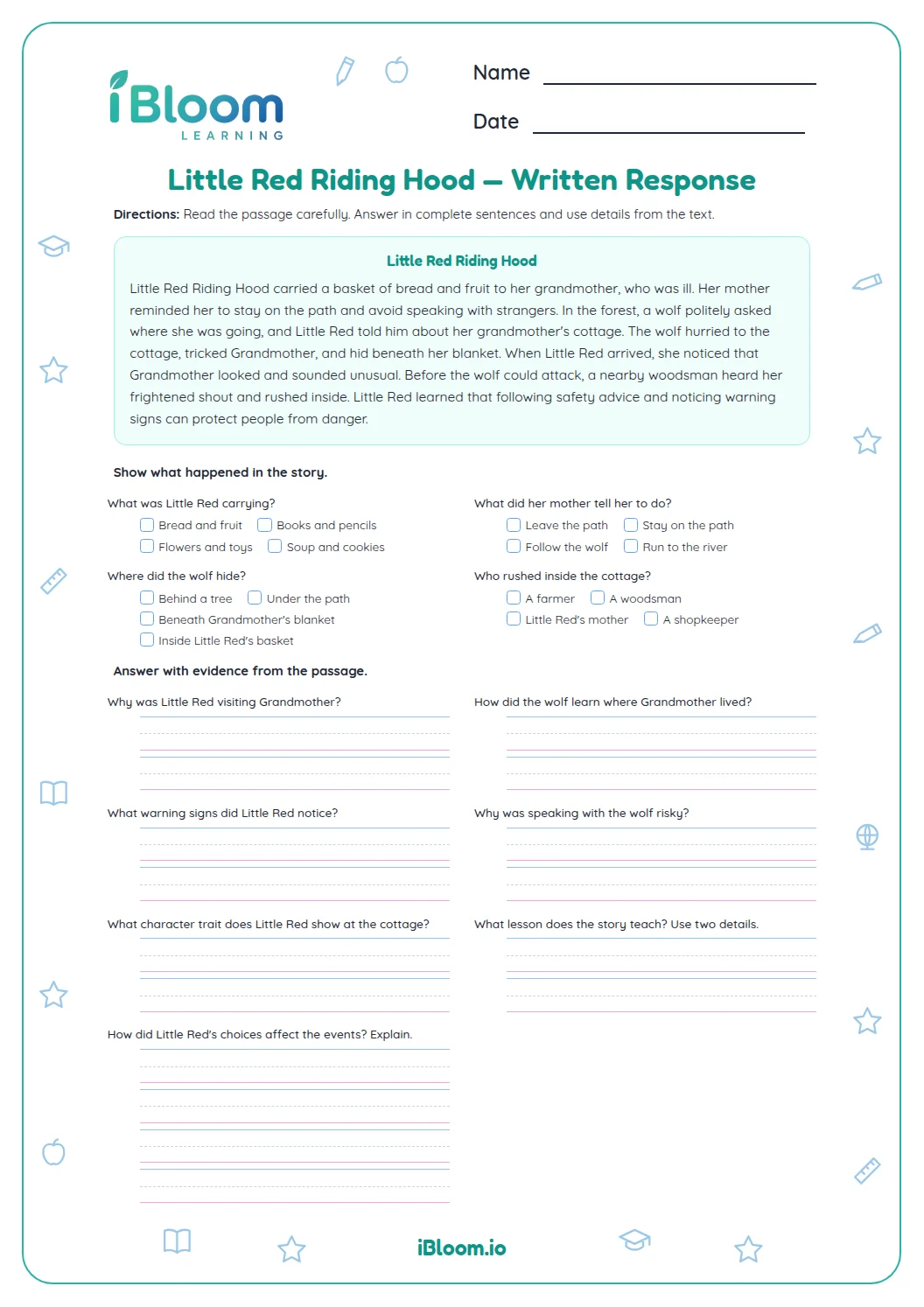
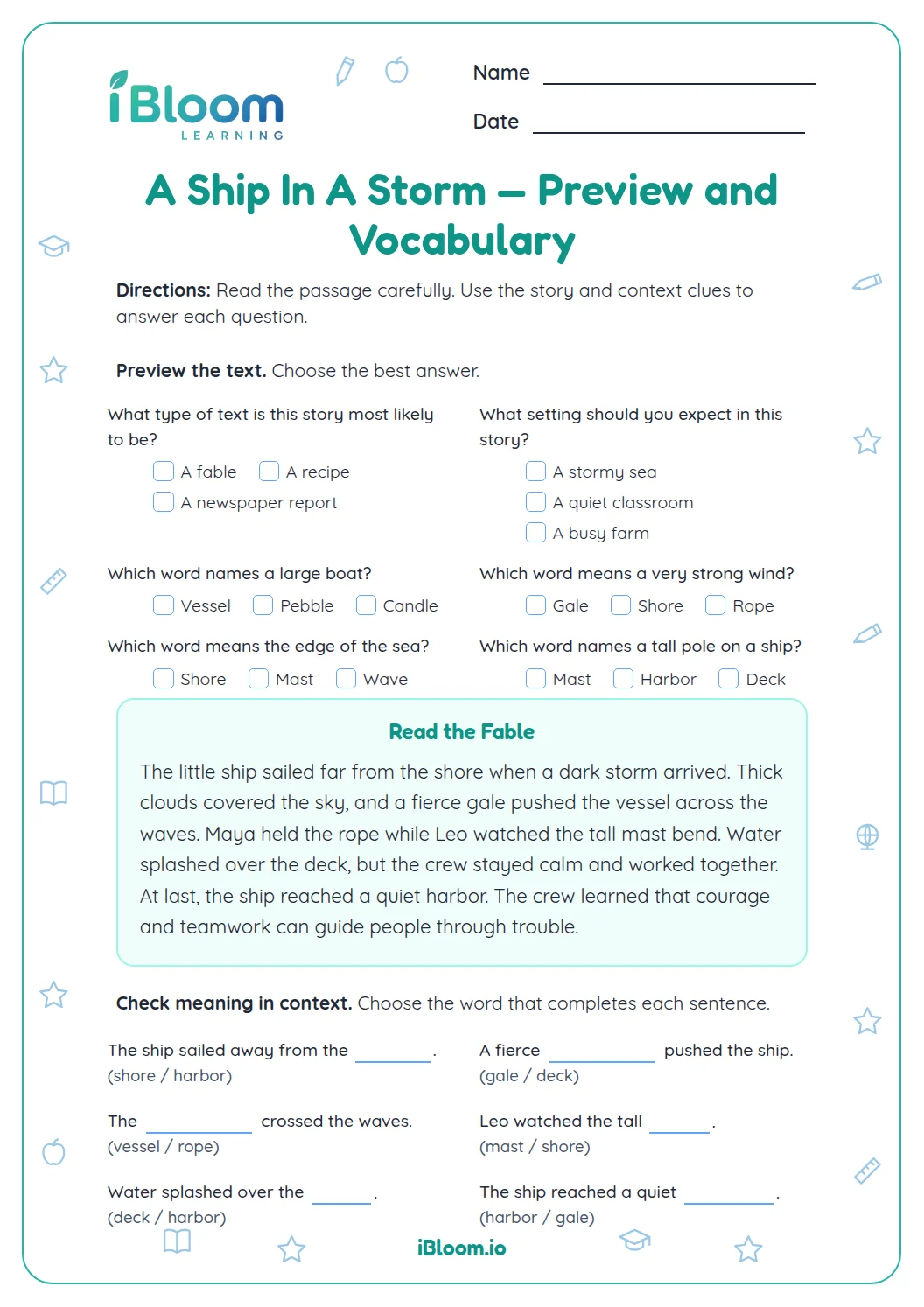
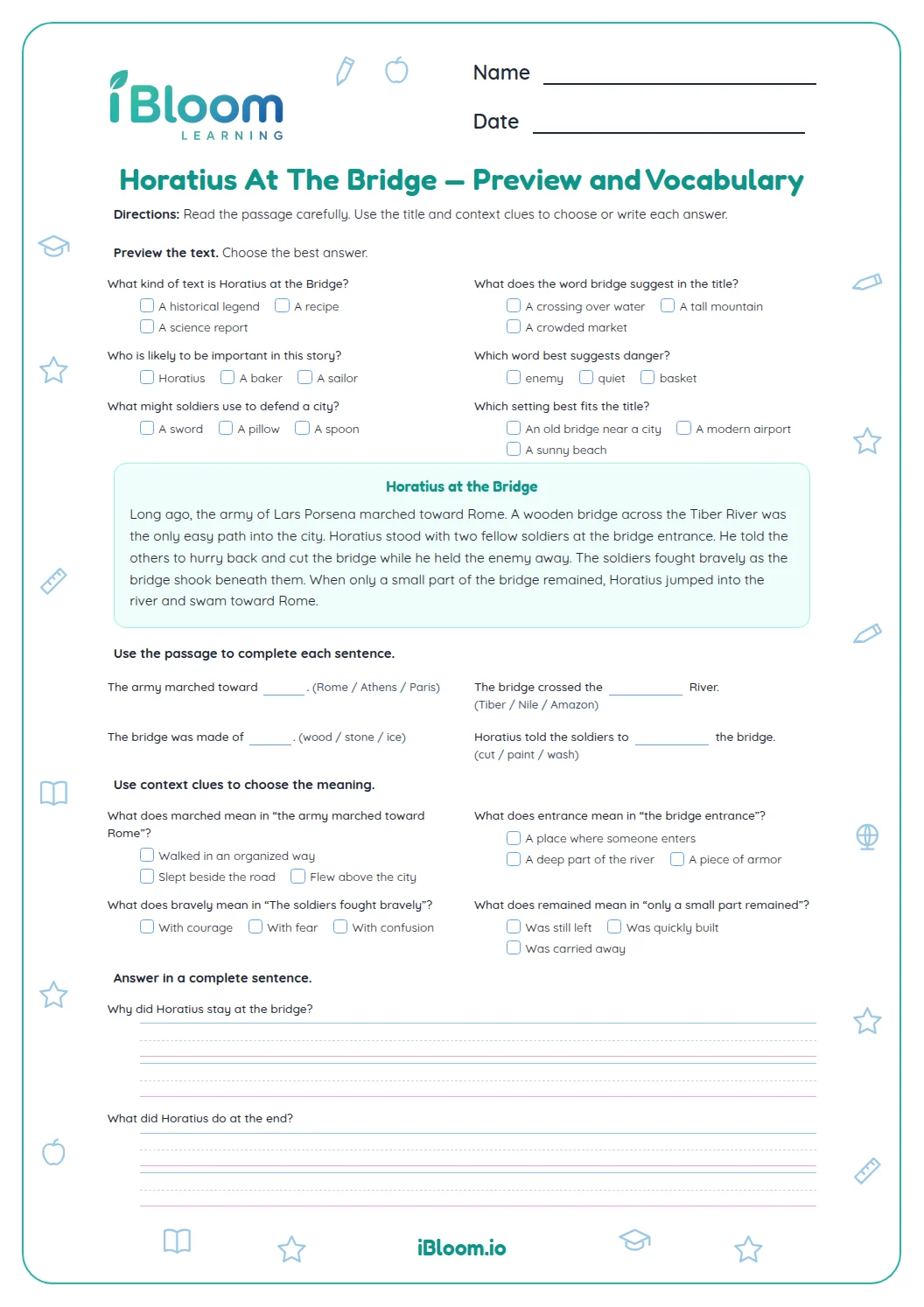
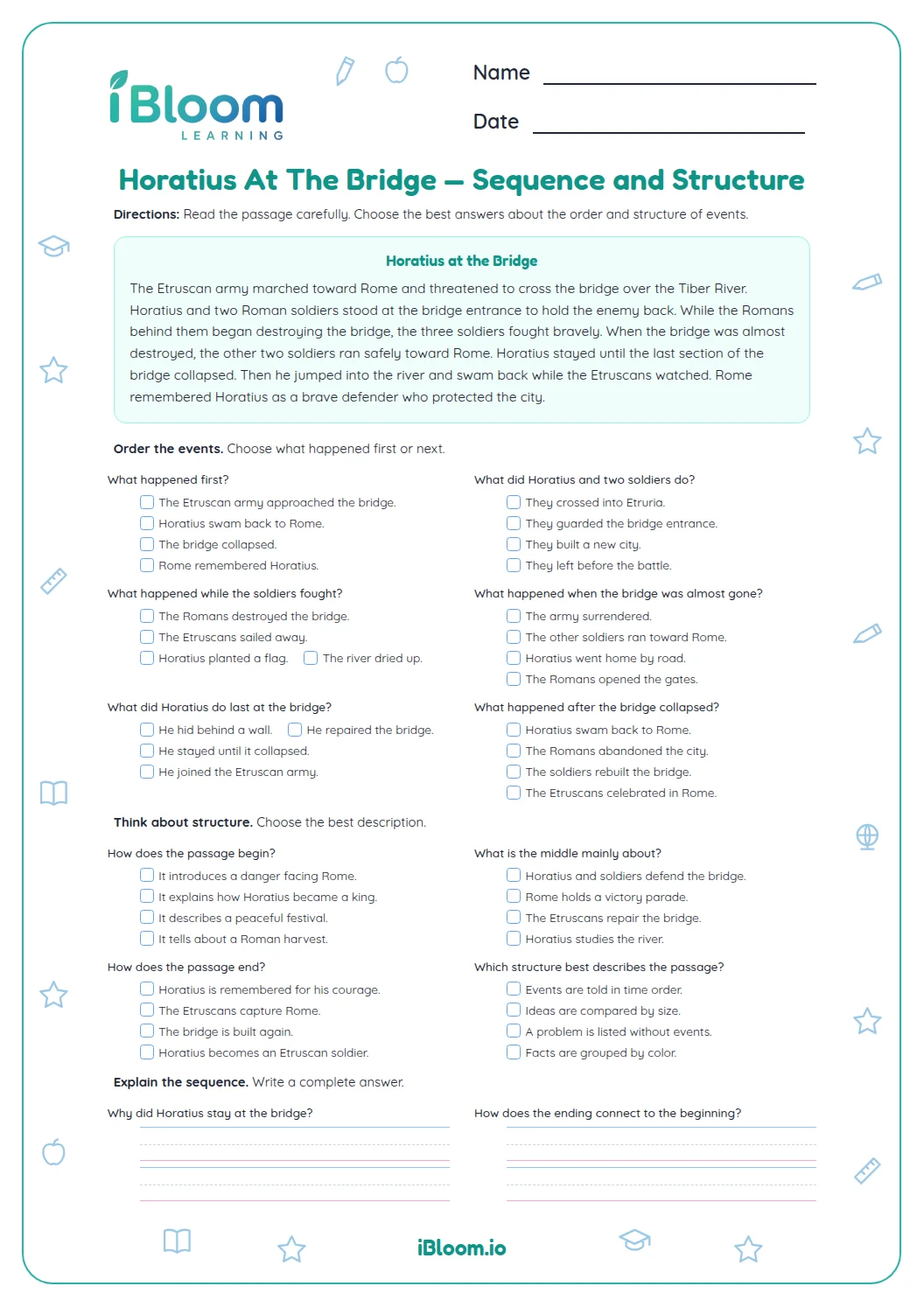
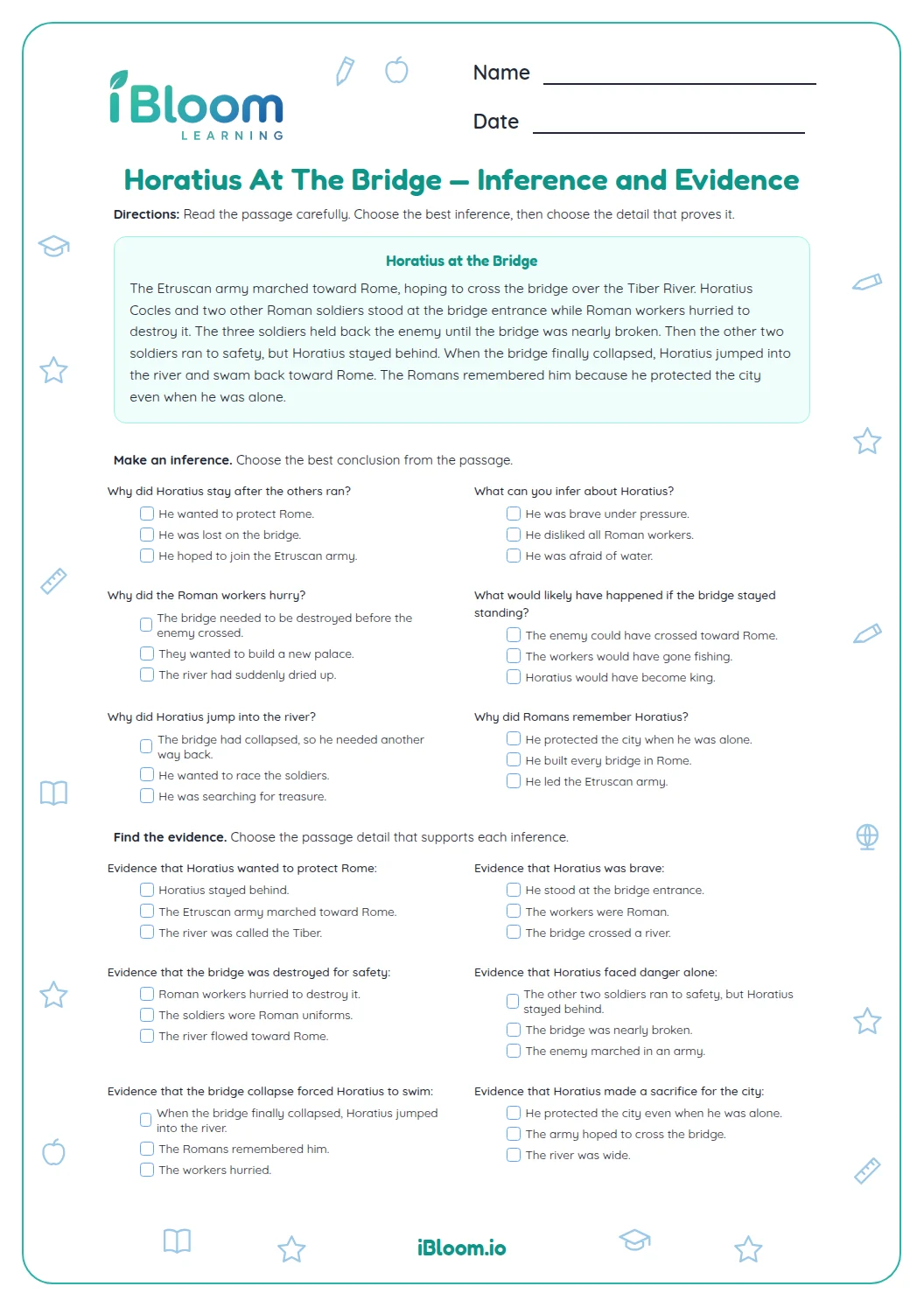
This Grade 5 reading worksheet pairs an original Little Red Riding Hood retelling with 12 preview and vocabulary questions. Children recall plot details, use nearby events to interpret words, infer why characters act, and answer short response questions with story evidence. The passage follows Red’s trip to her grandmother, the wolf’s shortcut, and the woodcutter’s help. It practices Common Core reading standards RL.5.1 and RL.5.4. A separate answer key provides correct choices and sample written responses.
Aligned to RL.5.4 and RL.5.1
What happens in this version of the tale?
Red carries bread and berries to her grandmother and meets a wolf on the path. The wolf reaches the cottage first, but Red notices that the figure in bed seems unfamiliar. A nearby woodcutter hears the commotion and helps.
The passage introduces the characters and the main events without assuming a child already knows the story. Question 1 checks a clear detail: Red carries bread and berries.
- 1Question: What did Red carry?
- 2Find the opening paragraph.
- 3It names a basket of bread and berries.
- 4Answer: bread and berries.
How can context help with unfamiliar words?
Look at the words and events around a new word. In question 4, the woodcutter hears a commotion, then comes to help; this context suggests a noisy disturbance. In question 9, Red calls the figure unfamiliar after noticing that the person does not look as expected.
How does the page ask children to use evidence?
Part B asks about motives and inferences using details such as the shortcut and the woodcutter’s response. Part C asks children to write short explanations and include an event or description from the passage.
- Part A previews plot details and two vocabulary words.
- Part B connects actions to motives and character clues.
- Part C gives four short written responses.
- The key includes concise model answers; equivalent evidence-based wording is acceptable.
How to use this worksheet
- 1Read the passage once to follow the main events.
- 2Reread the sentence around a vocabulary word.
- 3Return to the story before choosing a detail-based answer.
- 4For an inference, connect an action to a clue in the text.
- 5Write a complete sentence for the final responses.
Common mistakes and quick fixes
The mistake
Choosing an answer from memory of another version of the tale.
The fix
Use only details stated in this passage.
The mistake
Guessing a word meaning without reading nearby events.
The fix
Reread the sentence before and after the word.
The mistake
Giving an inference without a supporting clue.
The fix
Name the action or description that led to the conclusion.
Common Core alignment
This worksheet practices the following Common Core skill.
Use context and story details to determine word meaning and interpret language.
On this sheet: Children use passage context to interpret vocabulary such as “commotion” and “unfamiliar.”
Show the official wordingHide the official wording
Determine the meaning of words and phrases as they are used in a text, including figurative language such as metaphors and similes.
Answer questions by referring to details and examples in the story.
On this sheet: Learners select story details and make an inference supported by the passage.
Show the official wordingHide the official wording
Quote accurately from a text when explaining what the text says explicitly and when drawing inferences from the text.
What to practice next
Make more practice
Further reading
Questions parents and teachers ask
Is the passage a full retelling of every version of the tale?
No. It is a short original classroom retelling centered on Red’s visit, the wolf’s shortcut, and the woodcutter’s help. Different editions of the traditional story may include other details. The questions on this worksheet refer only to the passage printed here.
What does “commotion” mean in this story?
It means a noisy disturbance. The woodcutter hears a commotion near the cottage and comes to investigate, so the events around the word help explain it. Question 4 asks children to select the meaning that fits this context.
Why does the wolf take a shortcut?
He wants to arrive at the grandmother’s cottage before Red. The passage says he listens to Red’s destination and then hurries along a shortcut while she gathers flowers. Children can use those linked actions to infer his purpose.
What is one lesson Red learns?
A reasonable lesson is to follow her mother’s advice and be careful with strangers. At the end, Red thanks the woodcutter and promises to follow that advice on the way home. Children may phrase the lesson differently if they support it with a story detail.
How should my child answer the written questions?
Use a complete sentence and include a passage detail when the question asks for evidence. The answer key offers sample responses, but different wording can be correct if it matches the story. Encourage your child to point to the sentence or event that supports an answer.
How many questions and pages are included?
There are 12 questions in three parts, plus the story passage. The passage and questions are laid out across the worksheet pages, with a separate answer key page. The final page section includes short vocabulary, inference, and written-response practice.