






About this worksheet
This printable helps first graders connect plant structures with simple effects. Children identify what roots, stems, and leaves do, complete short statements about water and sunlight, and explain what may happen when a plant cannot get what it needs. The key gives sample explanations for open responses. The questions practice the Grade 1 life science idea that plant parts help plants meet their needs.
Aligned to 1-LS1-1
What are the plant-part jobs?
Roots take in water from soil and help anchor a plant. Stems support the plant and carry water to other parts. Leaves use sunlight to help the plant make food. Those jobs help children explain a likely effect when a plant part cannot do its work.
How does cause and effect work here?
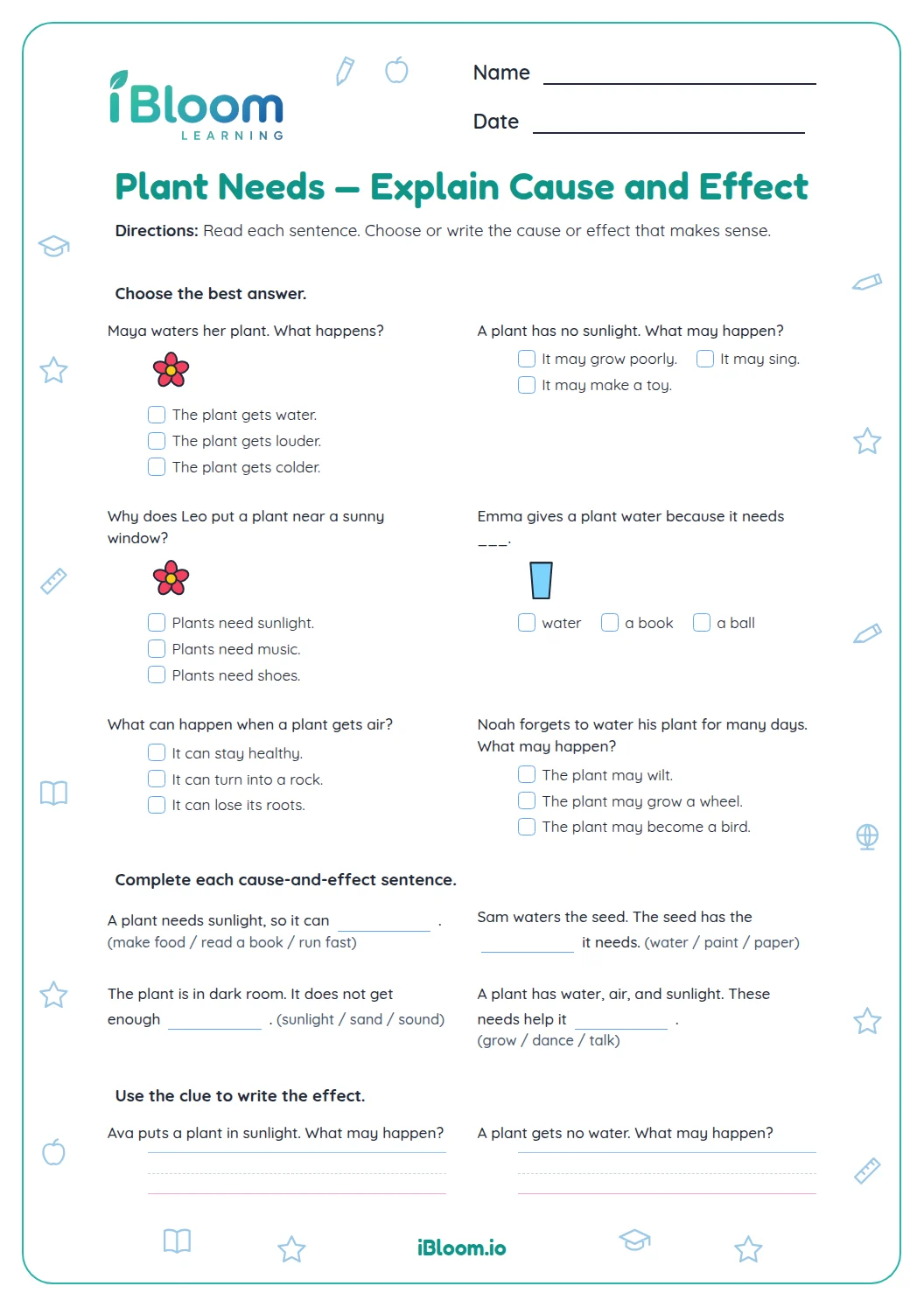
A cause is something that happens, such as soil becoming very dry. An effect is what may follow: roots may take in less water, and the plant may wilt. A broken stem may interrupt water movement. Use “may” because a prediction is not a promise that every plant will respond in exactly the same way.
What do Parts C and D ask?
Part C asks children to connect a plant part’s job to a possible result. Part D asks how roots and stems move water. The answer key gives sample responses; accept another clear explanation that matches the science idea.
How to use this worksheet
- 1Name roots, stems, and leaves on a plant or drawing.
- 2Complete Part A by choosing the part that does each job.
- 3Use the plant words to finish the cause-and-effect statements in Part B.
- 4In Part C, name a plant part, its job, and one possible effect.
- 5Check the key and talk about why each explanation makes sense.
Common mistakes and quick fixes
The mistake
Mixing up roots and leaves.
The fix
Repeat the clues: roots take in water; leaves use sunlight to help make food.
The mistake
Treating a prediction as certain.
The fix
Use “may” or “might” to describe a possible effect.
The mistake
Naming an effect without a plant-part job.
The fix
Ask what job could be affected, then connect that job to the result.
Curriculum alignment
This page targets the named skill at its intended grade. The cited standard gives the closest curriculum connection.
External parts help plants and animals survive, grow, and meet needs.
On this sheet: Children identify roots, stems, and leaves and use their jobs to reason about plant needs.
Show the official wordingHide the official wording
Use materials to design a solution to a human problem by mimicking how plants and/or animals use their external parts to help them survive, grow, and meet their needs.
What to practice next
Make more practice
Further reading
Questions parents and teachers ask
What do roots do?
Roots take in water from the soil and help anchor a plant. The worksheet connects those jobs with possible effects: when roots are damaged, a plant may take in less water or may not stay firmly in the soil. Ask children to point to the part named in their explanation.
Why do leaves need sunlight?
Leaves use sunlight to help a plant make food. If leaves cannot get light, the plant may have trouble making enough food and growing well. The worksheet treats this as a possible effect, not a guaranteed outcome for every plant, and encourages children to explain the connection.
Can a child give a different answer from the key?
Yes. The key gives sample answers for questions that allow different reasonable explanations. Children do not need to copy every word. Accept a response when it names a plant part or its job and connects that science idea to a possible effect on the plant.
Why does the worksheet say “may happen”?
A prediction should fit what a plant part does, but plants can respond in different ways. The word “may” helps children describe a reasonable possibility without claiming that every plant always has the same result. Encourage them to support each idea with a plant-part job.
How many questions are included?
The worksheet has 14 questions in three groups: identify plant parts, complete cause-and-effect statements, and explain possible effects. The answer key is separate and includes sample wording for the open-response items, so children can check both the science idea and their reasoning.