

About this worksheet
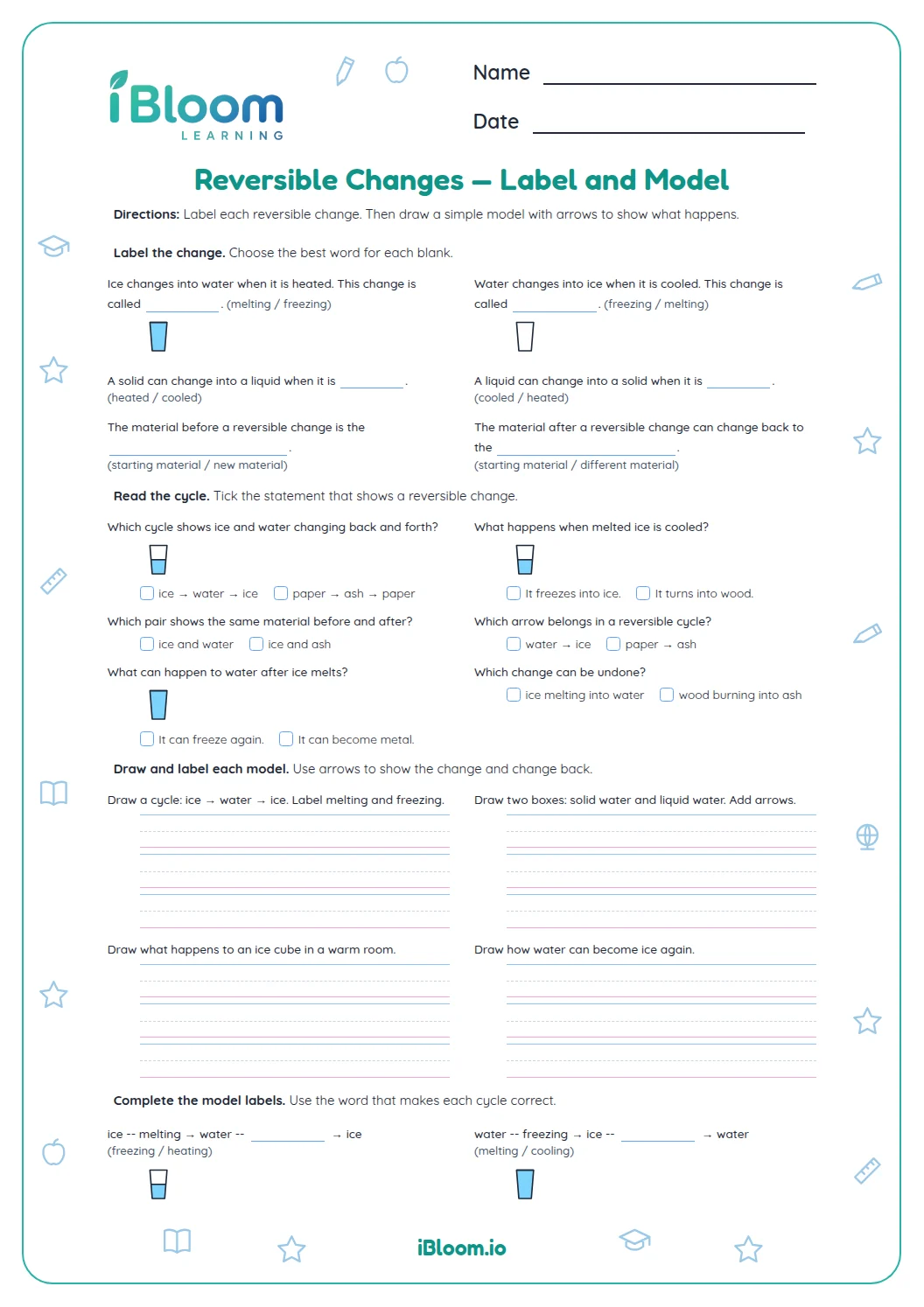
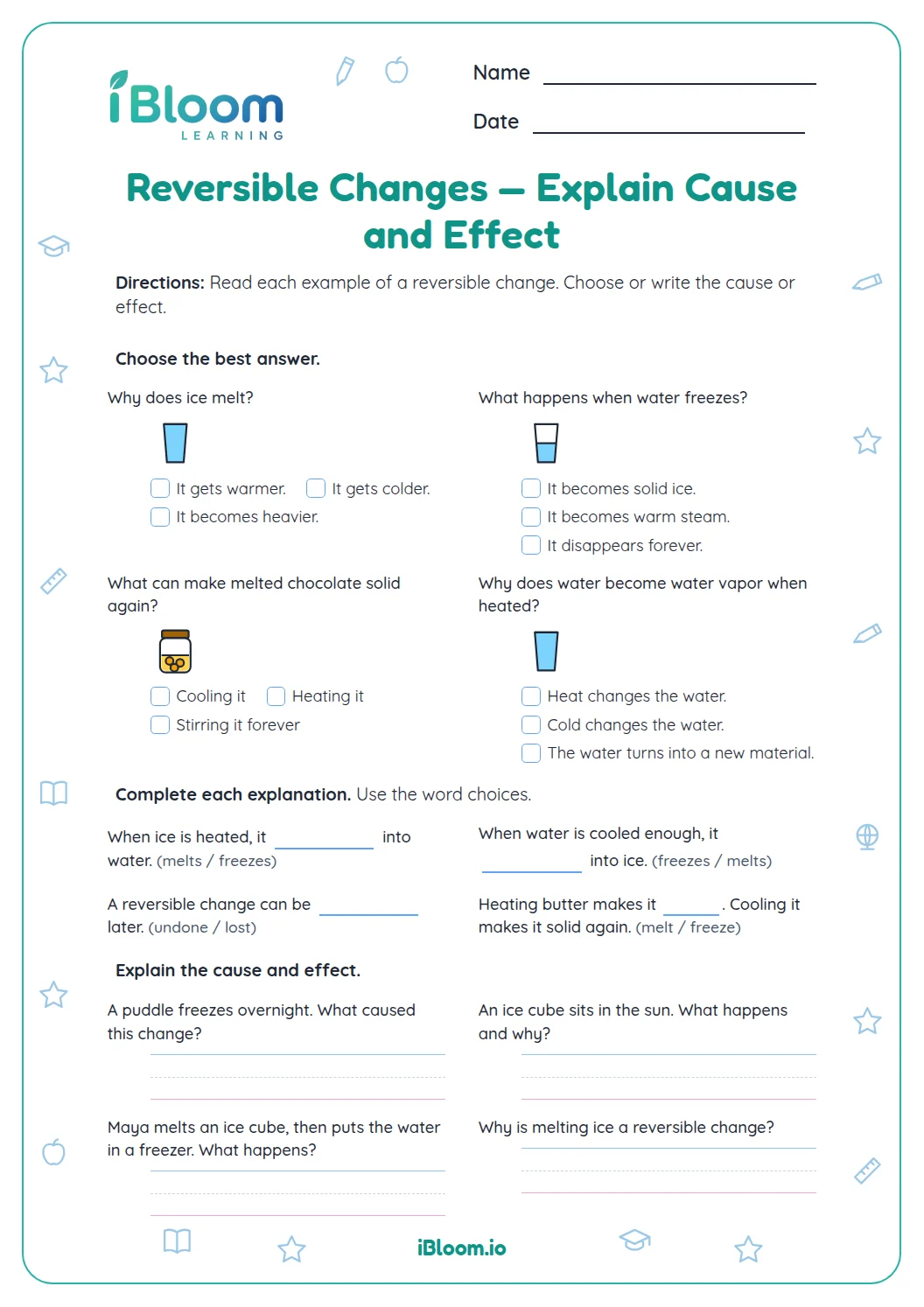
Children compare familiar changes such as melting ice, drying water, and baking an egg. The questions ask whether the material can return to its earlier state and what evidence supports that decision.
Aligned to 2-PS1-4
How can you tell if a change is reversible?
Look for what happened to the material. Water can freeze and melt again, so its change of state can be reversed. A baked cake does not turn back into the ingredients.
Part A asks children to classify everyday changes. Part B asks them to connect observations to a reason, and Part C applies the idea to salt water and cooking.
What will learners practice?
The sheet asks learners to classify material changes, connect observations to reasons, and apply the idea to evaporation, melting, and cooking.
- Part A: A
- Part B: B
- Part C: C
How to use this worksheet
- 1Read each situation carefully and name the material before and after.
- 2For Part B, ask whether the original material can return.
- 3In Part C, accept clear evidence-based wording; use the answer key as a model.
Common mistakes and quick fixes
The mistake
Calling evaporation “disappearing.”
The fix
Water becomes vapor and mixes with the air.
The mistake
Assuming every change caused by heat is reversible.
The fix
Compare melting with baking; cooking can make a new material.
Next Generation Science Standards alignment
This worksheet practices the following NGSS performance expectation.
Use evidence to explain which heating or cooling changes can be reversed.
On this sheet: Learners use observations to explain which changes caused by heating or cooling can be reversed.
Show the official wordingHide the official wording
Construct an argument with evidence that some changes caused by heating or cooling can be reversed and some cannot.
What to practice next
Further reading
Questions parents and teachers ask
What is a reversible change?
A reversible change lets a material return to an earlier state. Water can freeze into ice and melt into liquid water again. The substance remains water through both changes. Think about whether the material can change back when you decide how to classify an example.
Does water disappear when a puddle dries?
No. The liquid water changes into water vapor and mixes with the air. The water may be harder to see, but it has not vanished. This is called evaporation. A cooler surface can turn water vapor back into liquid drops through condensation.
Is cooking an egg reversible?
Cooking an egg is not easy to reverse. Heat changes the egg so it does not return to its raw state when it cools. Compare this with melting ice: cooling can freeze the same water again. The worksheet asks students to use these observations as evidence.
How can salt be separated from salt water?
If salt dissolves in water, the mixture can be left where the water can evaporate. The water moves into the air and salt remains behind. This separates the substances without making the salt disappear. Adult supervision is needed if using heat to speed evaporation.
What evidence can show that a change can be reversed?
Look for a way to return the material to its earlier state. Liquid water can freeze into ice, and the ice can melt again. On this sheet, students compare observable changes and explain which ones can be undone, using the material before and after as evidence.