

About this worksheet
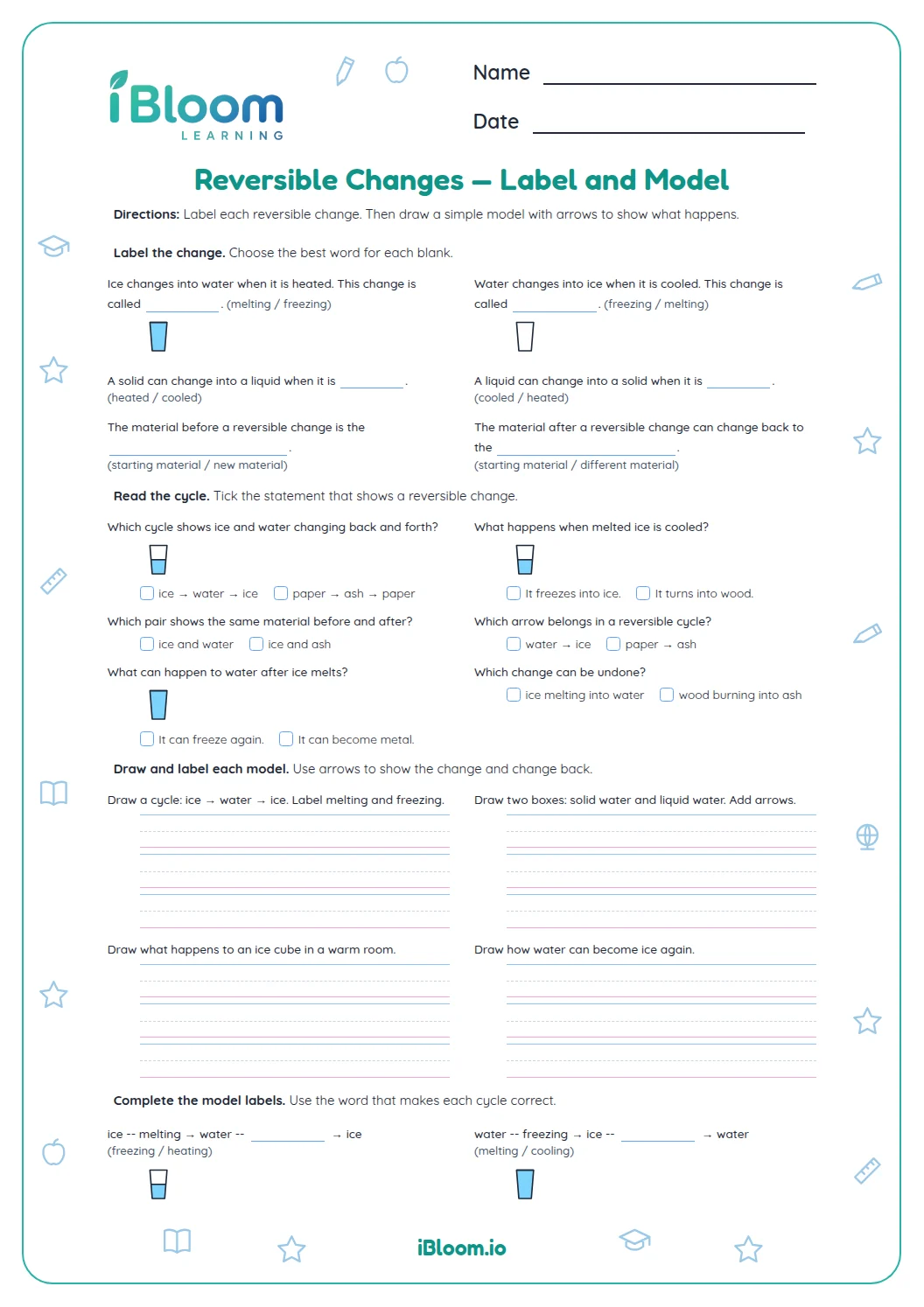
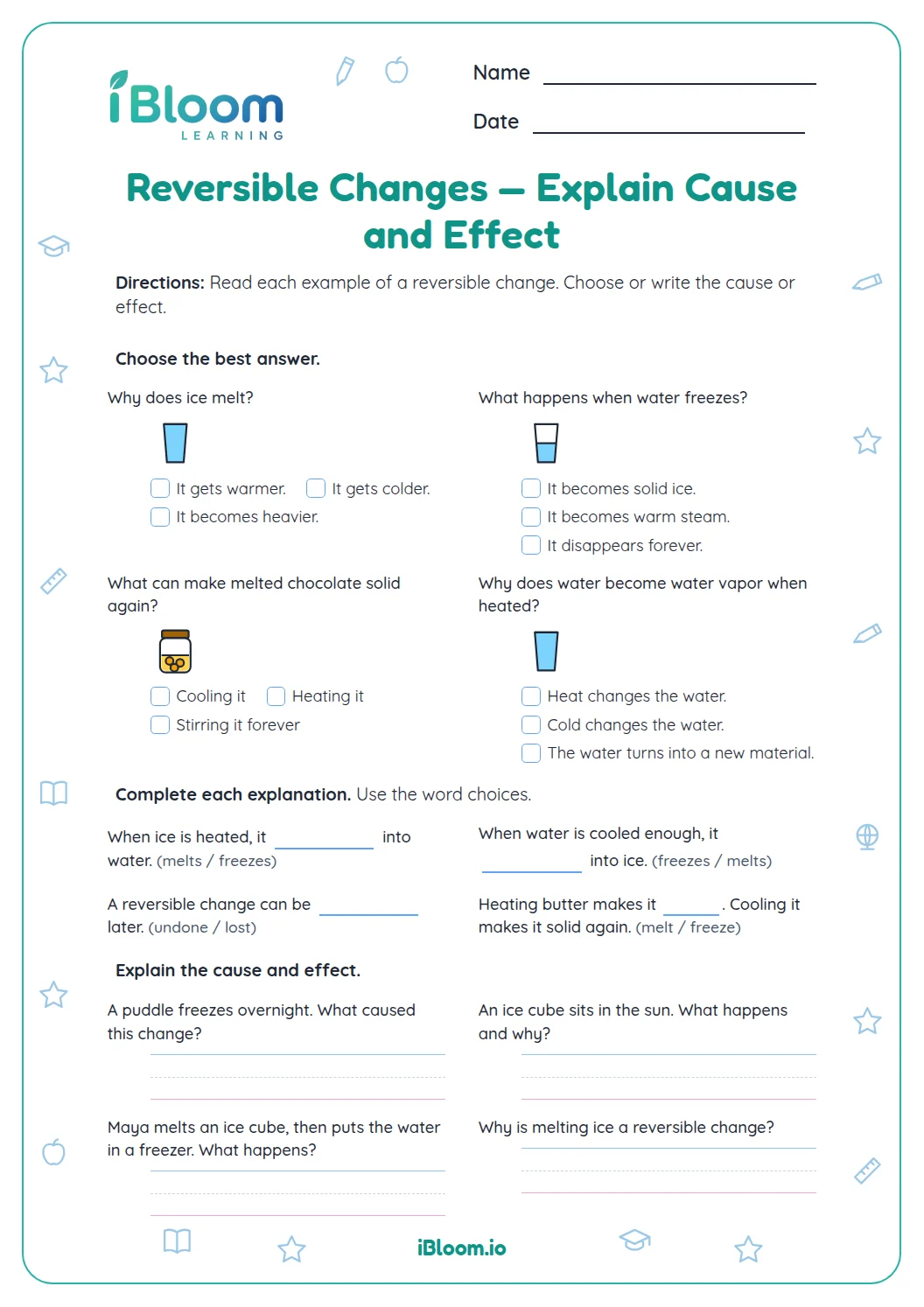
This free Grade 2 science worksheet reviews reversible changes with examples involving ice, water, butter, wax, eggs, leaves, paper, and chocolate. Children classify changes, choose evidence, and write short explanations using before-and-after observations. It aligns with NGSS 2-PS1-4 and includes an answer key with sample responses.
Aligned to 2-PS1-4
Which changes can reverse?
Part A classifies familiar heating and cooling examples. Part B compares observations about leaves, wax, paper, eggs, ice, and chocolate to evaluate claims. Part C asks for evidence in short written responses.
- Compare a material before and after a change
- Check what happens when heating or cooling is reversed
- Use an observation to support a claim
What evidence helps classify a change?
Compare the material before the change, after the change, and after the heating or cooling is reversed. A claim about reversibility needs this chain of observations.
How do you support a science claim?
State whether the change can reverse, then name the observation that supports the claim. A new shape does not always mean a new material state: melted chocolate may harden again even if it looks different.
- 1Claim: Melting ice is reversible.
- 2Evidence: The ice becomes liquid water when warmed.
- 3When cooled, the water freezes into ice again.
- 4The before and after states show the change can reverse.
Can every change caused by heating be undone?
No. Heating can cause changes that cannot be reversed, too. The cooked egg remains cooked after it cools. Use the specific evidence for each material rather than assuming all heating has the same result.
How to use this worksheet
- 1Name the material and what happened to it.
- 2Identify whether it was heated or cooled.
- 3Look for evidence after that heating or cooling is reversed.
- 4State whether the material returned to an earlier state.
- 5Support the claim with the before and after observations.
- 6Check your reasoning with the answer key.
Common mistakes and quick fixes
The mistake
Calling every change reversible because the material is still there.
The fix
Ask whether the material returns to an earlier state, not just whether it remains present.
The mistake
Assuming cooling always restores a material.
The fix
Use the example: cooling a cooked egg does not make it raw again.
The mistake
Saying a change reverses without naming evidence.
The fix
Describe what the material was like before and after heating or cooling is reversed.
Next Generation Science Standards alignment
This worksheet uses evidence about observable material changes caused by heating and cooling.
Use evidence to argue that heating or cooling changes may or may not reverse.
On this sheet: The 14 choice and written questions ask children to use observations to support claims about changes caused by heating or cooling.
Show the official wordingHide the official wording
Construct an argument with evidence that some changes caused by heating or cooling can be reversed and some cannot.
What to practice next
Make more practice
Further reading
Questions parents and teachers ask
What is a reversible change?
A reversible change can be changed back by reversing the heating or cooling. Water can freeze into ice and melt into water again. The worksheet asks children to compare what happened before and after, so they support the classification with observable evidence.
Which examples of changes are included?
There are 14 questions: 11 choice questions and three written explanations. The final questions ask children to name observations that support a claim about whether a change can reverse. The key gives sample responses for those open-ended items.
Why is cooking an egg irreversible in this activity?
Compare what a material was like before a change, after it changed, and after the heating or cooling condition is reversed. For example, ice melts when warmed and water freezes again when cooled. Those observations show that this change can reverse.
Does melted chocolate have to look exactly the same to count as reversible?
No. The worksheet contrasts changes such as melting ice or wax, which can reverse under the examples given, with a cooked egg that stays cooked after cooling. Children use the observed result for each material instead of assuming every change behaves alike.
How can a child support a claim?
First state whether the change can reverse. Then describe what the material was like before and after the heating or cooling was reversed. For example, water returns to ice when cooled, while a cooked egg does not return to raw egg.