
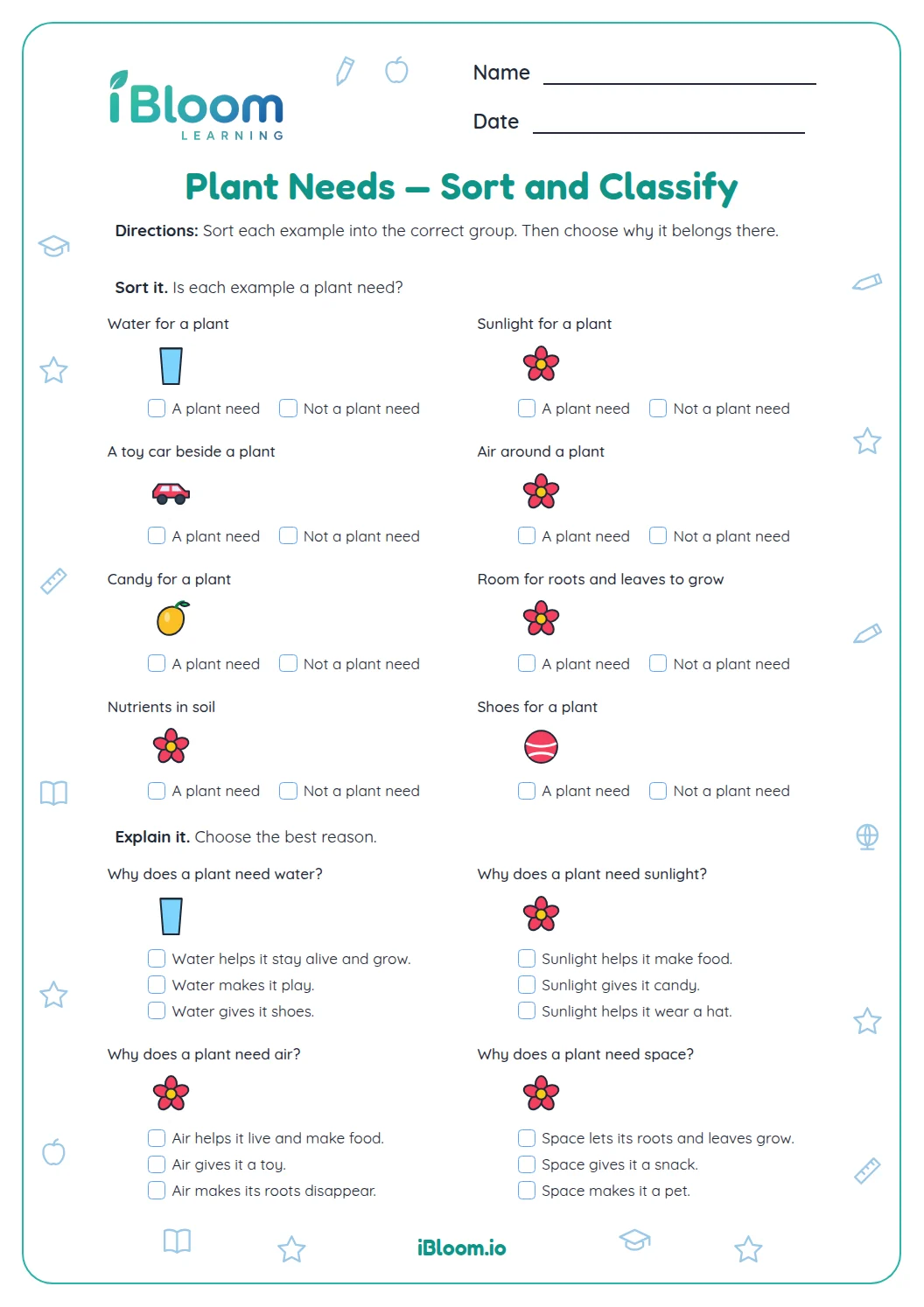


About this worksheet
This Grade 2 science worksheet asks students to reason about what plants need to grow. They compare fair-test setups, identify what changes, interpret simple observations, and connect evidence to claims about light and water. The questions support NGSS 2-LS2-1 through planning and reasoning about a plant investigation. The answer key gives direct answers and sample explanations.
Aligned to 2-LS2-1
What will students practice?
Students reason about light and water using fair-test setups, observations, evidence, and claims. Sixteen items include choices and written responses, followed by a concise key.
Learners compare one changed condition at a time and use observations to support a plant-growth claim.
How should students approach the questions?
For each test, name what changes and what stays the same. Use the recorded plant growth as evidence before making a claim.
What does one question look like?
Use this item to model how to find evidence before answering.
- 1Which two conditions do the seedlings need in this test? → Light and water
How can students check their work?
Check whether the test changed only one condition; then make sure the claim matches the observation.
How to use this worksheet
- 1Read the directions and identify the skill in this part.
- 2Study the passage, drawing, graph, or sentence clues.
- 3Answer one item at a time and show work where space is provided.
- 4For written responses, include the key evidence or idea.
- 5Use the answer key to check and correct any missed item.
Common mistakes and quick fixes
The mistake
Answering from memory without checking the item’s evidence.
The fix
Point to the passage detail, graph symbol, or sentence clue that supports the response.
The mistake
Skipping a key or place-value detail.
The fix
Check what each symbol represents or count decimal places before finalizing.
The mistake
Giving only part of the requested response.
The fix
Reread the prompt and include the requested comparison, reason, or complete thought.
This page practices the following standard.
Reason from a fair test about how light and water affect plant growth.
On this sheet:
Show the official wordingHide the official wording
Plan and conduct an investigation to determine if plants need sunlight and water to grow.
What to practice next
Make more practice
Further reading
Questions parents and teachers ask
How many questions are on this worksheet?
There are 16 questions arranged in four parts. The items progress from direct reading or recognition to comparisons, explanations, and applications of the same skill. Students compare one condition at a time and use the observations to support a conclusion.
What grade is this printable for?
This worksheet is written for Grade 2. The prompts and examples use the reading, science, writing, or math skill named in its title. It is suitable for second graders practicing simple plant investigations and evidence-based reasoning. Use a clue from the prompt to support the response.
Is an answer key included?
Yes. The printable includes a separate answer key with answers for each question. Written-response items include a sample response, and students may use different wording when the same idea is clear. The key supports checking selected choices and comparing written explanations with the science idea.
How can I help without giving the answer?
Ask the student to point to the evidence, drawing, or calculation that supports the answer. A prompt such as “What clue helped you decide?” encourages checking the work while leaving the reasoning to the learner. Ask what stayed the same and what changed before discussing what the result suggests.
How long should the practice take?
Plan for about 20 minutes, with extra time for written explanations or checking answers. Students can complete one part at a time and review the key afterward. Students may take longer on the written investigation and evidence questions than on the choices.