





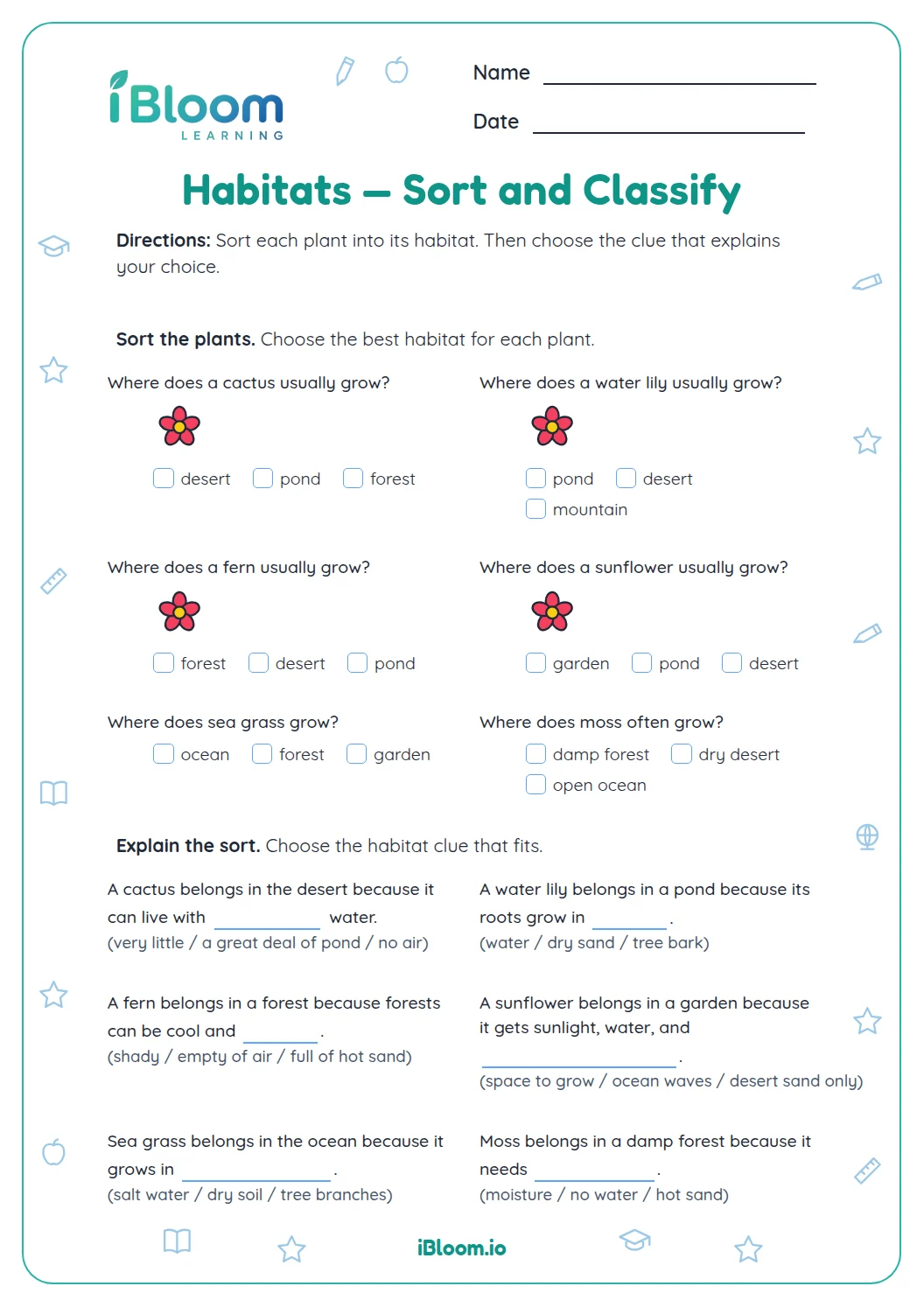


About this worksheet
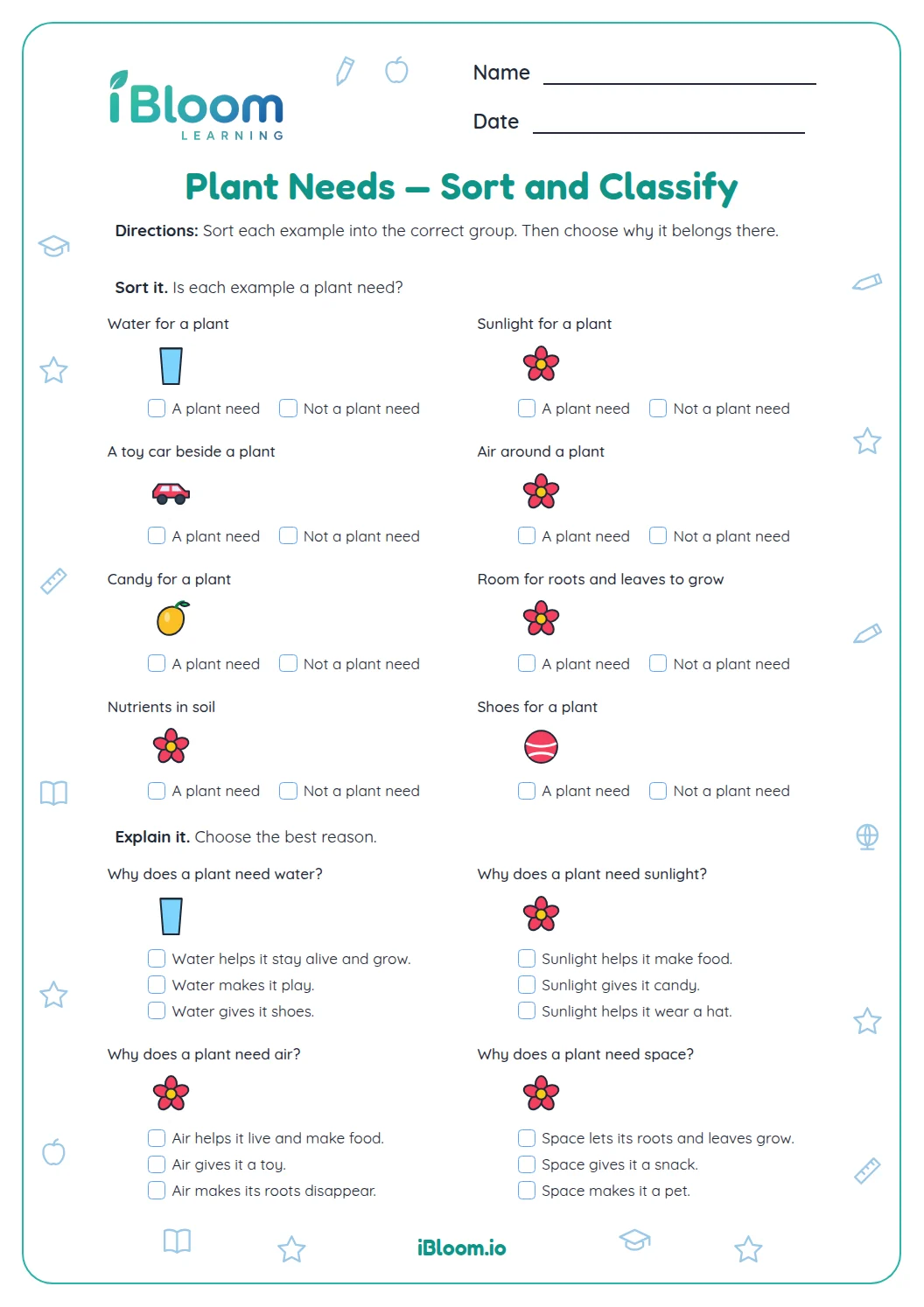
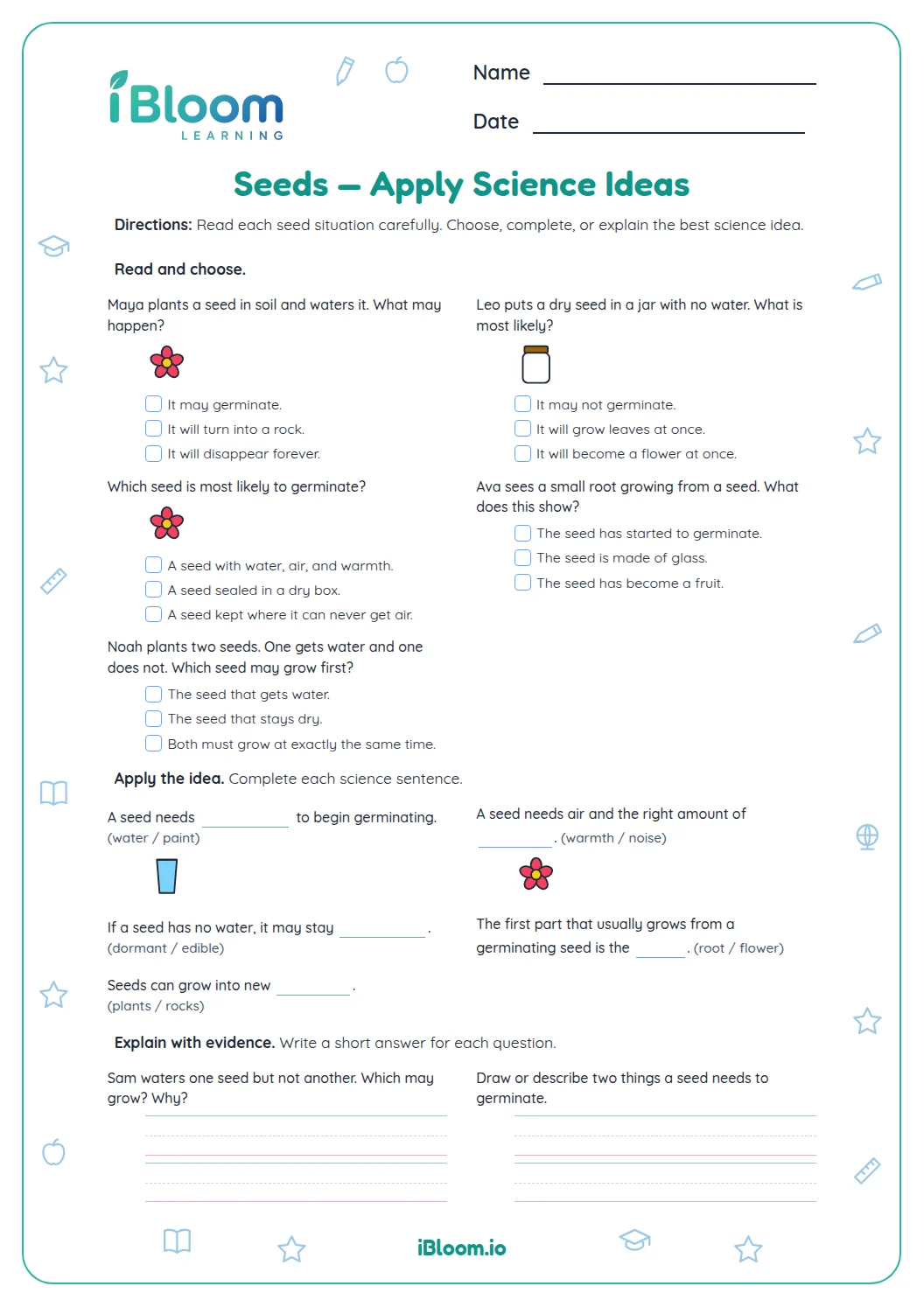
This Grade 2 science worksheet asks learners to apply ideas about what plants need and how to investigate growth. Children complete statements about sunlight, water, and roots, make predictions about plant conditions, and plan a fair comparison that tests sunlight while keeping other conditions alike. The 14-question sheet includes a separate answer key and practices NGSS 2-LS2-1.
Aligned to 2-LS2-1
What conditions help plants grow?
The first questions focus on sunlight and water and ask learners to connect those needs with roots and plant growth.
- 1Sunlight and ___ help many plants grow.
- 2Answer: water
How do learners apply the ideas?
The 14 questions are grouped into three parts. Learners complete plant-need statements, apply growth conditions, and answer fair-test questions.
- Part A: Name plant needs and connect them with growth.
- Part B: Apply ideas about space, light, and water.
- Part C: Choose a growth measure and plan a fair test.
What makes a sunlight test fair?
Use similar seedlings and keep water, soil, and other conditions the same. Change sunlight exposure, then observe and record growth over time. Part C asks learners to name a measure and explain why a fair comparison uses similar seedlings.
How to use this worksheet
- 1Name the plant condition in the question.
- 2Use sunlight and water ideas to predict what may happen.
- 3For a test, decide what changes and what stays the same.
- 4Choose a growth measure such as height.
- 5Compare observations and check with the answer key.
Common mistakes and quick fixes
The mistake
Changing water and sunlight at the same time.
The fix
Change one condition while keeping the other conditions alike.
The mistake
Making a prediction without connecting it to a plant need.
The fix
Name the need in the situation and explain how it relates to growth.
The mistake
Comparing seedlings that start in very different conditions.
The fix
Choose similar seedlings and give them the same soil and water.
Curriculum alignment
This worksheet gives learners practice with the standard below.
Plan a test of whether plants need sunlight and water to grow.
On this sheet: Learners plan a fair sunlight comparison and identify water and growth measures.
Show the official wordingHide the official wording
Plan and conduct an investigation to determine if plants need sunlight and water to grow.
What to practice next
Make more practice
Further reading
Questions parents and teachers ask
What two needs are emphasized on this worksheet?
The worksheet emphasizes sunlight and water as conditions that help many plants grow. Learners use those ideas to complete statements, predict what may happen in a plant situation, and plan a test. Changing one condition at a time makes it easier to connect an observation with the test question.
How can a learner test whether sunlight affects growth?
Use similar seedlings, give them the same water and soil, and place them in different light conditions. Measure or observe their growth over time so sunlight is the main condition being compared. Changing one condition at a time makes it easier to connect an observation with the test question.
What could a learner measure in the investigation?
Seedling height is one useful measure named in the worksheet. Record it at the same time each day, then compare the observations from the seedlings kept in different light conditions. Changing one condition at a time makes it easier to connect an observation with the test question.
Why keep water the same in a sunlight test?
If one seedling gets more water, it may grow differently for that reason. Giving both seedlings the same water helps make sunlight the main difference in the comparison. Changing one condition at a time makes it easier to connect an observation with the test question.
What is included in the answer key?
The separate key gives expected words for completion items and sample responses for predictions and investigation questions. For open responses, accept clear answers that identify the plant need or fair-test idea asked about. Changing one condition at a time makes it easier to connect an observation with the test question.