


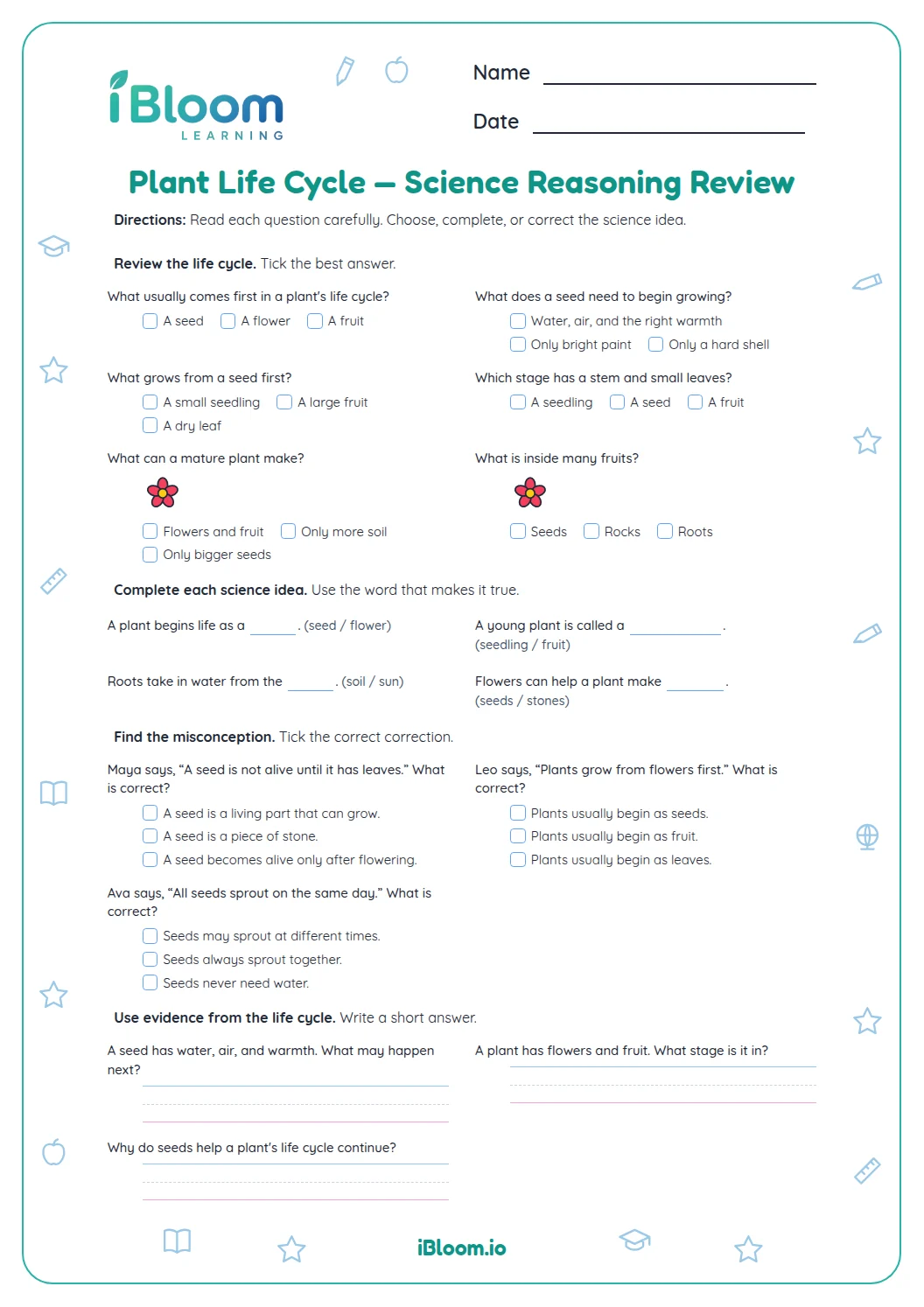
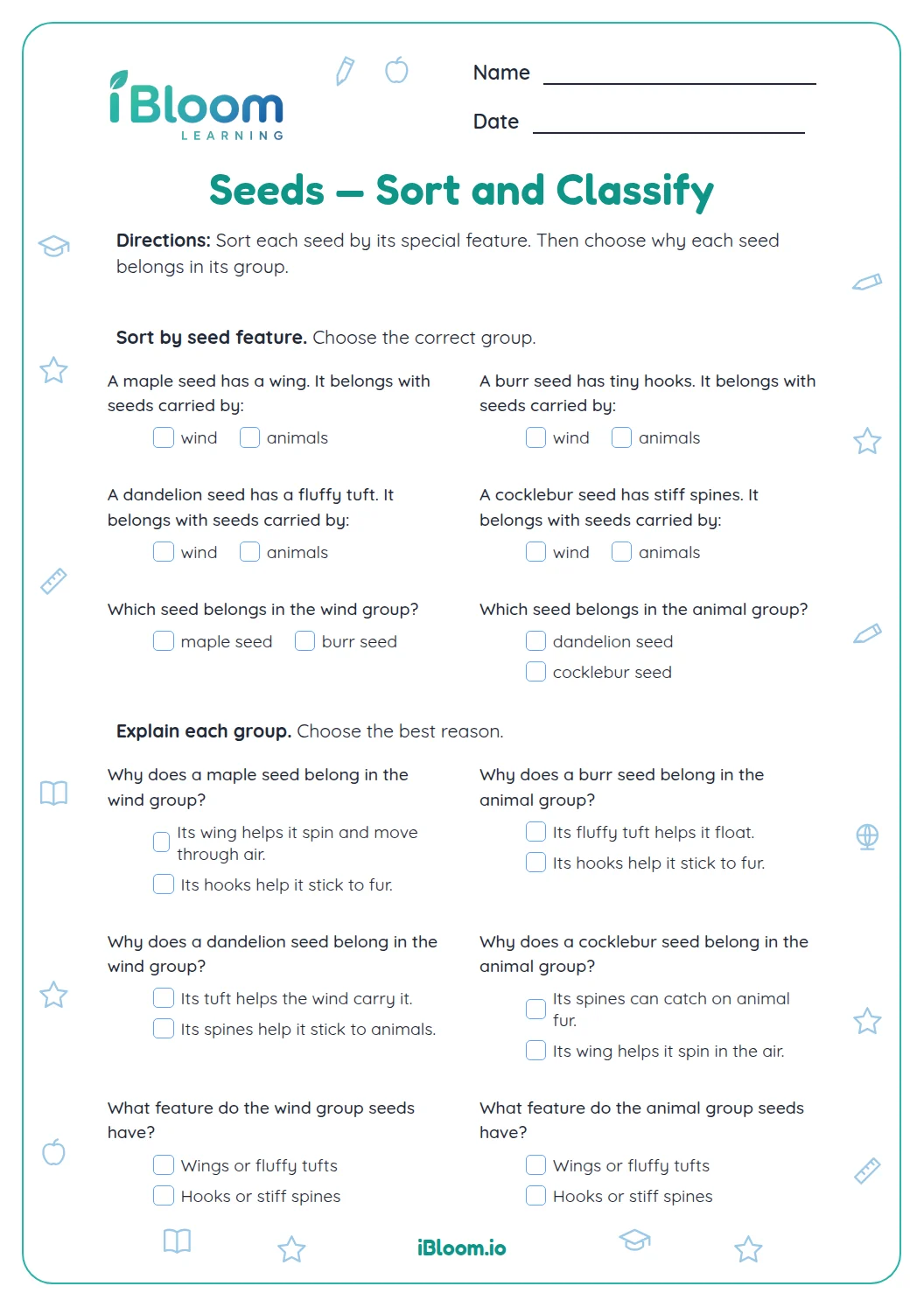

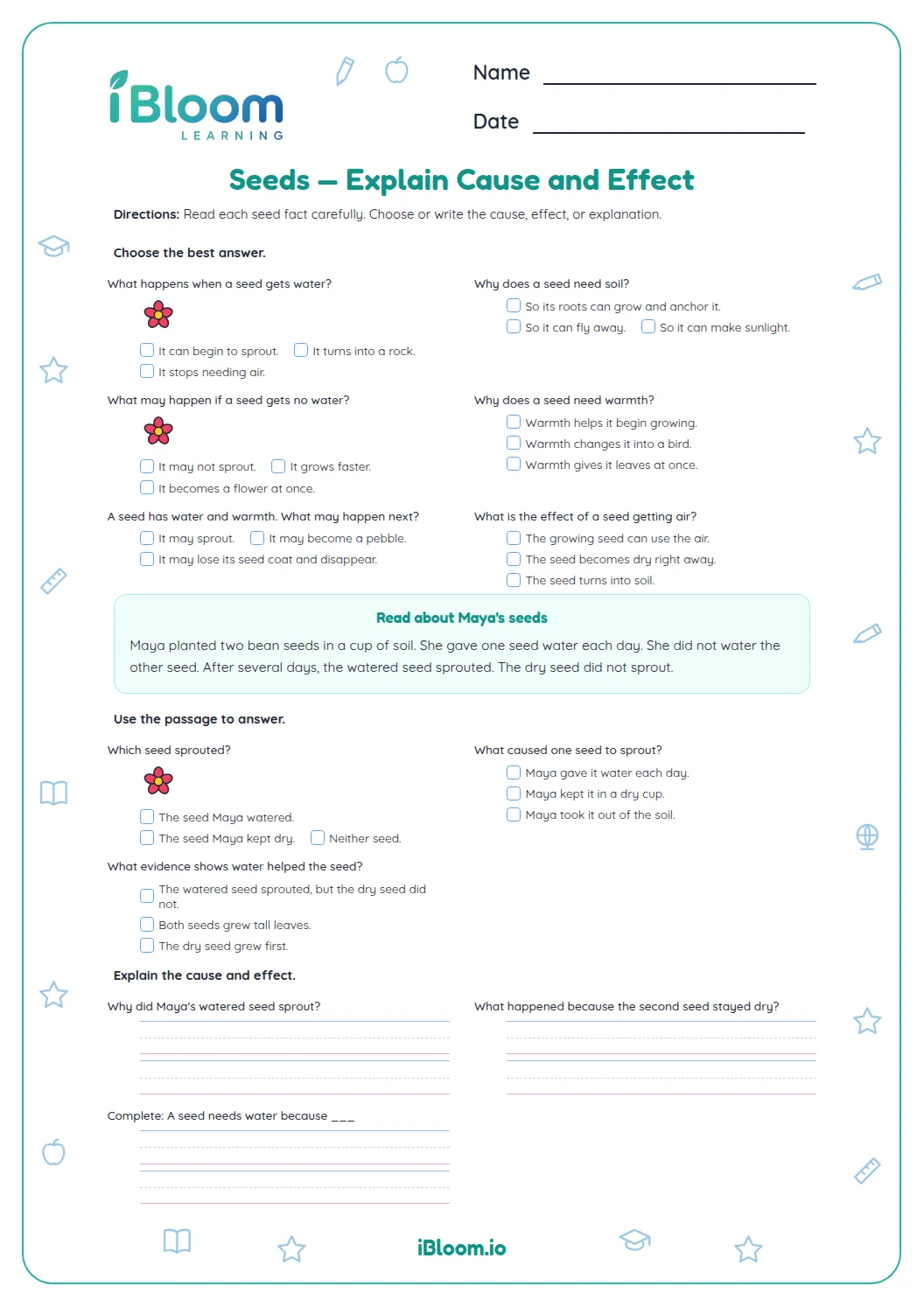
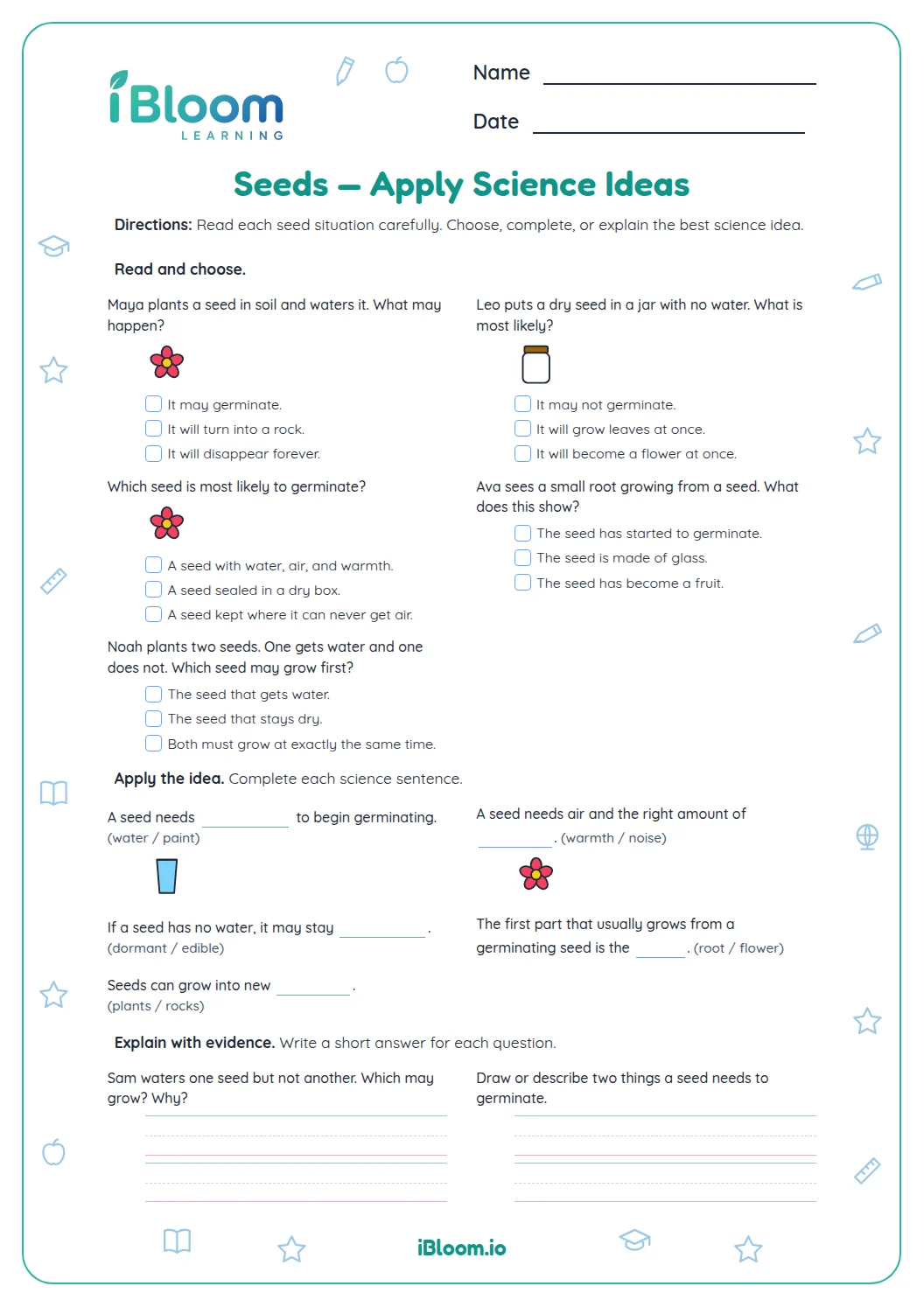
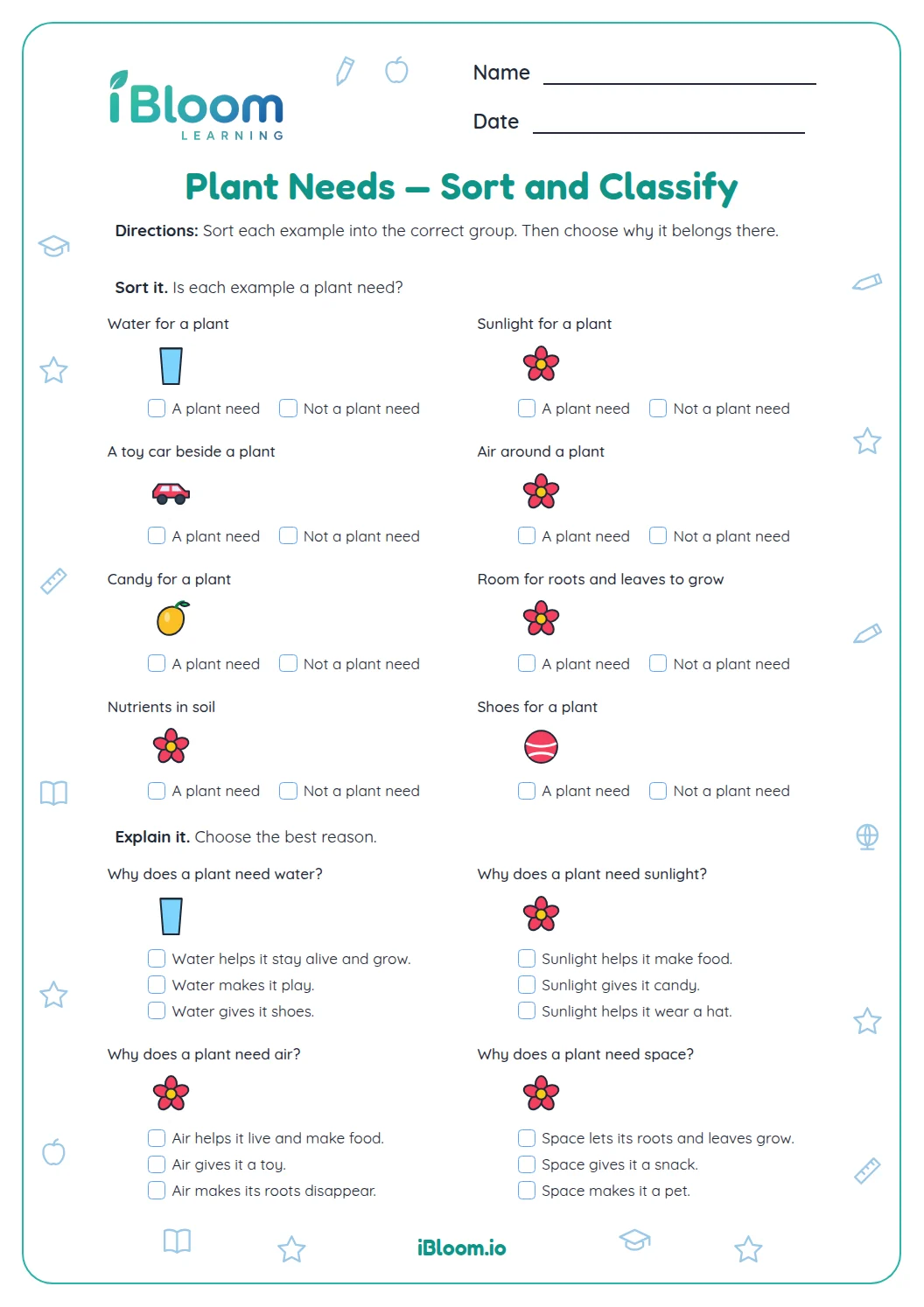


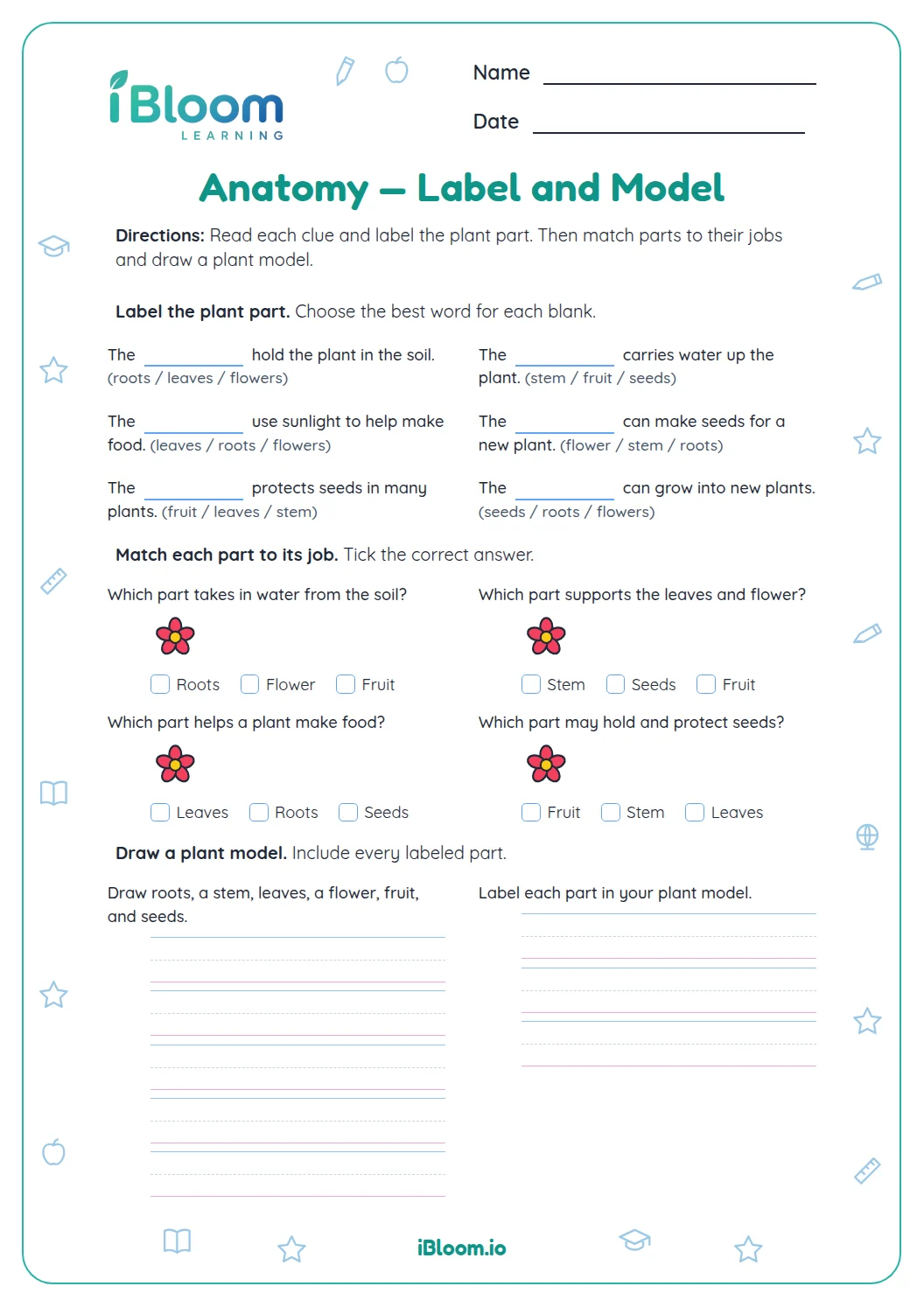
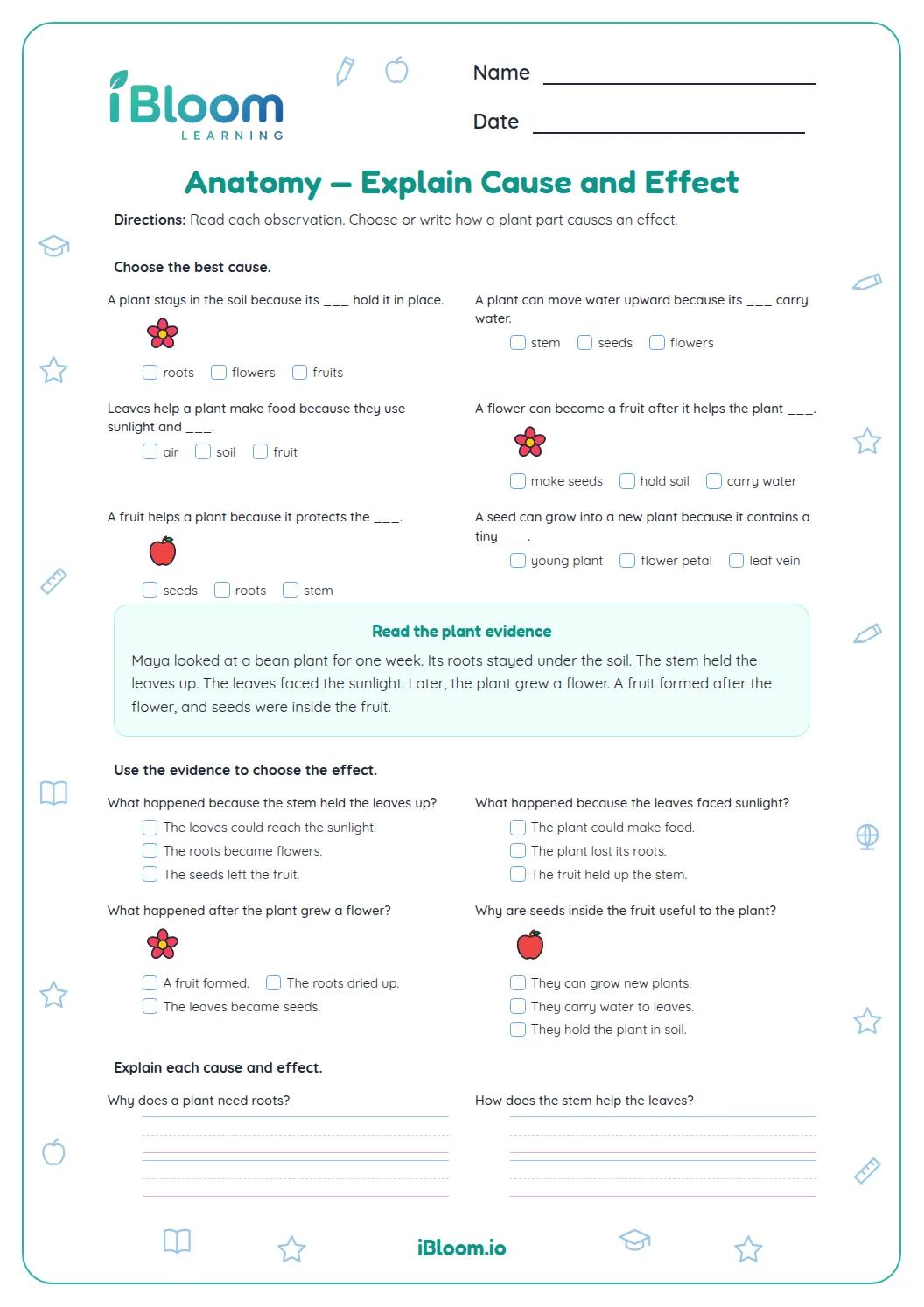

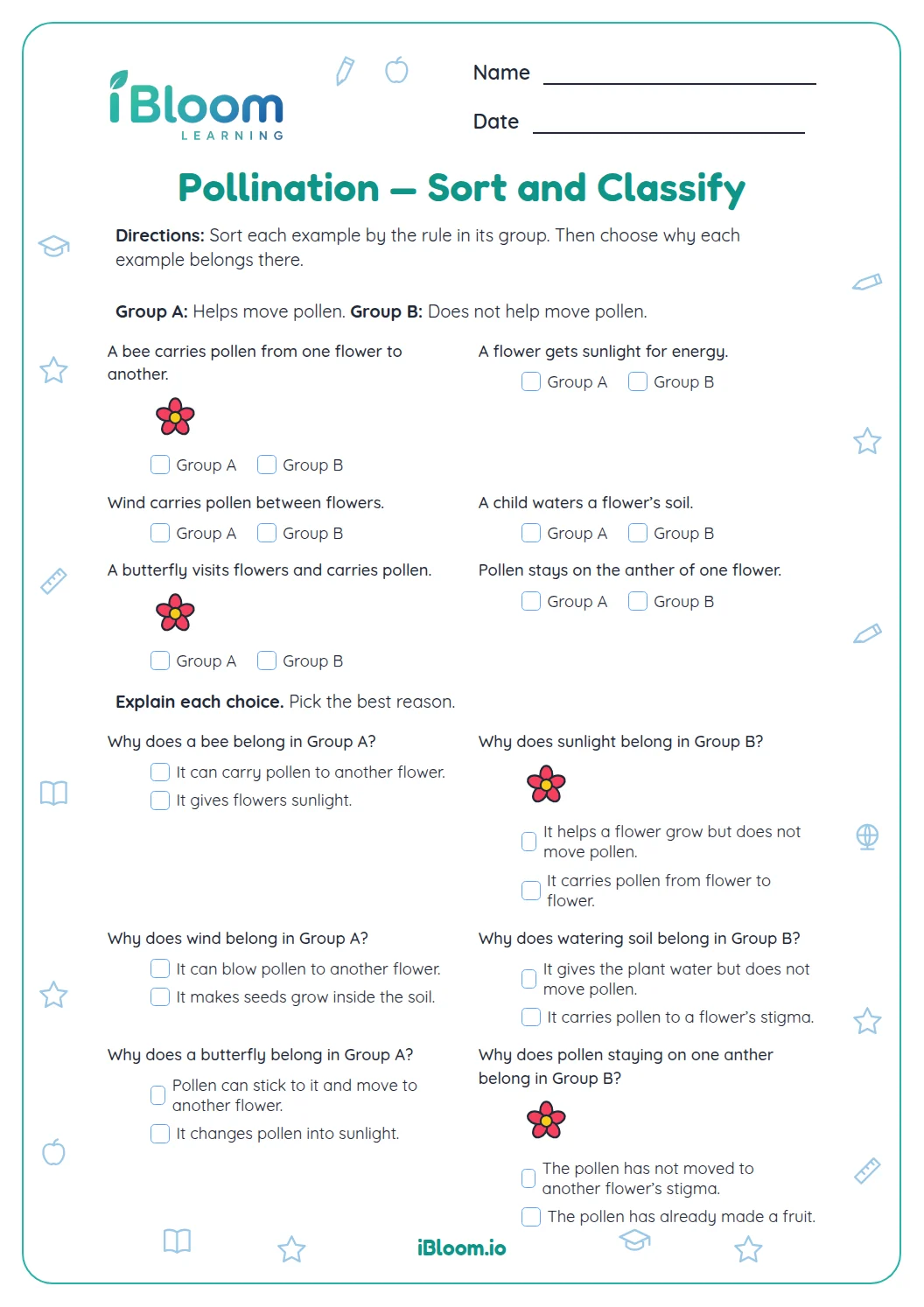


About this worksheet
This free printable worksheet gives Grade 2 students practice sorting examples into the stages of a plant's life cycle. In Part A they decide whether each clue or picture shows a seed, a young plant or a mature plant. Part B follows the cycle: what a seed needs to sprout, what it grows into, and what a mature plant makes. In Part C they explain two of their sorting choices in writing, using a clue from the example. A separate answer key shows every answer, with sample explanations.
What are the stages of a plant's life cycle?
A flowering plant goes through the same stages again and again. It begins as a seed. When the seed gets water, it sprouts, and a small stem and the first leaves push up through the soil. That is a young plant. The young plant keeps growing until it is a mature plant, fully grown, with flowers that make new seeds.
The seeds start the cycle again, which is why scientists call it a life cycle. This sheet uses three stage names: seed, young plant and mature plant.
How do you sort an example into a stage?
Look for the clue in the example. A dry seed that has not sprouted is a seed. A tiny plant with its first leaves or a small green stem is a young plant. A tall plant with flowers, or a plant that is fully grown with many leaves, is a mature plant. Questions 2 and 4 show a picture, and children check what the plant looks like.
A good habit is to ask two questions: has it sprouted yet, and can it make seeds? If the answer to both is no, it is a seed. If it has sprouted but cannot make seeds yet, it is a young plant. If it makes seeds, it is mature.
- 1A tall plant has flowers and makes seeds.
- 2Has it sprouted? Yes, it is tall.
- 3Can it make seeds? Yes.
- 4It is a mature plant.
Why does the sheet ask children to explain a group?
Naming the stage is one skill, and giving a reason is another. In Part C, children write why a dry seed belongs in the seed group and why a flowering plant is a mature plant. A good answer uses a clue from the example, such as "it has not sprouted" or "it makes seeds." Reading the answers shows whether a child sorted by clues or only guessed.
What is on this worksheet?
Twelve questions on two pages, in three parts, with two picture questions:
- Part A: 6 questions, sort each example as a seed, young plant or mature plant
- Part B: 4 questions, follow the cycle from sprouting seed to a mature plant that makes seeds
- Part C: 2 questions, explain why an example belongs in its group
- A two-page answer key with sample explanations
How to use this worksheet at home or in class
- 1Show a real seed, such as a bean or sunflower seed, and ask what it needs to grow.
- 2Say the three stage names together: seed, young plant, mature plant.
- 3Do question 1 together. Ask what clue tells you it is a seed.
- 4Let students finish Part A alone, then talk about any example they sorted differently.
- 5Do Part B. Ask students to tell the whole life cycle out loud, from seed to seed.
- 6Have students write the Part C reasons with a clue from the example, then check with the answer key.
Common mistakes and quick fixes
The mistake
Calling a tiny plant with its first leaves a mature plant because it is green and growing.
The fix
A mature plant is fully grown and makes flowers and seeds. If the plant is small and has just sprouted, it is still a young plant.
The mistake
Sorting a seed under the soil as a young plant because it is in the ground.
The fix
A seed has not sprouted yet. Ask whether a stem or leaf has pushed out of the seed. If not, it is still a seed.
The mistake
Explaining a group by repeating it, such as "It is a seed because it is a seed."
The fix
Ask for one clue: "What can you see or tell that shows it is a seed?" A dry seed that has not sprouted is a good reason.
What to practice next
Make more practice
Questions parents and teachers ask
What are the three stages on this worksheet?
The stages are seed, young plant and mature plant. A seed has not sprouted, a young plant has just sprouted and is small, and a mature plant is fully grown and makes flowers and seeds. The sheet asks students to sort examples into these groups and explain why.
What is the difference between a young plant and a mature plant?
A young plant is small and has only just sprouted, with a short stem and its first leaves. A mature plant is fully grown. It is taller, has many leaves, and has flowers that make seeds. Questions 2, 3, 4 and 6 ask children to tell these two apart.
Why does a mature plant make seeds?
Seeds are how the plant starts new plants. Each seed can sprout into a young plant if it gets what it needs, so the life cycle begins again. Question 8 asks what a mature plant makes that can grow into new plants, and the answer is seeds.
What does a seed need to sprout?
A seed needs water, and the right warmth, before it sprouts; until then it rests in the soil as a seed. Question 10 asks what water helps a seed in the soil do, and the answer is sprout. Once it is a young plant, it also needs sunlight to keep growing toward the mature stage.
What should students write in Part C?
Students should write one clue that shows why the example belongs in its group. For the dry seed, a good answer is that it is small and dry and has not sprouted yet. For the flowering plant, a good answer is that it is fully grown and makes seeds. The key has sample answers.
Is there an answer key for this worksheet?
Yes. A separate two-page answer key shows the correct stage for each Part A question, the answers to the four Part B questions, and sample answers for the two explanations in Part C. You can print the worksheet by itself, keep the key for checking, or download both as a PDF.