Free printable practice
Anatomy Practice Activities
Grade 2 plant anatomy worksheets help children label plant parts and explain how roots, stems, leaves, flowers, fruits, and seeds help plants live.
Free printable worksheet PDFs
Preview every available page, then download the free worksheet PDF for home, homeschool, tutoring, or classroom practice.
Preview the exact activity before downloading it.
 Anatomy — Sort and ClassifyGrade 2 plant anatomy worksheets help children label plant parts and explain how roots, stems, leaves, flowers, fruits, and seeds help plants live. This sort and classify worksheet provides a distinct, age-appropriate way to practise the same lesson.Grade 2Free PDF preview
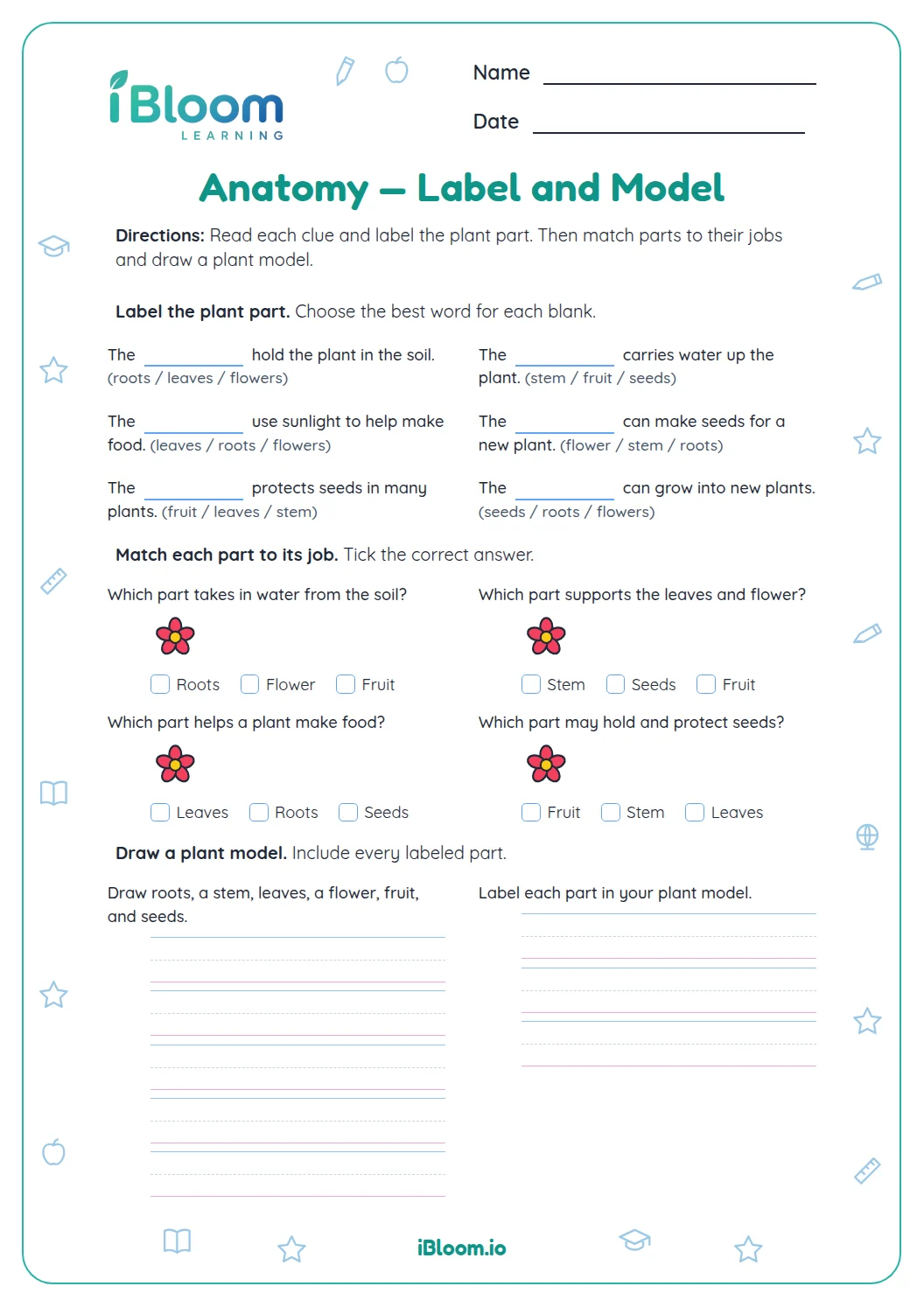 Anatomy — Label and ModelGrade 2 plant anatomy worksheets help children label plant parts and explain how roots, stems, leaves, flowers, fruits, and seeds help plants live. This label and model worksheet provides a distinct, age-appropriate way to practise the same lesson.Grade 2Free PDF preview
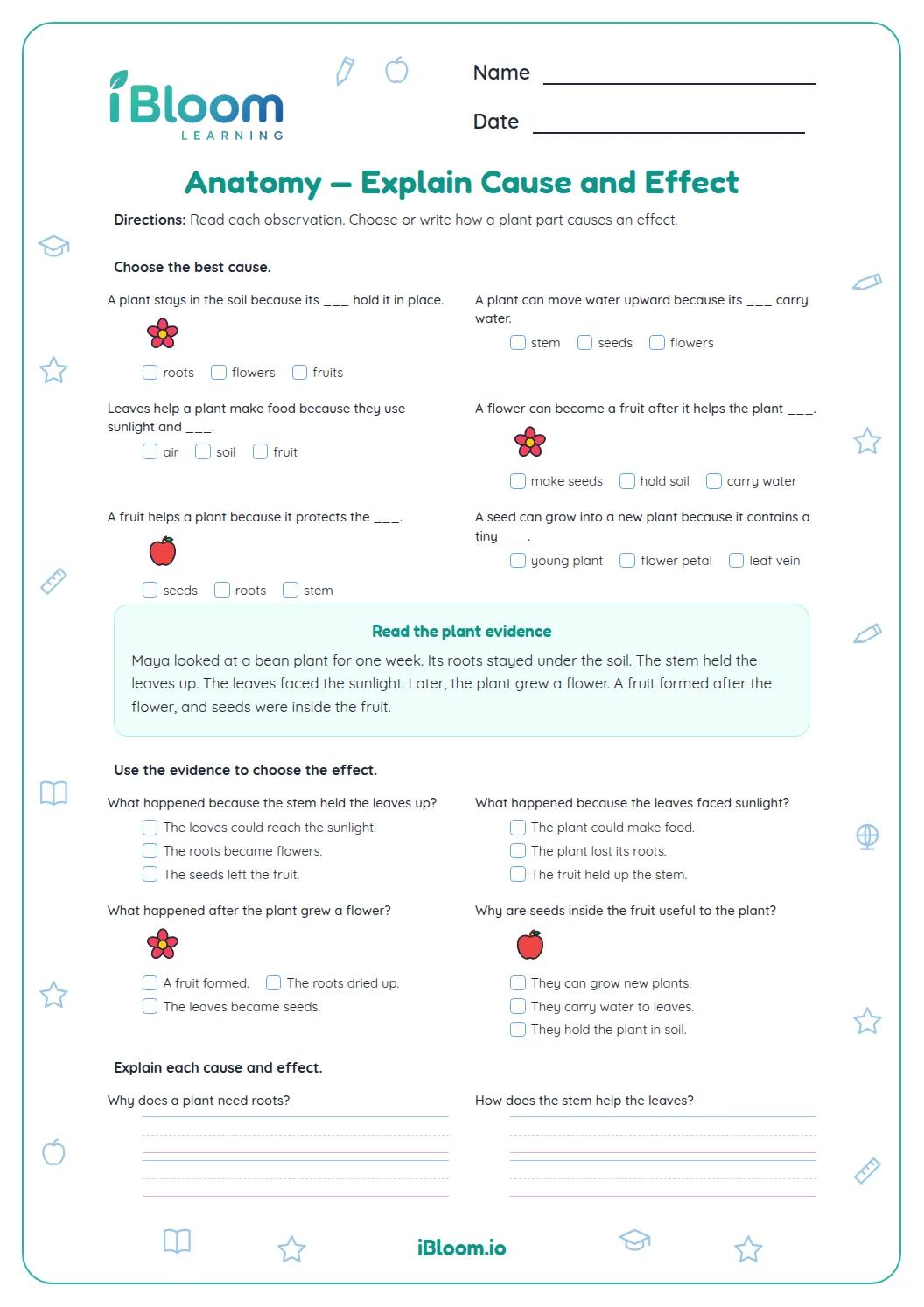 Anatomy — Explain Cause and EffectGrade 2 plant anatomy worksheets help children label plant parts and explain how roots, stems, leaves, flowers, fruits, and seeds help plants live. This explain cause and effect worksheet provides a distinct, age-appropriate way to practise the same lesson.Grade 2Free PDF preview
 Anatomy — Apply Science IdeasGrade 2 plant anatomy worksheets help children label plant parts and explain how roots, stems, leaves, flowers, fruits, and seeds help plants live. This apply science ideas worksheet provides a distinct, age-appropriate way to practise the same lesson.Grade 2Free PDF preview
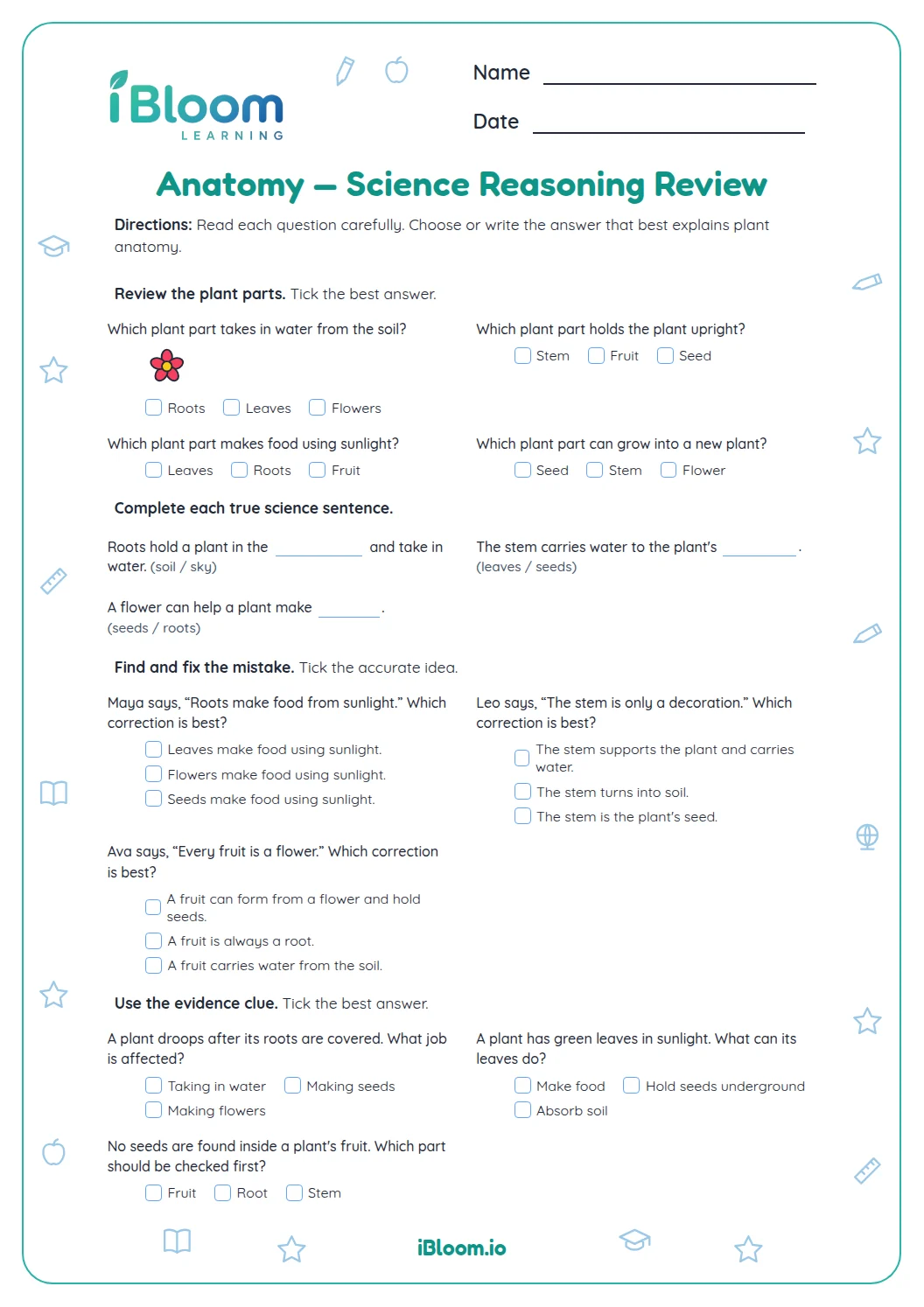 Anatomy — Science Reasoning ReviewGrade 2 plant anatomy worksheets help children label plant parts and explain how roots, stems, leaves, flowers, fruits, and seeds help plants live. This science reasoning review worksheet provides a distinct, age-appropriate way to practise the same lesson.Grade 2Free PDF preview
Practice that builds confidence
What Grade 2 learners practise
These Grade 2 science worksheets focus on plant anatomy: the visible parts of a plant and the job each part does. Children practise naming roots, stems, leaves, flowers, fruits, and seeds while connecting each structure to how a plant grows and survives.
The printable activities include labelled diagrams, matching tasks, fill-in vocabulary, observation prompts, and simple explanations of plant-part functions. They are designed for the Plants unit, with clear visuals that help young learners move from identifying parts to describing their purposes.
Plant anatomy in Grade 2 is about noticing that a plant is made of parts that work together. These worksheets build vocabulary such as root, stem, leaf, flower, fruit, and seed, then ask children to connect each word to a diagram or real plant. Learners may label a flower, trace arrows to show where water travels, or match leaves with making food for the plant.

From naming parts to explaining jobs
The progression starts with recognition: Which part is underground? Which part holds the plant upright? It then moves toward function. Roots take in water and help anchor the plant, stems support the plant and move water, leaves help the plant make food, flowers can help make seeds, and seeds can grow into new plants. Simple sentence frames help children explain these ideas without needing advanced biology terms.
A practical parent routine
At home, place a safe houseplant, herb, or picture of a plant beside the worksheet. Ask your child to point to one part, say its name, and tell one job it does. Then let them complete one diagram task and one short explanation task. Finish by asking, “What would happen if this plant had no roots?” This keeps practice concrete and encourages scientific thinking.

Classroom uses for teachers
Teachers can use these pages in science centers, small-group reteaching, plant observation journals, or after a read-aloud about growing plants. The worksheets also work well before or after a seed-planting activity because students can compare the diagram with what they see in soil, seedlings, leaves, and stems. Completed pages make useful notebook evidence of vocabulary and concept understanding.

Common errors to watch for
Children often call every green part a leaf, confuse fruits with flowers, or think seeds are only found in packets. Encourage close observation: leaves are usually flat and attached to stems, flowers are often where seeds begin forming, and fruits may protect seeds. Another common mistake is naming parts without explaining jobs, so prompt students to add a because statement.
Free printable PDF download
Use this grade 2 plant anatomy worksheet page to preview the activity, print it, or download it as a PDF for quick practice. It works well for homework, homeschool lessons, tutoring, morning work, revision, and classroom centers.
Answers and answer key support
After the child completes the worksheet independently, parents and teachers can use the answer support or answer key information to check the work, review mistakes, and choose the next practice step.
Why iBloom worksheets help
The activities use clear plant drawings, repeated vocabulary, and varied response types so children do more than memorize labels. A helpful child-friendly strategy is: name it, point to it, tell its job. For example, “This is the stem. It holds up the plant.” That short routine helps Grade 2 learners speak, write, and think like young scientists.
Helpful answers
Frequently asked questions
What plant parts are covered in these Grade 2 anatomy worksheets?
The worksheets focus on common plant parts children can observe and label: roots, stems, leaves, flowers, fruits, and seeds. They also practise the basic job of each part.
Are these worksheets only for labeling diagrams?
No. Labeling is included, but children also match plant parts to functions, complete simple science vocabulary tasks, and explain what each part does for the plant.
How can I connect the worksheet to a real plant at home?
Use a houseplant, herb, flower, or clear plant photo. Ask your child to find one part on the real plant, label it on the worksheet, and say its job in a full sentence.
What mistakes do Grade 2 students often make with plant anatomy?
They may mix up stems and leaves, think flowers and fruits are the same, or remember names without understanding functions. Pointing to real examples helps correct these misunderstandings.
Can teachers use these during a plant-growing activity?
Yes. They are useful before planting seeds to introduce vocabulary, during observations to identify new growth, and after the activity to review how plant parts work together.
Is this grade 2 plant anatomy worksheet free?
Yes. You can preview it for free and use the printable worksheet for home or classroom practice.
Can I download this grade 2 plant anatomy worksheet as a PDF?
Yes. Use the worksheet download option to save a printable PDF, or print the worksheet directly from the page.
Does this grade 2 plant anatomy worksheet include answers or an answer key?
When the activity has fixed answers, iBloom includes answer support so parents and teachers can check the completed worksheet.