





About this worksheet
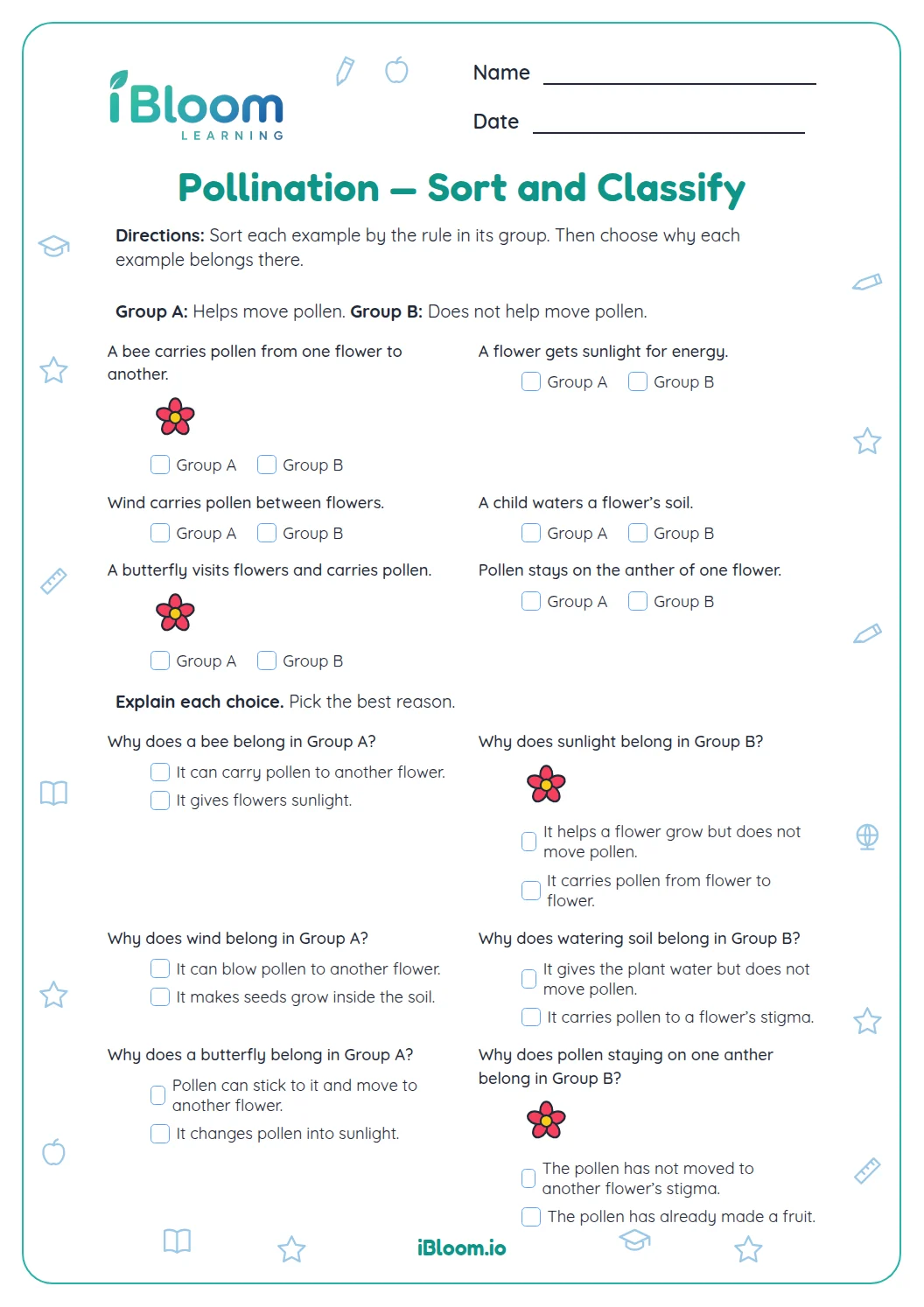
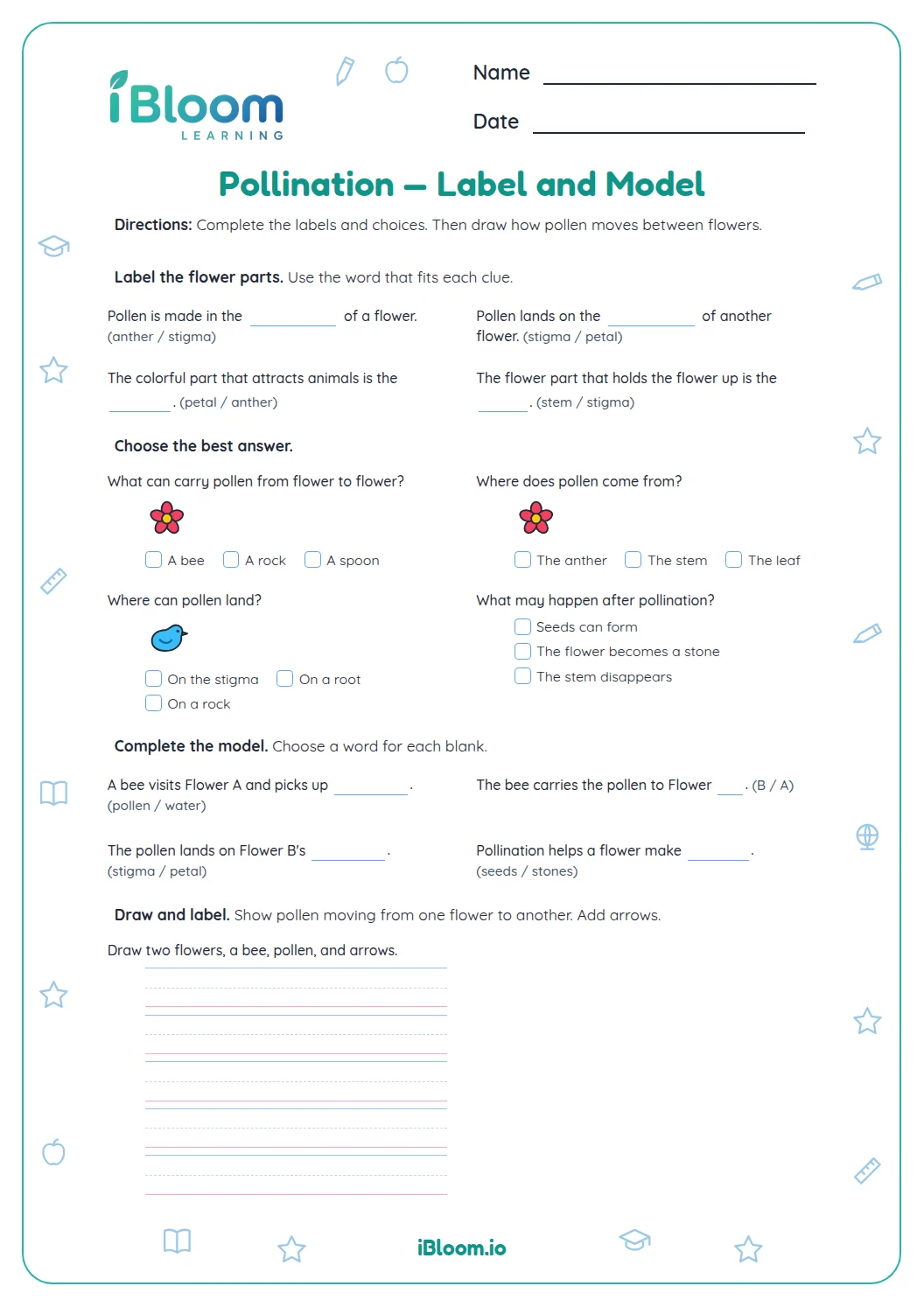
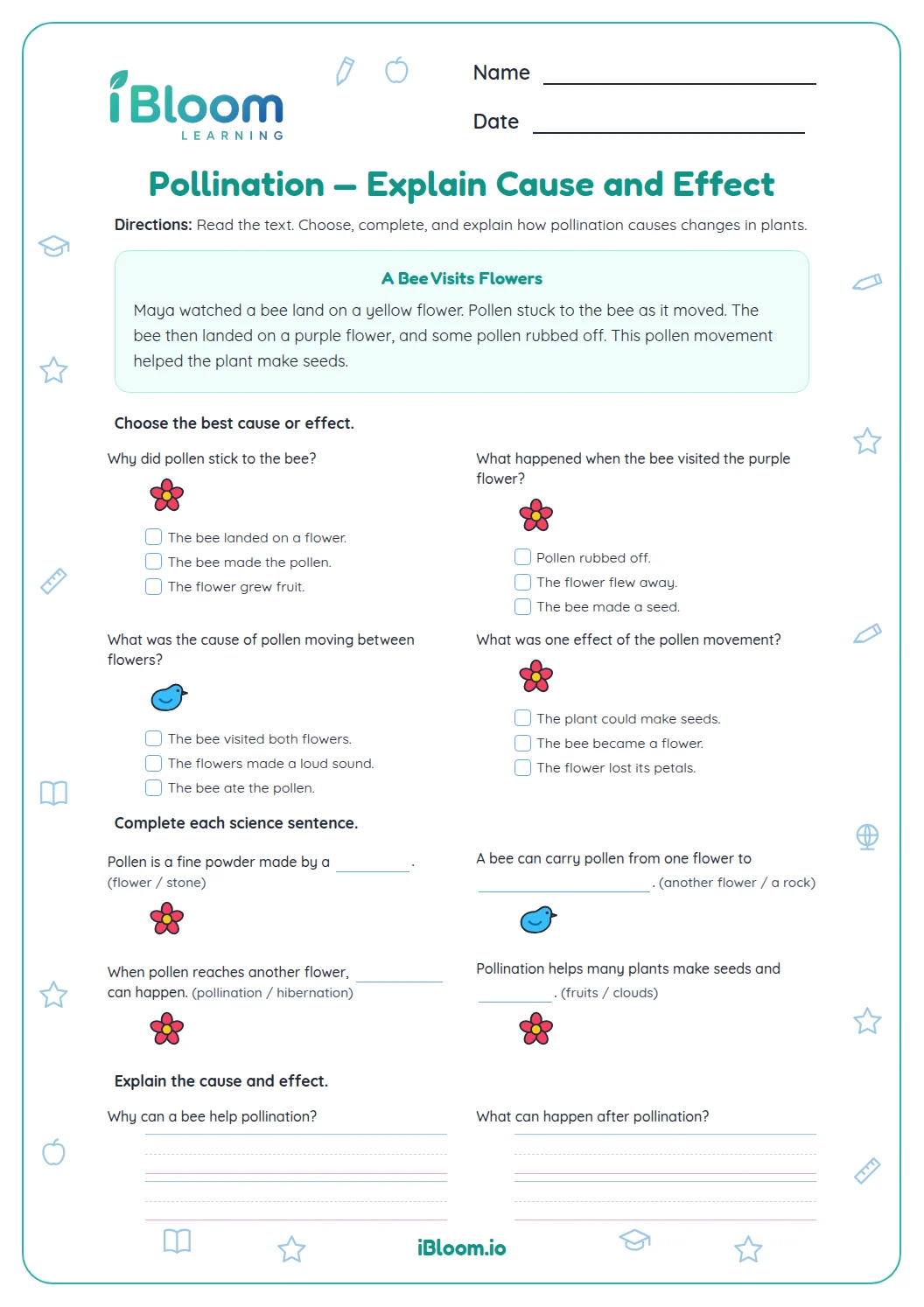
This Grade 2 printable focuses on applying ideas about pollination. Learners name pollen and pollinators, connect flower visits with possible seed formation, interpret observations, and describe a simple model that could carry pollen between two flowers. It includes 14 questions in two parts and a separate key. The questions align with NGSS 2-LS2-2 through the idea of modeling an animal’s role in pollination.
Aligned to 2-LS2-2
What does a pollinator move?
Pollen is a fine material made by flowers. An animal such as a bee can pick up pollen while visiting one flower and leave some on another flower. That movement can help the plant make seeds.
How can a model show pollination?
A useful model imitates the important action: something picks up material at one flower and carries it to another. A fuzzy brush can stand for an animal, and colored powder can stand for pollen.
- 1A cotton swab touches two flowers.
- 2It can pick up and leave pollen-like material.
- 3The swab models how an animal can carry pollen between flowers.
What evidence supports an explanation?
Look for observations connected to pollen movement, such as pollen dust on an animal after a flower visit. A cloudy sky or a long root does not show pollen transfer. Ask whether the observation helps explain how pollen got to another flower.
How to use this worksheet
- 1Read the directions before starting each part.
- 2Complete one question at a time and say the clue aloud.
- 3Use a drawing, count, or number strategy where helpful.
- 4Review each response before moving to the next part.
- 5Check the finished page with the separate answer key.
Common mistakes and quick fixes
The mistake
Saying that an animal makes pollen.
The fix
Pollen comes from flowers; an animal can carry it.
The mistake
Describing a model that touches only one flower.
The fix
Include two flowers so the model shows pollen moving between them.
The mistake
Saying every pollinated flower immediately makes seeds.
The fix
Explain that pollen transfer can help seeds begin to form.
Science alignment
This page uses a simple model and evidence about how animals help plants reproduce.
Develop a simple model that imitates an animal pollinating plants.
On this sheet: Questions connect pollen transfer with an animal-inspired model.
Show the official wordingHide the official wording
Develop a simple model that mimics the function of an animal in dispersing seeds or pollinating plants.
What to practice next
Further reading
Questions parents and teachers ask
What does pollination mean on this worksheet?
Pollination is the movement of pollen from one flower to another flower of the same kind. The questions ask learners to identify pollen, describe how an animal may carry it, and connect the transfer with seed formation. Children can trace the route with a finger: anther to pollinator, then to another flower.
How does the worksheet connect to a model?
Several prompts ask what a cotton swab or fuzzy brush can represent and why a model should move pollen between flowers. Learners explain how that simple action imitates an animal visiting flowers. Ask the learner to name the carried material before discussing where it travels.
How many questions are included?
There are 14 short-answer questions in two parts. The first checks core pollination ideas and observations; the second asks learners to apply those ideas to a transfer model and explain what may happen next. The key accepts a pollinating animal such as a bee or butterfly.
What might count as evidence of a flower visit?
Pollen on an animal after it visits a flower is an observation connected to pollen movement. The worksheet asks learners to distinguish that kind of clue from details that do not show pollen transfer. Keep the example focused on flowers of the same kind when discussing seed formation.
Does pollination always make seeds right away?
The worksheet uses careful wording: pollen reaching another flower of the same kind can help seeds begin to form. Learners describe a possible result, rather than claiming that every flower visit produces seeds. A swab or fuzzy brush is a simple model because it can pick up and transfer pollen.