






About this worksheet
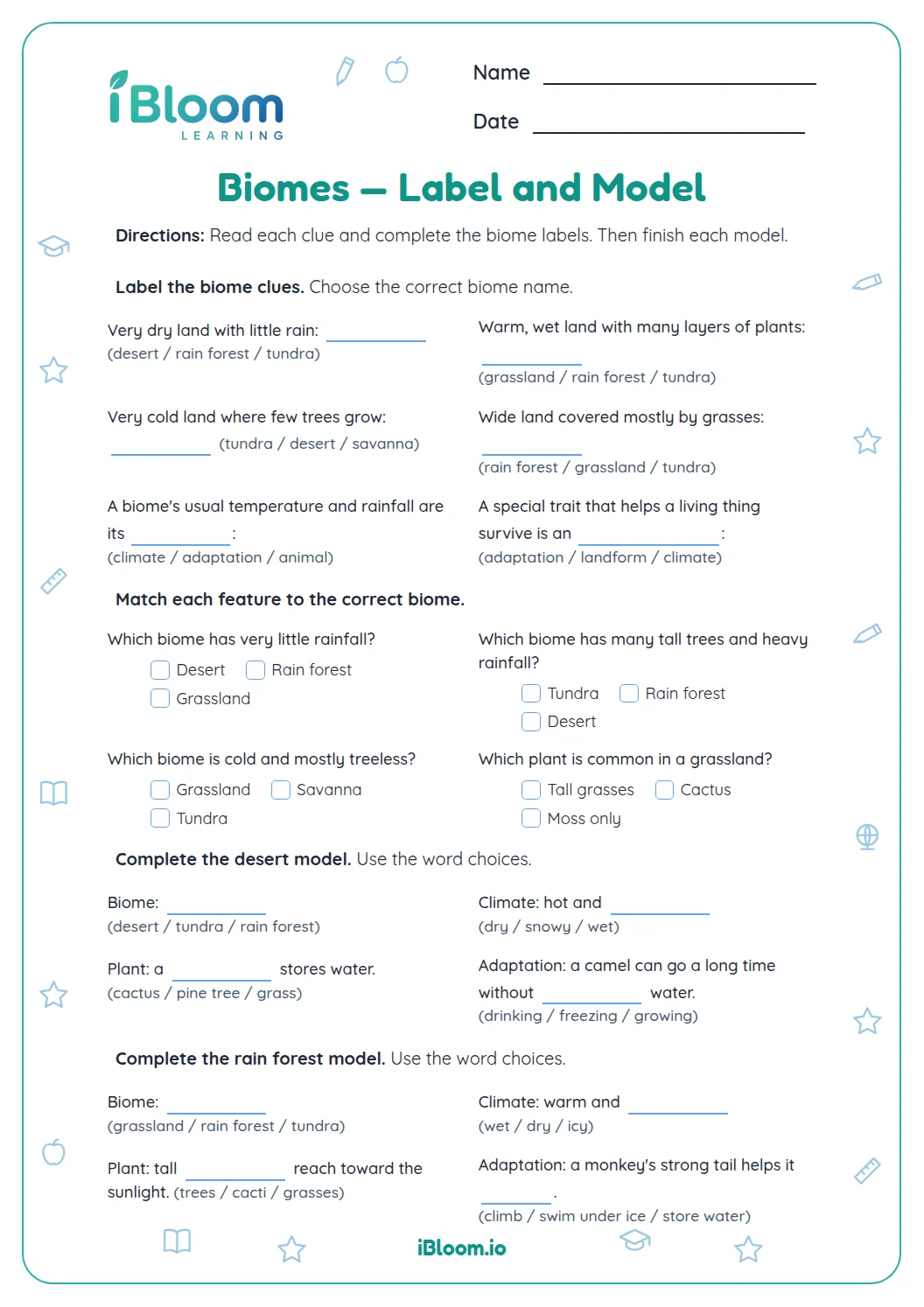
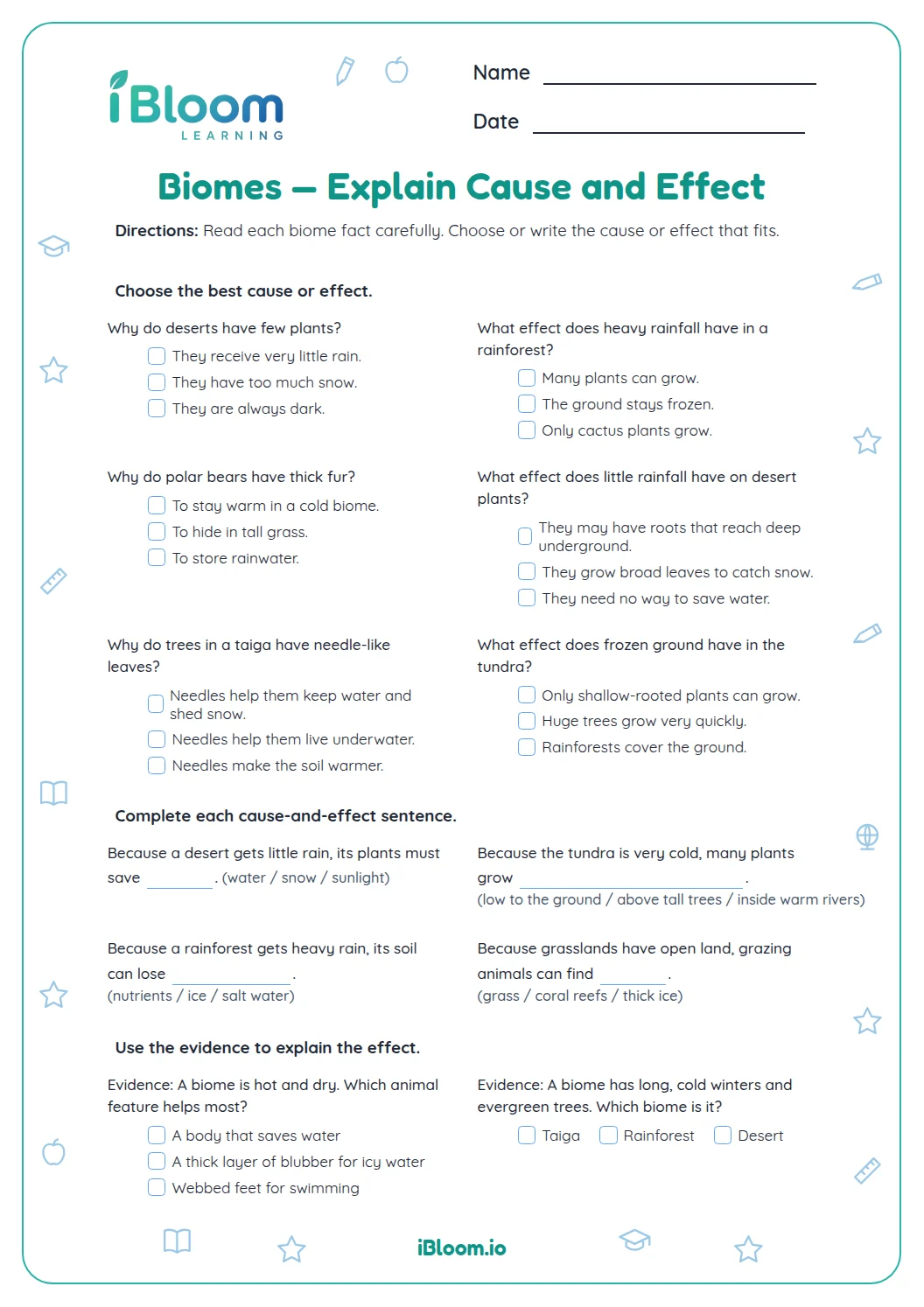
This Grade 3 worksheet asks students to connect habitat conditions with features that help organisms meet their needs. Students complete 16 short ideas about deserts, grasslands, wetlands, ponds, and tundra, including how a habitat change can affect survival. The separate answer key gives the intended words and sample phrasing. It practices NGSS 3-LS4-3 through evidence based reasoning about organisms in particular habitats.
Aligned to 3-LS4-3
How do habitats shape what organisms need?
A habitat provides resources such as water, food, shelter, and space. Temperature, rainfall, wind, and sunlight also affect which organisms can survive there. A feature is useful when it helps an organism meet a need in those conditions.
How can students solve a habitat question?
Find the condition named in the prompt. Then ask which feature or resource would help with that condition. For example, thick fur helps an animal stay warm in a cold place.
- 1Clue: a fox lives through cold winters.
- 2Helpful feature: thick fur.
- 3Complete: Thick winter fur helps a fox stay warm.
What is on the worksheet?
Part A connects habitat features with the conditions they help an organism handle. Part B applies those ideas to climate and habitat changes. All 16 items are short completions.
How to use this worksheet
- 1Read the complete habitat clue.
- 2Name the condition or resource it describes.
- 3Think of a feature or need that fits the condition.
- 4Complete the sentence with a clear word or phrase.
- 5Use the key to compare accurate answers.
Common mistakes and quick fixes
The mistake
Choosing a feature that sounds interesting but does not fit the habitat clue.
The fix
Point to the clue word, such as dry or cold, and match the answer to it.
The mistake
Naming a habitat change without saying how it affects a living thing.
The fix
Add the organism and the need affected, such as a frog needing a wet place.
The mistake
Treating one sample answer as the only possible response.
The fix
Check whether another answer makes a clear, accurate habitat connection.
Science alignment
Use evidence to explain how a habitat supports organisms.
On this sheet: Students connect habitat conditions and resources with organism survival.
Show the official wordingHide the official wording
Construct an argument with evidence that in a particular habitat some organisms can survive well, some survive less well, and some cannot survive at all.
What to practice next
Questions parents and teachers ask
What does this biomes worksheet practice?
This Grade 3 worksheet asks students to connect climate and habitat conditions with features that help organisms meet their needs. Students complete 16 short ideas about deserts, grasslands, wetlands, ponds, and tundra. The separate answer key gives the intended words and sample phrasing.
How many questions are on the sheet?
There are 16 short completions: eight feature and habitat connections, followed by eight applications about climate and habitat changes. The separate answer key lists each response. Ask students to point to the condition in a prompt before completing the sentence.
Can students use more than one answer for an explanation?
The key gives a suggested word or phrase for each blank. Accept another response when it names a relevant habitat condition and accurately connects it to a plant or animal need in the setting described. A clear link between the setting and the organism is the important part.
What is a biome?
A biome is a large region with a typical climate and living things suited to it. This worksheet uses familiar habitats to practice how water, temperature, sunlight, and other conditions affect organisms and their survival. Its examples include dry deserts, wet wetlands, snowy places, and shaded forests.
How should I review a missed item?
Ask the student to reread the habitat clue and name its condition, such as cold, dry, or wet. Then connect that condition to a body feature, resource, or survival need before checking the answer key together. This keeps the discussion focused on the science idea instead of memorizing a phrase.