

About this worksheet
This Grade 3 climate worksheet helps students connect a cause with a long-term weather pattern. A short evidence passage compares two regions, then students identify climate clues, complete cause-and-effect statements, and explain how sunlight, elevation, or a nearby ocean can shape typical conditions. The questions distinguish a climate pattern from one day of weather, with a separate key for the selected and sample answers.
Aligned to 3-ESS2-2
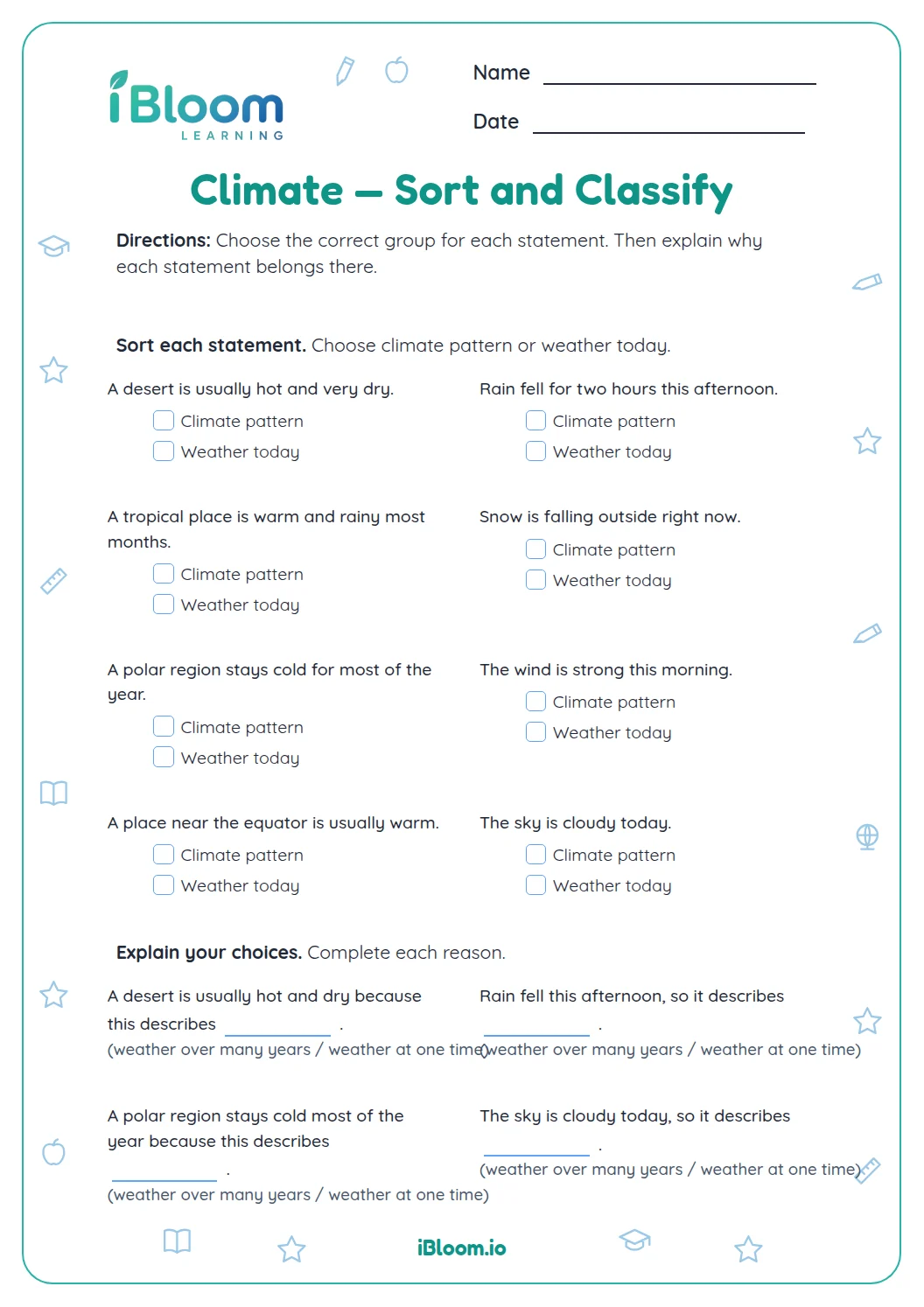
Which clues describe climate patterns?
A climate describes typical weather conditions in a region and how those conditions vary over years. A cold morning or rainy afternoon is weather; a place that is usually dry or warm across seasons has a climate pattern. The passage compares three regions.
- 16) Little direct sunlight → cooler conditions
- 2The cause helps explain a pattern, not a single day.
How can regional features affect climate?
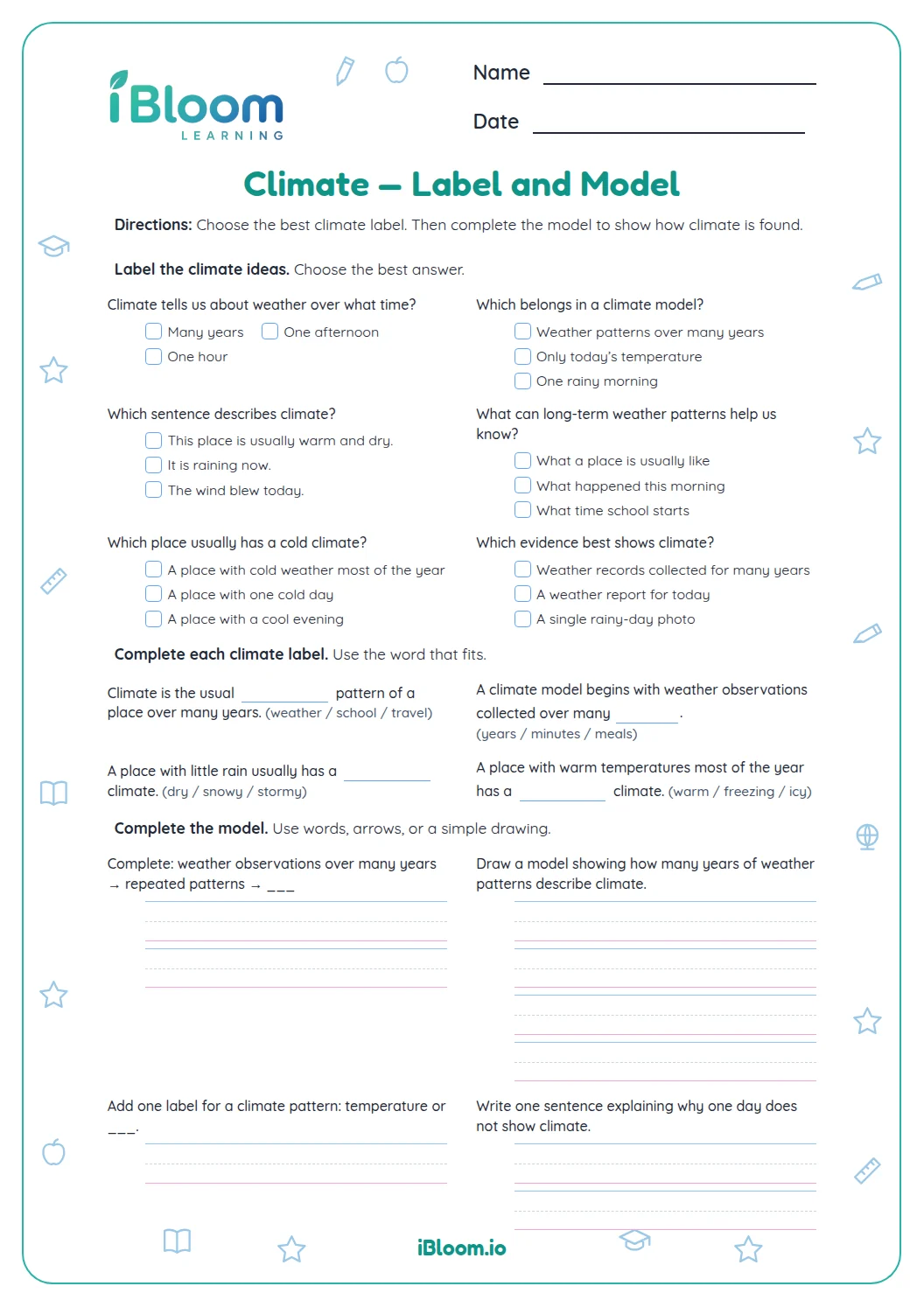
Sunlight, elevation, and nearby water can help explain regional patterns. Strong sunlight through much of the year can support warmth, higher elevation can mean cooler temperatures, and ocean water changes temperature slowly. The passage and questions connect each factor with a typical effect.
How should a student explain cause and effect?
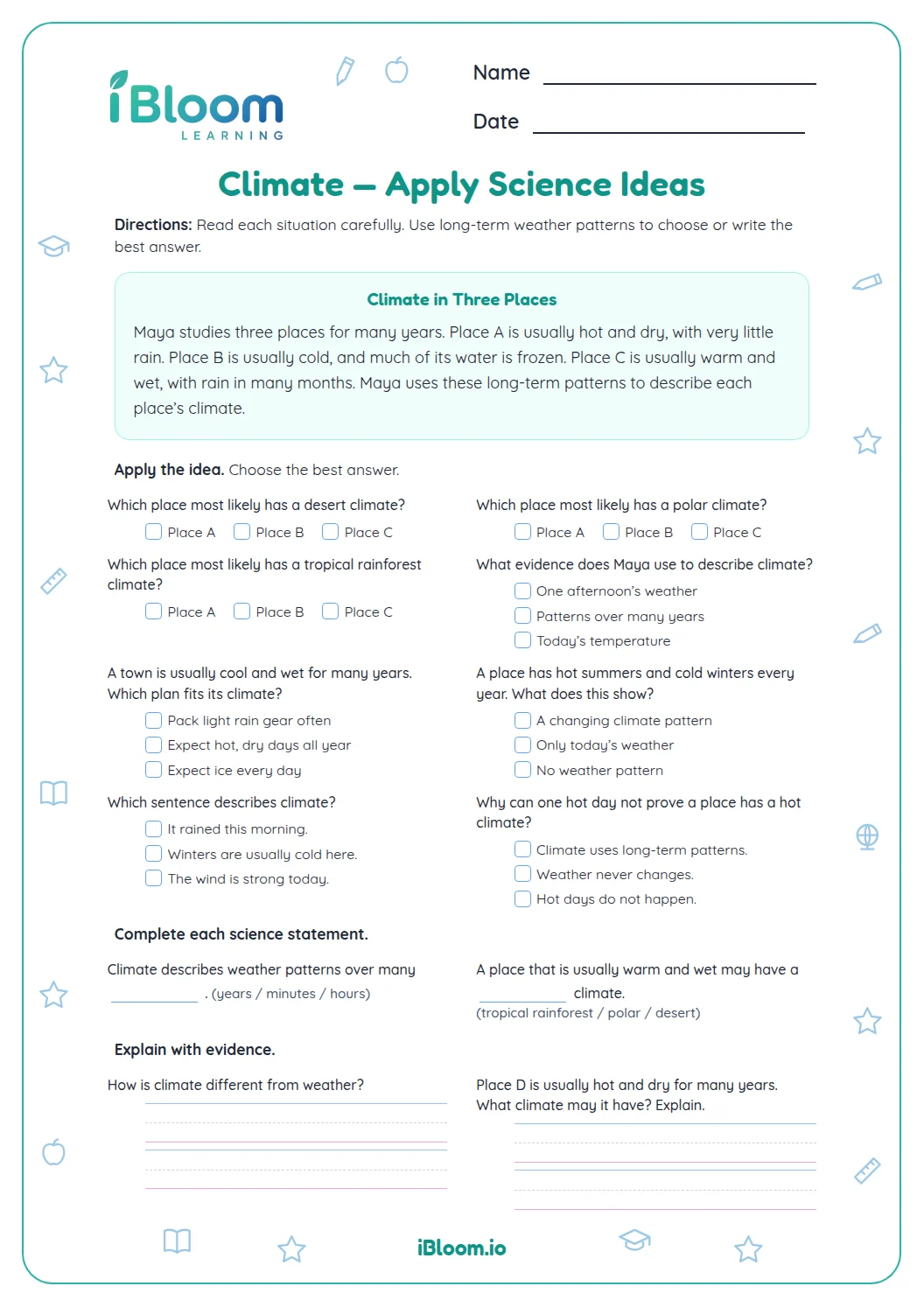
Name the evidence, state what it suggests, and connect the cause to the effect. The passage describes Region A’s sunlight, Region B’s elevation, and Region C’s nearby ocean; use the matching detail to explain each typical pattern.
How to use this worksheet
- 1Read the passage once for the two regions’ typical conditions.
- 2Underline a clue that describes a pattern over time.
- 3For each choice, name the cause before selecting its likely effect.
- 4Use a specific passage detail in the written explanations.
- 5Compare written responses with the sample key; accept clear equivalent reasoning.
Common mistakes and quick fixes
The mistake
Treating one rainy or cold day as a climate pattern.
The fix
Ask whether the clue describes typical conditions across many years.
The mistake
Saying an ocean makes every day rainy.
The fix
Use the slower warming and cooling of water to explain temperature patterns.
The mistake
Naming a cause without linking its effect.
The fix
Write both parts: “Higher elevation can lead to cooler temperatures.”
Curriculum alignment
This practice connects the page activities with the listed learning standard.
Use information about regional climate patterns to explain typical conditions.
On this sheet: Students use regional climate descriptions and evidence to connect causes with typical conditions.
Show the official wordingHide the official wording
Obtain and combine information to describe climates in different regions of the world.
What to practice next
Make more practice
Further reading
Questions parents and teachers ask
What is the difference between weather and climate?
Weather describes conditions at a particular time, such as rain today. Climate describes typical conditions and how they vary over many years. The first part asks students to spot long-term clues, and question 13 asks why one cold day cannot establish a region’s climate.
How does sunlight affect a region’s climate?
A region near the equator can receive strong sunlight through much of the year, helping explain why it is often warm. Question 11 asks students to use the passage detail about Region A and connect it to the pattern of warmth.
Why can a mountain town be cooler?
Higher elevation can be one cause of cooler temperatures. Question 3 asks students to choose that factor when comparing a mountain town with a lowland town. The question focuses on a possible climate explanation, rather than a one-day forecast. Ask the learner to explain the clue or number pattern used to check the answer.
How can an ocean affect nearby temperatures?
Ocean water warms and cools slowly, so it can make nearby land temperatures change more gradually and remain milder. The passage gives this example for coastal Region C. Students also select the slow temperature change in Part B and explain the ocean effect in question 12.
How many questions are on the worksheet?
There are 14 questions after the short passage: five climate-clue choices, five cause-and-effect completions, and four written explanations. Including the passage, the worksheet has four parts. The answer key provides sample responses for the written questions and accepts clear equivalent explanations.
Can a student use different words than the answer key?
Yes. The four written questions have sample answers, so another response works when it uses climate evidence and explains the relationship. For instance, “higher places are cooler” expresses question 3’s idea; a complete response should connect that effect to the higher elevation described in the passage.