




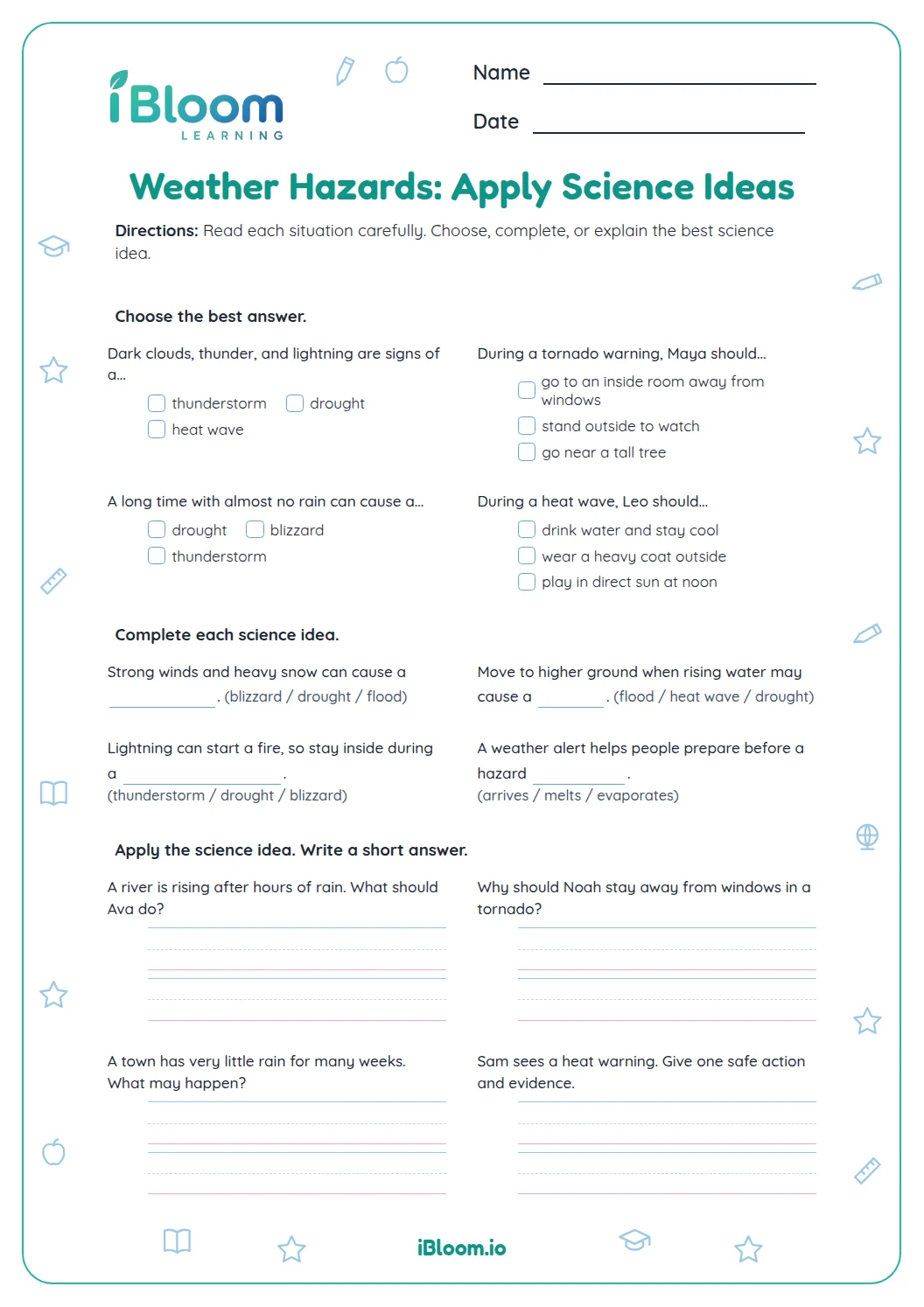
About this worksheet
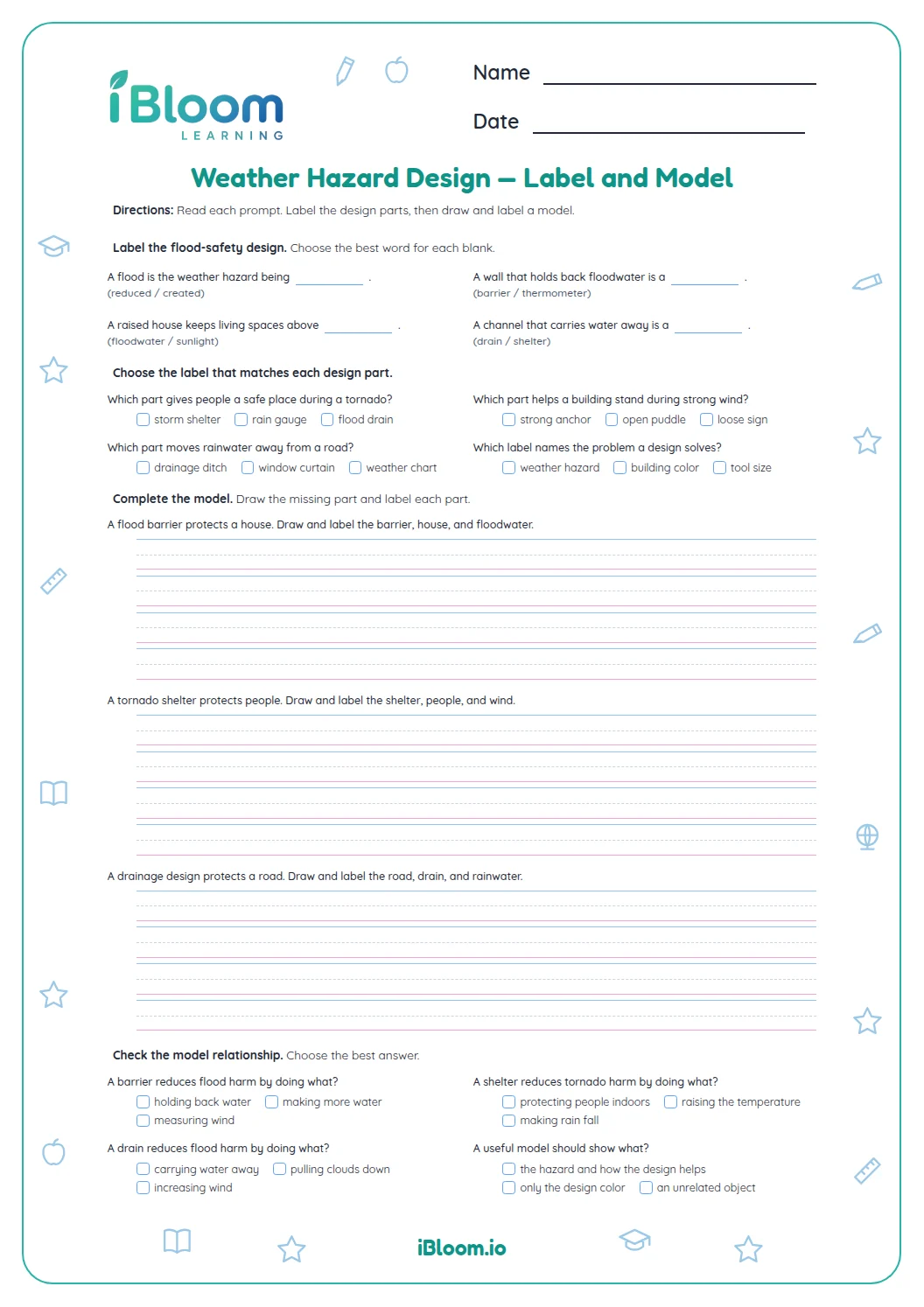
This free Grade 3 science worksheet asks learners to connect weather hazards with designs that can reduce harm. Across 14 multiple-choice questions in two parts, they consider flooding, strong wind, lightning, and hail, then interpret simple model-test evidence. The answer key identifies the best supported choice. The work practices NGSS 3-ESS3-1 by making claims about the merit of design solutions for weather-related hazards.
Aligned to 3-ESS3-1
How do a hazard and a design solution connect?
Begin by naming the hazard, then ask what kind of harm it can cause. A design is useful when its feature addresses that hazard. A raised doorway can help keep floodwater out; a lightning rod provides a path for electrical discharge to the ground.
For q1, heavy rain can cause flooding. A raised doorway can reduce the chance that water enters through a low doorway, so it matches the situation.
- 1Hazard: flooding after heavy rain.
- 2Design: raise the doorway.
- 3Claim: the raised doorway can help keep water out.
What can a model test tell an engineering team?
A fair comparison keeps relevant conditions the same while changing the feature being tested. If a roof stays attached at a stronger fan setting, that is evidence about the roof in that model test. It does not establish how the design will perform in every real storm.
What will learners decide on the worksheet?
Part A connects hazards with possible design features and considers fair tests. Part B asks learners to apply those ideas to test results and additional hazards. Each question has three choices; the key marks the answer that best fits the evidence and situation.
How does the page practice NGSS 3-ESS3-1?
Learners make claims about design choices that can reduce weather-related harm and use model-test evidence to support those choices.
How to use this worksheet
- 1Read the situation and name the weather hazard.
- 2Identify what harm the design is meant to reduce.
- 3Choose the feature that addresses that harm.
- 4For a test question, notice what changed and what stayed the same.
- 5Use the answer key to discuss why the evidence supports the choice.
Science reasoning slips and quick fixes
The mistake
Choosing a design that does not address the named hazard.
The fix
State the hazard and the harm first, then match the feature to it.
The mistake
Treating one model test as proof about every storm.
The fix
Describe only what the test conditions and results show.
The mistake
Changing several features and not knowing which mattered.
The fix
Keep conditions consistent and test one design change at a time.
Curriculum alignment
This worksheet practices the standard below through its questions and worked examples.
Design solutions can reduce the impacts of weather-related hazards.
On this sheet: Select, explain, and sketch design solutions for flooding, wind, and lightning hazards.
Show the official wordingHide the official wording
Make a claim about the merit of a design solution that reduces the impacts of a weather-related hazard.
What to practice next
Make more practice
Further reading
Questions parents and teachers ask
What is a weather hazard design solution?
It is a feature or structure intended to reduce harm from a weather hazard. The worksheet uses examples such as a raised doorway, a wind-resistant roof, a lightning rod, and a crop cover. Learners match each feature to the hazard it can address.
How can a raised doorway help during flooding?
A raised doorway can make it harder for shallow floodwater to enter a building through a low entrance. It does not prevent flooding itself. The worksheet asks learners to identify how a design feature may reduce a particular impact. A barrier or raised entrance can reduce risk without removing the hazard from the area.
What makes a model test fair?
A fair test keeps relevant conditions the same while changing the design feature being tested. Then the team can compare outcomes and make a better supported claim about that change. The fan-test question asks learners to identify a condition that should stay consistent.
Does one successful roof test prove it will work in every storm?
No. A classroom model gives evidence under the conditions used in that test. Real storms can differ in wind, rain, and debris, so a team should describe what the evidence suggests without claiming it predicts every event or guarantees a design will work in all locations.
What should engineers do after a model roof lifts?
They can revise the roof design and test it again under controlled conditions. A new test can show whether the change improved the result. On this worksheet, learners choose a next step that uses the failed test as useful evidence.
What standard does this sheet practice?
The worksheet practices NGSS 3-ESS3-1: make a claim about the merit of a design solution that reduces the impacts of a weather-related hazard. Learners connect hazards to designs and consider evidence from simple model tests in the questions. Its questions ask learners to connect a hazard, a feature, and an observed outcome.