


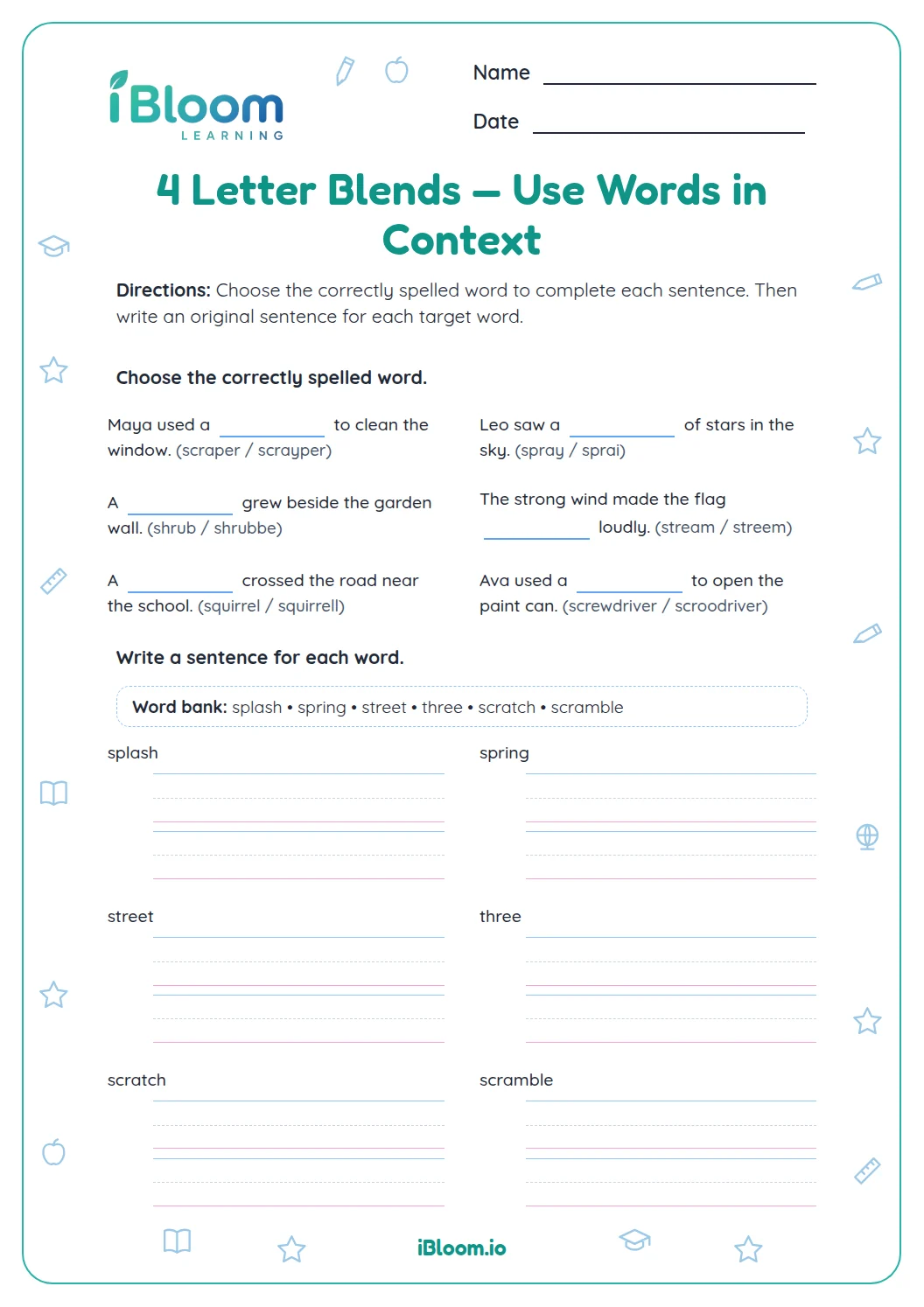


About this worksheet
This Grade 3 spelling worksheet reviews words beginning with scr, shr, spl, spr, str, and thr. Part A completes six word beginnings using meaning clues. Part B completes four sentences with whole words. Part C asks children to choose the correct spelling for four words. The 14 questions use the patterns in words such as scratch, shrimp, street, and three, supporting CCSS L.3.2f.
Aligned to L.3.2f
Which word beginnings does this review practice?
The six groups are scr, shr, spl, spr, str, and thr. Part A uses them in scratch, shrimp, splash, spring, stripe, and throne. A short definition helps children identify the intended word before choosing its beginning.
- 1___imp: a small sea animal.
- 2shr + imp spells shrimp.
How do the meaning clues help with spelling?
The clue “a small sea animal” identifies shrimp. Children need the letters shr before imp, in that order. Read the ending and say the complete word before choosing the beginning group.
How do children check a complete spelling?
Part B uses scream, sprout, splendid, and street in sentences. Part C asks children to choose the correct spelling for shred, three, scratch, and shrimp. Check the whole word, including letters after the beginning group.
Use the review for careful spelling
- 1Read the six letter groups: scr, shr, spl, spr, str, and thr.
- 2Use each definition to identify the intended word.
- 3Choose the beginning group that completes the word.
- 4Read each sentence and choose the whole word that fits.
- 5In the repair section, compare the spellings and choose the correct one.
Spelling mistakes to check
The mistake
Choosing spr for ___imp because spr is a familiar word beginning.
The fix
Use the sea-animal clue: shrimp begins with shr. Join shr and imp before reading the word.
The mistake
Writing only spr in the sentence about a green sprout.
The fix
Part B needs the whole word. Write sprout and read the completed sentence aloud.
The mistake
Writing three as thre, leaving off the last e.
The fix
Check the whole spelling after the thr beginning: three ends with ee.
Common Core alignment
Use beginning letter groups and familiar word spellings to complete and correct words.
On this sheet: Children identify scr, shr, spl, spr, str and thr in words, then write whole words and repair spellings.
Show the official wordingHide the official wording
Use spelling patterns and generalizations (e.g., word families, position-based spellings, syllable patterns, ending rules, meaningful word parts ) in writing words.
What to practice next
Make more practice
Further reading
Questions parents and teachers ask
Which words are practiced on this sheet?
The 14 questions include scratch, shrimp, splash, spring, stripe, throne, scream, sprout, splendid, street, shred, and three. Scratch and shrimp appear again in the spelling repairs. Children complete beginnings, use words in sentences, and choose correct spellings for the final items.
Should children write a beginning group or a whole word?
Part A asks children to choose the three-letter group that completes each word. Part B asks them to choose a whole word for a sentence. Part C asks them to select the correct spelling. Follow each part’s direction because the task changes.
How can a meaning clue help with an unfamiliar spelling?
A clue helps identify the word before choosing its letters. In question 2, “a small sea animal” points to shrimp, so shr belongs before imp. Read the complete word after joining the parts to check that the spelling and meaning both fit.
Why do some words appear more than once?
Scratch and shrimp appear in Part A and again in the spelling repair section. Seeing a word in two task types lets children first identify its beginning and later check its complete spelling. The answer key gives the correct choices for both appearances.
What should I check in the spelling repairs?
Check every letter in shred, three, scratch, and shrimp. For three, the beginning thr is followed by ee. For shrimp, the beginning shr is followed by imp. The answer key shows the correctly spelled choice for each item.