


About this worksheet
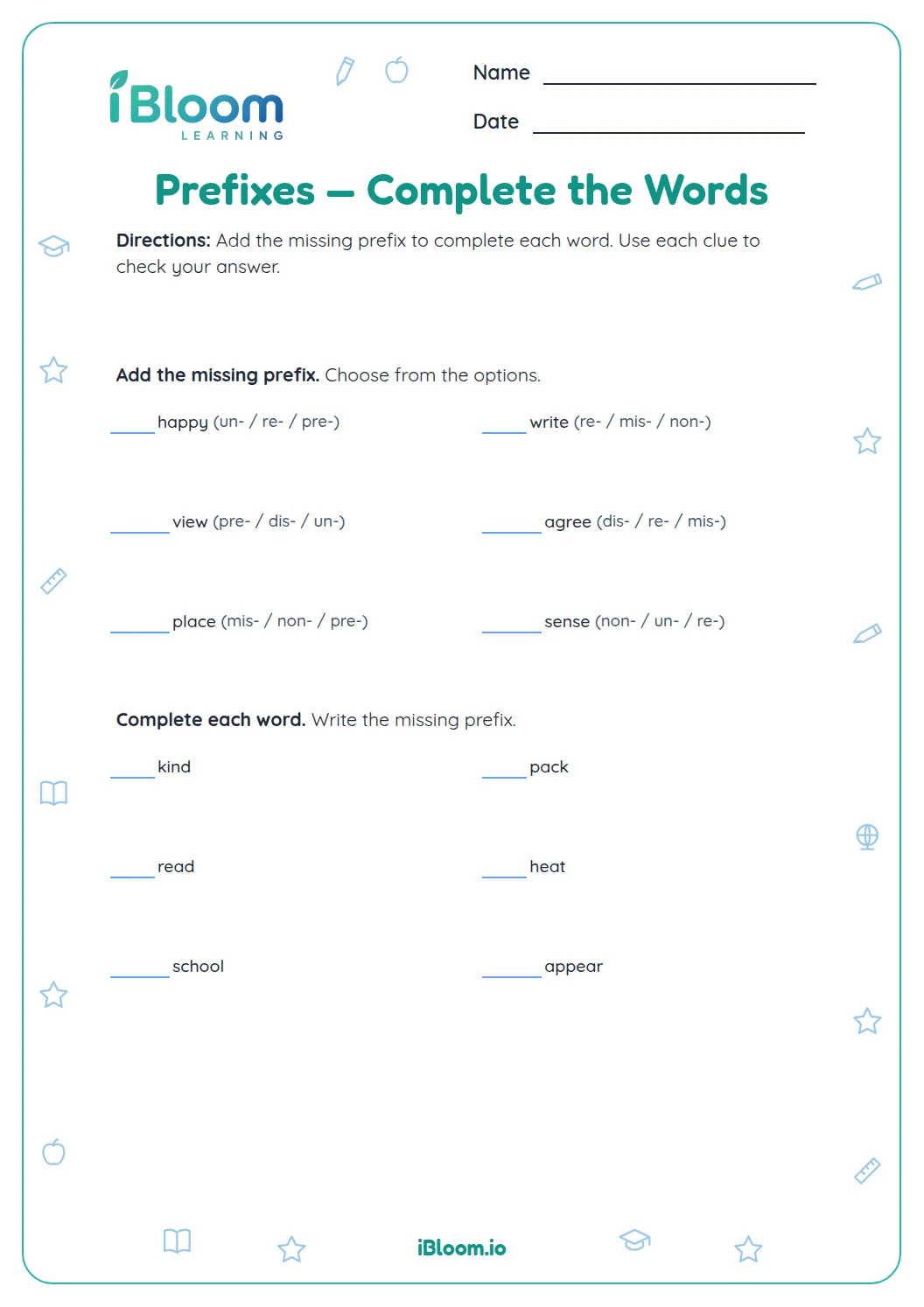
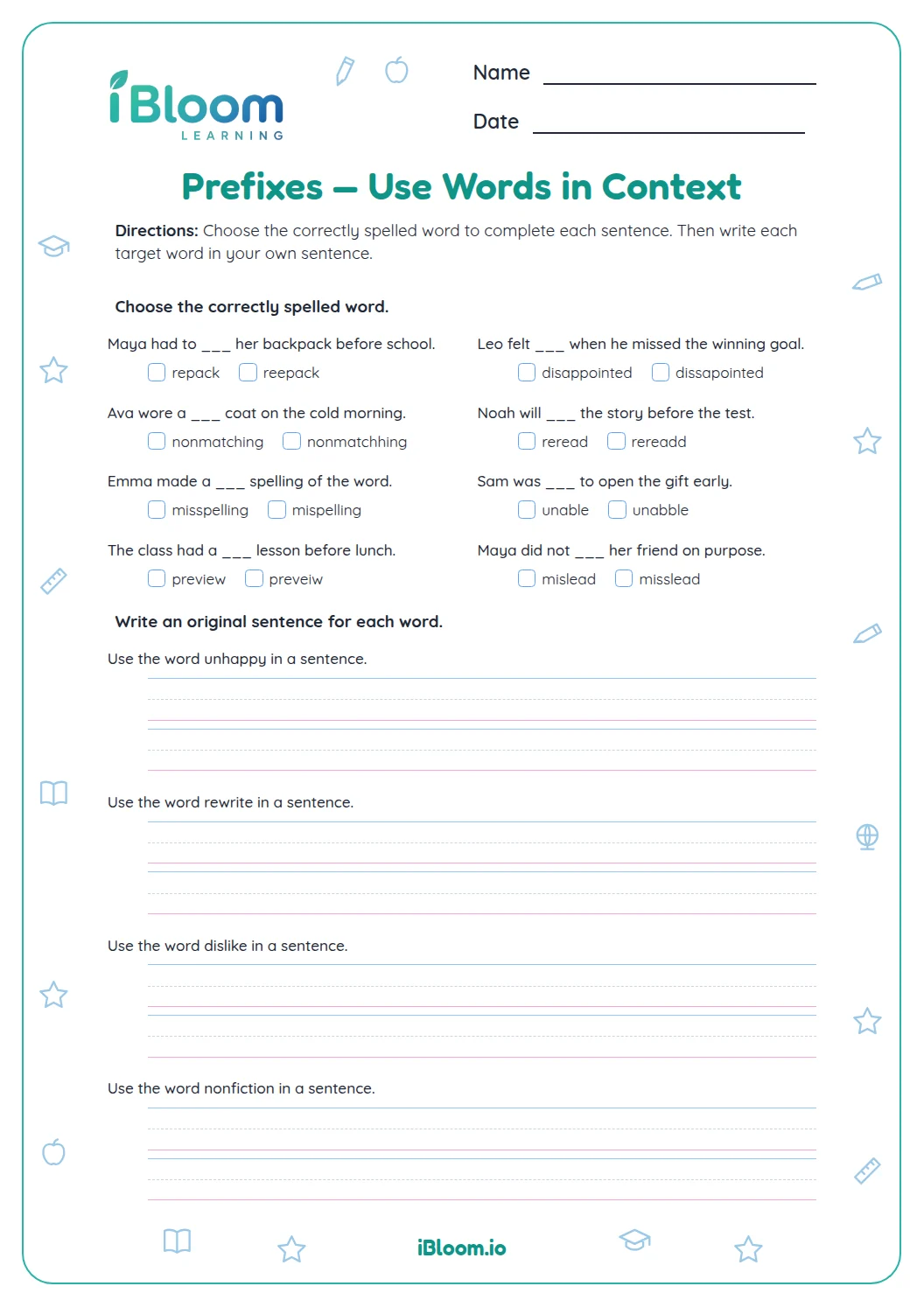
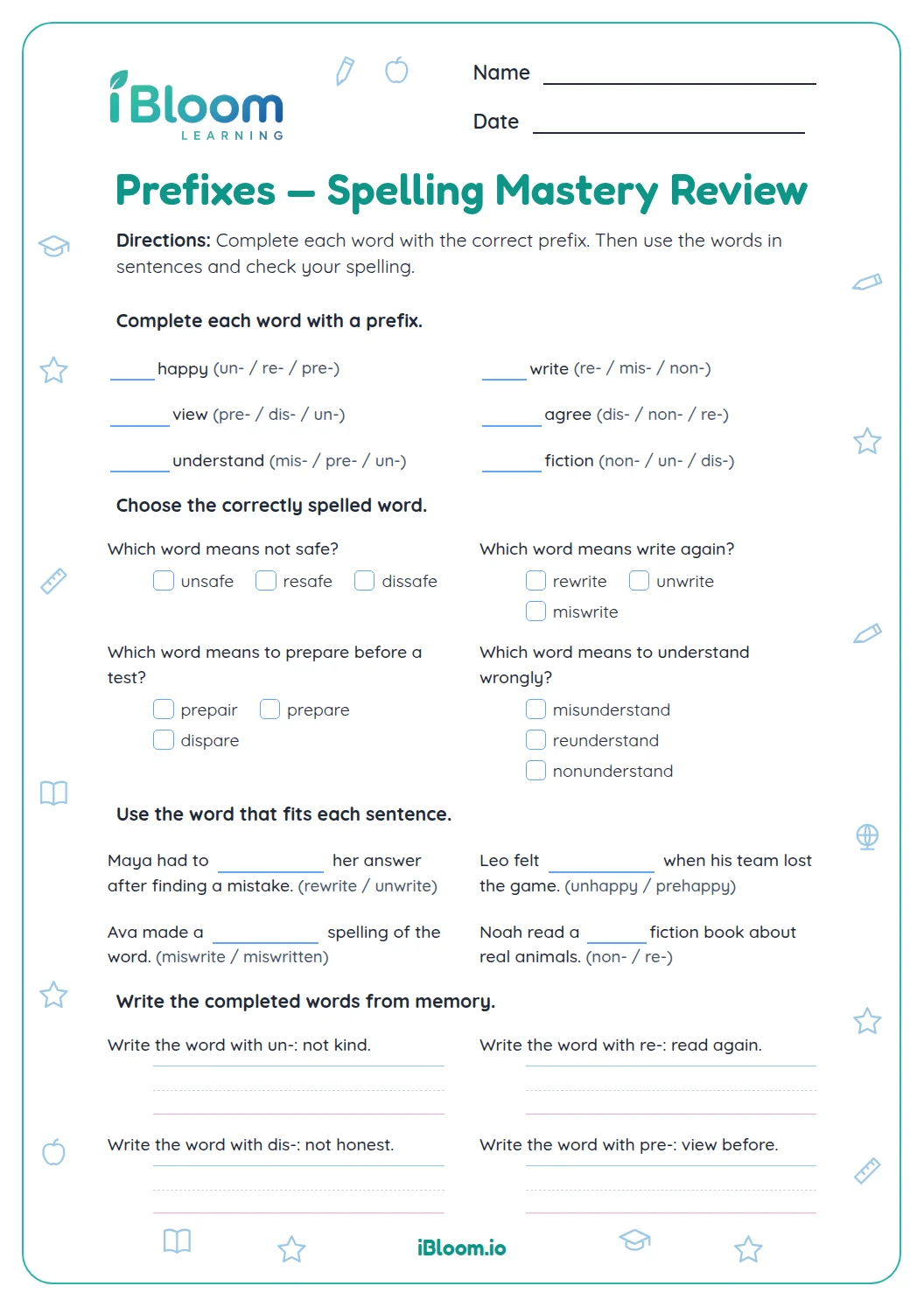
This free printable worksheet gives Grade 3 students practice with six common prefixes: un-, re-, dis-, mis-, non- and pre-. Children sort four words by their prefix, match four meanings to the correctly spelled word, join eight prefixes to base words, and finish four sentences with the right prefix word. It practices Common Core L.3.4.b and L.3.2.f, finding the meaning of a word with a prefix and spelling it correctly. The sheet has 2 pages with 20 questions, and a separate answer key.
Aligned to L.3.4.b and L.3.2.f
What is on this worksheet?
Four parts, each a different way to work with prefixes. Sorting and matching come first, where children recognize prefixes and meanings. The last two parts ask them to build and use words themselves.
All six prefixes appear in Part C, where children build preview, rebuild, unnatural, disappear, misplace, nonstop, unable and reuse. Part D then puts four prefix words, such as preheat and misspell, back into everyday sentences.
- Part A: color the prefix at the start of each word (questions 1 to 4)
- Part B: match a meaning to the correctly spelled word (questions 5 to 8)
- Part C: write the whole word from a prefix and base word, such as dis + appear (questions 9 to 16)
- Part D: choose the prefix word that completes a sentence (questions 17 to 20)
What do common prefixes mean?
Prefixes carry meaning. Un-, non- and dis- usually mean not or the opposite of, re- means again, mis- means wrongly, and pre- means before. Knowing these lets children work out a word they have not seen, such as unable or prewash.
Part B puts the meanings first. Children read “to read wrongly,” then look for the choice with mis-, which is misread. Spelling alternatives like unread and reread are real words with other meanings, so each one checks the reasoning.
- 15) to fill again → refill (re- means again)
- 26) not safe → unsafe (un- means not)
- 37) to read wrongly → misread (mis- means wrongly)
Does the spelling change when you add a prefix?
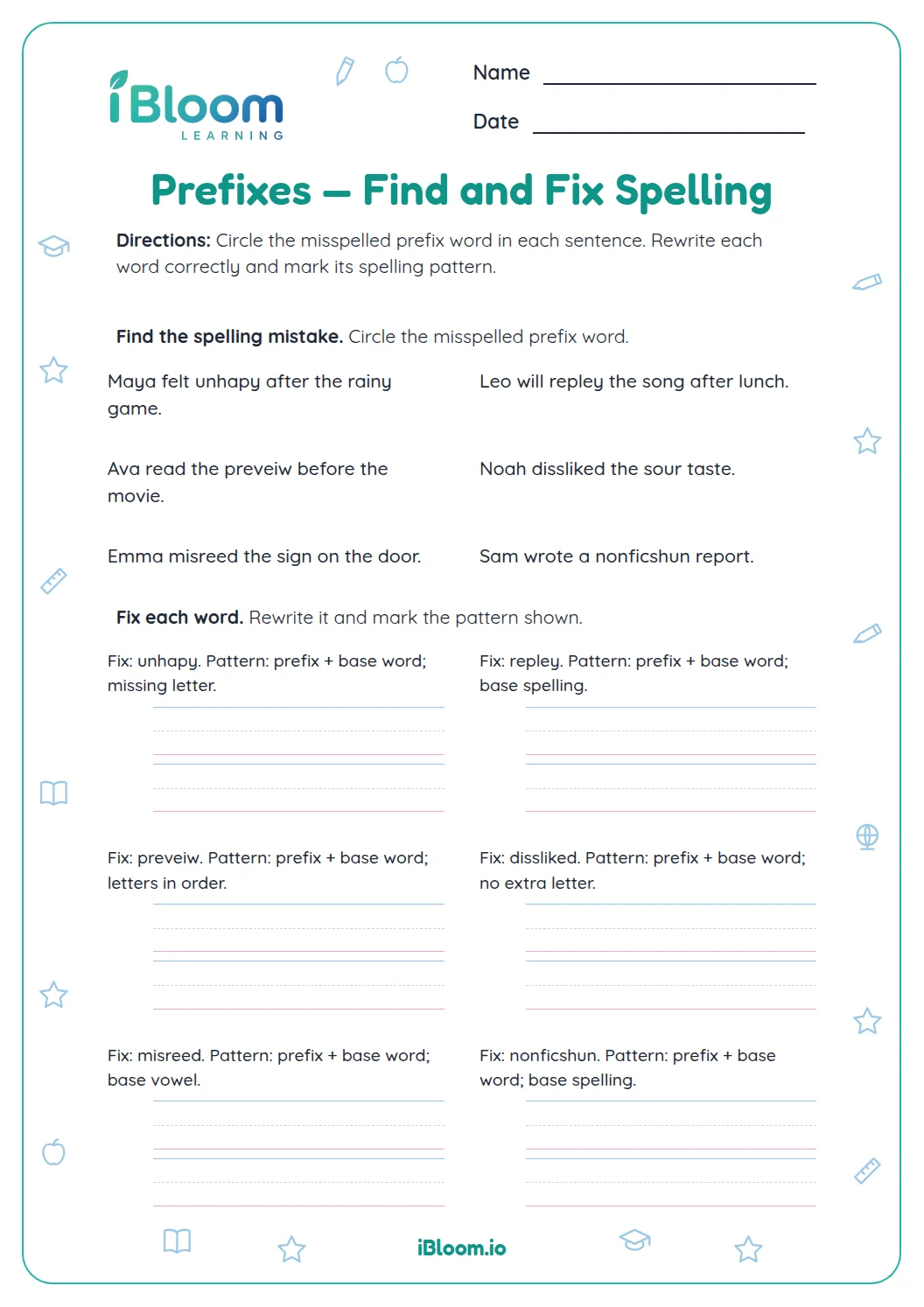
No. A prefix is added to the front without changing the base word, so every letter of both parts stays. This is why un + natural becomes unnatural with two n’s, and dis + appear becomes disappear with one p and one s in the middle.
Part C is built around this idea. Children write each whole word, then look at the join to check that no letter was dropped or doubled.
- 111) un + natural → unnatural (the n at the end of un and the n at the start of natural both stay)
- 212) dis + appear → disappear (not “dissappear”)
Why finish sentences with prefix words?
A word is only useful when it fits what you are saying. In question 17, “Please ___ the oven before you bake the cake,” preheat fits because pre- means before. Reheat would mean heat again, which does not fit.
Each sentence has one choice that works, plus two that are not words or not the right meaning, so children use meaning as well as spelling.
How to use this worksheet at home or in class
- 1Read the six prefixes aloud: un-, re-, dis-, mis-, non- and pre-. Say what each one means.
- 2Have your child complete Part A, then check with the key.
- 3For Part B, ask your child to say the meaning aloud and find the prefix that matches it before choosing a word.
- 4In Part C, tell your child to write both parts together and then read the whole word aloud.
- 5In Part D, read each sentence with each choice in the blank and decide which one makes sense.
- 6Ask your child to find two more prefix words in a book and use them in sentences of their own.
Common mistakes and quick fixes
The mistake
Doubling the s in disappear, writing “dissappear.”
The fix
Point out that dis- ends in s and appear starts with a, so no extra s is needed. Have your child write the two parts, then join them without adding letters.
The mistake
Dropping a letter from unnatural and writing “unatural.”
The fix
Show that un- ends in n and natural begins with n. Both letters stay, so the word has two n’s. Writing the parts separately before joining them helps.
The mistake
Mixing up mis- and dis-, such as choosing dis- for misbehave in Part A.
The fix
Say the word slowly and listen to the first sound. Dis- is for opposites (dislike), and mis- is for wrongly (misbehave means to behave wrongly).
Common Core alignment
Most US states teach spelling and word study with the Common Core language standards or a close state version. These Grade 3 standards fit the work on this sheet.
Work out the meaning of a word when a prefix is added to it.
On this sheet: Parts B and D ask children to match prefix words to their meanings and use them in sentences.
Show the official wordingHide the official wording
Determine the meaning of the new word formed when a known affix is added to a known word (e.g., agreeable/disagreeable, comfortable/uncomfortable, care/careless, heat/preheat ).
Use word parts and spelling patterns when writing words.
On this sheet: Part C has children write eight words by joining a prefix to a base word.
Show the official wordingHide the official wording
Use spelling patterns and generalizations (e.g., word families, position-based spellings, syllable patterns, ending rules, meaningful word parts ) in writing words.
What to practice next
Make more practice
Further reading
Questions parents and teachers ask
Which prefixes are on this worksheet?
The sheet uses un-, re-, dis-, mis-, non- and pre-. Part A sorts words with un-, dis-, mis- and non-, and the later parts use re- and pre- as well. In Part C each prefix appears at least once, so children get practice with all six.
What is the difference between dis- and mis-?
Dis- usually means not or the opposite of, as in dislike and disappear. Mis- means wrongly or badly, as in misbehave, misread and misplace. Both are sorted in Part A and used again in Parts B and C, so children can compare them side by side.
Why are some choices not real words?
Choices such as dissafe, nonsafe and unfill test whether children know which prefix fits which word. Others, such as unread and reread, are real words with different meanings. Children must match the meaning in the question with the prefix, not just pick a word that looks familiar.
Does a prefix change the spelling of the base word?
No, the base word keeps all of its letters. That is why un + natural is unnatural, with two n’s, and mis + place is misplace. Part C gives eight practice joins where children write the whole word, so they can check the letters where the two parts meet.
How should my child prepare for a spelling test using this sheet?
Have your child cover the answers and rewrite the eight Part C words from memory. Then say each word with its meaning, such as “unnatural means not natural” or “misplace means put in the wrong place.” Linking the prefix to its meaning makes the spelling easier to rebuild. The answer key shows every correct spelling for checking.
What should my child do after this worksheet?
Try the suffixes worksheets next, since they work in the same way at the end of a word. You can also ask your child to find prefix words in a favorite book and write them with their base words. Words such as unhappy, rebuild and preview are good starting points.