

About this worksheet
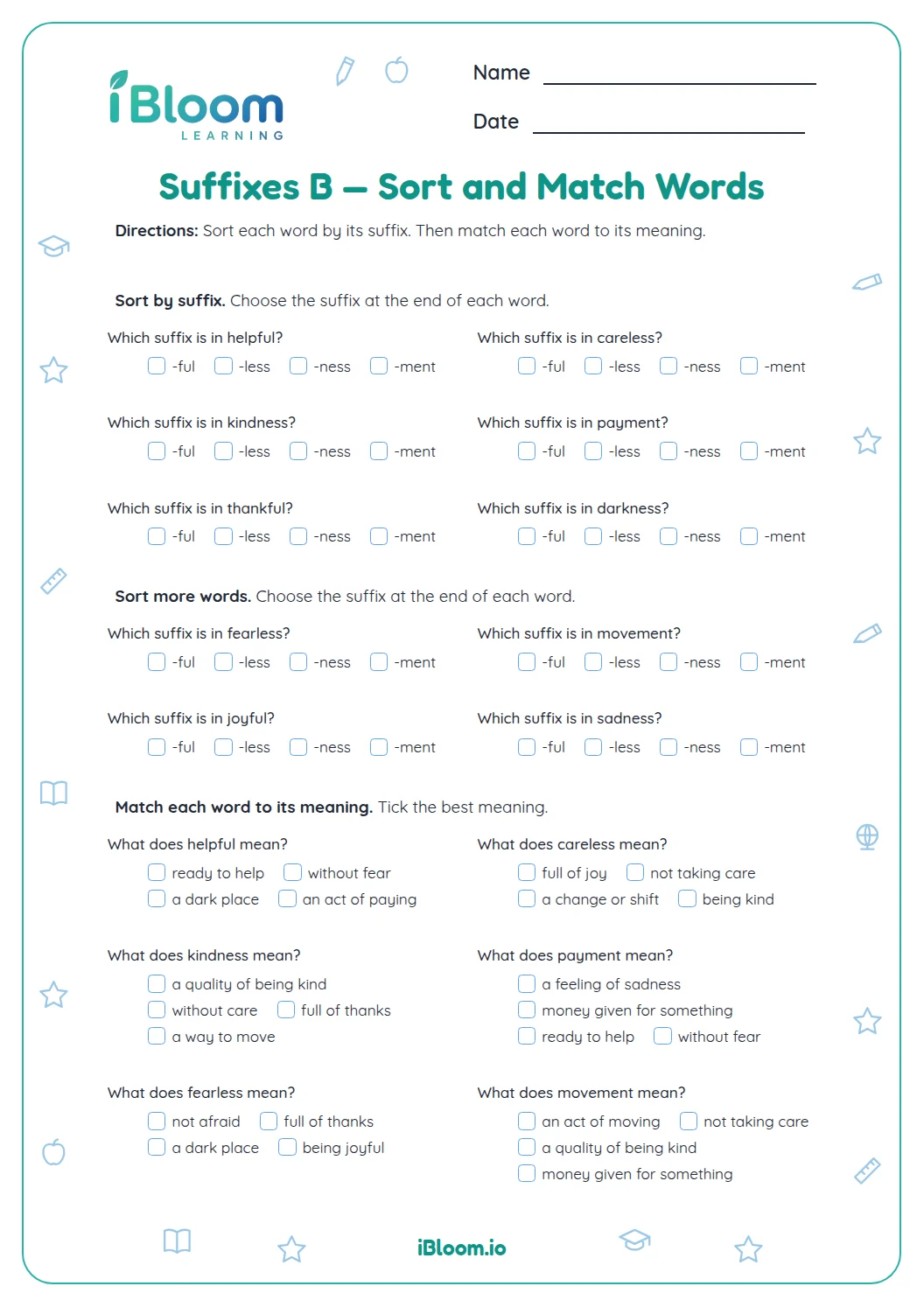
This free Grade 3 spelling worksheet has 16 questions on six common suffixes: -less, -ness, -ful, -ly, -er and -able. Students identify word endings, connect words to their meanings and spell new words. The two-page printable includes a separate answer key.
How can you spot a suffix?
Look at the end of a word and identify the letters added to its base. In careless, care is the base and -less is the suffix.
- 1care + -less = careless
- 2-less means “without.”
How does a suffix change meaning?
The ending can add an idea such as “without” (-less), “full of” (-ful), or “in a way” (-ly). A suffix can also form a person word, as -er does in teacher.
What spelling changes should children notice?
Keep the base word in view and check the ending rule. When happy takes -ness, change y to i: happiness. Read the new word to make sure its spelling looks and sounds right.
How to use this worksheet
- 1Read the whole word and find its ending.
- 2Name the base word before matching the suffix.
- 3Use the suffix meaning to check the new word.
- 4When building a word, check whether the base spelling changes.
- 5Read the finished word aloud and review each letter.
Common mistakes and quick fixes
The mistake
Choosing an ending because it looks familiar.
The fix
Use the word meaning and the suffix clue together.
The mistake
Writing happy + ness as happyness.
The fix
Change y to i before adding -ness: happiness.
The mistake
Adding an extra l to careful.
The fix
The suffix is -ful with one l at its start; careful has one l after the base.
What to practice next
Make more practice
Questions parents and teachers ask
Which suffixes appear on the sheet?
The worksheet uses -less, -ness, -ful, -ly, -er, and -able. Students identify each ending in a complete word, match selected words to meanings, and add suffixes to base words. The final choices check spelling patterns. The answer key lists the expected answer for every question.
What is the difference between a base word and a suffix?
A base word carries the main meaning, such as “care” or “kind.” A suffix is added at the end to make a related word: careless means without care, and kindness names the quality of being kind. Questions 9–14 ask students to build these forms.
Does spelling always stay the same when a suffix is added?
Some base words change spelling when an ending is added. For example, happy changes to happiness: the y becomes i before -ness. Question 15 asks students to recognize that spelling, while the other build-a-word items keep their base spelling.
How many questions are on the printable?
There are 16 questions in three parts. The first six ask students to identify suffixes, the next two connect words to meanings, and the final eight ask them to build or choose correctly spelled words. The worksheet and its answer key each use two pages.
What does -less mean in careless?
The suffix -less means “without,” so careless means without care. Compare it with careful: -ful means full of, so careful means showing care. Questions 7 and 8 use meaning clues to connect a suffix with the whole word.
How can I help my child check a word?
Ask your child to say the base word, point to the suffix, and read the new word aloud. Then discuss how the ending changes the meaning and check the spelling. For happiness, remind them to look at the y-to-i change before -ness.