

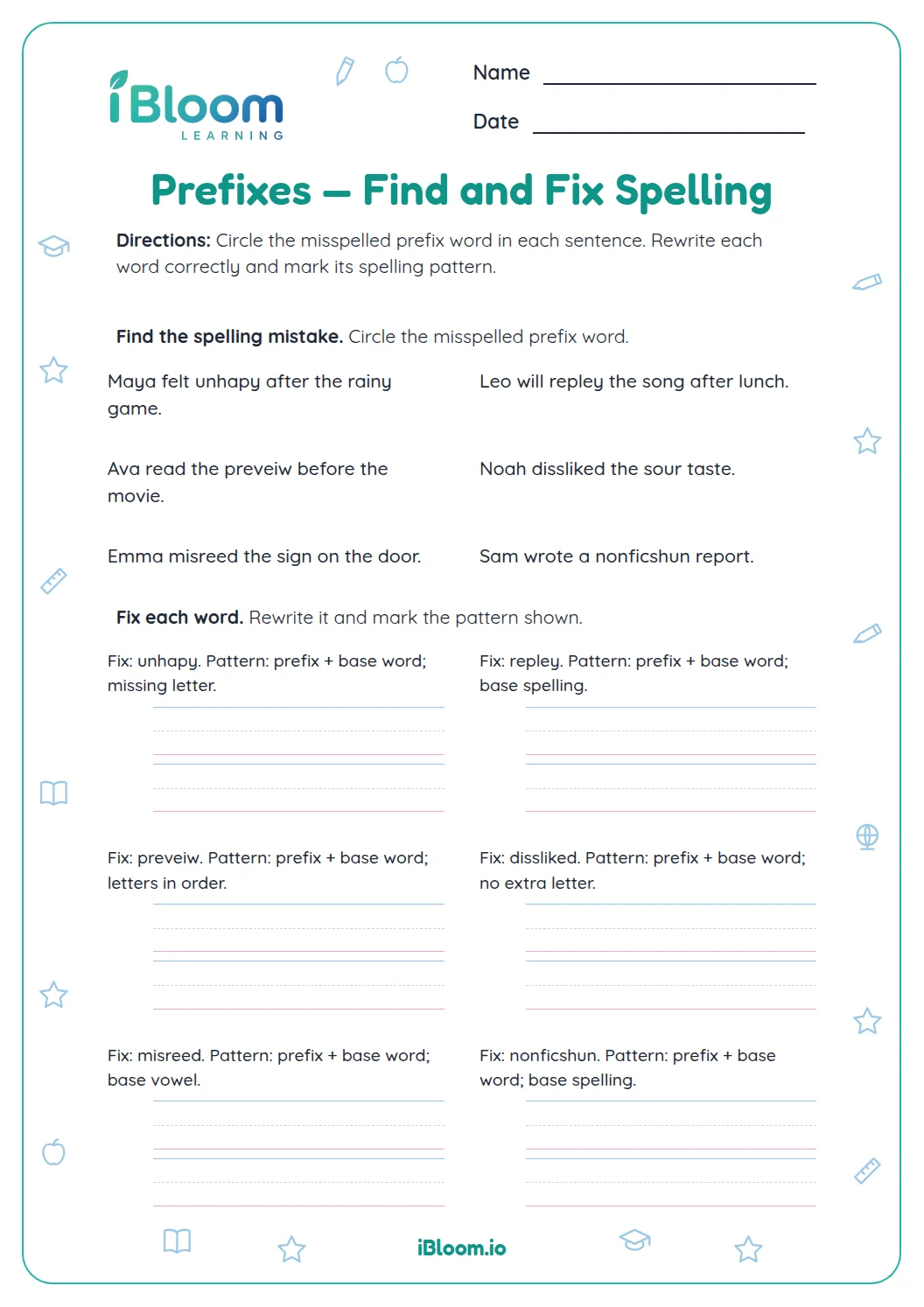
About this worksheet
This Grade 3 spelling worksheet gives students 16 sentences with a misspelled word to correct. The examples practice common suffixes such as -ing, -ed, -ful, -ly, -ness, -able, and -y, including changes like dropping a silent e or doubling a consonant. A separate answer key provides the corrected word for each sentence.
Aligned to L.3.2.e
What suffix patterns appear on the sheet?
Students correct 16 misspelled words in sentences. The set includes endings such as -ing, -ed, -ful, -ly, -ness, -able, and -y, with spelling changes to notice at the base-word boundary.
For example, hope + ing becomes hoping: drop the final silent e before adding -ing. The answer is not hopeing.
- Find a misspelled word in each sentence.
- Rewrite the corrected word in the answer space.
- Notice whether the base stays the same, drops e, doubles a consonant, or changes y.
How do you spell a word when adding a suffix?
Look at the base word before adding the ending. Some words keep the base intact, some drop a silent e before a vowel suffix, and some double a final consonant. The worksheet offers examples to compare.
How can students check the correction?
Read the corrected word in the sentence. Then separate the base and suffix aloud, such as hope + ful or plan + ing, and check that the spelling change matches the word.
How to use this worksheet
- 1Read the whole sentence and find the misspelled word.
- 2Say the base word and identify its suffix.
- 3Check for a final-e drop, consonant doubling, or y change.
- 4Write the corrected word clearly.
- 5Reread the sentence and compare with the answer key.
Common mistakes and quick fixes
The mistake
Keeping a silent e before a vowel suffix.
The fix
Drop the e in hoping and baking.
The mistake
Forgetting to double the final consonant.
The fix
Double it in running, stopped, and shopping.
The mistake
Adding an extra l to -ful words.
The fix
Remember that -ful has one l: careful, playful, hopeful.
Common Core alignment
This worksheet gives practice with use conventional spelling for studied words and for adding suffixes to base words.
Use conventional spelling for studied words and for adding suffixes to base words.
On this sheet: Use conventional spelling for studied words and for adding suffixes to base words.
Show the official wordingHide the official wording
Use conventional spelling for high-frequency and other studied words and for adding suffixes to base words (e.g., sitting, smiled, cries, happiness).
What to practice next
Make more practice
Further reading
Questions parents and teachers ask
What is a suffix?
A suffix is a group of letters added to the end of a base word to make a related word. This worksheet uses endings such as -ing, -ed, -ful, -ly, and -ness. Students correct the spelling of the word in each sentence.
Which spelling changes are practiced?
The sentences include dropping a final silent e before a vowel suffix, doubling a final consonant in words such as running, and keeping one l in words ending in -ful. Students also see endings such as -ness and -able in context.
Does this worksheet include an answer key?
Yes. A separate answer key lists the corrected word for each of the 16 sentences. Students can compare their spelling, then identify the base word and suffix to explain the change rather than memorizing each correction alone. It is useful to name the suffix before checking the spelling.
How can I teach the difference between hopeful and hoping?
Start with the base word hope. In hopeful, the suffix begins with a consonant, so the e stays. In hoping, -ing begins with a vowel, so the silent e is dropped. The worksheet includes both forms to compare. This is one example of how the ending affects the base.
How long does this spelling worksheet take?
Allow about 20 minutes for 16 corrections and a quick pattern check. Students can work through the sentences first, then revisit any word where the suffix changed the base spelling. The answer key supports review after the writing is complete.