
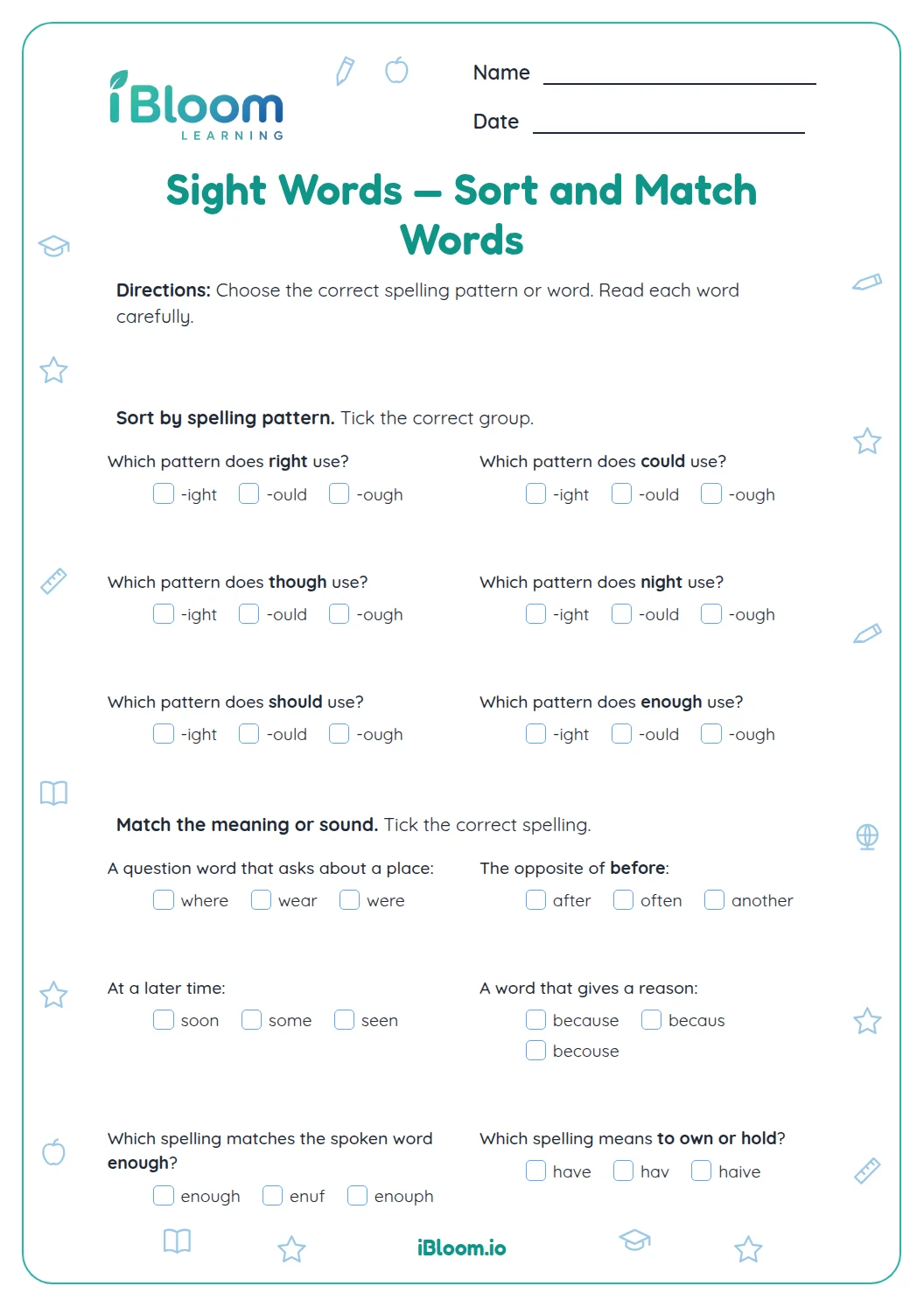


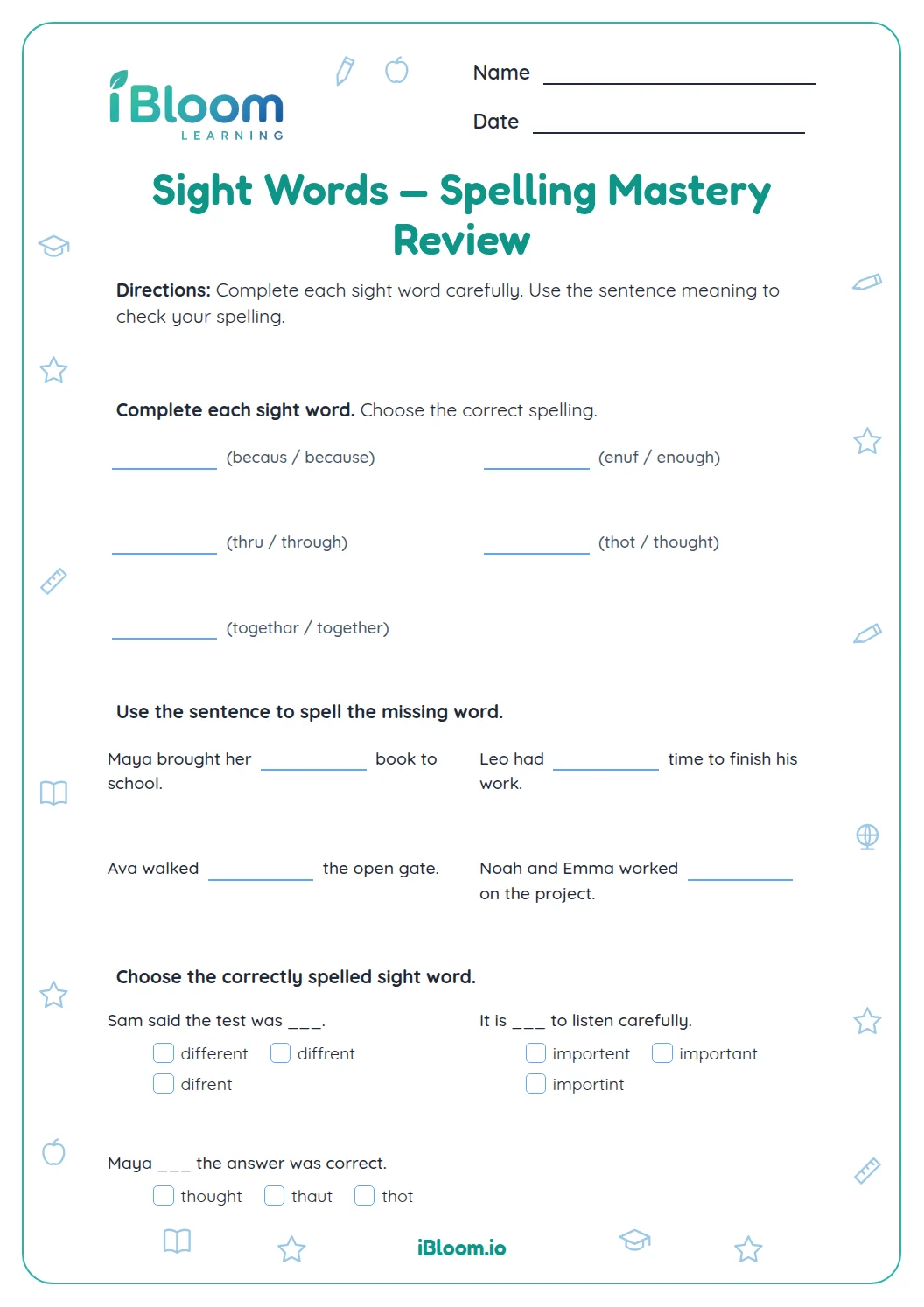

About this worksheet
This Grade 3 printable practices the spelling of 16 familiar sight words. Students choose missing letters for eight word patterns, then use sentence clues to complete eight more words. Every item leaves part of the word visible. The practice supports CCSS L.3.2.e through spelling high-frequency words, with a separate answer key for checking each letter group.
Aligned to L.3.2.e
What does this sight-word worksheet practice?
Part A offers two letter choices for each incomplete sight word. Part B leaves letters out of a word within a sentence, so students use both spelling and meaning.
All 16 answers are missing letters. Students read the completed words aloud after filling the blanks.
How can students check an incomplete word?
Try each letter choice in the gap and read the completed word. In Part B, read the sentence first, then check that the finished word fits its meaning.
- 1Question 1: bec___use → because
- 2The missing letter is a.
What comes after completing sight words?
Cover a completed word and try writing it from memory on scrap paper. Compare it with the worksheet, paying special attention to the letters that were missing.
How to use this worksheet
- 1Read the visible letters around the blank.
- 2In Part A, try both letter choices and write the correct group.
- 3In Part B, use the sentence and remaining letters to identify the word.
- 4Read each completed word aloud, then check the missing letters with the key.
Common mistakes and quick fixes
The mistake
Writing the whole word in a letter gap.
The fix
Keep the printed letters and add only the missing group.
The mistake
Reversing the middle letters in friend.
The fix
Read the completed word and check that i comes before e.
The mistake
Guessing a word from the sentence alone.
The fix
Make sure the guess also matches all the letters already printed.
Common Core alignment
Use conventional spelling to complete high-frequency words.
On this sheet: Students supply missing letters in high-frequency words, then read the completed spellings.
Show the official wordingHide the official wording
Use conventional spelling for high-frequency and other studied words and for adding suffixes to base words (e.g., sitting, smiled, cries, happiness).
What to practice next
Make more practice
Further reading
Questions parents and teachers ask
What do students write in the blanks?
Students write only the missing letters, not the whole word. The printed letters stay in place around each gap. Part A gives two choices for the missing group; Part B provides a sentence clue. Reading the completed word aloud is a useful final check.
How many questions are included?
There are 16 questions in two parts, with eight questions in each. The first part uses incomplete word patterns and letter choices. The second uses incomplete words in sentences. A separate answer key supplies the exact letter or letter group for every blank.
Why include sentences with the spelling words?
The sentences help students identify the intended word before completing its spelling. For example, a sentence about a path through the woods supports the incomplete word thr___gh. Students must still check the printed letters, then add the group that makes the complete word.
Can students say the words before writing?
Yes, students can say each word before filling its blank. Saying the word helps identify it, while looking at the letters helps check its spelling. If a word is unfamiliar, read it together, discuss its meaning, and then let the student complete the gap.
How should we review a missed answer?
Compare the missing letters with the key, then read the whole word again. Ask the student to point to the corrected letter group. For extra practice, cover the word and write it on scrap paper, then uncover it to check the complete spelling.