


About this worksheet
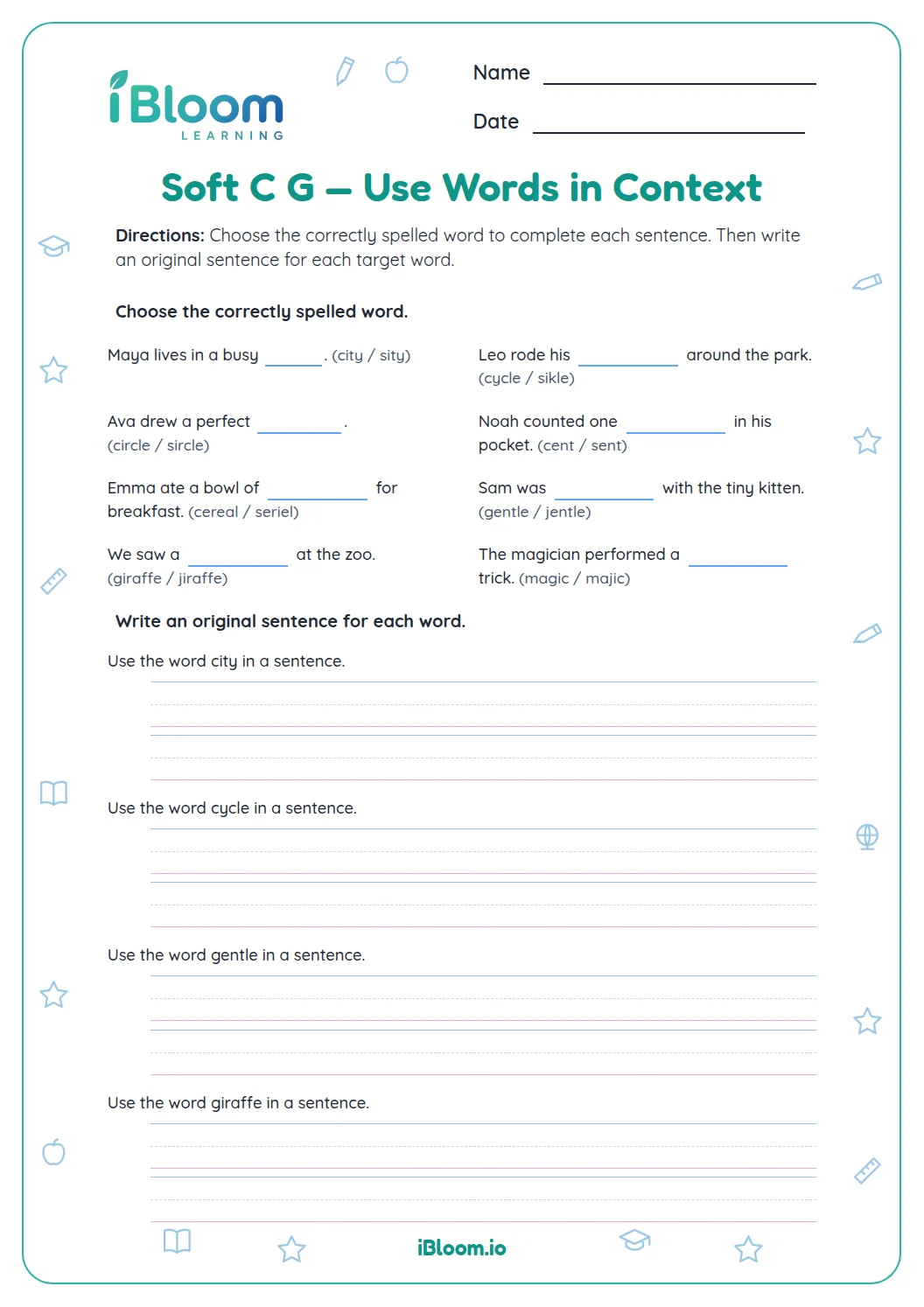
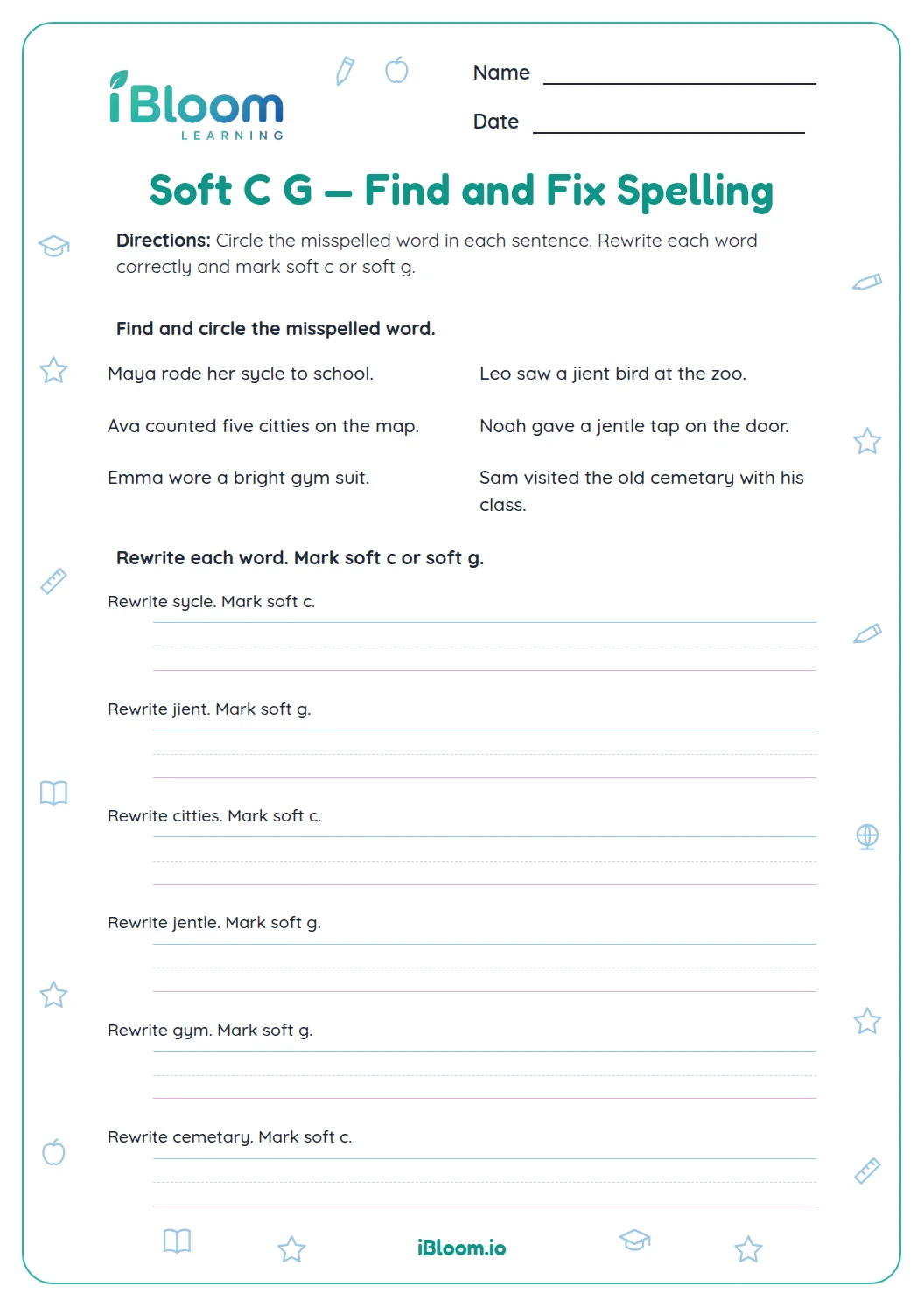
This free Grade 3 spelling worksheet connects soft letter sounds with spellings and meanings. Part A asks students to choose and write six words with soft c or soft g. Each pair uses the same starting letter, as in city and cat, so students must check its sound. Part B matches all six practice words with definitions. Part C asks children to restore a missing letter and write the whole word. The fourteen questions practice CCSS L.3.2f through spelling patterns and position-based spellings. A separate answer key supplies every word.
Aligned to L.3.2f
How can children tell soft c from soft g?
Say city slowly and listen to its first sound: /s/. Now say giant and listen for /j/. In these words, c and g have their soft sounds. Children then copy the word that fits the sound group named in each question.
In the six soft-sound answers, c or g comes before e, i or y. Compare each answer with its hard-sound partner: city and cat, for example. Check the spoken word as well as the following letter; gift starts with hard g even though i follows it.
How does the sound sort work?
Each Part A row names one soft-sound group and gives two words beginning with the same letter. Children say both words, select the one with the soft sound and copy it. The six answers are city, giant, cent, gentle, cycle and gym.
- 1Soft c (/s/): cycle or cake?
- 2Say cycle. The first c sounds like /s/.
- 3The c before y is soft; the later c before l is hard.
- 4Write cycle.
Why match meanings after sorting the sounds?
Part B matches all six practice words to meanings. A large town matches city, a repeating series matches cycle, and a room for indoor exercise matches gym. The choices include other practice words, so children need to use meaning as well as pronunciation.
Part C returns to spelling. Children complete _ent and _ym, then write cent and gym in full. The meaning clues distinguish the intended word and encourage children to read what they wrote.
Say, sort and spell
- 1Say city and giant aloud to establish the two soft sounds.
- 2In Part A, read the requested sound group before comparing the words.
- 3Copy the chosen word carefully and underline its soft c or g.
- 4Read each meaning in Part B and test all three word choices.
- 5For Part C, fill the missing letter mentally, then write the whole word.
- 6Check with the key and say each corrected word aloud.
Mistakes to notice and how to help
The mistake
Choosing cat for soft c because it starts with c.
The fix
Say both words: cat starts with /k/, while city starts with /s/. The question asks for the soft sound.
The mistake
Assuming both c letters in cycle have the same sound.
The fix
The first c before y is /s/; the second c before l is /k/. Sort by the soft c at the start.
The mistake
Writing only c for the final cent question.
The fix
The direction asks for the whole word. Add c to ent and write cent.
Curriculum alignment
Use soft c and g patterns to sort words and write their complete spellings.
On this sheet: Students copy words by sound group and use letter-position patterns to complete cent and gym.
Show the official wordingHide the official wording
Use spelling patterns and generalizations (e.g., word families, position-based spellings, syllable patterns, ending rules, meaningful word parts) in writing words.
What to practice next
Make more practice
Further reading
Questions parents and teachers ask
Which words does the worksheet use?
The six practice words are city, giant, cent, gentle, cycle and gym. Part A pairs each with a word that starts with the same letter but has a hard sound. Part B matches all six to meanings. Part C asks students to complete and write cent and gym.
Does c or g always have a soft sound before e, i or y?
The following letter is a clue, but students also need to say the word. City, cent and cycle begin with soft c; giant, gentle and gym begin with soft g. In question 6, gift has hard g even though i follows it, while gym has soft g.
Why is cycle in the soft c group?
Cycle begins with a c that sounds like /s/, followed by y. Its second c sounds like /k/. The sort focuses on the soft sound at the start of the word. Saying the two syllables slowly helps children hear that one spelling can contain both c sounds.
Do students draw matching lines in Part B?
Students choose a word from three options for each meaning. For example, the meaning a large town matches city, and kind and careful matches gentle. The format keeps each match in its own question so students can read, decide and check one meaning at a time.
How can I review a wrong spelling without giving the answer?
Ask your child to say the word, listen for its first sound and look at the letter that follows the blank. Then have the child write the complete word and compare it with Part A. For gym, the /j/ sound and following y support choosing g.