




About this worksheet
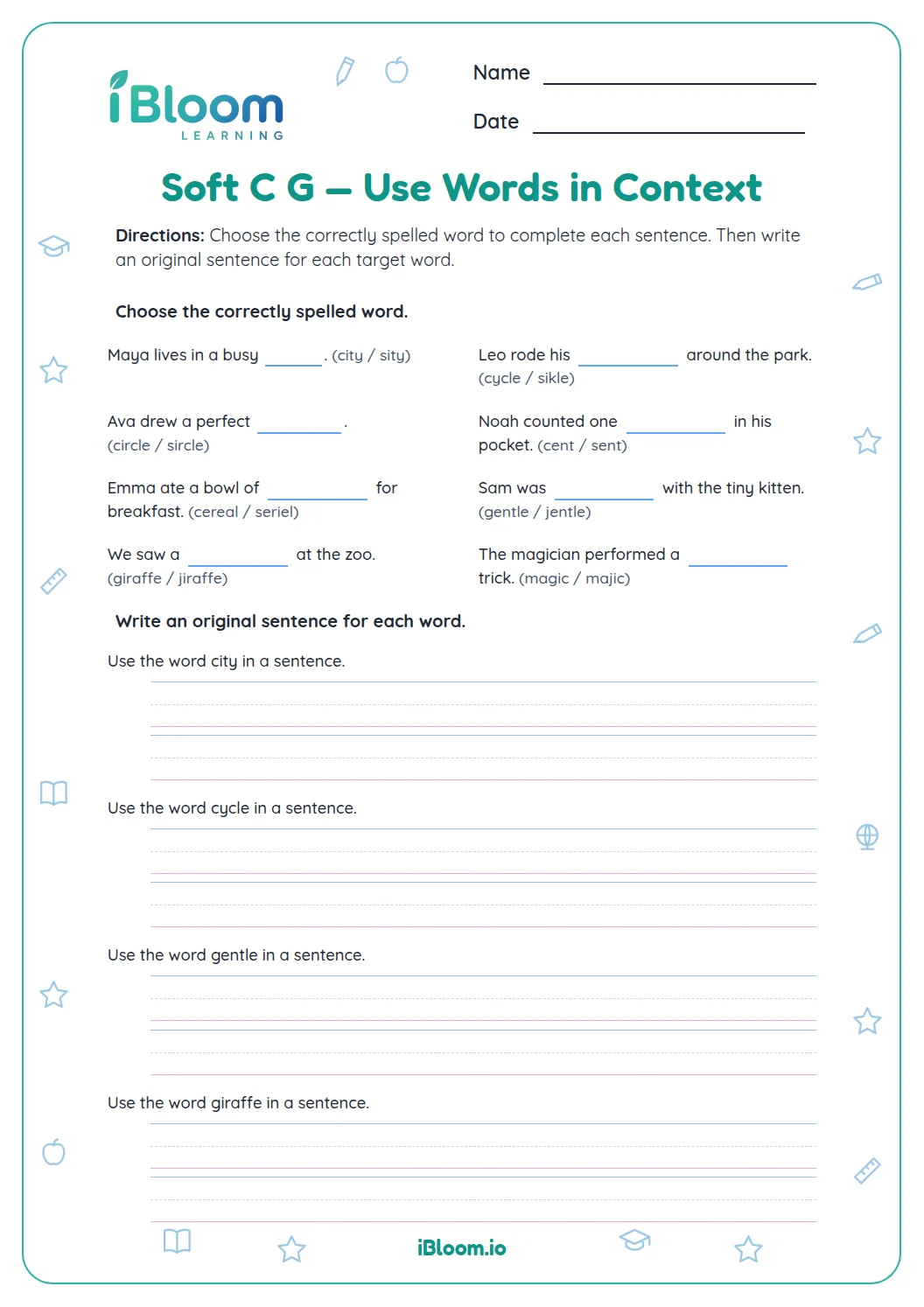
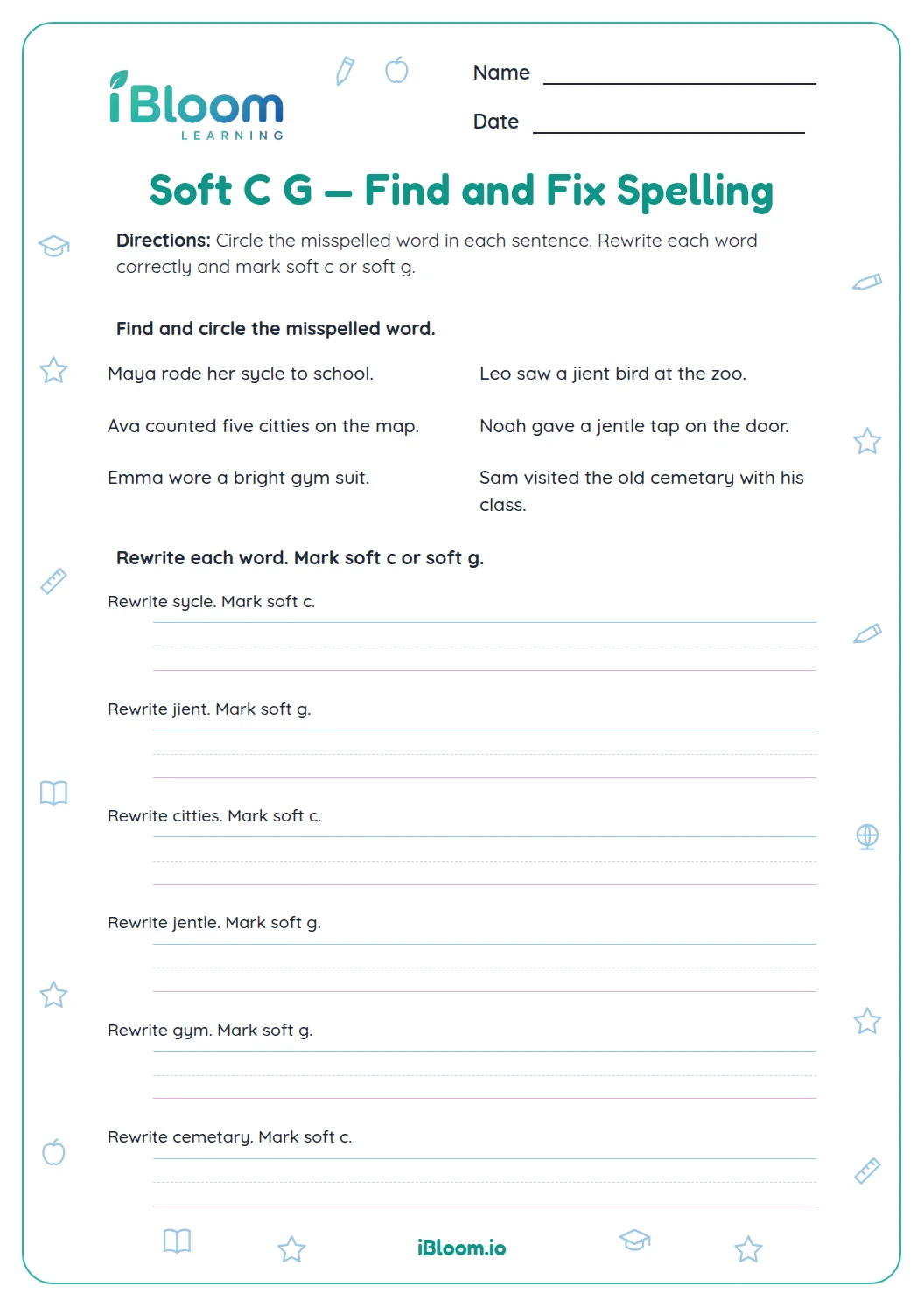
This Grade 3 spelling worksheet gives children 22 sentence blanks to complete with words that show soft c or soft g. Context supports the spelling choice, and a separate answer key lists each word. The practice connects to CCSS L.3.2, applying standard English spelling conventions while writing.
Aligned to L.3.2
When does c make a soft sound?
A c before e, i, or y often sounds like /s/. In city, the c comes before i; in circle, it comes before i as well.
Question 1 reads “The ___ity has a new park.” The complete word is city, so the missing beginning is ci.
- 1The ___ity has a new park.
- 2c before i sounds like /s/.
- 3The completed word is city.
When does g make a soft sound?
A g before e, i, or y often sounds like /j/. Gentle has g before e, giant has g before i, and gym has g before y.
How does context help with spelling?
Read the full sentence to identify a word that makes sense, then check its spelling pattern. “We saw a ___iant drum” points to giant; the g is followed by i and has its soft sound.
How to use this worksheet
- 1Read the full sentence before filling the blank.
- 2Choose a word that makes sense in context.
- 3Check whether c or g comes before e, i, or y.
- 4Say the soft sound and spell the whole word.
- 5Reread the completed sentence.
- 6Check each spelling with the key.
Common mistakes and quick fixes
The mistake
Choosing a hard sound for c or g
The fix
Look at the next letter; e, i, and y often signal the soft sound.
The mistake
Writing only the missing letter when the prompt needs a word
The fix
Write the whole word so the sentence is complete.
The mistake
Ignoring how the sentence makes sense
The fix
Read the sentence aloud and select the word that fits its meaning.
Common Core alignment
This worksheet gives focused practice with the standard below.
Soft c or g often appears before e, i, or y.
On this sheet: The questions directly practice this skill.
Show the official wordingHide the official wording
Demonstrate command of the conventions of standard English capitalization, punctuation, and spelling when writing.
What to practice next
Make more practice
Further reading
Questions parents and teachers ask
What makes c or g soft?
The letters c and g often have a soft sound before e, i, or y. In city, c is before i and sounds like /s/; in gentle, g is before e and sounds like /j/. Read each sentence for meaning as you fill in the missing word.
How many words are on the worksheet?
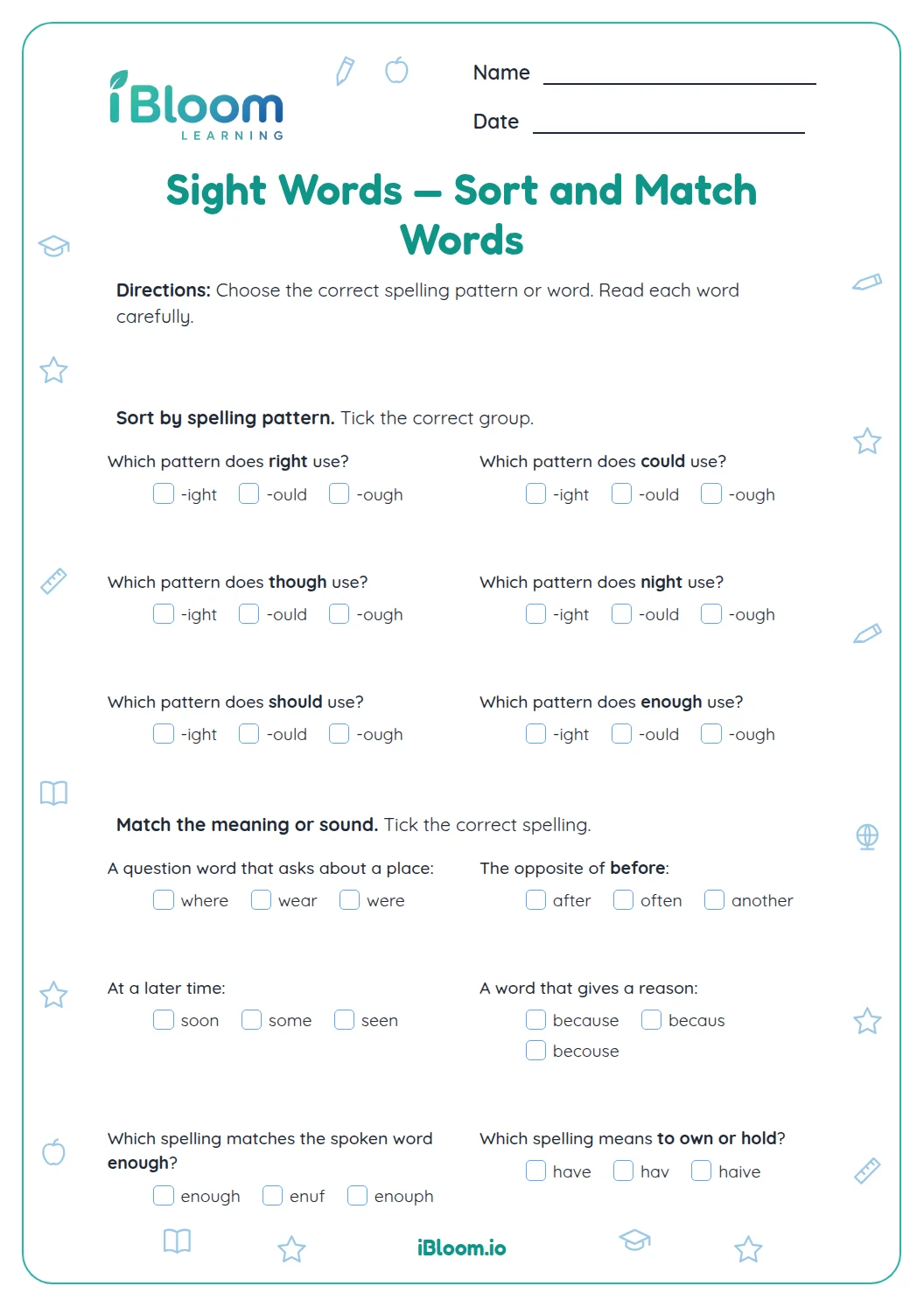
There are 22 sentence-completion questions divided into two parts across two worksheet pages. The words include examples of soft c and soft g, and each appears in a short context sentence. The answer key takes two pages and lists each completed word.
What is a soft c example?
City is an example: c is followed by i and sounds like /s/. Circle and cent give learners more chances to notice c before i or e. The sentences provide context for choosing the full word and writing its correct spelling.
What is a soft g example?
Gentle is an example: g is followed by e and sounds like /j/. Giant and gym show the same sound before i and y. Read the word aloud and notice how the next vowel letter relates to the sound of g.
How can a child check a spelling?
Read the completed sentence and sound out the word. Check whether c or g comes before e, i, or y, then compare the word with the answer key. Context and the spelling pattern work together to confirm the choice and help the learner remember the correct spelling.