





About this worksheet
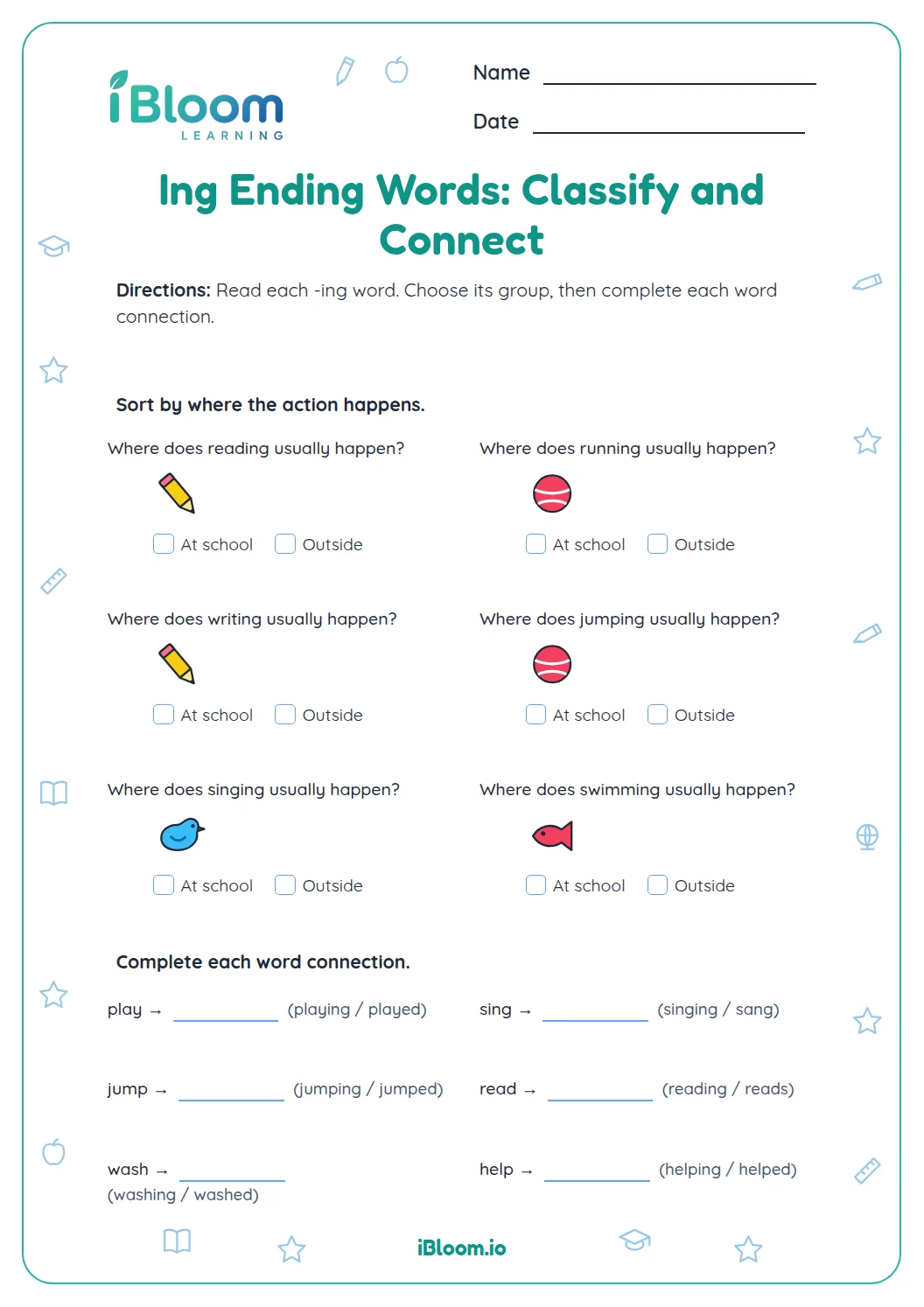
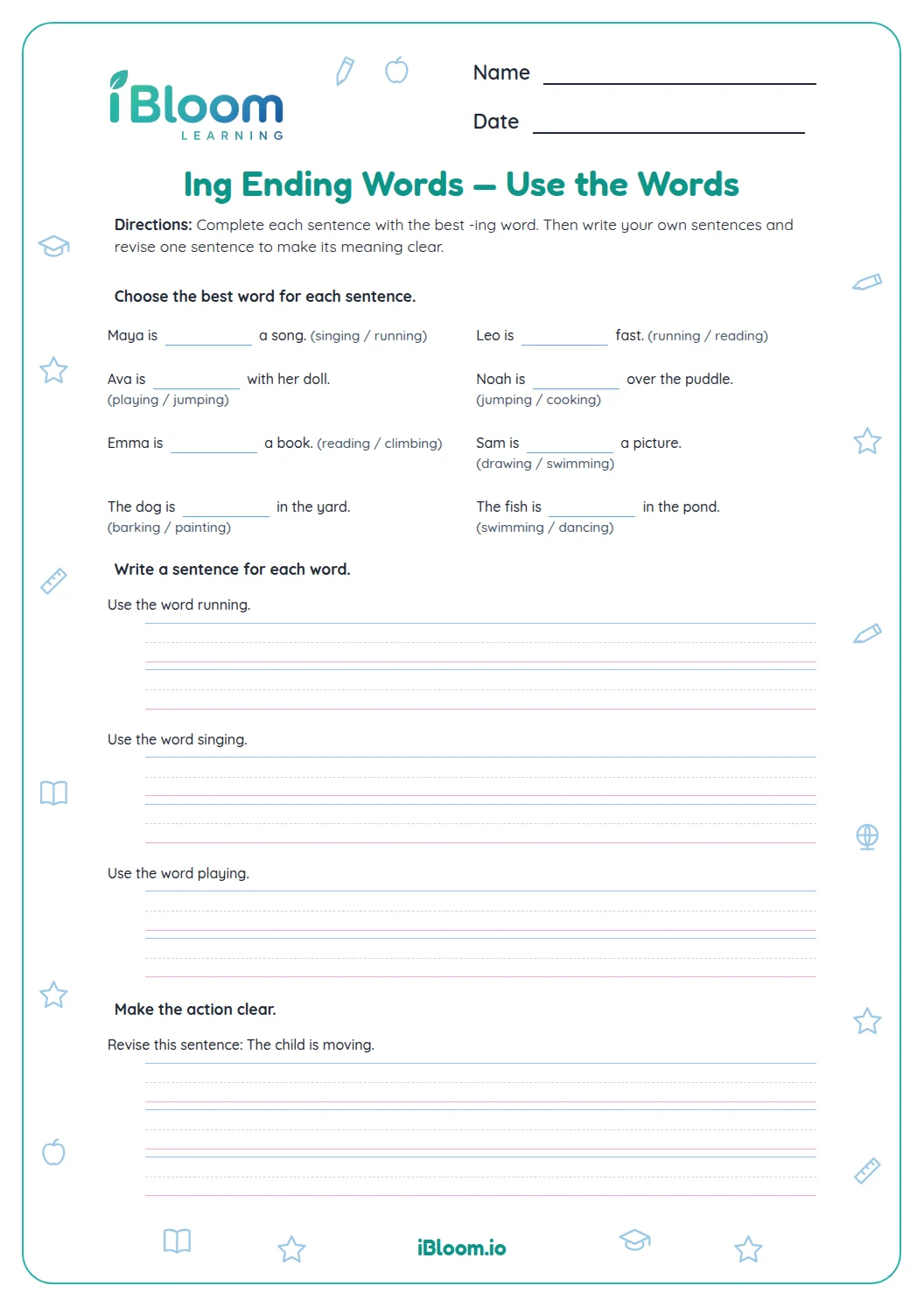
This two-page Grade 1 worksheet connects familiar words ending in -ing with their meanings and spelling. In Part A, students use sentences to choose words such as jumping, singing, and reading. Part B practices adding -ing to bake, ride, make, and smile. Part C asks students to match short action clues with words such as dripping and clapping. The key gives the correct word for each of the 16 questions. It supports CCSS L.1.4.a by using sentence context to clarify word meaning.
Aligned to L.1.4.a
What is on the -ing worksheet?
The 16 questions move from choosing familiar words to building and interpreting them. Part A has eight sentence choices, Part B has four spelling prompts, and Part C has four action clues.
Students use context to connect each word with an action. The spelling practice also highlights the silent-e pattern: remove the final e before adding -ing, as in bake → baking.
- Part A: choose the -ing word that fits eight sentences
- Part B: build four words by adding -ing
- Part C: choose a word that names each of four actions
How do sentence clues help identify an action?
Read the words around the blank and picture the action they describe. A frog going over a log is jumping; someone using a brush to make a picture is painting. Try each choice in the sentence and keep the one that matches the clue.
- 1The frog is ___ over the log.
- 2The clue “over the log” describes a jump.
- 3Answer: jumping
How do you add -ing to a silent-e word?
For bake, ride, make, and smile, drop the final e before adding -ing: bake becomes baking. Say the base word, notice the final e, then write the new form. Part B practices this spelling pattern directly.
How to work through the worksheet
- 1Read the full sentence, including the words after the blank.
- 2Picture the action described by the clue.
- 3Try each choice and reread the sentence with the word in place.
- 4For Part B, drop final e before adding -ing.
- 5Check the answer key and read each completed sentence aloud.
Common mistakes and quick fixes
The mistake
Choosing an action that does not fit the sentence.
The fix
Use the clue around the blank; a frog going over a log is jumping.
The mistake
Keeping the final e in bakeing.
The fix
Drop the silent e before adding -ing: bake becomes baking.
The mistake
Confusing the base word with the -ing form.
The fix
Check that the answer names the action in the form the sentence needs, such as is singing.
Common Core alignment
This worksheet practices skills described in these grade-level language or reading standards.
Use sentence-level context as a clue to the meaning of a word or phrase.
On this sheet: Students use sentence clues to choose a word that names the action.
Show the official wordingHide the official wording
Use sentence-level context as a clue to the meaning of a word or phrase.
What to practice next
Make more practice
Questions parents and teachers ask
What does -ing mean in these words?
The ending -ing helps form a word that names an action, as in jumping or reading. The worksheet asks children to use sentence clues to connect each form with what someone is doing. Part B also practices spelling when the base word ends in silent e.
Why does bake become baking?
Use splashes when one person or thing does the action in the present, as in “The duck splashes in the pond.” With I, you, we, or they, use splash: “We splash near the shore.” The sentence subject helps determine the form.
What kinds of clues are on the page?
Some clues describe a scene, such as a frog going over a log or a person using a brush. Others name an action directly, such as water falling one drop at a time. Students match the clue to an -ing word.
How many questions are included?
Some clues describe a scene, such as a frog going over a log or a person using a brush. Others name an action directly, such as water falling one drop at a time. Students match each clue to an -ing word that names the action.
How can I help a child use context?
There are 16 questions on two worksheet pages: eight sentence choices, four word-building items, and four action clues. The separate answer key gives a short answer for each item, making it easy to review word meaning and spelling together at home.