




About this worksheet
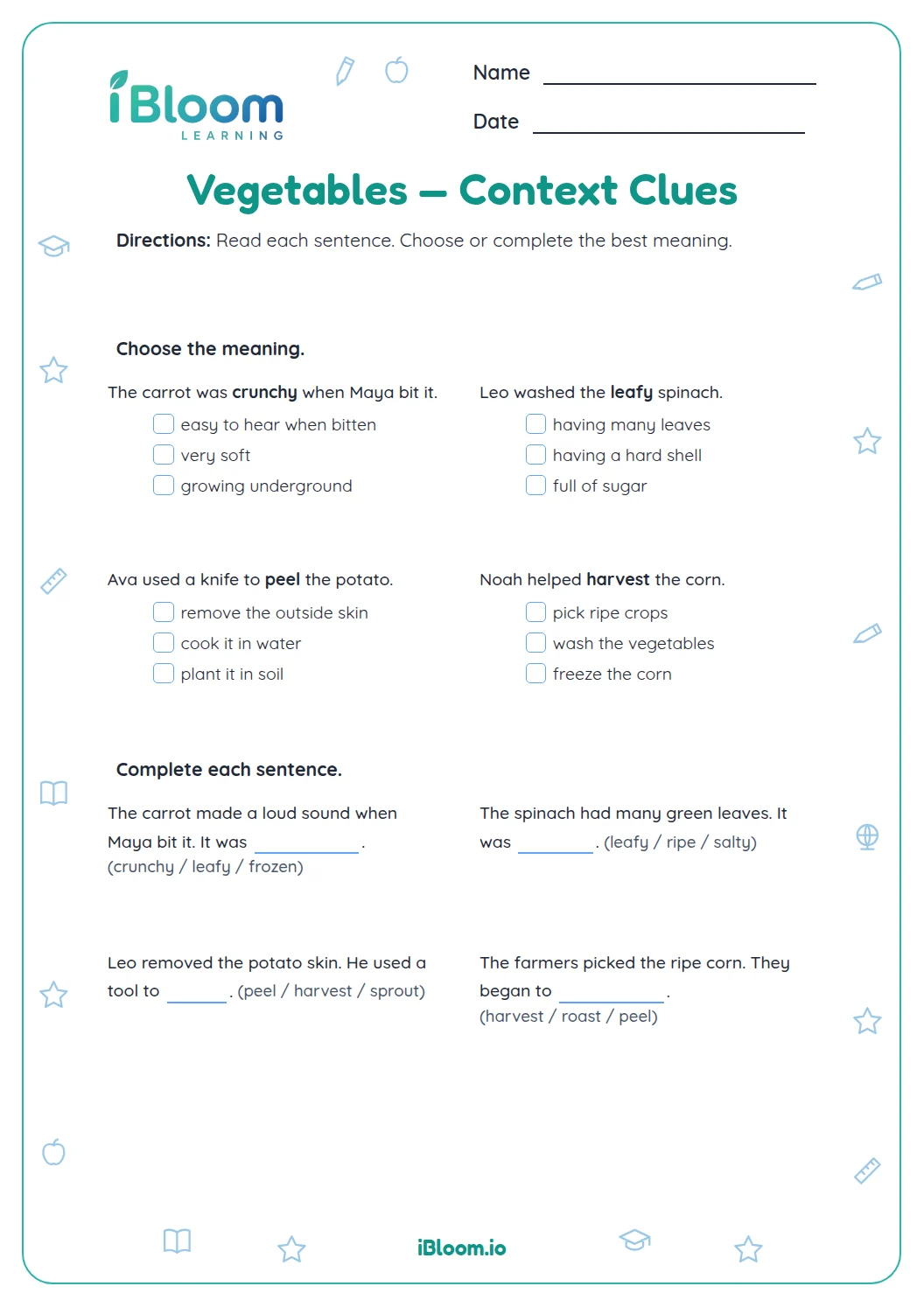
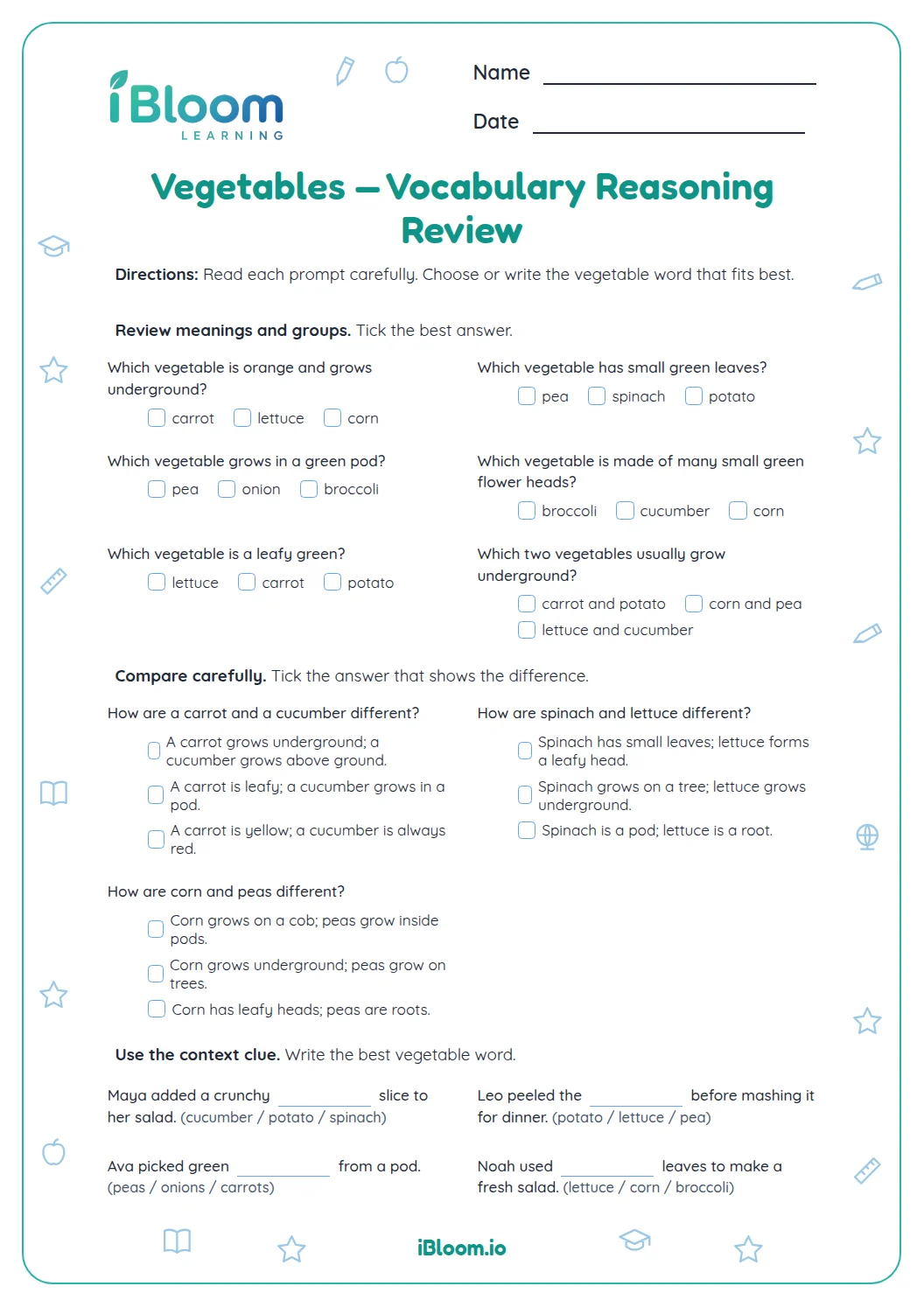
This Grade 1 vegetable word search includes two grids and 18 activities. Children find familiar vegetable names, connect each word to a descriptive clue, and complete short sentences using the search words. The classification work practices Common Core L.1.5a, sorting words into categories. A separate answer key lists the search words and clue answers.
Aligned to L.1.5a
What will children find in the grids?
Each grid contains six vegetable names written across or down. Children can scan rows and columns, marking each complete word on the list. Carrot and broccoli appear in both grids for extra recognition practice.
How do clues help sort the vegetable words?
A clue points to a familiar feature, such as leafy, kernels, or florets. Children match each description to one word in the puzzle list. This links the spelling they spotted in the grid to the meaning of the word.
- 1Which one is a leafy vegetable?
- 2Look for a leafy vegetable in the word list.
- 3Answer: lettuce
How does the last part use the word list?
Short sentence clues ask children to recall a vegetable name and place it in a sentence. The word list gives a spelling reference, while the clue gives the meaning.
How to use this worksheet
- 1Read the word list before searching.
- 2Scan across one row at a time and mark words you find.
- 3Search down the columns for any words still missing.
- 4For each clue, say the feature and choose a matching vegetable.
- 5Use the word list to spell the vegetable that completes a sentence.
Common mistakes and fixes
The mistake
Marking a group of letters that does not make a full word.
The fix
Check each letter in order against the word list.
The mistake
Mixing up vegetable names with similar colors.
The fix
Use the whole clue, not color alone, to pick a match.
The mistake
Writing a food that is not one of the search words.
The fix
Reread the puzzle list and find the vegetable name there.
Common Core alignment
Sort familiar words into groups by what they name.
On this sheet: Children group familiar vegetable names by shared features and clues.
Show the official wordingHide the official wording
Sort words into categories (e.g., colors, clothing) to gain a sense of the concepts the categories represent.
What to practice next
Make more practice
Further reading
Questions parents and teachers ask
How many vegetable words are in the puzzles?
There are two grids with six vegetable names each. Carrot and broccoli appear in both grids, so children can practice finding those familiar words again while searching for different vegetables too. Point to the matching puzzle word and ask how its letters and clue connect to the vegetable.
Which directions do the words go?
The vegetable names run across or down in the grids. Children can scan one row at a time, then look down each column and mark a word when all its letters are found. Point to the matching puzzle word and ask how its letters and clue connect to the vegetable.
What does classify mean here?
Classifying means putting words together because they share a feature. The clue questions ask children to connect vegetables with familiar traits, such as leafy lettuce, kernels of corn, or the florets on broccoli. Point to the matching puzzle word and ask how its letters and clue connect to the vegetable.
Are the word search words also used in the clues?
Yes. Eight clue questions and eight sentence blanks use words from the two grids. This gives children a chance to see the vegetable names again and connect spelling with meaning. Point to the matching puzzle word and ask how its letters and clue connect to the vegetable.
Can a child use a different answer in a blank?
The blanks have a target word from the puzzle list, shown in the answer key. If a child supplies another vegetable that fits the clue, talk about whether the clue distinguishes that answer; the printed key follows the most direct match. Point to the matching puzzle word and ask how its letters and clue connect to the vegetable.
Is an answer key included?
Yes. The key page lists the words to find and the answers to the clue and sentence questions. Children can compare their marked grids with the word list after finishing each puzzle. Point to the matching puzzle word and ask how its letters and clue connect to the vegetable.