







About this worksheet
This free Grade 1 printable combines a vegetable word search with vocabulary practice. Students find eight words, match vegetable names to clues, and complete sentences using meaning and context. The 17 questions build word recognition and use in simple sentences, aligned with Common Core L.1.6. The answer key lists each word and the intended sentence response.
Aligned to L.1.6
Which words should students find?
The word search includes eight familiar vegetable names. Each appears across one row, so readers can scan from left to right while matching letters to the list. After finding a word, have the child point to each letter in order before circling it.
- 1A rabbit may nibble a crunchy orange ___.
- 2The clue “crunchy orange” points to carrot.
- Part A: find 8 words in the grid (1)
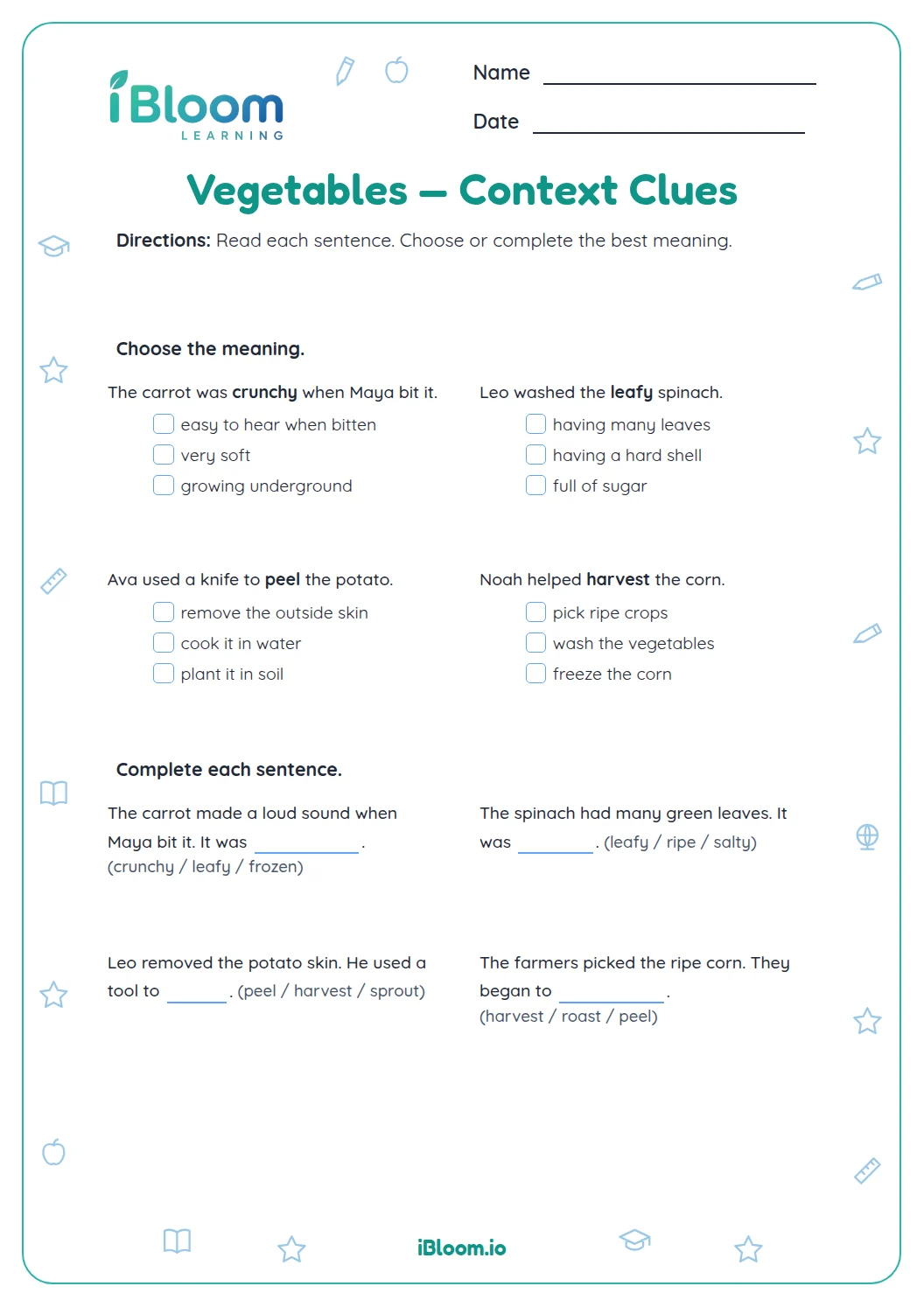
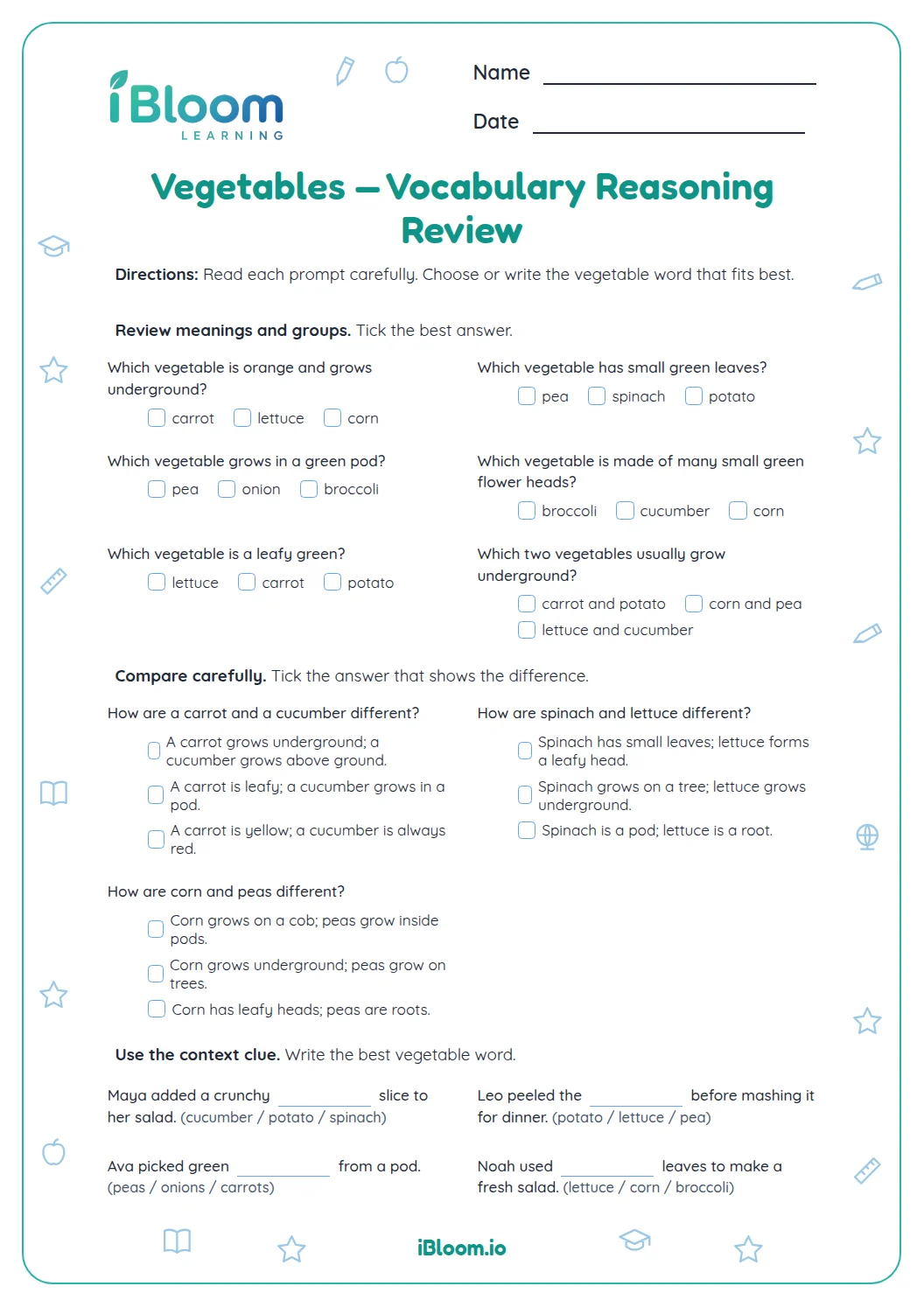
- Part B: choose the vegetable that matches a clue (2–9)
- Part C: complete a sentence using a word (10–17)
How do sentence clues help with vegetable words?
A clue tells one feature, taste or use of a vegetable. Read the whole sentence before choosing: a potato fits “baked, mashed, or made into fries,” while an onion fits a clue about eyes watering when it is chopped. The word should make the entire sentence sensible.
- 1A ___ can be baked, mashed, or made into fries.
- 2Choose potato because those are familiar ways to prepare it.
How can students use a new word in a sentence?
In Part C, the blank asks for a word that completes a simple idea about a vegetable. Read the words around the blank and picture the meaning: “An onion can add flavor to a pot of ___” points to soup. Reread the completed sentence aloud to check it.
How to use the vegetable word sheet
- 1Read the vegetable word list before searching.
- 2Scan each row from left to right and circle a word only when all its letters match in order.
- 3Use the clue sentence to think of a vegetable before looking at choices.
- 4For the final part, read the whole sentence and fill the blank with the word that makes sense.
- 5Reread each completed sentence and check the answer key.
Common mistakes and quick fixes
The mistake
Circling a similar-looking letter string that is not one of the listed words.
The fix
Point to each letter in the target word list and match them in order before circling.
The mistake
Choosing a vegetable from one clue word alone.
The fix
Read the whole sentence. “Orange” could fit more than one vegetable, but the rest of the clue helps narrow the answer.
The mistake
Writing a word that fits the topic but not the sentence.
The fix
Read the completed sentence aloud and ask whether the meaning sounds right.
Common Core alignment
Use familiar and newly learned words in sentences and responses.
On this sheet: Students identify vegetable words and use them in sentence contexts.
Show the official wordingHide the official wording
Use words and phrases acquired through conversations, reading and being read to, and responding to texts, including using frequently occurring conjunctions to signal simple relationships (e.g., because).
What to practice next
Make more practice
Further reading
Questions parents and teachers ask
Which vegetable words are hidden in the grid?
The grid contains carrot, broccoli, cucumber, potato, tomato, pumpkin, pepper and onion. Each word appears across one row. Students circle all eight in question 1, then use vegetable meanings and sentence clues in the next two parts. The answer key lists them in order.
Are the words hidden diagonally or backward?
No. Every target word is placed left to right across one row, which keeps the search approachable for Grade 1 readers. The answer key names all eight words so an adult can check the grid without marking the student copy.
How does the worksheet practice vocabulary?
After the word search, students choose a vegetable that fits a clue sentence and complete another sentence using a related word. The clues connect each word to a feature or familiar use, such as a potato being mashed or an onion adding flavor.
Can a child use a different word in the final section?
The answer key gives the intended word for each blank. Some sentences can be completed with another sensible word, but the listed answer shows the vocabulary response the prompt is designed to practice. Ask the child to explain how the word fits and what clue helped.
How many questions are on this vegetable sheet?
There are 17 questions: one word-search activity, eight multiple-choice vocabulary clues, and eight sentence completions. The key includes the full word list and the intended response for each sentence, so adults can check both the search and the clues together.