











About this worksheet
This Grade 1 vocabulary worksheet uses fruit sentences to practice context clues. Students circle a detail that helps explain a capitalized word in 12 short sentences, find five fruit names in a word search, and identify a curved fruit in a picture row. A separate answer key is included. The sentence items practice CCSS L.1.4.a.
Aligned to L.1.4.a
How do sentence clues help with fruit words?
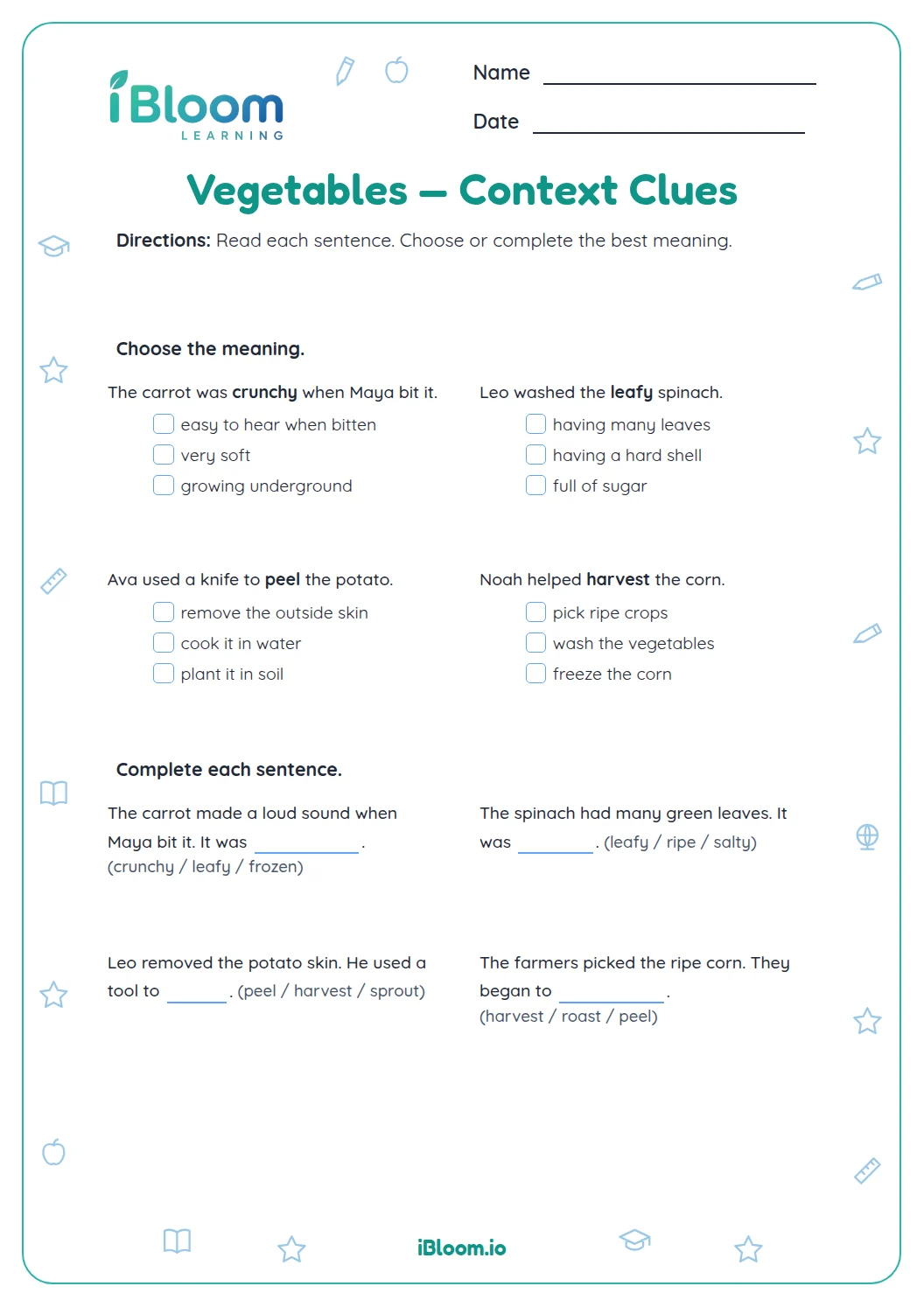
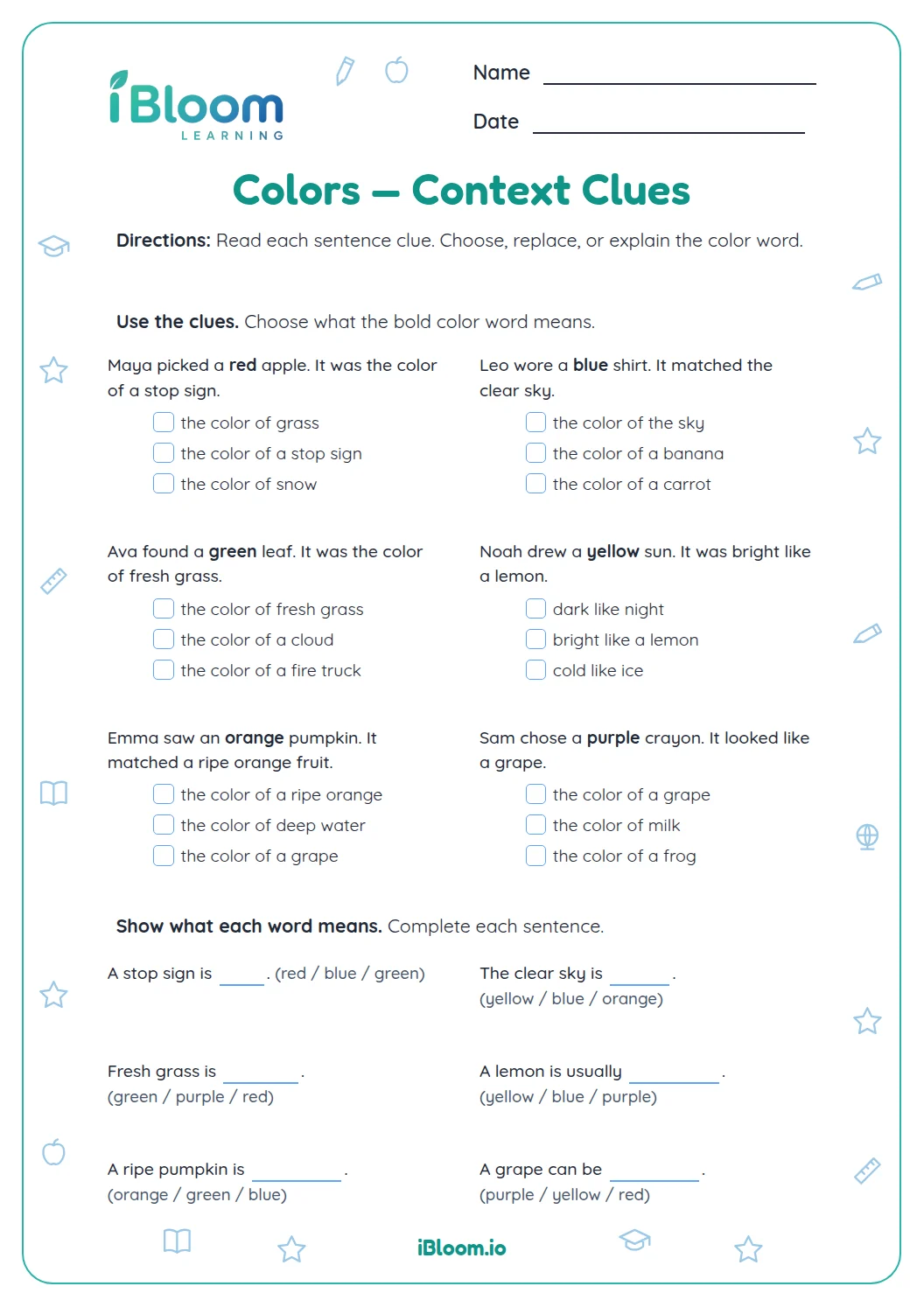
A nearby action or detail can explain an unfamiliar word. If a child puckers after tasting a lemon, that reaction points to a sharp, sour taste. If a bite makes a crunch, the fruit is crisp. Read the whole sentence and connect the clue to the capitalized word.
- 1Kai puckered at the SOUR lemon.
- 2The clue word “puckered” helps explain SOUR.
- 3Circle: puckered
What is in the word search?
The final activity asks children to find apple, pear, plum, mango, and melon. Each name runs across a row. The key lists all five so children can check their search.
Which detail should a reader circle?
Look for an action, description, or comparison that helps explain the capitalized word. For example, sugar helps explain SWEET, and a ball shape helps explain ROUND. The final two activities add a word search and a fruit picture choice.
How to use this worksheet
- 1Read the full sentence and notice the capitalized word.
- 2Circle the detail that helps explain that word.
- 3Search the grid for apple, pear, plum, mango, and melon.
- 4Look across the fruit pictures and circle the long, curved fruit.
- 5Use the separate key to check your answers.
Common mix-ups
The mistake
Choosing a meaning without using the sentence detail.
The fix
Reread the clue, such as a crunch or a puckered face, and connect it to the word.
The mistake
Mixing up a peel, seed, and core.
The fix
A peel is the outside, a seed can grow, and a core is the firm center.
The mistake
Stopping after finding only some grid words.
The fix
Check off all five fruit names against the list and scan each row again.
Language arts alignment
Students use sentence details to choose the meaning of fruit words.
Use nearby sentence details to figure out what a fruit word means.
On this sheet: The 12 clue sentences pair target words with details that help explain their meanings.
Show the official wordingHide the official wording
Use sentence-level context as a clue to the meaning of a word or phrase.
What to practice next
Make more practice
Further reading
Questions parents and teachers ask
How do context clues help with these fruit words?
A detail in a sentence can help a reader understand a word. A puckered face after tasting a lemon hints at sour, while a crunch points to crisp. Children read each short sentence and circle the detail that gives a clue to the capitalized word, then check it with the key.
Which words are in the fruit word search?
The grid contains apple, pear, plum, mango, and melon. Each fruit name runs from left to right across one row in the grid. Children can find and circle each word, then use the answer key to check that all five are included.
What does “core” mean in this worksheet?
A core is the firm center of a fruit, where seeds may be found. The sentence describes it as the hard center of an apple, giving clues to the word. Children fill in “core” and then check the spelling in the answer key.
Can an adult read the sentences aloud?
Yes. An adult can read each sentence aloud while the child listens for the clue. Ask the child to name the detail that helped, such as a crunch or a puckered face, and then try a word in the blank. Rereading checks the meaning.
How many activities are on the printable?
There are 14 numbered questions: 12 sentence clues, one word-search activity, and one fruit-picture activity. The grid contains five fruit names. A separate answer key lists the clue words and activity answers, and the printable has a worksheet page and an answer-key page.
What is the answer key for?
The separate answer key lists the 12 clue words, the five words in the grid, and the fruit to circle in the picture row. After the child finishes, reread a sentence and ask how the clue detail helps explain the capitalized word.