









About this worksheet
This free printable Grade 1 vocabulary worksheet helps children group fruit words and connect them with names and features. Twelve questions are arranged in three parts: choose a fruit word from three foods, name a pictured fruit, and use a clue to select the matching fruit. The pictures show an apple, banana, grapes, and an orange. Children also meet lemon, peach, and watermelon in the word choices. Common Core L.1.5a and L.1.5b guide the category and attribute work. An answer key gives all twelve responses for checking together.
Aligned to L.1.5a and L.1.5b
How does sorting food words build a fruit category?
Part A presents three food words at a time. One is a fruit, and the other two are foods such as bread, cheese, rice, or eggs. Children use meaning to decide which word belongs in the fruit group.
Read unfamiliar food words aloud if needed. Keep the task about the category: ask which word names a fruit, then have the child explain the choice or name another fruit they know.
- 1Question 1: Which word names a fruit?
- 2Choices: bread, pear, cheese
- 3Answer: pear. Bread and cheese are other kinds of food.
Which fruit pictures do children name?
Part B shows four pictures, one per question: apple, banana, grapes, and orange. Children write the fruit name on the short answer line. The words apple and banana appear earlier; grapes and orange appear in the later choices for children who need spellings to copy.
Say the word together before writing it. The grapes picture shows a bunch, so the key uses the plural word grapes.
How do the fruit clues connect words with features?
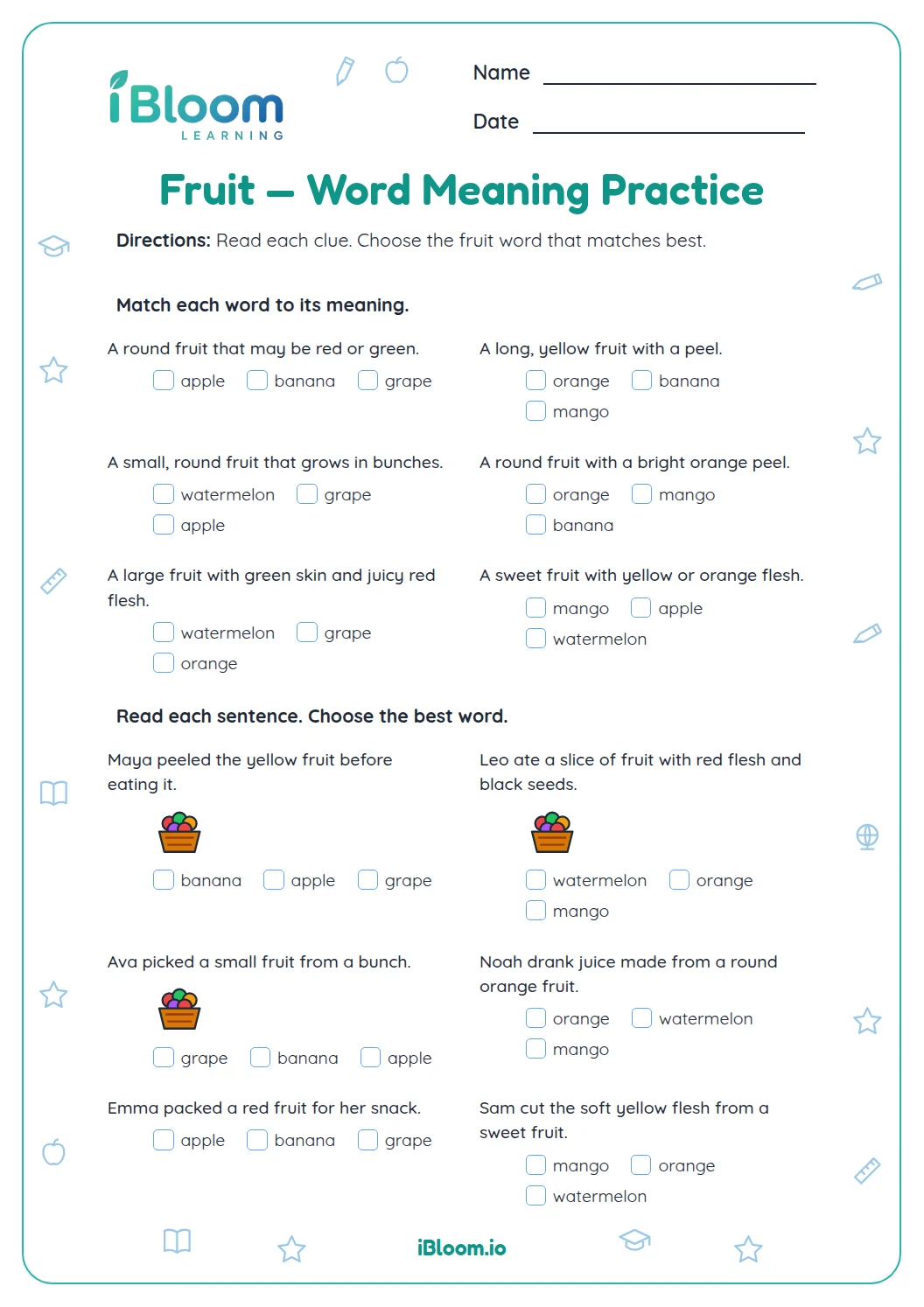
Part C gives two choices for each clue. A long, curved fruit with a yellow peel points to banana; small fruits in a bunch point to grapes. The final clues distinguish lemon by its yellow peel and sour juice, and watermelon by its green rind and pink or red inside.
Ask children to use the whole clue. Color alone may fit more than one fruit, while color plus shape, taste, or growing pattern makes the intended choice clear.
How to use the worksheet
- 1Say a few fruit names aloud before starting Part A.
- 2Read each group of food words and choose the fruit.
- 3Name each Part B picture aloud, then write the word.
- 4Read each Part C clue fully before choosing between the two fruits.
- 5Check the key and explain one fruit feature in a complete spoken sentence.
Mistakes to check together
The mistake
Choosing cheese because it is a favorite snack.
The fix
Return to the category word fruit. A favorite food still needs to belong to that group.
The mistake
Writing orange under the apple picture.
The fix
Compare the shape and surface of the pictured fruit, then say its name before writing.
The mistake
Choosing orange for the sour yellow fruit clue.
The fix
Use both details: a yellow peel and sour juice identify lemon from these two choices.
Common Core alignment
Sort food words by identifying the ones that belong to the fruit category.
On this sheet: Part A asks children to select a fruit word from other food words.
Show the official wordingHide the official wording
Sort words into categories (e.g., colors, clothing) to gain a sense of the concepts the categories represent.
Connect fruit names with pictures and key attributes.
On this sheet: Part C identifies fruits from clues about shape, peel, taste, and how they grow.
Show the official wordingHide the official wording
Define words by category and by one or more key attributes (e.g., a duck is a bird that swims; a tiger is a large cat with stripes).
What to practice next
Make more practice
Further reading
Questions parents and teachers ask
Which fruit words appear in the practice?
The practice uses pear, apple, banana, grapes, orange, lemon, peach, and watermelon. Some are category answers, some appear in pictures, and others appear in descriptive clues or choices. Children connect the words through the shared fruit category and through details that help tell the fruits apart.
Can I read the questions to my first grader?
Yes, you can read the questions and choices aloud. The main goal is to understand fruit names, categories, and features. Let your child make the selections and name the pictures. For the four written labels, say the word first, then help the child find or write its spelling.
Do all twelve questions require writing?
No, eight questions use answer choices, and four ask children to write a fruit name under a picture. Part A has four choices about categories, Part B has four picture labels, and Part C has four choices based on clues. This keeps the written work focused on useful vocabulary.
How do I check the picture-label answers?
Match the written word to the pictured fruit: apple, banana, grapes, and orange, in that order. The answer key supplies those names. If a child identifies a fruit correctly aloud but misspells it, acknowledge the correct meaning, then model the spelling and let the child correct the label.
How can we extend the classification activity?
Choose a few familiar foods and ask your child to name which belong in the fruit group. Then invite a clue with two features, such as shape and color, for you to solve. Keep the fruit visible if needed so the child can describe something concrete and check the answer.