








About this worksheet
This free printable gives Grade 1 children twelve questions about vegetable names and related word meanings. Part A pairs pictures of a carrot, corn, broccoli, an onion, a potato and a cucumber with three name choices each. Part B uses six short sentences to explain words such as raw, peel, slice and rinse. Children use the clue in each sentence to choose a meaning, practicing Common Core L.1.4a. The garden theme keeps the page tied to the vocabulary, and a separate answer key shows every correct choice.
Aligned to L.1.4a
Which vegetable names are on the sheet?
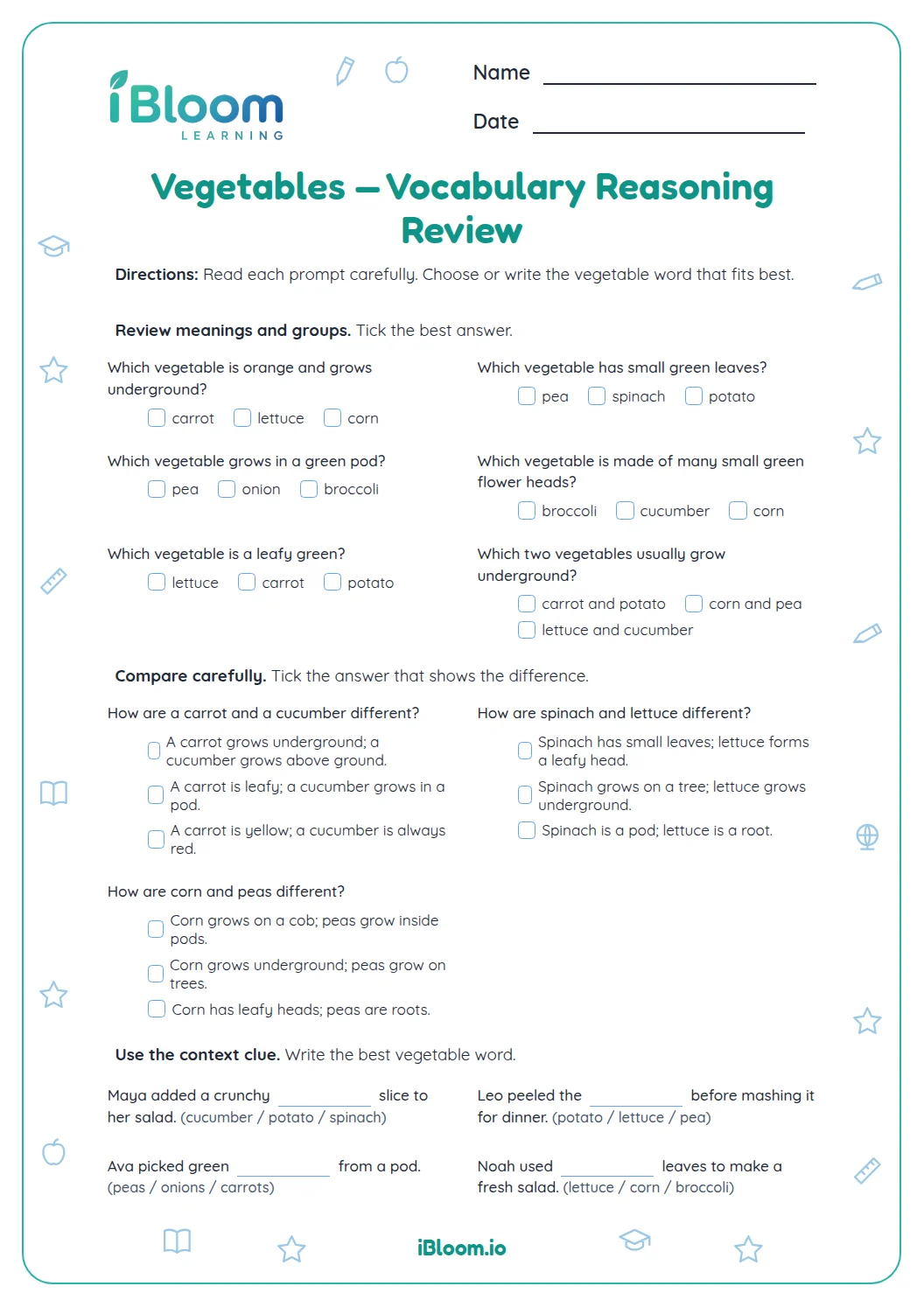
Part A introduces carrot, corn, broccoli, onion, potato and cucumber with a picture for each. Children match each picture to one of three printed words. Say the names aloud together if a child knows the food but cannot yet read its name.
The picture task connects each vegetable with its name before Part B moves to sentence clues. Carrot, potato, cucumber and broccoli appear again in sentences about texture and food preparation.
How do children work out what raw means?
In question 7, the sentence explains the word directly: the raw carrot is not cooked. Ask the child to find the phrase that tells the meaning before looking at the three choices.
- 1The RAW carrot is not cooked.
- 2Clue words: not cooked
- 3Raw means not cooked.
How can we practice the words after finishing?
During a meal, name a vegetable and talk about a word from the sheet. A cucumber can be sliced; broccoli can be rinsed. The child can explain the action in words or point while an adult prepares the food.
Keep the distinction between the food name and the describing or action word clear. Carrot names a vegetable, crunchy describes its texture, and peel names an action.
How to use this worksheet
- 1Say the names of the six pictured vegetables together.
- 2Let the child select each matching name in Part A.
- 3Read each Part B sentence, emphasizing the word in capitals.
- 4Ask the child to point to the phrase that explains the word.
- 5Check with the key and have the child explain one action using a vegetable name.
Mistakes to catch and how to fix them
The mistake
Choosing corn for the broccoli picture.
The fix
Compare the clustered top of the broccoli with the rows of kernels on corn, then say both names.
The mistake
Choosing “very hot” for raw because carrots can be cooked.
The fix
Return to the exact sentence: the raw carrot is not cooked.
The mistake
Mixing up peel and slice.
The fix
Peel means remove the skin; slice means cut into thin pieces. Reread the potato and cucumber sentences side by side.
Common Core alignment
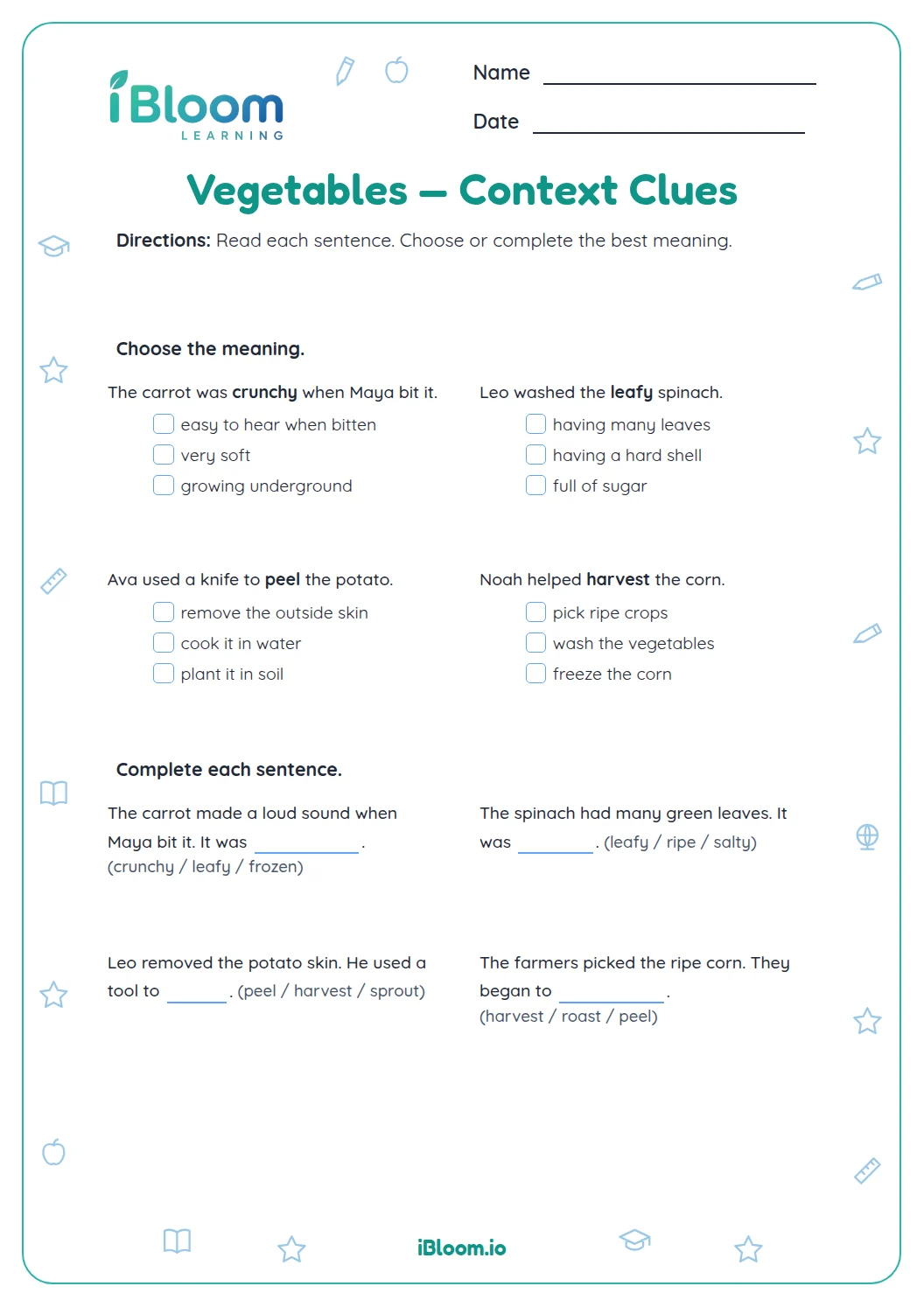
Use vegetable sentences to work out the meanings of preparation and texture words.
On this sheet: Part B supplies sentence clues for raw, peel, slice, rinse, crunchy and mash.
Show the official wordingHide the official wording
Use sentence-level context as a clue to the meaning of a word or phrase.
What to practice next
Make more practice
Further reading
Questions parents and teachers ask
Which vegetables appear in this worksheet?
The six picture questions show carrot, corn, broccoli, onion, potato and cucumber. The sentence questions also mention potato and cucumber while introducing words about food preparation and texture. Children name the pictures first, then use clear sentence clues to learn six related meanings in Part B.
Does my child need to spell the vegetable names?
No, children select from three printed choices for every question. They can concentrate on connecting a picture or sentence clue with a word’s meaning. If reading a name is difficult, say the choices aloud and let the child point to the matching printed word.
What does Part B teach?
Part B teaches raw, peel, slice, rinse, crunchy and mash through short vegetable sentences. Each sentence contains a meaning clue. For example, “We peel a potato by taking off its skin” tells the child what peel means before the child chooses an answer.
How can I help without giving away the answer?
Read the whole sentence and ask which words explain the word in capitals. For raw, your child can point to “not cooked.” Then read all three choices. Let the child choose and explain the match before you use the separate answer key to check.
Can we use real vegetables with the sheet?
Yes, familiar vegetables can help connect the printed words with everyday objects. Name a carrot or onion together, then discuss one word from Part B. An adult can demonstrate rinsing or slicing while the child explains what the action means using the sentence clues.