




About this worksheet
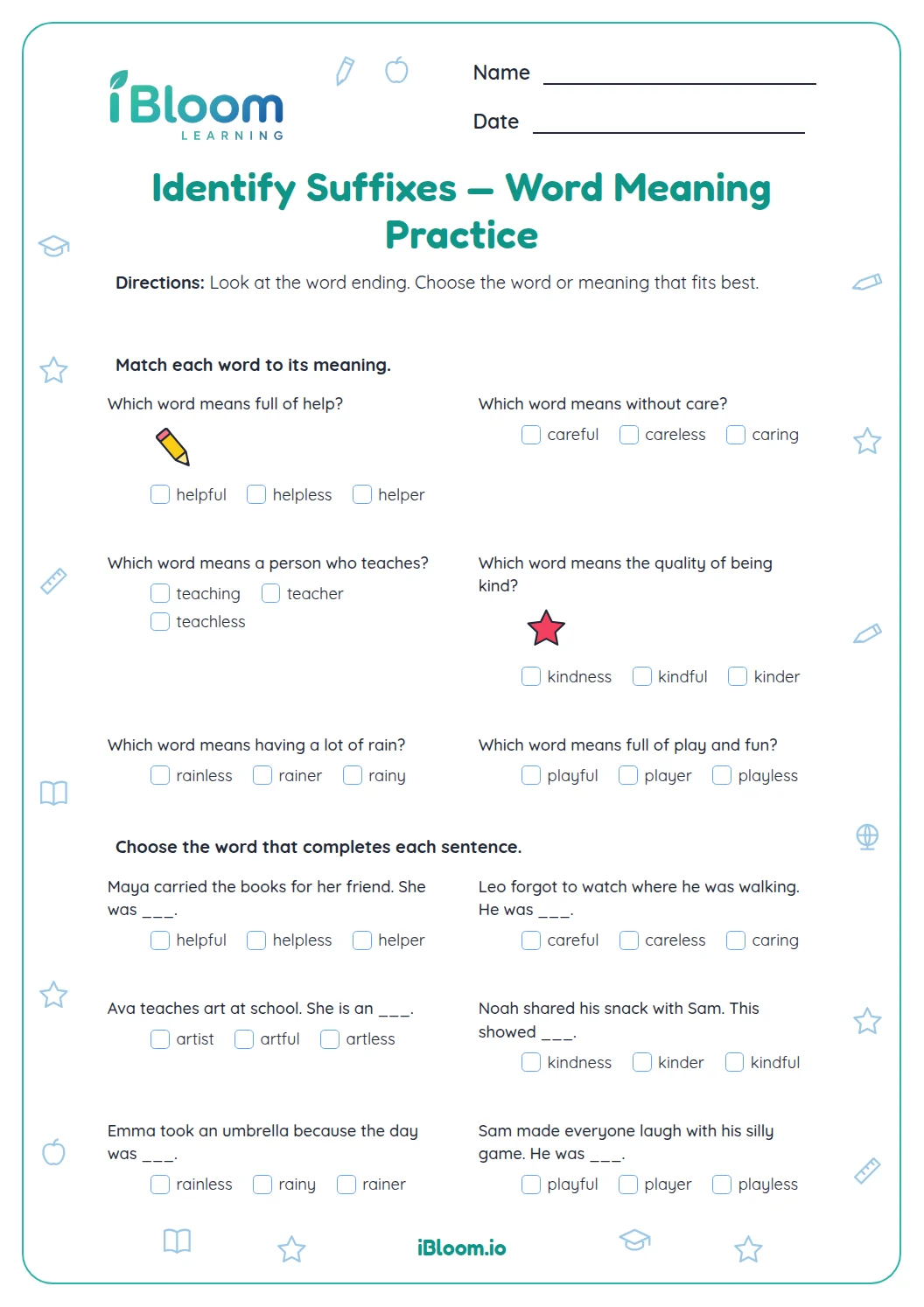
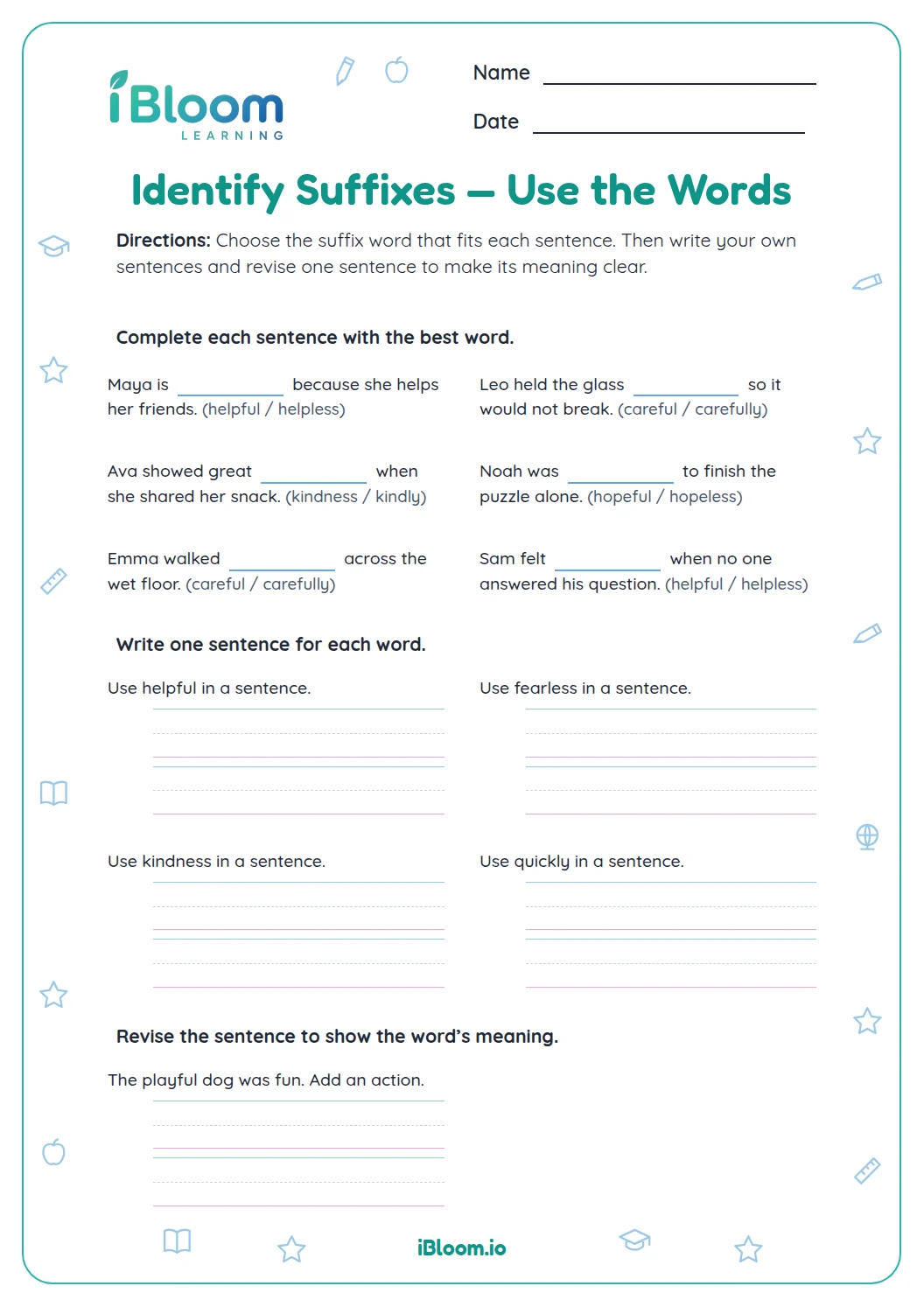
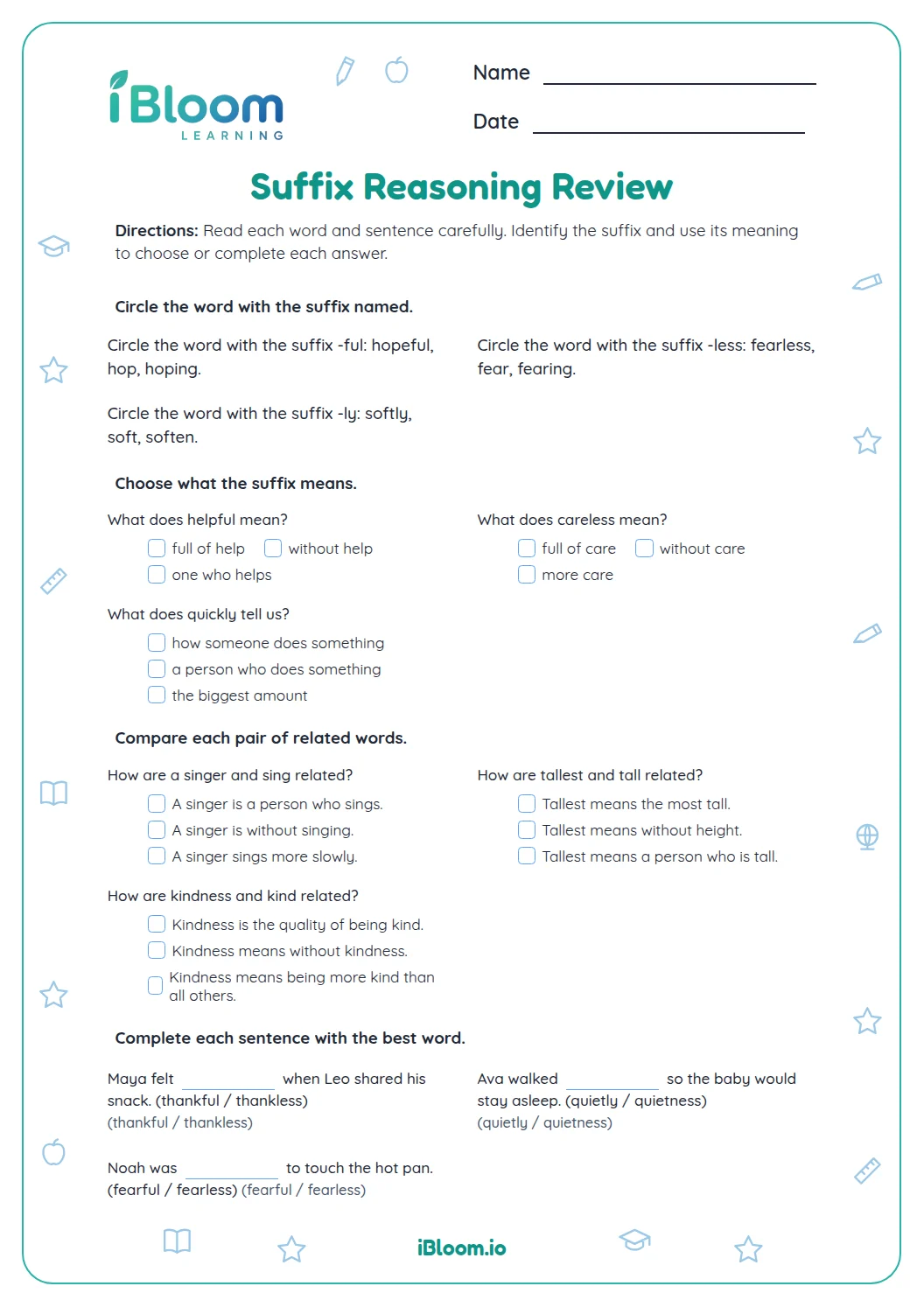
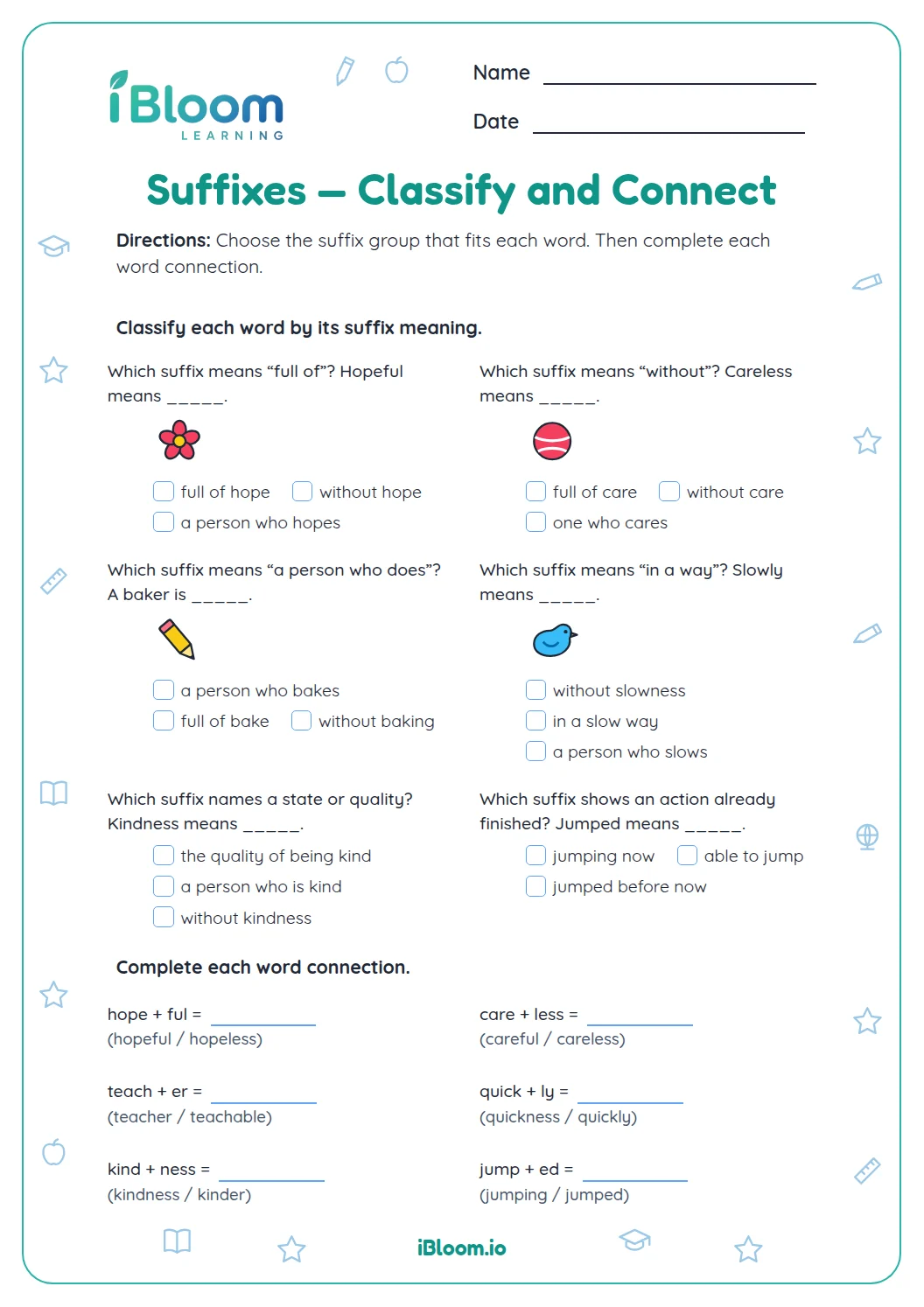
This free printable Grade 2 worksheet helps children identify suffixes and connect them to word meanings. Part A asks children to classify eight words by their endings: -ful, -less, -er or -ness. Part B has eight multiple-choice questions linking word parts to meanings, such as fearless and without fear. Part C supplies a base word and a meaning so children can build six complete words. These twenty-two questions practice Common Core L.2.4c and RF.2.3d through familiar base words and common suffixes. A separate answer key lists every suffix, choice and completed word.
Aligned to L.2.4c and RF.2.3d
Which four suffixes do children sort?
The suffix -ful can mean having or full of: colorful means full of color. On this sheet, -less means without, -er names a person who does something, and -ness names a state or quality. Teacher, for example, means a person who teaches.
Part A includes two examples for each category: helpful and colorful; fearless and painless; teacher and farmer; kindness and darkness. Children write the suffix beside each word, then read the base and ending together.
How does a base word help explain the new word?
A familiar base anchors the meaning. Fear gives the central idea in fearless, and -less changes that idea to without fear. Keeping the base visible helps children connect the original word to the new one.
- 1Base word: fear.
- 2Suffix: -less, meaning without.
- 3fear + less makes fearless.
- 4Choose “without fear.”
How do children connect sorting to building words?
Part B asks for meanings of helpful, fearless, teacher and kindness, then connects four more meanings to words. The choices include meanings associated with other suffixes, so children must use both the base and the actual ending.
Part C turns the task around. A base word and a definition lead to joyful, careless, painter, softness, useful and harmless. Children write the whole word. Reading each result aloud makes the connection between its parts and its meaning clear.
How to use this worksheet
- 1Read the four suffixes aloud and explain their meanings with one familiar word.
- 2In Part A, say each word and separate the familiar base from its ending.
- 3Write the suffix, including its hyphen, beside each Part A word.
- 4For Part B, try each meaning and choose the one supported by both word parts.
- 5In Part C, add the ending that fits the definition and write the complete word.
- 6Use the answer key to check spellings and ask the child to explain one word from each suffix group.
Mistakes to notice and fix
The mistake
Writing -full with two l’s in helpful.
The fix
The word full has two l’s, but the suffix -ful has one. Compare help + ful with helpful.
The mistake
Reading fearless as full of fear.
The fix
Separate fear and -less. Say “without fear” and compare it with fearful, which uses a different suffix.
The mistake
Treating the last letters of every word as a suffix.
The fix
Find a meaningful base first. Teacher separates into teach and -er; the same reasoning does not turn corner into corn plus a person-ending.
Common Core alignment
Use familiar base words to explain words with -ful, -less, -er and -ness.
On this sheet: Children connect help to helpful, fear to fearless and other base words to suffixed words.
Show the official wordingHide the official wording
Use a known root word as a clue to the meaning of an unknown word with the same root (e.g., addition, additional).
Read words with familiar suffixes and identify their endings.
On this sheet: Reading each base word and suffix aloud supports the sorting and word-building tasks.
Show the official wordingHide the official wording
Decode words with common prefixes and suffixes.
What to practice next
Make more practice
Further reading
Questions parents and teachers ask
What does classify mean on this worksheet?
It means identifying which ending group each word belongs to. Children write -ful, -less, -er or -ness beside eight words. Each suffix occurs twice, so children can compare two examples in the same group and see how one ending works with different familiar base words.
What does -ness mean in kindness?
In kindness, -ness turns kind into the quality or state of being kind. The base word keeps its meaning, while the ending makes a word that names that quality. The worksheet connects kindness to being kind and also uses darkness and softness for the same ending.
Should children write the hyphen in a completed word?
No; the hyphen marks a suffix when it stands alone, as in -less in Part A. In Part C, children attach the ending directly to the base word and write careless. Show care plus less, then read the joined word aloud to make the difference clear.
How can I check whether my child understands the meanings?
Ask your child to explain one word from each suffix group after checking the sheet. For example, fearless means without fear, and teacher means a person who teaches. An explanation that uses both the base word and the ending shows more than simply copying the final letters.
Does -er always mean a person?
On this sheet, -er names a person in teacher, farmer and painter. Other words can use -er to compare, such as taller. Keep the explanation tied to the words being read, and ask what the whole word means before deciding which job an ending has.