



About this worksheet
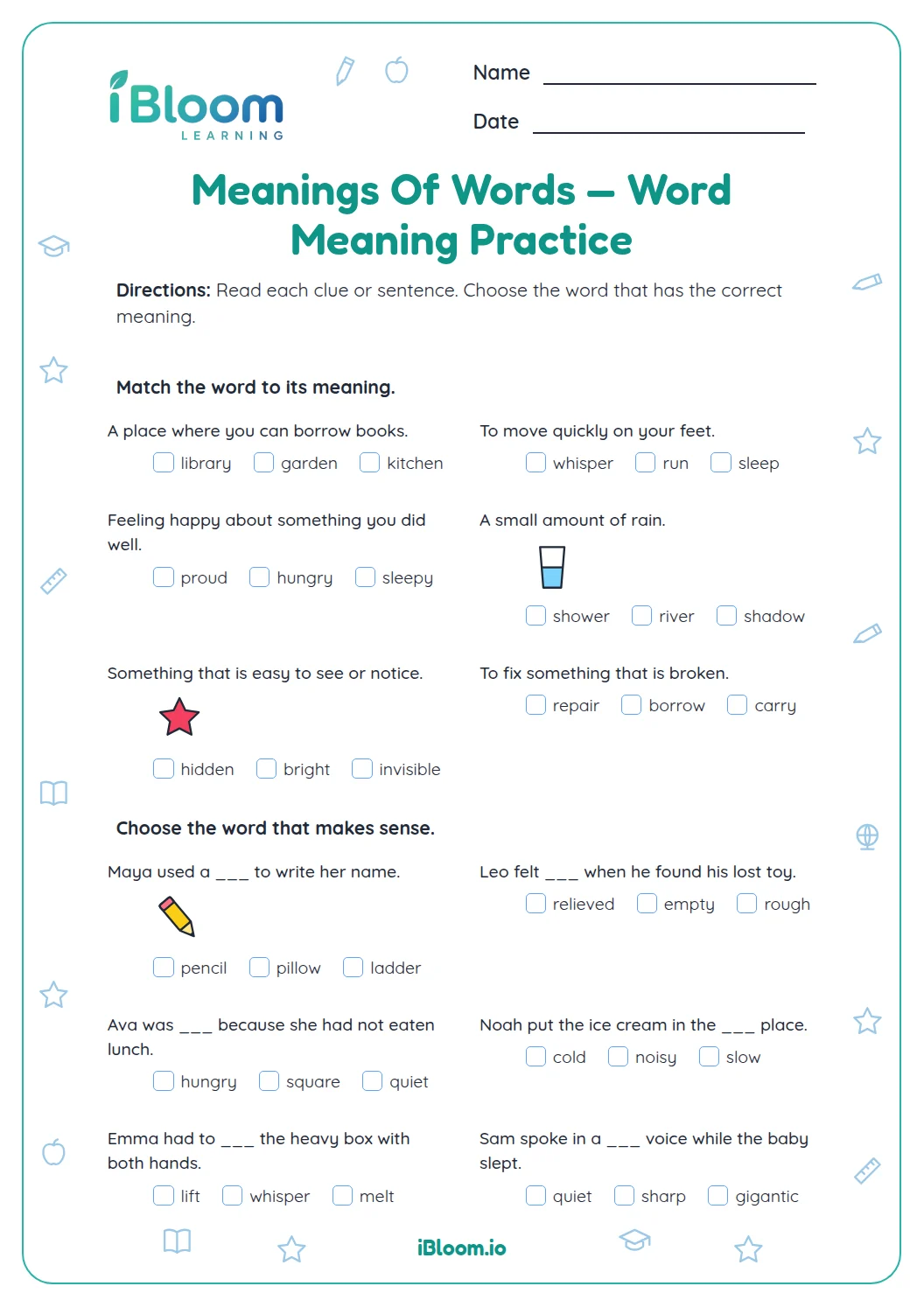
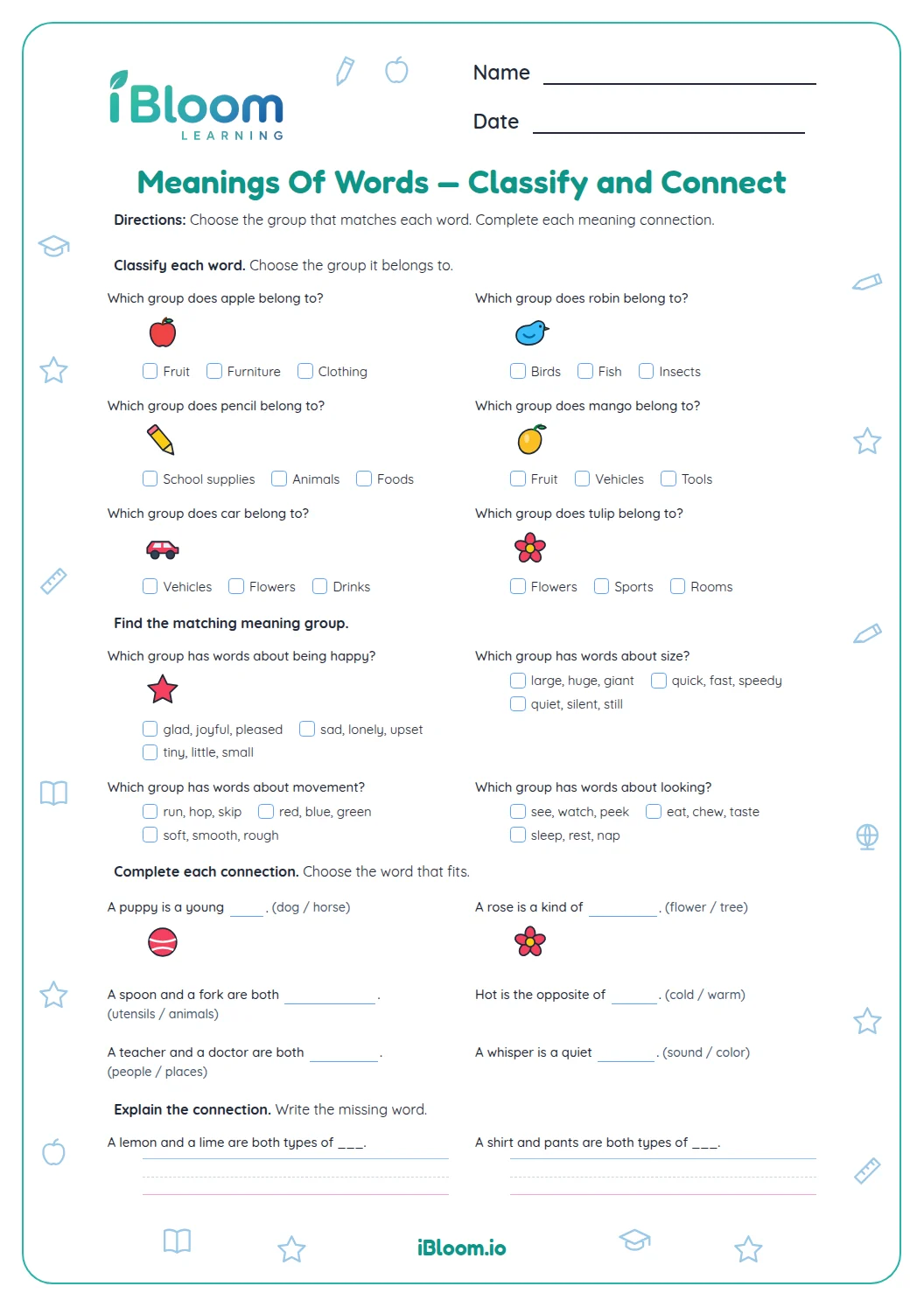
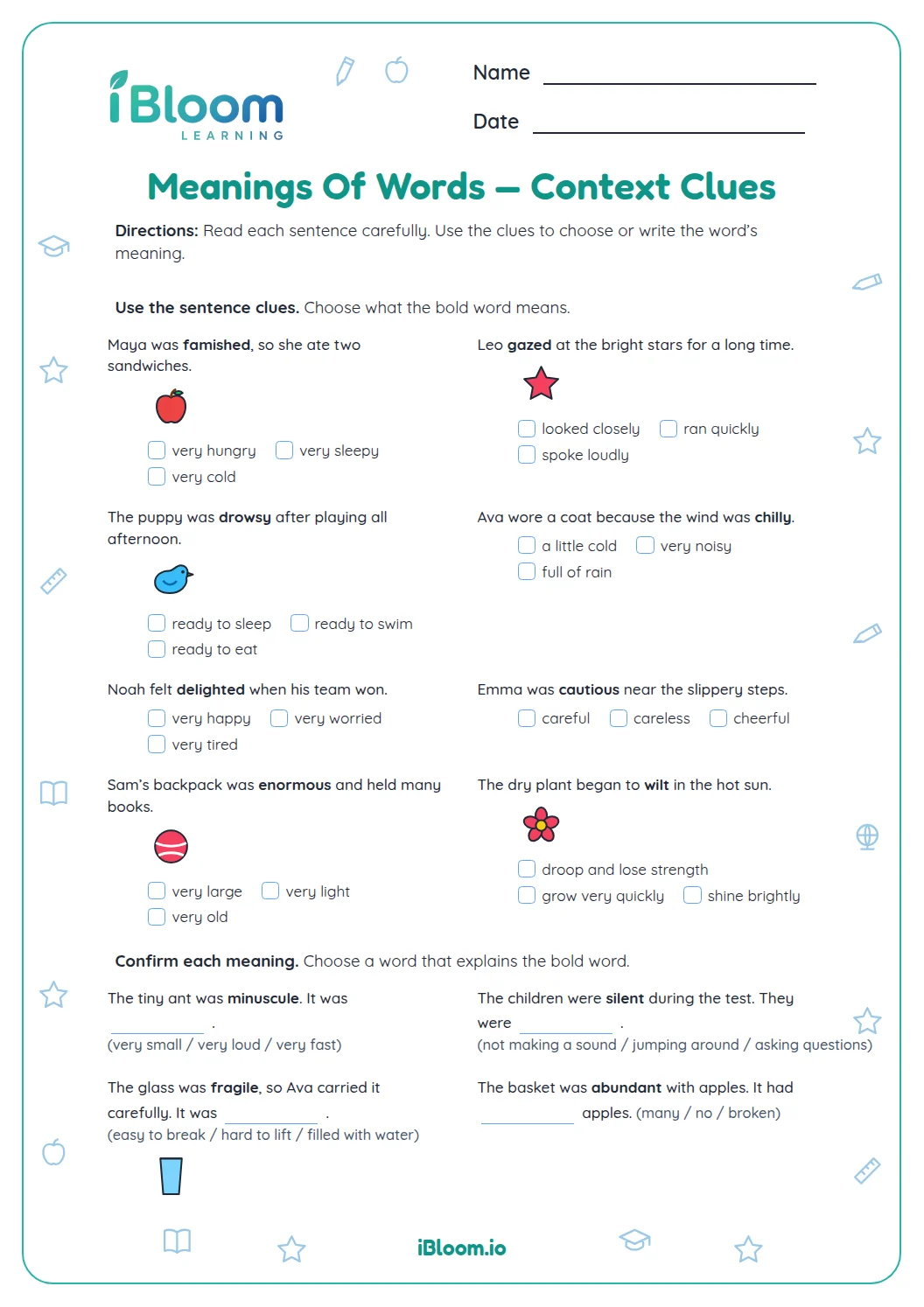
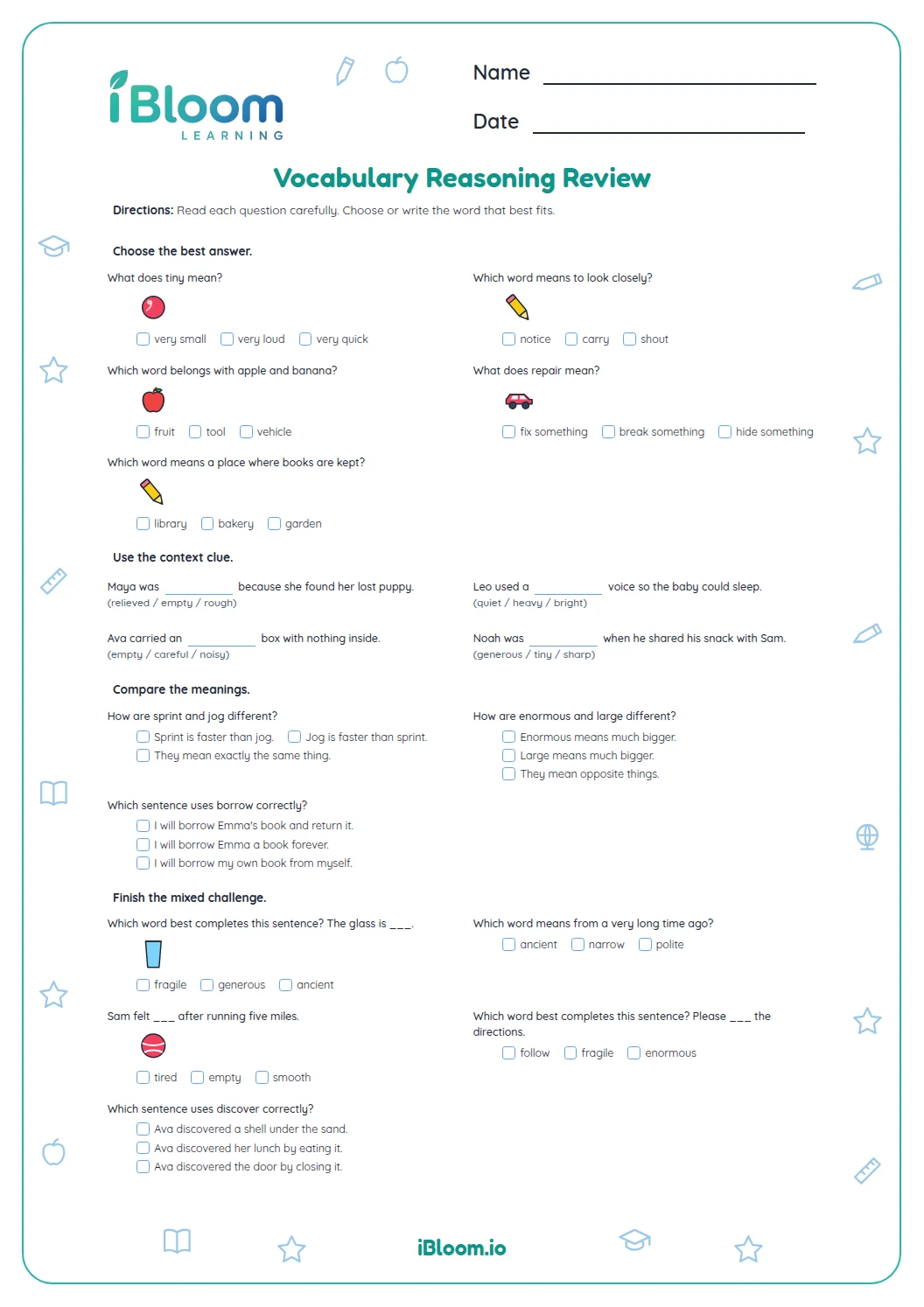
This Grade 2 vocabulary worksheet gives children practice using context to understand words and use them accurately. Ten meaning choices, four sentence-context questions, and one original sentence build toward independent word use. It practices CCSS L.2.4a, and the separate answer key includes the expected choices and a sample sentence.
Aligned to L.2.4a
How do context clues work?
A context clue is a nearby detail that helps explain a word. In “The puppy was timid, so it hid behind my legs,” the puppy’s action helps show that timid means shy.
- 1Read the full sentence: the puppy hid behind someone’s legs.
- 2That action fits a shy puppy.
- 3So timid means shy.
How do children use a word accurately?
They can fit a word into a sentence and check whether the surrounding details make sense. The middle questions ask children to choose a word that completes a sentence; the final prompt asks them to write an original example using discover.
What kinds of practice are included?
The sheet starts with sentence clues, moves to word meanings, then returns to sentence context before a final writing prompt. The answer key lists the expected choices and one sample sentence for discover.
How to use this worksheet
- 1Read the whole sentence before choosing.
- 2Look for an action or detail that hints at the word meaning.
- 3Try your choice in the sentence to see whether it fits.
- 4For the final prompt, add a detail that shows discover in action.
Common mistakes and quick fixes
The mistake
Choosing a familiar meaning without rereading the sentence.
The fix
Look for the action or detail that points to the word’s meaning.
The mistake
Filling a blank with a word that does not fit the whole sentence.
The fix
Read the completed sentence aloud and check that it makes sense.
The mistake
Using discover without showing what was found.
The fix
Add a person, place, or thing that is new to the sentence.
Common Core alignment
Students use sentence context to work out word meanings.
Use sentence-level context as a clue to a word’s meaning.
On this sheet: The first six items and questions 11–14 use sentence context to identify or select word meanings.
Show the official wordingHide the official wording
Use sentence-level context as a clue to the meaning of a word or phrase.
What to practice next
Make more practice
Further reading
Questions parents and teachers ask
What are context clues?
Context clues are details in a sentence that help readers work out a word’s meaning. In the first question, the puppy hides behind someone’s legs, which suggests timid means shy. Children can reread the full sentence and point to the detail that supports their answer.
Can an adult read the questions aloud?
Yes. Reading the sentence and choices aloud can keep attention on word meaning. Ask the child to listen for a clue and explain which words helped. Children who are ready can read the prompts independently and compare their reasoning with the answer key.
What should the final sentence show?
The final response should use discover so its meaning is clear, such as finding something not known before. The key offers one sample about finding a bird nest. Other original sentences work if the context shows what was found.
Which words appear on the worksheet?
The worksheet includes timid, eager, narrow, repaired, chilly, hurried, huge, inspect, library, assist, sleepy, get lost, fragile, damp, and discover. Some appear in a context sentence and others are used in a sentence the child completes or writes.
How long does the worksheet take?
The worksheet has 15 questions: ten meaning choices, four sentence-context choices, and one original sentence. About 20 minutes gives time to discuss clues and write the final response. The answer key is separate and includes the expected choices plus a sample sentence.