






About this worksheet
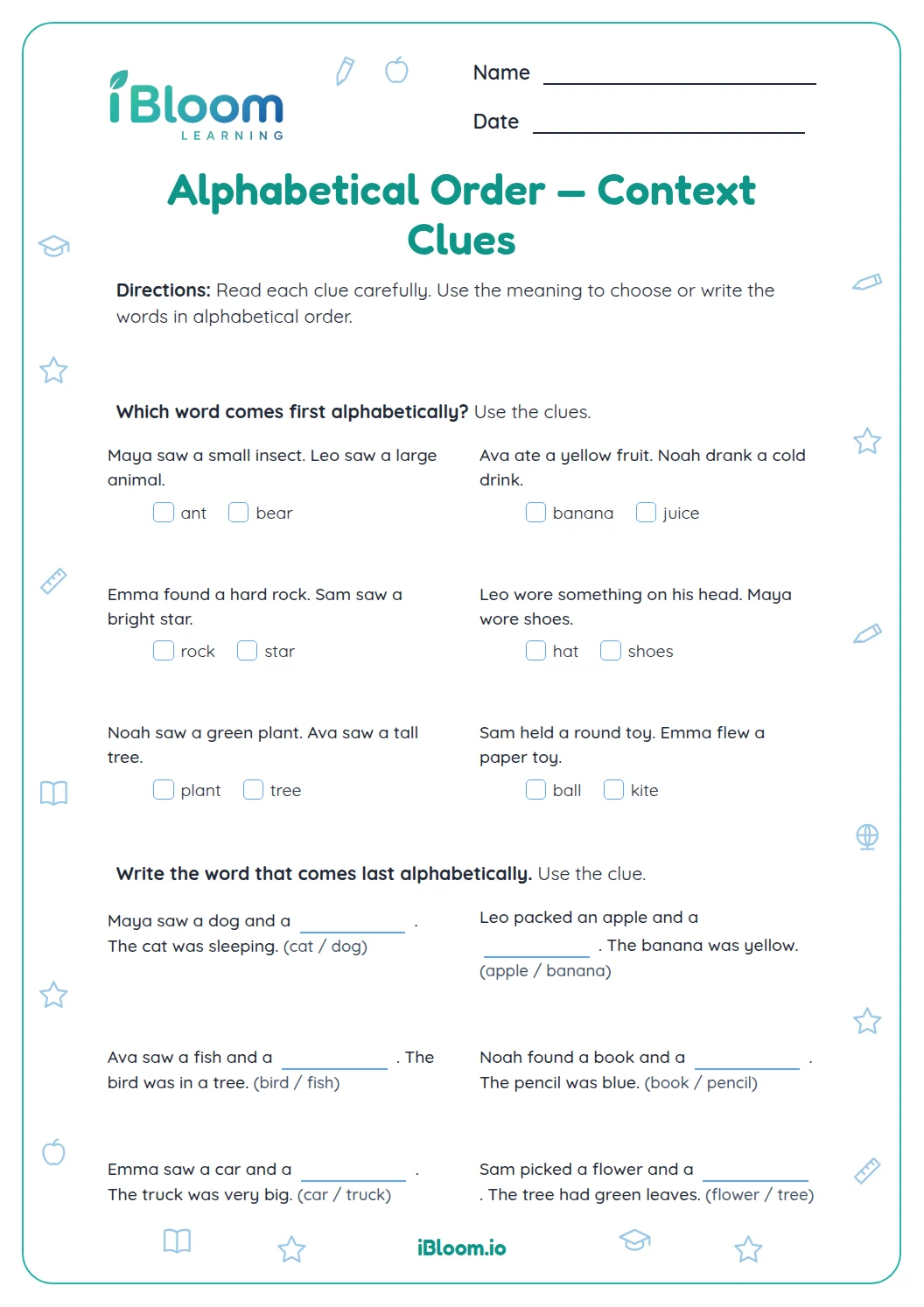
This Grade 2 worksheet gives children 16 word groups to alphabetize. Early items make first-letter comparisons visible; later groups include words with the same first letters, so children compare farther into each word. The answer key lists every group in order.
What does alphabetical order mean?
Alphabetical order follows the letters from A to Z. Compare two words from the beginning and stop at the first letter that differs. For “apple” and “bear,” a comes before b, so apple comes first.
- 1Question 9: crane, crash, crate, crawl
- 2All four begin with c r a. Compare the next letter: n, s, t, w.
- 3Order: crane, crash, crate, crawl.
What if several words begin the same way?
Keep moving one letter at a time. “Plant” and “plate” both begin with pla, but n comes before t, so plant comes first. Do not guess from how long a word looks or from its meaning.
How can the answer key support practice?
Ask the child to point to the first letter that settles each close pair. Then compare the written sequence with the key. The explanation matters: naming the deciding letter helps make the sorting strategy reusable.
How to use this worksheet
- 1Say the alphabet quietly or use an alphabet strip.
- 2Compare the first letter of every word in the group.
- 3When letters match, move one place to the right.
- 4Write the full group in order, separated by commas.
- 5Check close pairs against the answer key.
Common mistakes and quick fixes
The mistake
Stopping after matching first letters.
The fix
Compare the next letter where the words differ.
The mistake
Sorting by word length.
The fix
Ignore length and compare spelling from left to right.
The mistake
Reordering letters inside a word.
The fix
Keep each word exactly as printed; change only its place in the list.
What to practice next
Make more practice
Questions parents and teachers ask
How many word groups are on this page?
There are 16 groups. Each one has four words to arrange in alphabetical order, and the answer key shows the sequence for each group. Keeping the words in their printed spelling helps the learner focus on order instead of changing the words themselves.
Why do some groups feel harder?
Some words share their first two or three letters. Those groups ask children to compare farther into the spelling before deciding which word comes first. When the first letter matches, compare the second letter, then continue until a different letter settles the order.
Should children sort by word meaning?
No. The task is to compare the letters in each spelling. Word meanings do not change alphabetical order. The four-word groups provide repeated practice, and the key makes every sequence easy to check. The first differing letter determines which word comes first.
What does “ABC order” mean here?
It means arranging words by the alphabet from A toward Z. Compare the first letters, then move right until two words differ. An alphabet strip can help a learner who is still building confidence with the order of the letters.
What can I do if my child gets stuck?
Choose two words and compare one letter at a time. Ask which letter comes first at the first place they differ, then put those two words in that order before sorting the rest. Close spellings are useful practice because they require careful comparison beyond the first character.