




About this worksheet
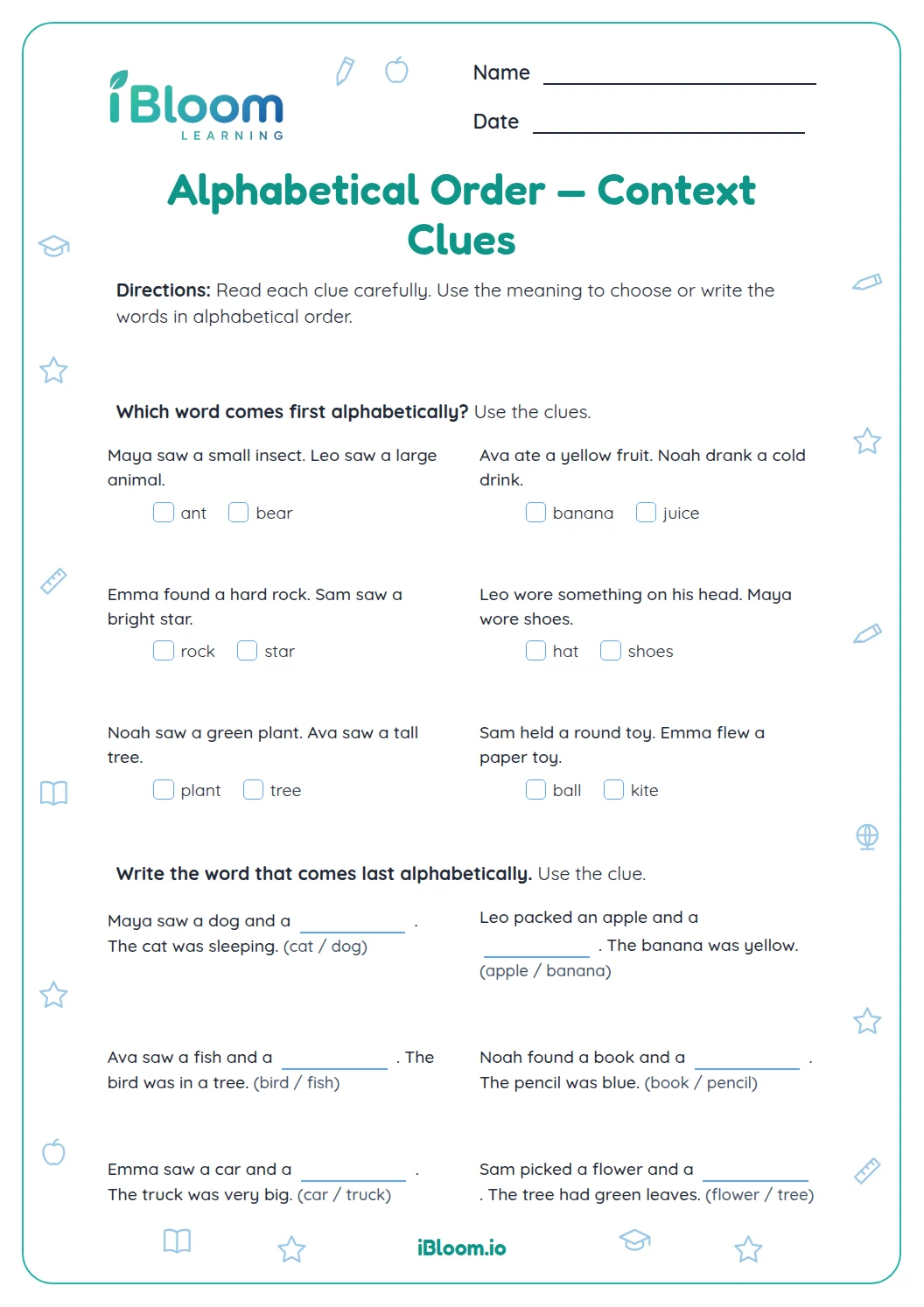
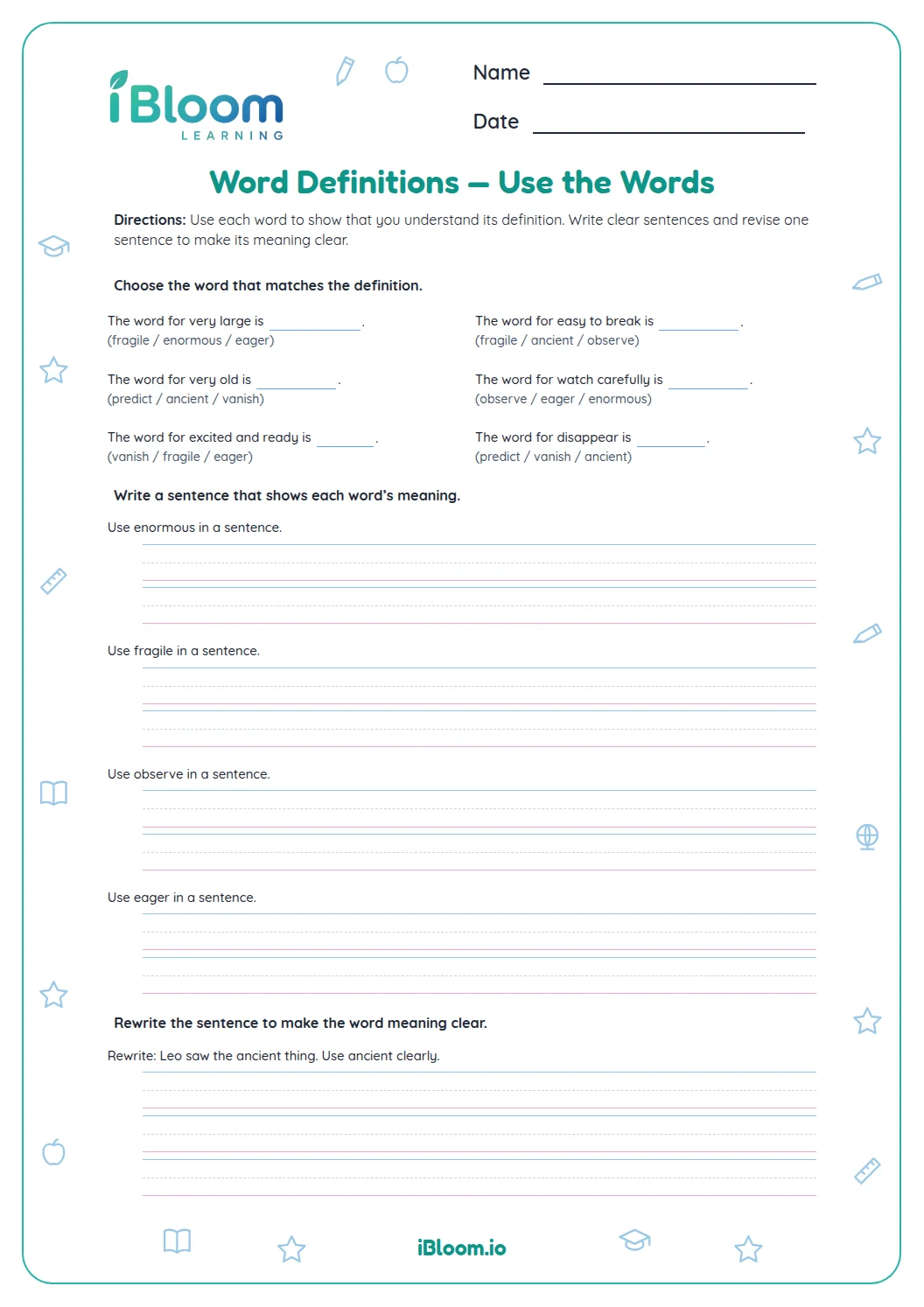
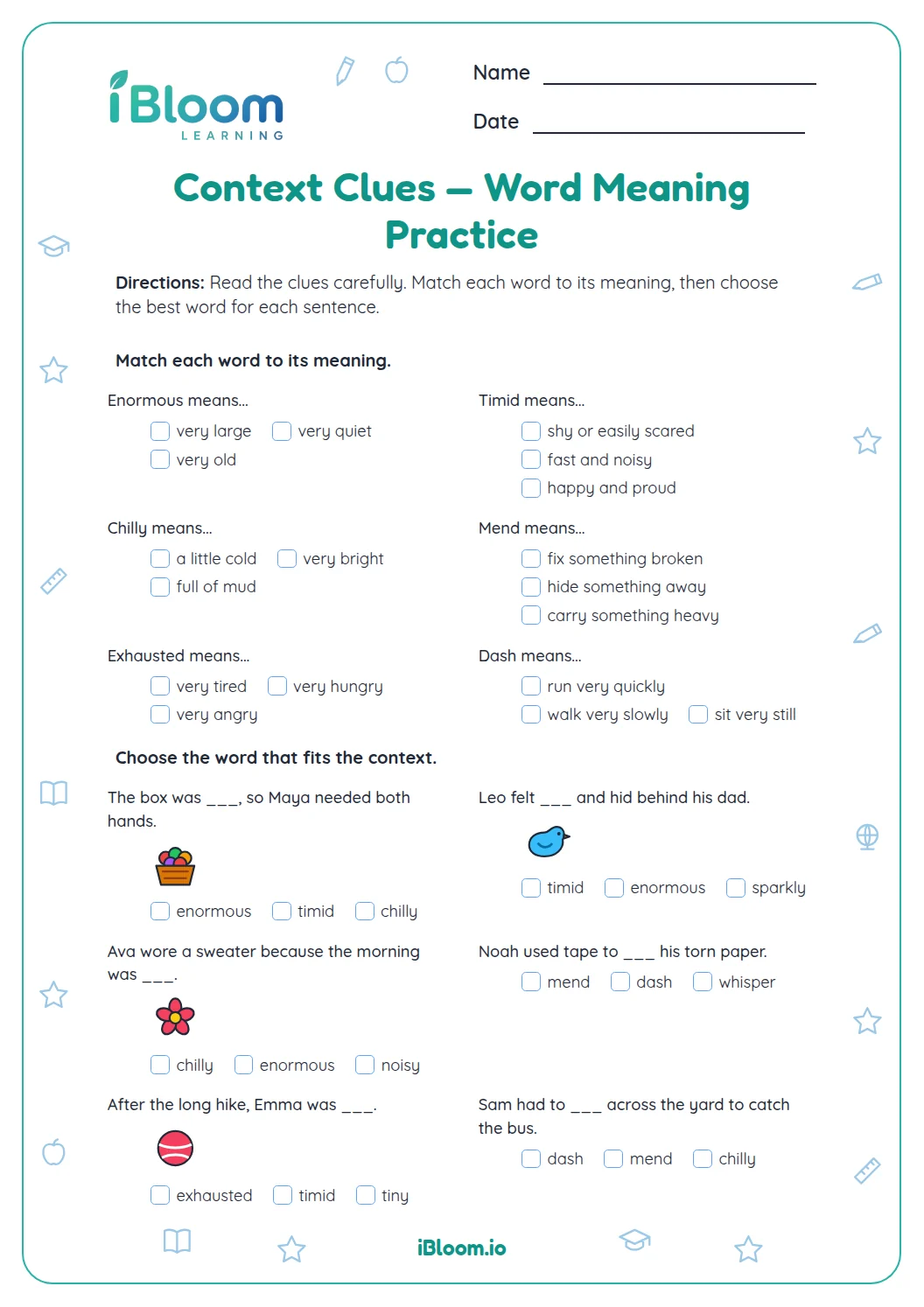
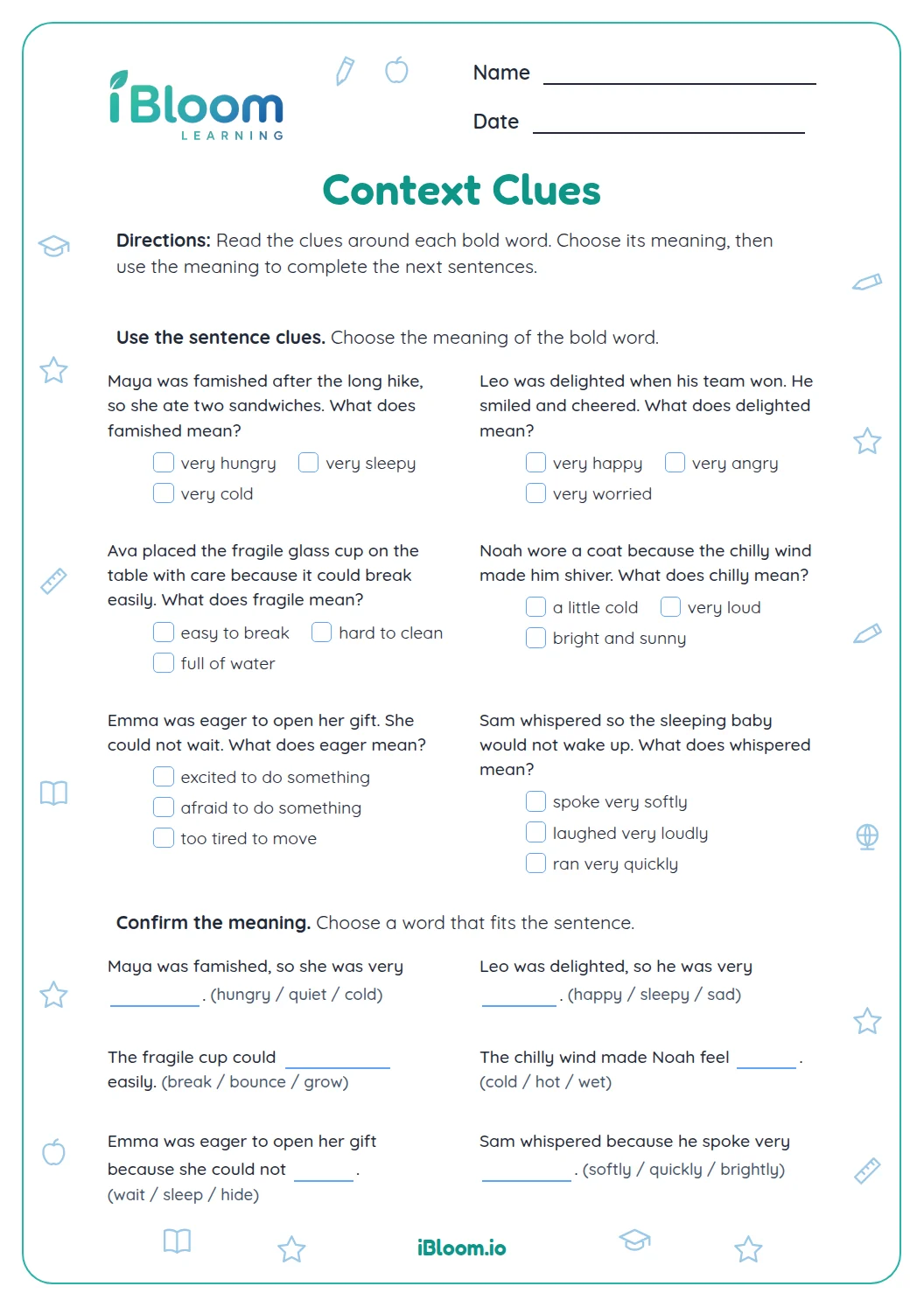
This free Grade 2 vocabulary worksheet brings alphabetical order and word meanings together. Children first sort four groups of three words, comparing later letters when the first letters match. They then answer four questions using printed mini glossaries. In the final four questions, they identify a word from its definition and decide whether it comes before or after another entry. The glossary work supports Common Core L.2.4e, using reference entries to clarify word meanings. All entries needed for the questions are printed on the sheet, and a separate answer key lists the ordered groups, choices, and two-part responses.
Aligned to L.2.4e
What happens when words start with the same letter?
Compare the next letters until you find a difference. The words mop, map, and mud all start with m, so children compare o, a, and u. The order is map, mop, mud.
Question 4 moves the comparison one letter farther: clip, clap, and club all start with cl. Children compare the third letters and write clap, clip, club.
How do the mini glossaries teach word meaning?
Each mini glossary prints a word followed by a short definition. Children read the entries to answer the question, so no separate reference book is needed. Several questions ask them to apply the definition, such as choosing dim for a faint lamp.
Encourage children to point first to the entry word and then to its definition. This makes the two functions visible: the entry names the word being explained, while the definition supplies its meaning.
How do children combine meaning and order?
Part C combines a glossary meaning with the word’s place in ABC order. Children choose the pair that matches both clues, comparing the letters when the words begin alike.
- 1peek = look quickly; peer = look closely
- 2“Look closely” matches peer.
- 3Both words start with pee; compare k and r.
- 4k comes before r, so the answer is peer; after.
How to use this worksheet
- 1Say the alphabet together or keep an alphabet strip nearby.
- 2Complete Part A by comparing one letter at a time.
- 3Read each Part B entry before looking at the answer choices.
- 4In Part C, identify the meaning first and compare the spellings second.
- 5Check both pieces of each Part C response with the answer key.
Mistakes to check together
The mistake
Sorting by word length instead of letter order.
The fix
Cover the endings and compare the first letters, moving right only when needed.
The mistake
Stopping at a shared first letter.
The fix
For clip, clap, and club, compare the third letters because cl is shared.
The mistake
Answering only the meaning question in Part C.
The fix
Check for both the entry word and a before-or-after decision.
Common Core alignment
Use printed mini glossaries to find and clarify word meanings.
On this sheet: Parts B and C supply glossary entries that children consult to identify the requested meanings.
Show the official wordingHide the official wording
Use glossaries and beginning dictionaries, both print and digital, to determine or clarify the meaning of words and phrases.
What to practice next
Make more practice
Further reading
Questions parents and teachers ask
Does my child need a separate dictionary?
No, the worksheet prints every glossary entry needed for Parts B and C. Each entry pairs a word with a short definition, such as weary meaning tired. Children can practice consulting a reference entry directly on the page, then use the same routine with a classroom glossary.
How far into each word must children compare letters?
Children compare letters until they find the first difference. In mop, map, and mud, the second letter decides the order. In clip, clap, and club, the first two letters match, so the third letter decides. The peek and peer comparison in Part C reaches the fourth letter.
What do the Part C choices ask children to do?
Part C pairs a definition with an ABC-order comparison in each question. Children choose the entry that matches the meaning, then use the first different letter to decide whether it comes before or after the other word. For example, peer follows peek because r comes after k.
Why include both alphabetical order and definitions?
The two skills serve different parts of using a glossary. Letter order helps children locate an entry, and the definition helps them understand it. This sheet first practices each job separately, then combines them in four questions so children must check both spelling order and word meaning.
How can I help with the word sorts?
Give your child an alphabet strip and ask which letter first makes the words different. For clap, clip, and club, point out the shared cl and compare a, i, and u. Have your child say the ordered words aloud before writing them on the answer line.