






About this worksheet
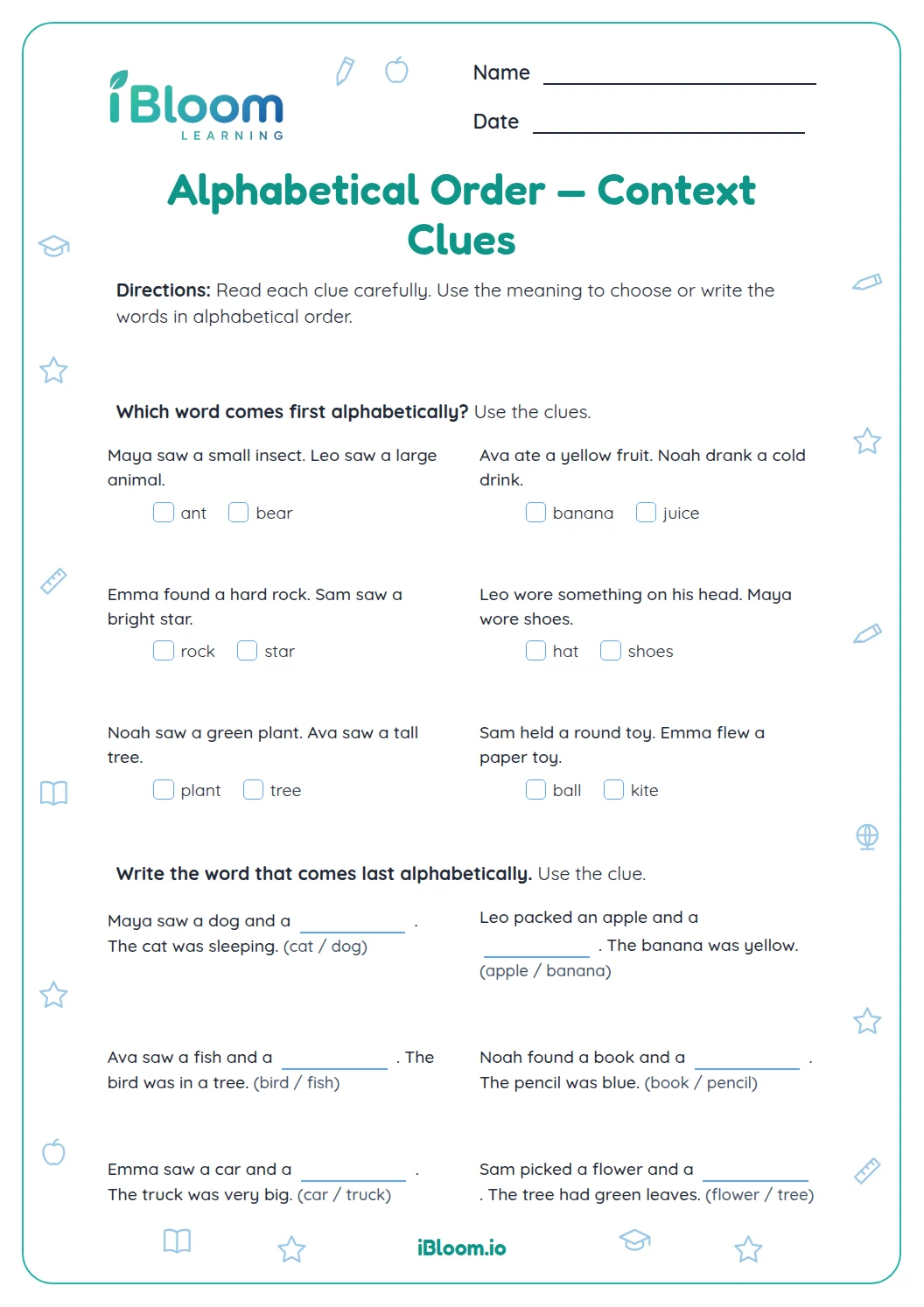
This free Grade 2 printable gives students 14 alphabetical-order questions. They sort word groups and choose which word comes first or last, including close spellings that share beginning letters. A separate answer key supports checking each response.
What does alphabetical order mean?
Alphabetical order places words by the order of their letters, from A through Z. Compare the first letter in each word. The word with the earlier letter comes first.
When first letters match, compare the second letters, then the third if needed. Keep moving from left to right until one letter decides the order.
How do you compare words that start alike?
Read the spellings carefully, not just the sounds or meanings. For “clock, cloud, clown,” c and l match, then o matches; compare the next letters to place them.
- 1Words: cloud, clock, clown
- 2The first three letters match in each word.
- 3Compare the fourth letters: u, o, and l.
- 4Order: clock, cloud, clown.
What will students practice?
The 14 questions mix complete three-word sorts with first-word and last-word choices. Several sets share their first letters, so students compare spellings from left to right.
How to use this worksheet
- 1Say the alphabet together once from A to Z.
- 2Read each word and compare its first letter.
- 3When letters match, compare the next letter in both words.
- 4For a three-word sort, find the earliest word, then compare the remaining pair.
- 5Check the key and explain which letter decided a close pair.
Common mistakes and quick fixes
The mistake
Stopping after matching first letters.
The fix
Compare the next letter, then keep moving until the letters differ.
The mistake
Sorting by how important or familiar a word feels.
The fix
Use spelling order only; word meaning does not set the sequence.
The mistake
Skipping a word when sorting three items.
The fix
Write all three words in order and check that each appears once.
What to practice next
Make more practice
Questions parents and teachers ask
How do I put words in alphabetical order?
Compare the first letter of each word, using the alphabet from A to Z. When two words start with the same letter, compare the second letter; if those match too, move to the third letter. This sheet includes several sets with shared first letters.
What does ABC order mean?
ABC order arranges words by their letters in the same order as the alphabet. For example, apple comes before peach because A comes before P. Students sort short word sets and identify which word belongs first or last, using spelling rather than meaning.
Why do some words begin with the same letter?
Those questions ask students to look beyond the first letter. Compare the next letters from left to right until one pair differs. In chair and cheese, c and h match, so compare a and e; chair comes first.
How many questions are on this printable?
There are 14 multiple-choice questions in two parts. Students sort complete three-word sets, choose which word comes first, and decide which word comes last. The separate answer key gives the correct order or target word for each item.
Can an adult read the words aloud?
Yes. An adult can read the words aloud while the student compares their spellings to decide the order. Invite the child to point to the first letter, then move along the words when starting letters match. The alphabet order is the clue.
What should we do after checking an answer?
Choose one set that was tricky and explain how the letters decided the order. Ask which letter was the first one that differed. That brief explanation helps show whether the student compared the whole spelling instead of guessing from meaning.