




About this worksheet
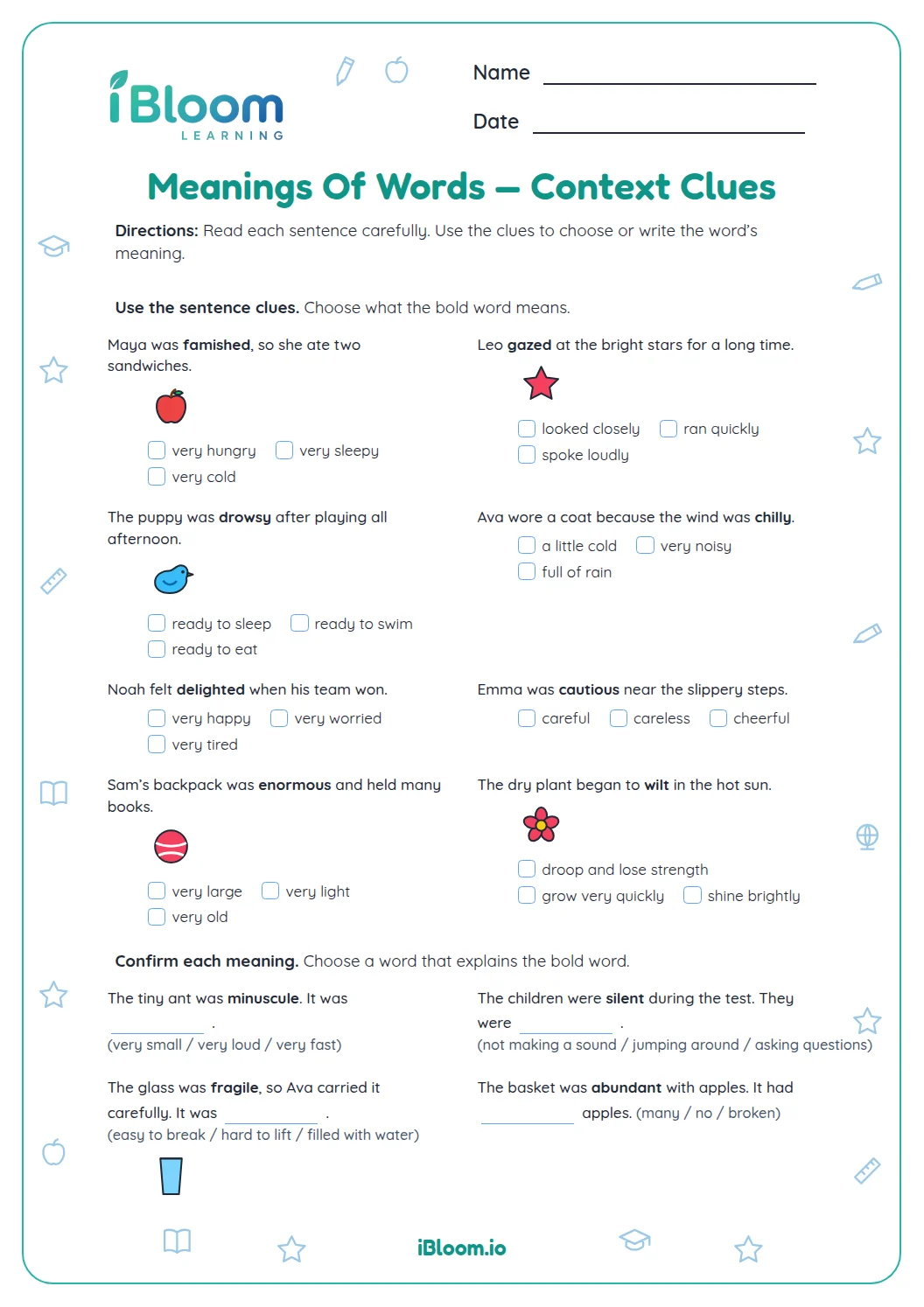
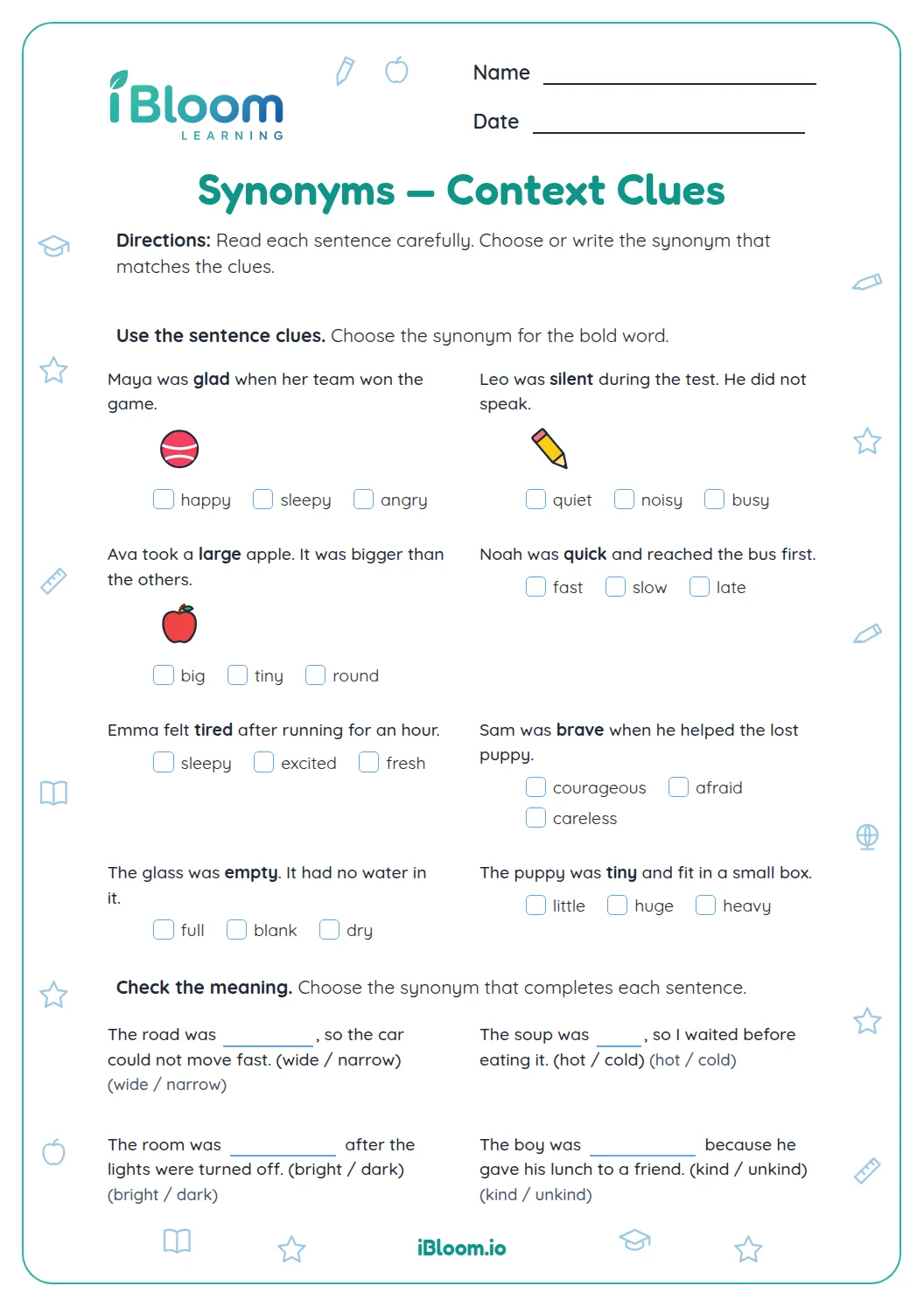
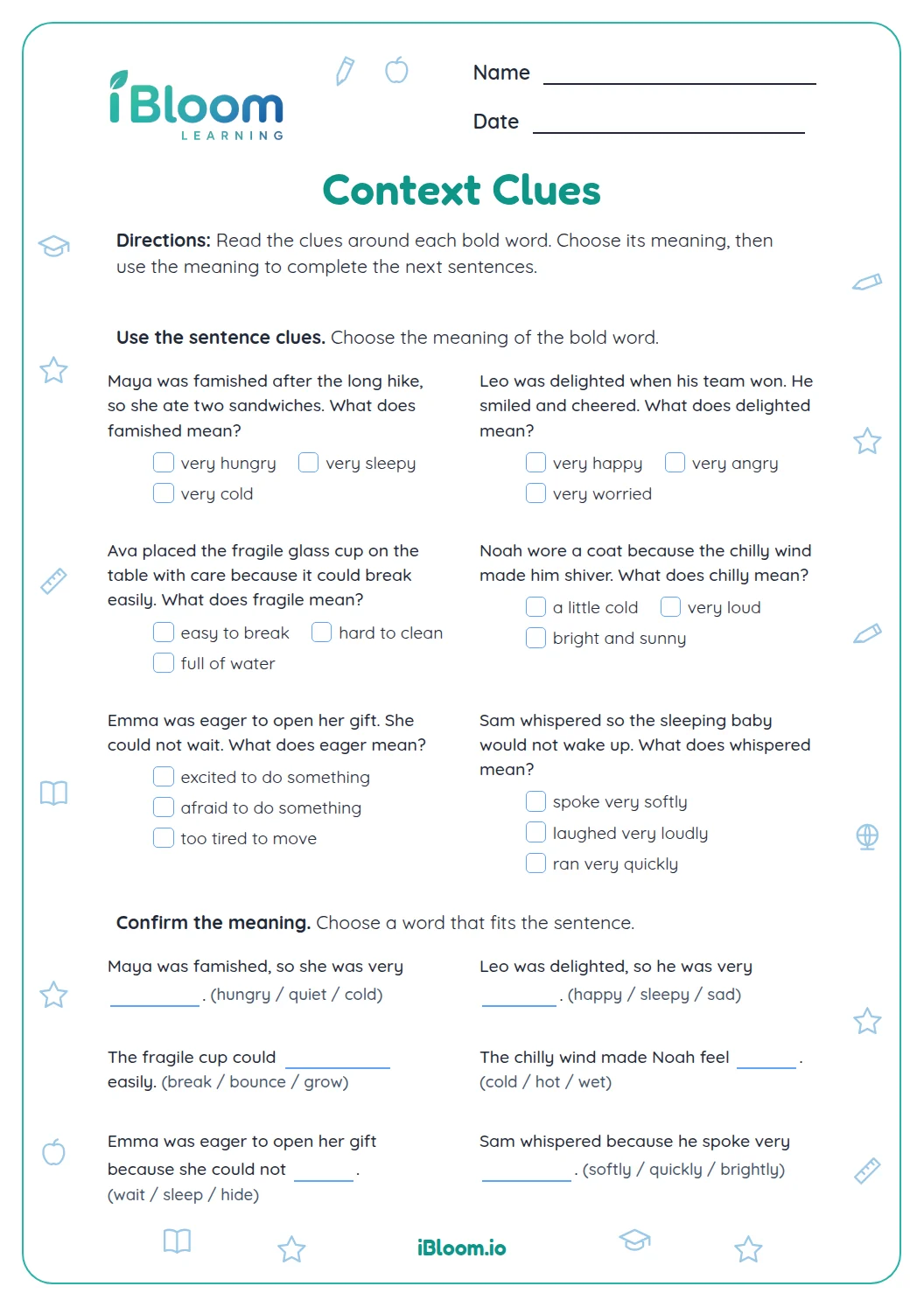
This Grade 2 vocabulary worksheet teaches students to use sentence-level context to figure out unfamiliar word meanings. In Part A, children choose meanings for words supported by nearby details. Part B completes a definition from a clue, and Part C explains meanings in short contexts. Fourteen questions fill two worksheet pages, followed by a separate answer key with sample explanations. It aligns with L.2.4a.
Aligned to L.2.4a
What does each part practice?
Part A selects meanings for words such as timid and sturdy using sentence clues. Part B completes a meaning from a clue, and Part C uses examples or restatements to confirm a word’s meaning in a new sentence.
How does a sentence help define filthy?
In “The muddy boots were filthy, so Lena washed them,” the words muddy boots and washed them point to dirt. The best meaning is very dirty. The clue supports the answer instead of asking the reader to guess from the word alone.
What should students do when the clue is subtle?
Reread the whole sentence and try each possible meaning in context. If the sentence says a box did not bend, strong is a better meaning for sturdy than soft or small. Check that the chosen meaning makes the whole sentence sensible.
How to use this worksheet
- 1Read the entire sentence, including the words after the target word.
- 2Notice an example, action, or restatement that helps explain it.
- 3Try a possible meaning in place of the target word.
- 4Check whether the replacement makes sense in the sentence.
- 5For an explanation, name the clue as well as the meaning.
Common mistakes and quick fixes
The mistake
Choosing a meaning from the target word alone.
The fix
Reread the sentence and use the details around the word.
The mistake
Stopping at a broad meaning.
The fix
Use the clue to choose a precise meaning, such as very dirty for filthy.
The mistake
Giving a meaning without citing the sentence clue.
The fix
Point to the example or action that supports the definition.
Common Core alignment
This sheet gives students practice with the following standard.
Use sentence-level clues in the worksheet to determine word and phrase meanings.
On this sheet: Use sentence-level clues in the worksheet to determine word and phrase meanings.
Show the official wordingHide the official wording
Use sentence-level context as a clue to the meaning of a word or phrase.
What to practice next
Make more practice
Further reading
Questions parents and teachers ask
What is a context clue?
A context clue is a nearby word, example, or explanation that helps a reader work out meaning. In “The muddy boots were filthy, so Lena washed them,” the muddy boots and washing action point to very dirty. The learner can point to the clue before explaining why the meaning fits.
What does this worksheet ask students to do?
Students choose meanings, complete a meaning from a clue, and explain meanings in short sentences. The 14 questions use target words including timid, sturdy, narrow, parched, and filthy. Ask students to point to the clue in the sentence before checking the key.
How should students solve an unfamiliar word?
Read the whole sentence and look for what happens or what is explained nearby. Then substitute a possible meaning and check that it fits. The worksheet’s Part C asks learners to use that routine in fresh contexts. Students can underline the clue words before deciding whether the replacement fits.
Does the answer key accept different explanations?
Yes. The answer key gives the central meaning and sample wording for open responses. A student can use different words if the meaning is accurate and the explanation points to the same sentence clue. The key supports review after the student has tried each meaning independently.
What is an example from the page?
For “The sturdy box did not bend,” the clue is that the box did not bend. That supports sturdy meaning strong or not easy to break. The sentence helps narrow the intended meaning. Students can explain which words in the sentence support their chosen definition.