




About this worksheet
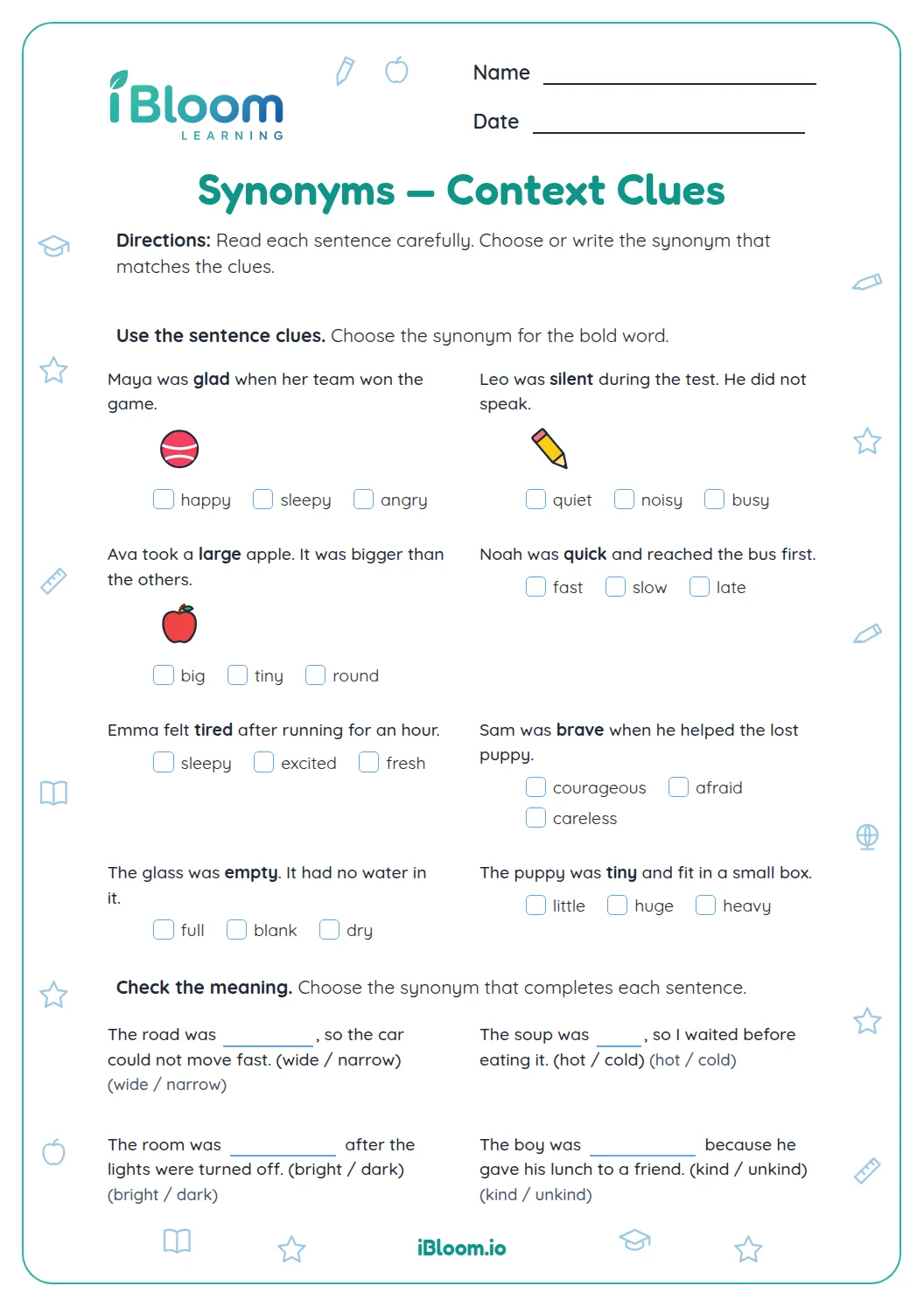
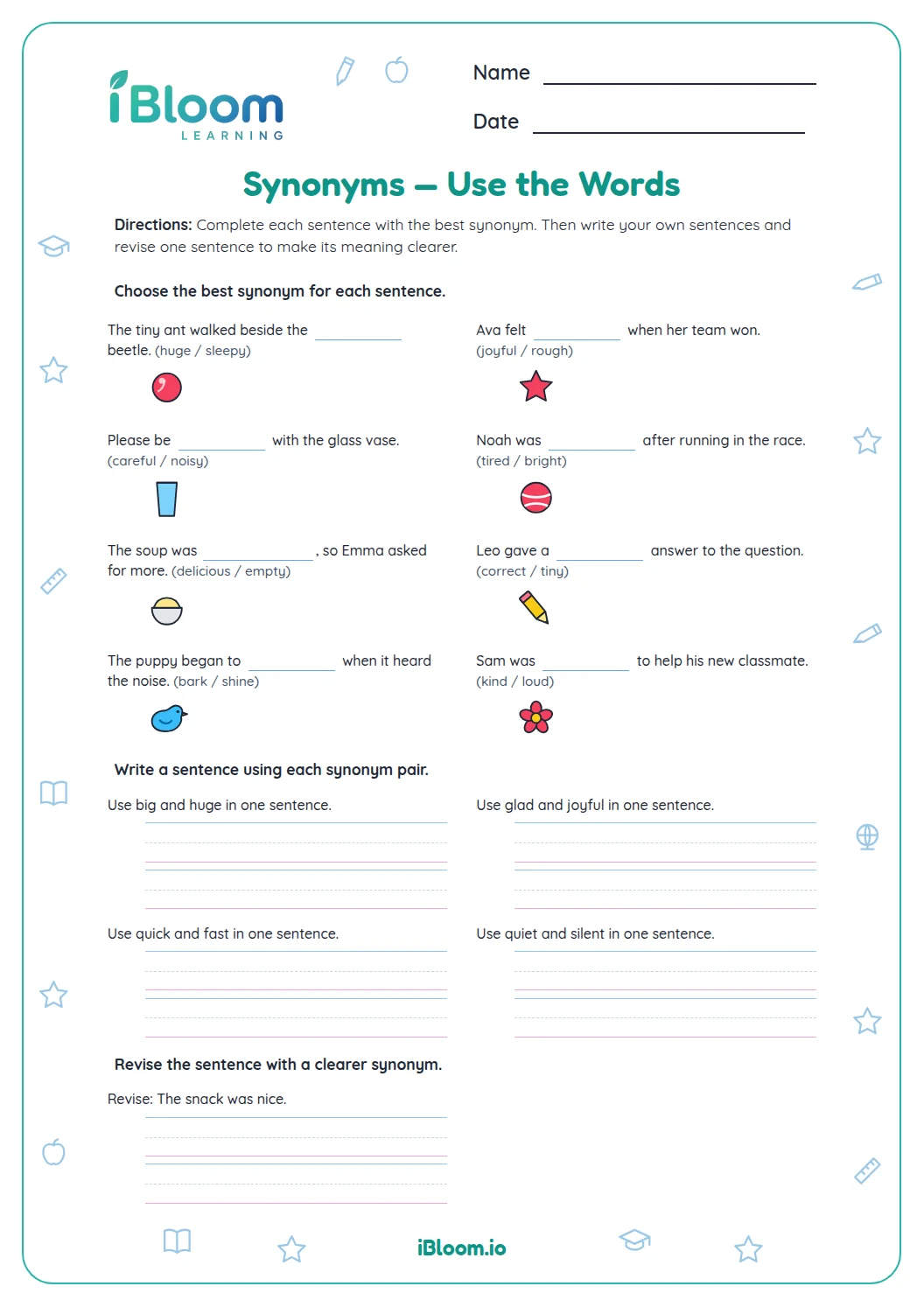
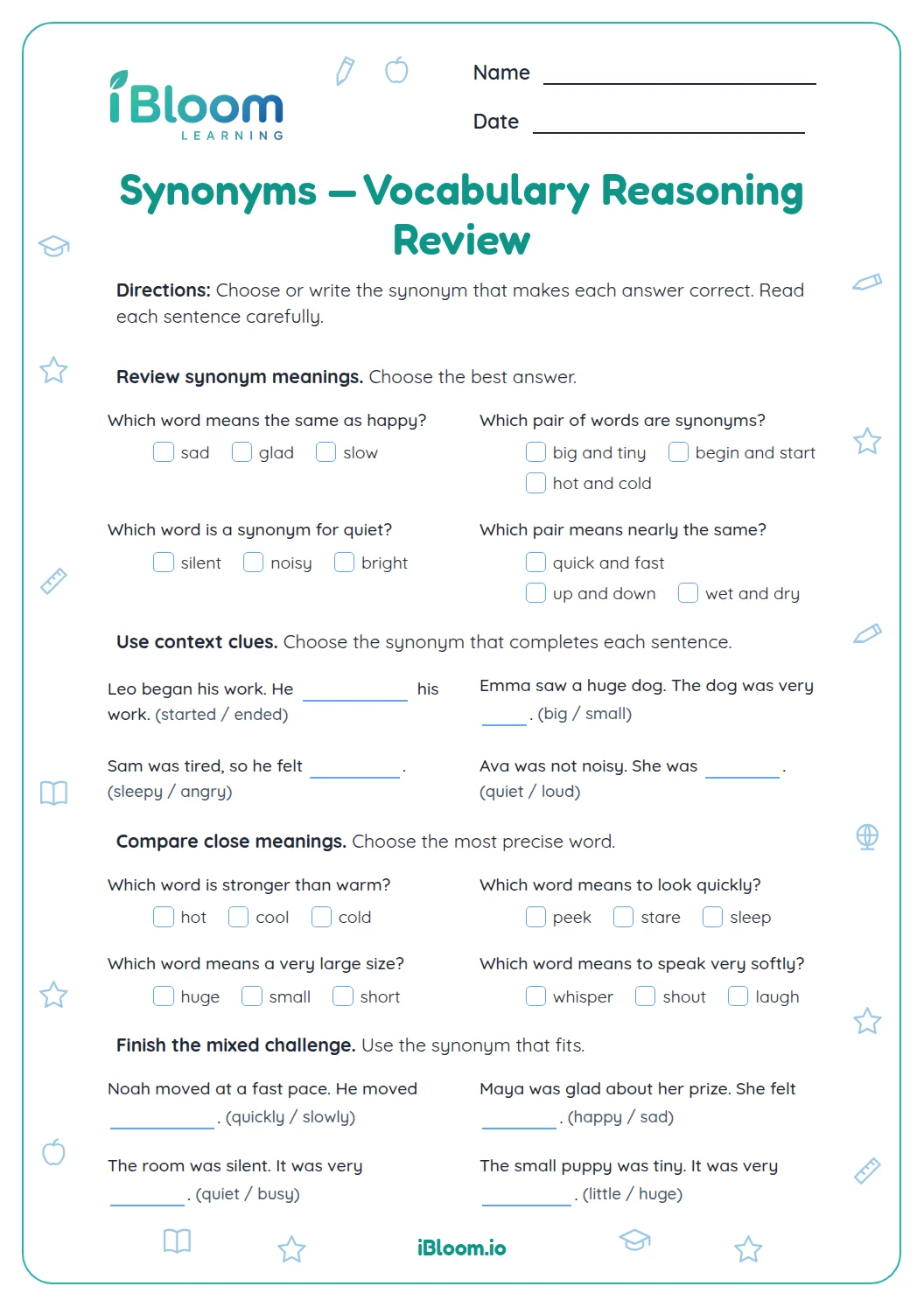
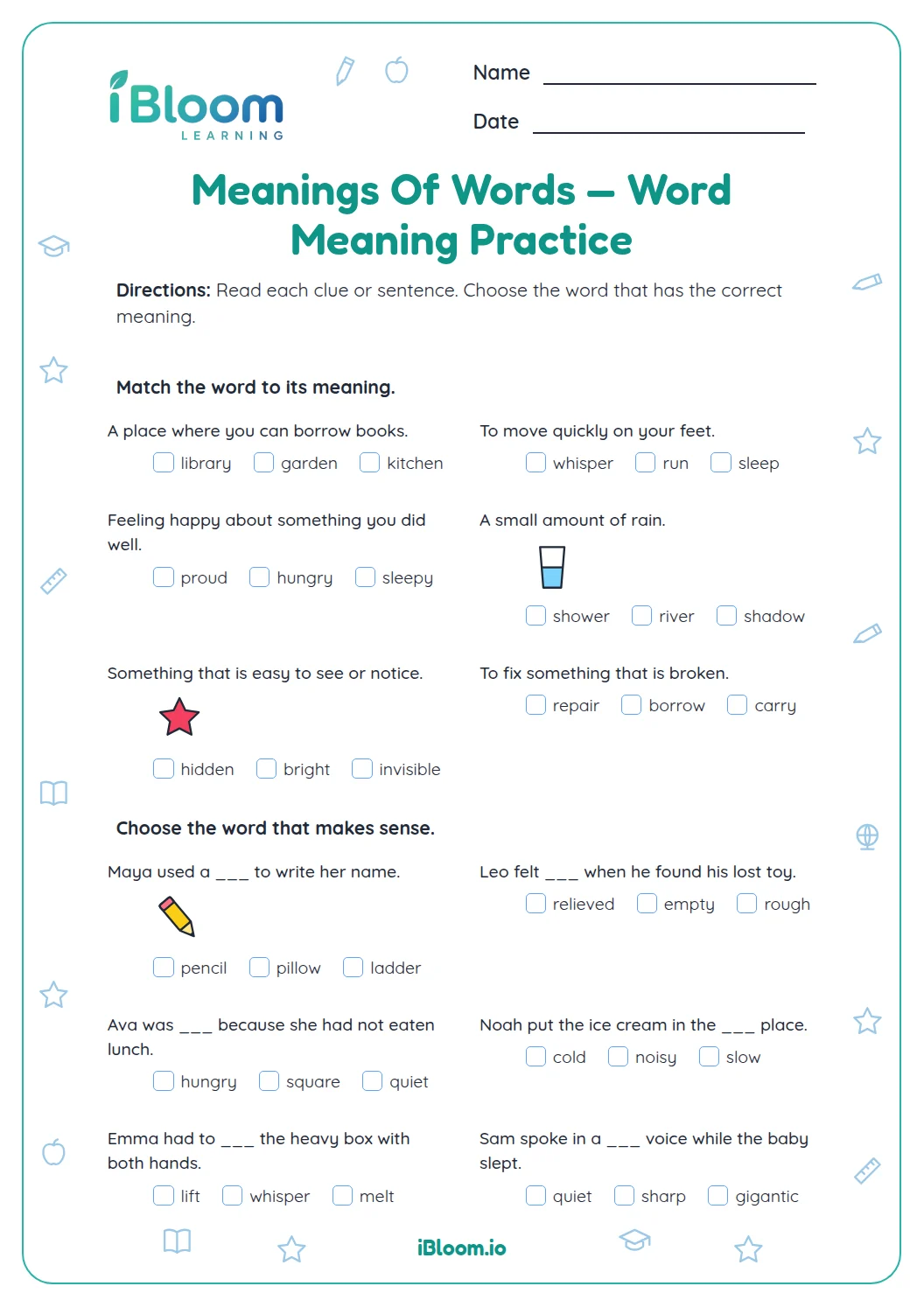
This free printable Grade 2 vocabulary worksheet helps children connect synonyms with the meanings of sentences. Part A has six questions about familiar words: happy, small, quick, begin, angry and large. Part B has six short sentences, each with a capitalized word to replace. Children choose a synonym that keeps the sentence meaning, using details such as a bird fitting in a hand. The sheet practices CCSS L.2.5 and L.2.4a through word relationships and context clues. A separate answer key marks the correct choice for all twelve questions.
Aligned to L.2.5 and L.2.4a
What are the synonym pairs on this sheet?
Part A introduces happy/glad, small/little, quick/fast, begin/start, angry/mad and large/big. Part B revisits these relationships in sentences and adds tiny as another word close in meaning to small.
Describe synonyms as words with the same or nearly the same meaning. Tiny suggests something especially small, so it is useful to discuss the slight difference even though small is the best replacement among the choices.
How does a sentence help a child choose a synonym?
Question 7 says, “The TINY bird fit in my hand.” Fitting in one hand is a clue about size. Small preserves that idea, while angry changes the sentence to a statement about feelings and bright changes it to a statement about appearance.
Have the child substitute the chosen word and reread the entire sentence. This tests both the word relationship and whether the replacement fits naturally.
- 1Original: The TINY bird fit in my hand.
- 2Clue: fit in my hand tells us about size.
- 3Choices: angry, small, bright
- 4Replacement: The small bird fit in my hand.
- 5Answer: small
How should I respond to a wrong choice?
Ask the child what the chosen word means before giving the answer. For begin and finish, act out starting and ending a short task. Both words relate to the task, but they describe opposite moments.
For Part B, compare the original and revised sentences aloud. A sentence can still sound grammatical while its meaning changes. The runner could be quiet, but quiet is not a synonym for quick.
For extra context practice, cover the target word in question 9 and read “taking our first turns.” In question 12, “too big to fit on the shelf” explains large directly. These clues let children justify their choices using the sentence.
Practice replacing a word without changing the message
- 1Explain same or nearly the same meaning using happy and glad.
- 2Let your child choose the six Part A synonyms and say each pair aloud.
- 3In Part B, read the complete sentence before looking at its choices.
- 4Replace the capitalized word with the selected word and reread the sentence.
- 5Check the key, then revisit any choice that changed the message.
Synonym mistakes and fixes
The mistake
Choosing sad for happy because both name feelings.
The fix
Name the feeling each word expresses. Glad matches happy; sad expresses an opposite feeling.
The mistake
Choosing finish for begin because both describe doing a task.
The fix
Act out starting and stopping. Begin pairs with start, not finish.
The mistake
Choosing bright for tiny because a bird could be bright.
The fix
Use the size clue “fit in my hand.” Small keeps the meaning of tiny in this sentence.
Common Core alignment
Connect words that have the same or nearly the same meaning.
On this sheet: Students identify synonyms and consider which replacement preserves a sentence’s meaning.
Show the official wordingHide the official wording
Demonstrate understanding of word relationships and nuances in word meanings.
Use details in each sentence to choose a word with the intended meaning.
On this sheet: Part B gives contextual clues about size, speed, feelings and starting an activity.
Show the official wordingHide the official wording
Use sentence-level context as a clue to the meaning of a word or phrase.
What to practice next
Make more practice
Further reading
Questions parents and teachers ask
How many synonym questions are included?
There are twelve multiple-choice questions, split into two parts of six. Part A asks for synonyms of individual words, and Part B asks for replacements within sentences. Each item has three choices and one correct answer, with the correct positions varied across the page.
What does a word in capital letters mean on this sheet?
A capitalized word in Part B is the word your child should replace. Read the whole sentence first, choose a synonym and then reread using that choice. For example, taking the first turns gives a clue that BEGIN means start in the sentence about a game.
Are small and tiny exactly the same?
They are close in meaning, but tiny usually suggests something very small. In the bird sentence, small is the best synonym among the three choices because both words describe size. You can discuss that slight difference after your child chooses the answer and rereads the sentence.
Can I read the sentences aloud to my child?
Yes, you can read the sentences aloud to focus on vocabulary meaning. Keep the target word visible and let your child make the choice. Then ask for a reason using the sentence, such as the bird fitting in a hand or the runner finishing before everyone else.
How do we use the separate answer key?
Check the key after your child has tried both parts. For any different answer, reread the sentence with that choice and discuss whether it keeps the original meaning. The key marks all twelve correct options, so you can check the word pairs as well as the sentence replacements.