




About this worksheet
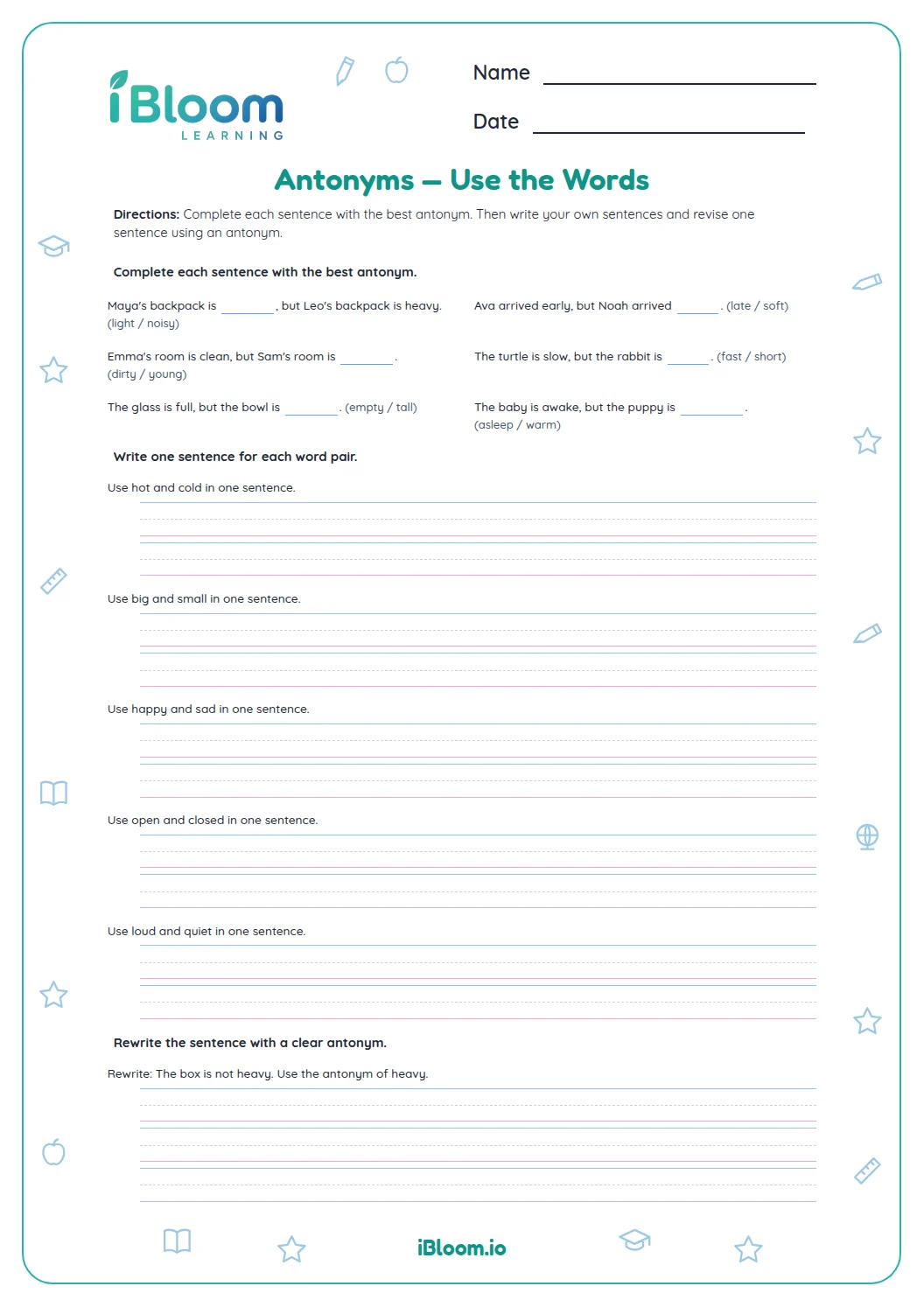
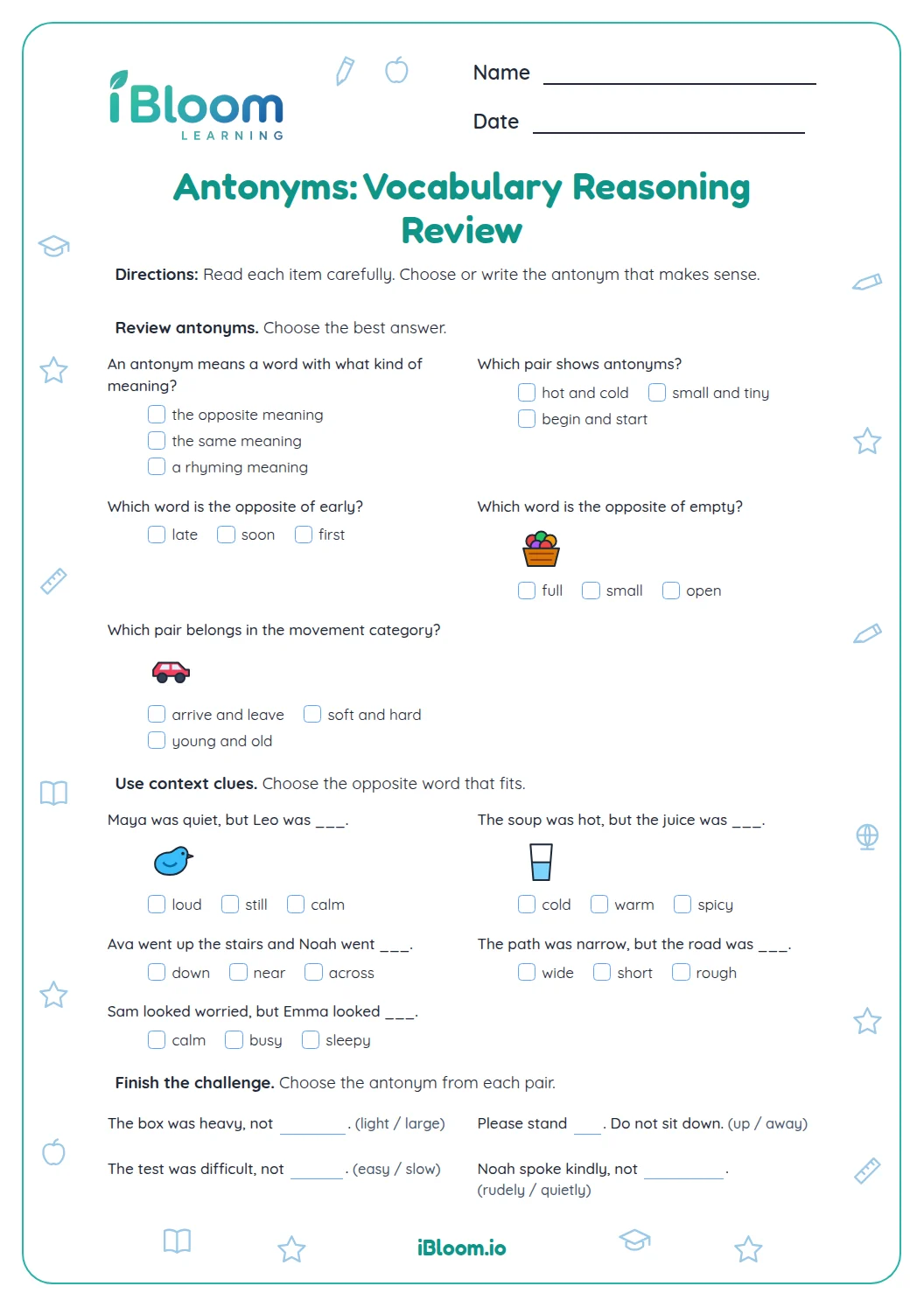
This free printable Grade 2 vocabulary worksheet helps children use sentence context to write antonyms. Each item gives a contrast, such as hot soup and cold lemonade, so the opposite word must fit both the meaning and the sentence. The 16 fill-in-the-blank questions practice word relationships in context and align with Common Core L.2.5. The answer key lists the word that completes each sentence.
Aligned to L.2.5
What is an antonym?
An antonym is a word with an opposite meaning. Hot and cold are antonyms. A sentence can help readers notice the relationship by putting contrasting ideas together.
How does context help identify an antonym?
Look for a contrast word such as but or not. Then write an opposite of the described word that still makes sense in the sentence.
- 1The soup was hot, but the lemonade was ___.
- 2Hot and cold are opposites.
- 3Answer: cold.
How do you check the answer?
Read the sentence again with your word in the blank. A strong answer is both an antonym and a natural fit for the sentence.
How to use this worksheet
- 1Read the full sentence before writing an answer.
- 2Notice the contrast word, such as but or not.
- 3Say the opposite of the target word.
- 4Read the full sentence again with the antonym in place.
- 5Check the answer key and reread any sentence that felt tricky.
Common mistakes and quick fixes
The mistake
Choosing a related word that is not an opposite.
The fix
Ask whether the two words have reverse meanings, not just a connection.
The mistake
Ignoring the contrast clue.
The fix
Circle words such as but or not and use the second part of the sentence.
The mistake
Writing an opposite that does not fit the sentence.
The fix
Read the complete sentence with the word in place and check that it sounds sensible.
Common Core alignment
This page connects the worksheet practice to a specific Common Core skill.
Use word relationships to understand opposites in sentences.
On this sheet: Children use the contrast in each sentence to select an antonym that fits its context.
Show the official wordingHide the official wording
Demonstrate understanding of word relationships and nuances in word meanings.
What to practice next
Make more practice
Further reading
Questions parents and teachers ask
What is an antonym?
An antonym is a word with the opposite meaning. Hot and cold are opposites. Here each short sentence sets up a contrast, and the blank is for an antonym that makes sense in context. The answer key lists one word for each blank. Read it back aloud to check.
How many questions are included?
There are 16 fill-in-the-blank questions across two worksheet pages. Each sentence has a context clue, such as but or not, and one blank for the antonym. A separate answer key lists the word for each item and lets learners check their work.
What clues should children look for?
Words such as but and not often signal a contrast. Children can compare the first description with the second, then write an opposite that fits the sentence. Reading the completed sentence again helps check that the word works in both meaning and grammar.
Can an antonym depend on the sentence?
Yes. A word can have more than one possible opposite depending on how it is used. The sentence narrows the meaning here, and children write an antonym that fits the contrast. Asking them to say the opposite pair aloud can make the relationship clearer.
Does the answer key include explanations?
The key lists the correct antonym for each question. To extend practice, ask the child to explain which word in the sentence signals the contrast and how the opposite fits. The key makes it easy to check the word that completes each context clue.
Is this different from a synonym worksheet?
Yes. A synonym has a similar meaning, while an antonym has an opposite meaning. This page asks children to complete contrasts such as hot versus cold or empty versus full. Reading the full sentence again helps confirm both meaning and grammar.