Free printable practice
Shades Meaning Practice Activities
Grade 2 printable vocabulary worksheets for understanding shades of meaning between closely related words.
Free printable worksheet PDFs
Preview every available page, then download the free worksheet PDF for home, homeschool, tutoring, or classroom practice.
Preview the exact activity before downloading it.
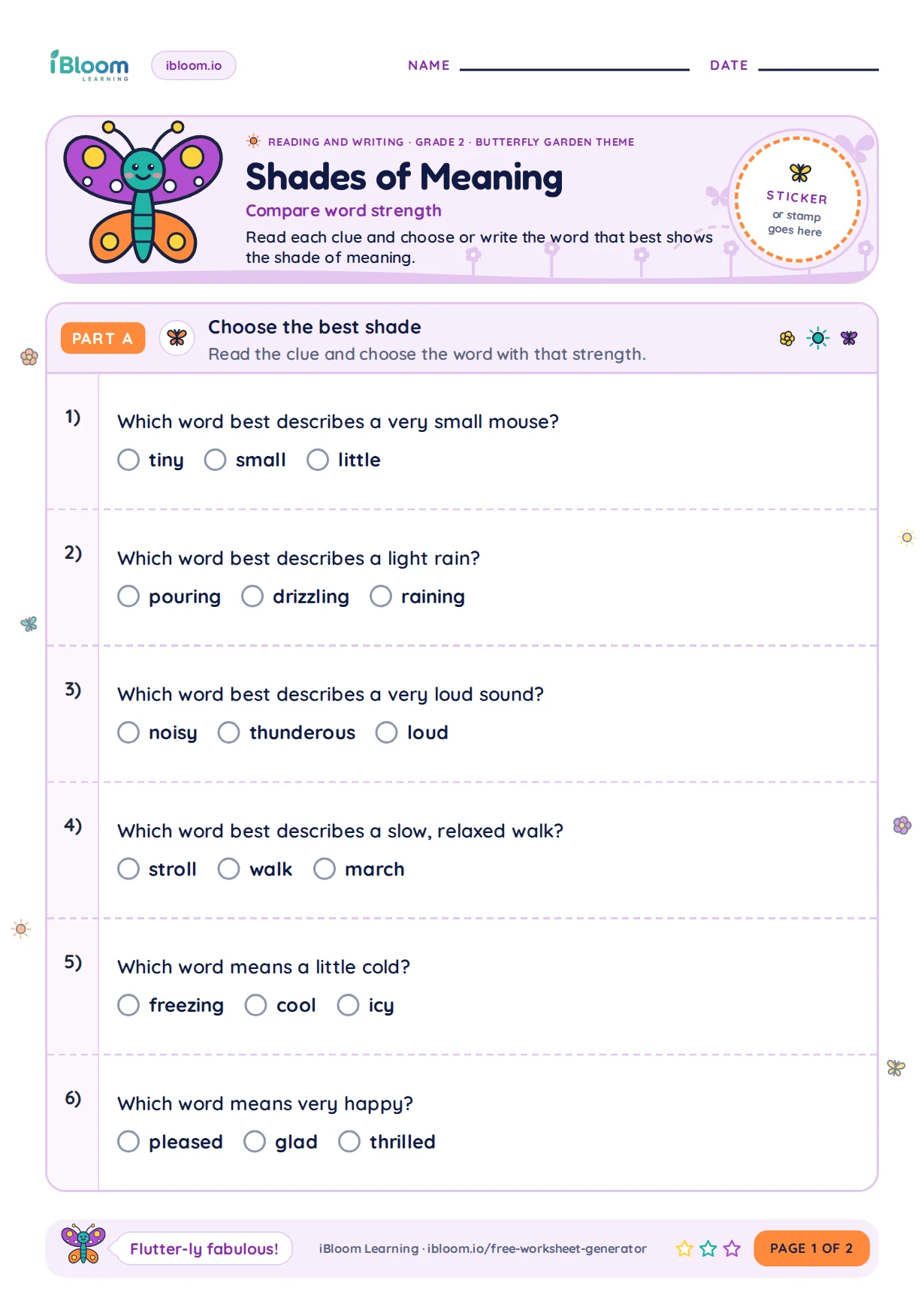 Shades Meaning — Word Meaning PracticeGrade 2 printable vocabulary worksheets for understanding shades of meaning between closely related words. This word meaning practice worksheet provides a distinct, age-appropriate way to practise the same lesson.Grade 2Free PDF preview
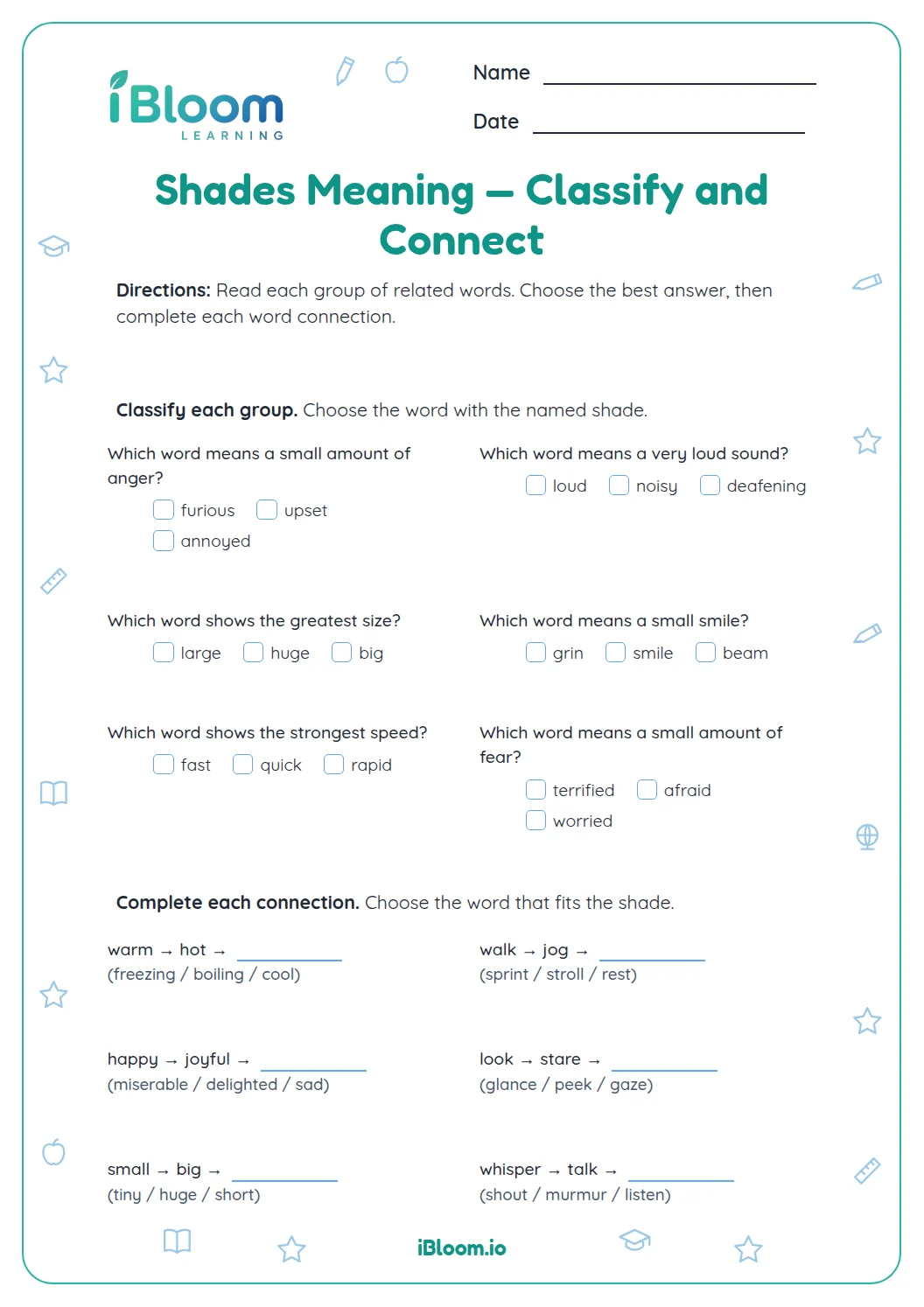 Shades Meaning — Classify and ConnectGrade 2 printable vocabulary worksheets for understanding shades of meaning between closely related words. This classify and connect worksheet provides a distinct, age-appropriate way to practise the same lesson.Grade 2Free PDF preview
 Shades Meaning — Context CluesGrade 2 printable vocabulary worksheets for understanding shades of meaning between closely related words. This context clues worksheet provides a distinct, age-appropriate way to practise the same lesson.Grade 2Free PDF preview
 Shades Meaning — Use the WordsGrade 2 printable vocabulary worksheets for understanding shades of meaning between closely related words. This use the words worksheet provides a distinct, age-appropriate way to practise the same lesson.Grade 2Free PDF preview
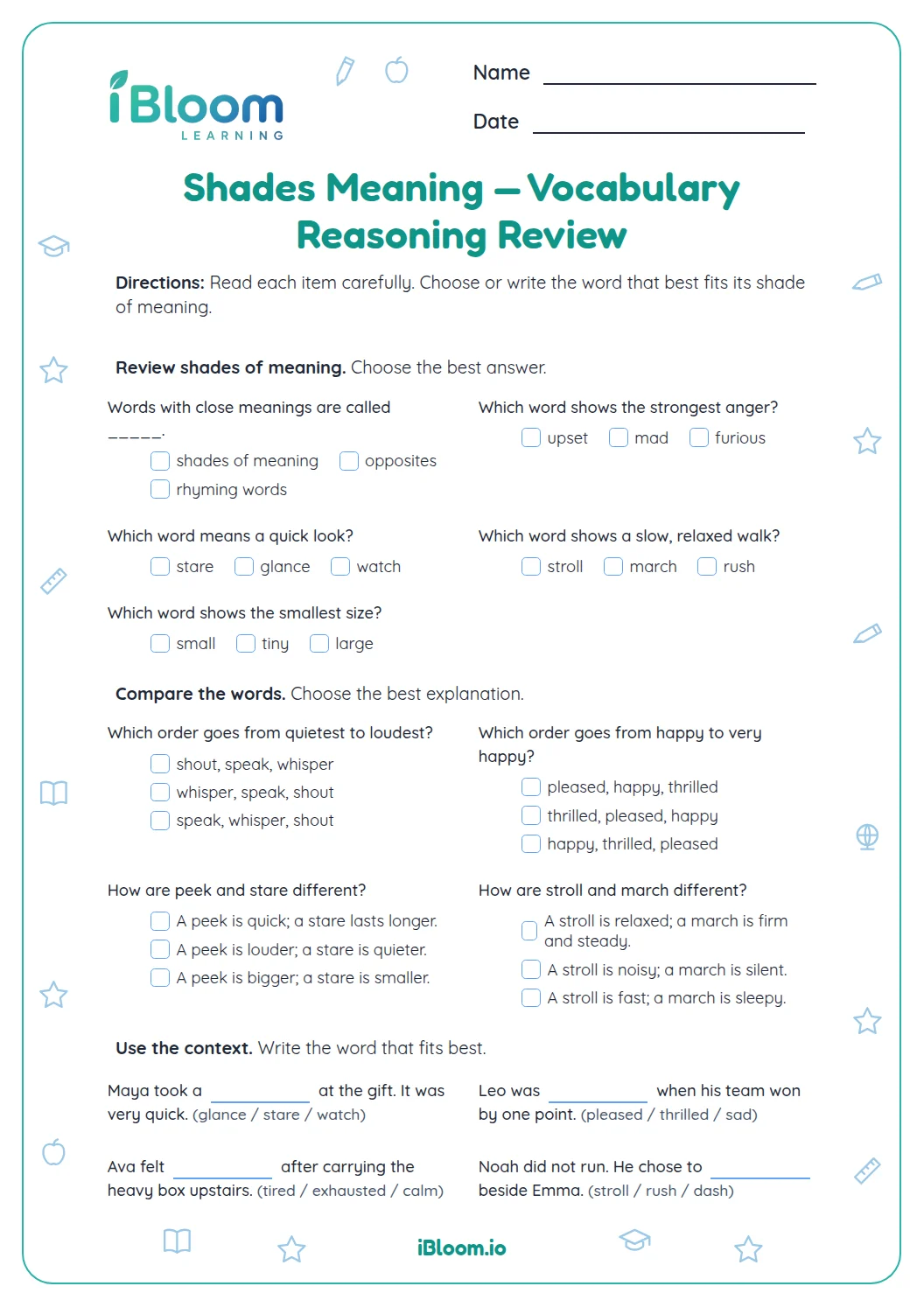 Shades Meaning — Vocabulary Reasoning ReviewGrade 2 printable vocabulary worksheets for understanding shades of meaning between closely related words. This vocabulary reasoning review worksheet provides a distinct, age-appropriate way to practise the same lesson.Grade 2Free PDF preview
Practice that builds confidence
What “shades of meaning” means
These Grade 2 vocabulary worksheets help children notice shades of meaning—small differences between related words such as look, stare, and glare or tiny, small, and huge. Children practice choosing words that match a feeling, action, or degree of intensity.
Printable activities include sorting words from weakest to strongest, matching words to sentences, replacing dull words with more exact choices, and using context clues to pick the best word. The pages build word awareness for reading comprehension and clearer writing.
Shades of meaning are the fine differences between words that seem similar but are not exactly the same. A child may know that mad and furious are related, but these worksheets help them see that furious shows a stronger feeling. This skill supports vocabulary growth because children learn to choose words by meaning, not just by topic.
How the practice progresses
Activities begin with simple word groups, where children compare familiar adjectives and verbs. They may place words in order of strength, choose which word best completes a sentence, or decide whether two words have almost the same meaning. Later tasks ask students to use context clues, so they learn why stroll fits one sentence while rush fits another.
A parent routine that works
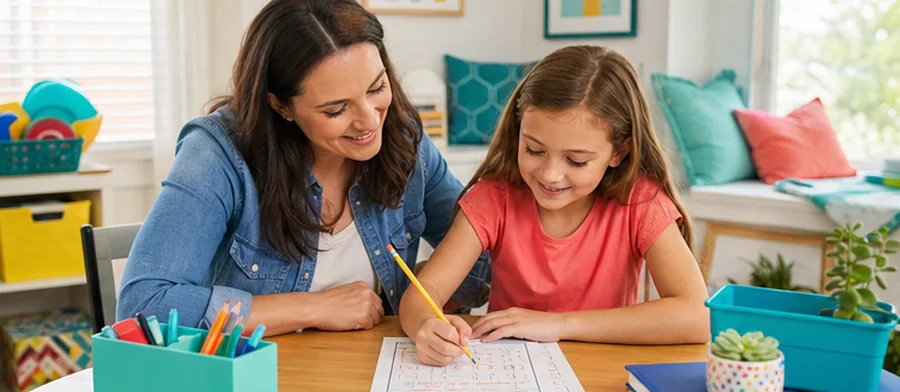
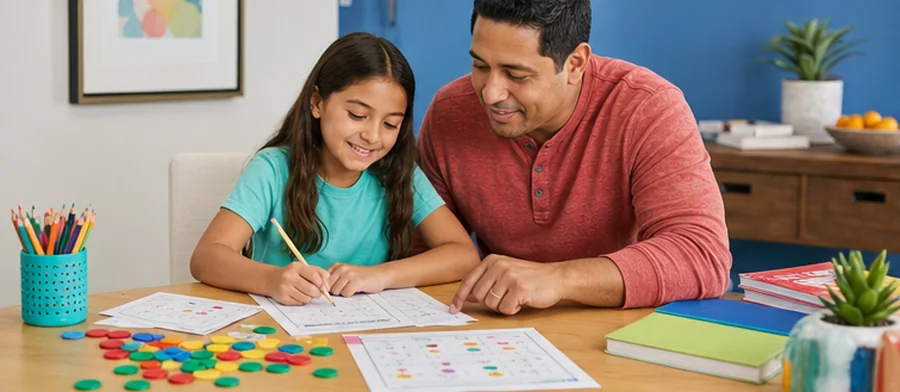
At home, read one word set aloud and ask your child to act out or describe each word. For example, compare walk, march, and stomp. Then have your child explain which word is strongest and why. Finish by asking them to write or say one sentence using the most exact word, such as “The giant stomped across the bridge.”
Classroom uses for teachers
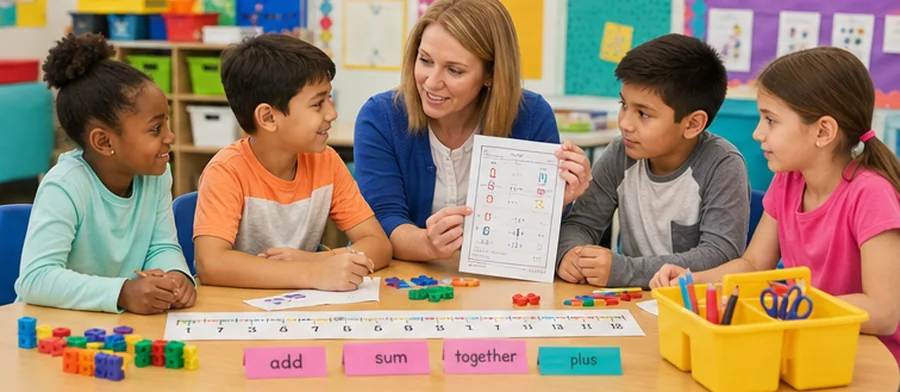
Teachers can use these printables during vocabulary lessons, literacy centers, small-group reading, or writing conferences. The sorting pages work well for partner talk because students must justify their choices. Sentence-based questions are useful before narrative writing, helping children replace general words like said, nice, or big with more precise choices.
Common errors to watch for
Second graders often choose the longest word instead of the most accurate one. They may also think all synonyms are interchangeable, even when the feeling or intensity changes. Encourage students to check the whole sentence and ask, “Does this word sound too weak, too strong, or just right?”
Free printable PDF download
Use this grade 2 shades of meaning worksheet page to preview the activity, print it, or download it as a PDF for quick practice. It works well for homework, homeschool lessons, tutoring, morning work, revision, and classroom centers.
Answers and answer key support
After the child completes the worksheet independently, parents and teachers can use the answer support or answer key information to check the work, review mistakes, and choose the next practice step.
Why iBloom worksheets help
The worksheets give children repeated practice with clear word sets, meaningful contexts, and visual ordering tasks. A child-friendly strategy is: read the sentence, picture the action or feeling, compare the word choices, then pick the word that matches the picture best.
Helpful answers
Frequently asked questions
What are shades of meaning in Grade 2 vocabulary?
Shades of meaning are small differences between related words. For example, peek, look, and stare all involve seeing, but each word shows a different kind or strength of action.
How do these worksheets help with writing?
They help children replace general words with more exact ones. Instead of writing “The dog was big,” a student might choose huge or enormous if the sentence needs a stronger meaning.
Are these activities only about synonyms?
No. The worksheets include synonym groups, but the focus is on how similar words differ in strength, feeling, or use in a sentence.
What should my child do if two answers seem correct?
Ask your child to reread the sentence and picture what is happening. Then compare which word is too weak, too strong, or the best fit for that exact context.
Can teachers use these pages in literacy centers?
Yes. Sorting, matching, and sentence-choice tasks are well suited for vocabulary centers, partner discussions, small groups, or quick follow-up practice after a lesson.
Is this grade 2 shades of meaning worksheet free?
Yes. You can preview it for free and use the printable worksheet for home or classroom practice.
Can I download this grade 2 shades of meaning worksheet as a PDF?
Yes. Use the worksheet download option to save a printable PDF, or print the worksheet directly from the page.
Does this grade 2 shades of meaning worksheet include answers or an answer key?
When the activity has fixed answers, iBloom includes answer support so parents and teachers can check the completed worksheet.