Free printable practice
Antonyms Practice Activities
Printable Grade 2 antonyms worksheets help children match, choose, and use opposite-meaning words in clear vocabulary activities.
Free printable worksheet PDFs
Preview every available page, then download the free worksheet PDF for home, homeschool, tutoring, or classroom practice.
Preview the exact activity before downloading it.
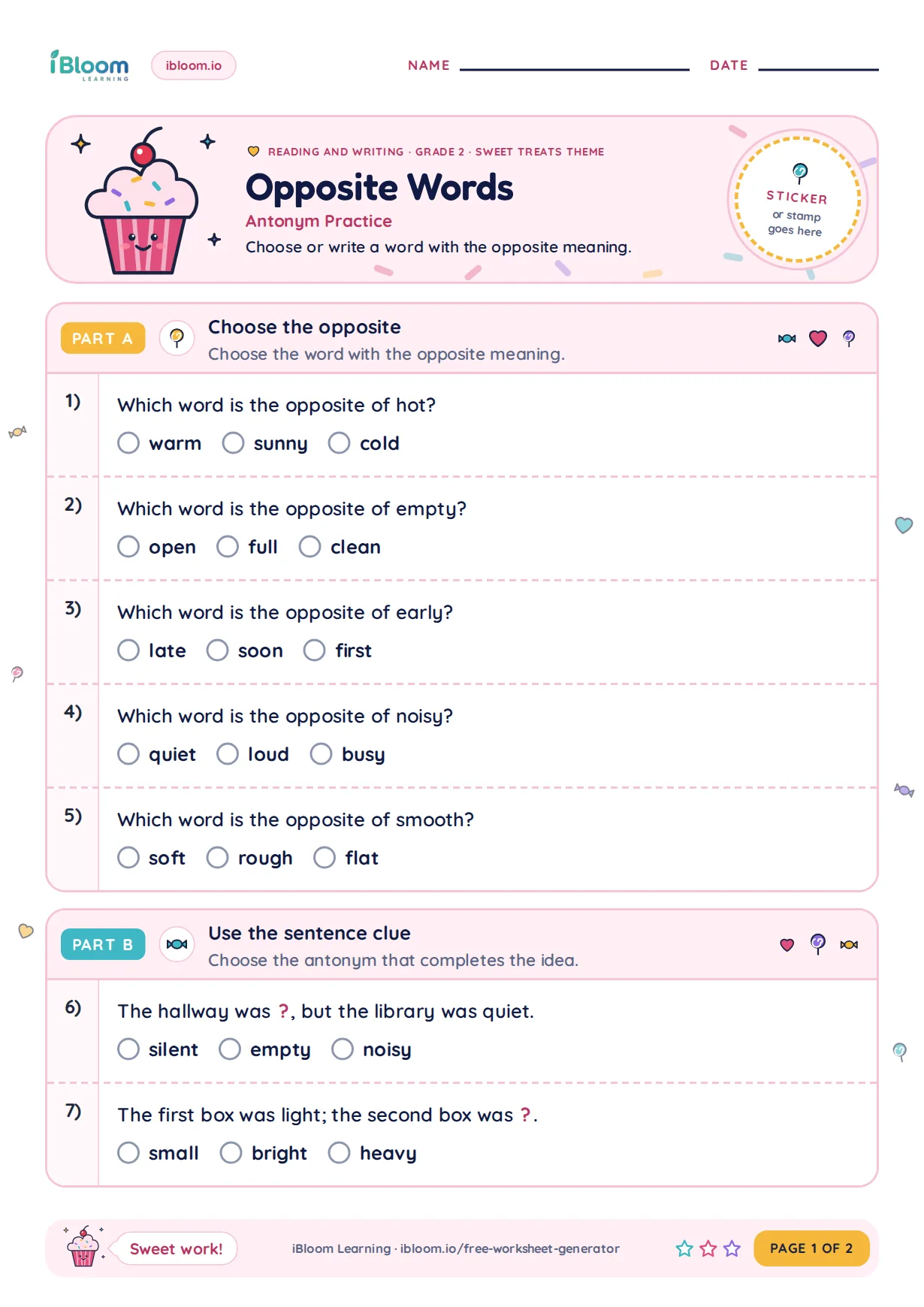 Antonyms — Word Meaning PracticePrintable Grade 2 antonyms worksheets help children match, choose, and use opposite-meaning words in clear vocabulary activities. This word meaning practice worksheet provides a distinct, age-appropriate way to practise the same lesson.Grade 2Free PDF preview
 Antonyms — Classify and ConnectPrintable Grade 2 antonyms worksheets help children match, choose, and use opposite-meaning words in clear vocabulary activities. This classify and connect worksheet provides a distinct, age-appropriate way to practise the same lesson.Grade 2Free PDF preview4 pages
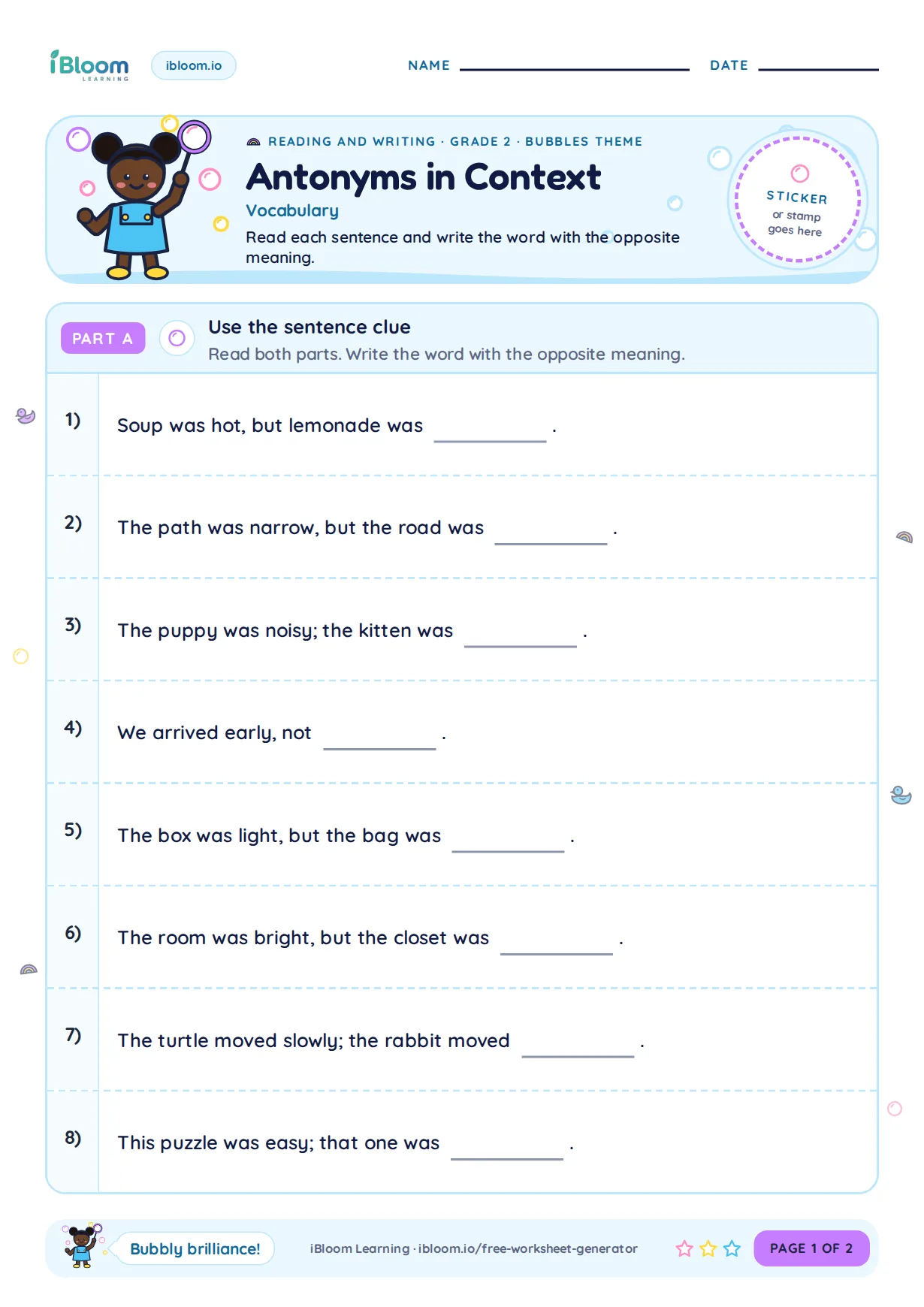 Antonyms — Context CluesPrintable Grade 2 antonyms worksheets help children match, choose, and use opposite-meaning words in clear vocabulary activities. This context clues worksheet provides a distinct, age-appropriate way to practise the same lesson.Grade 2Free PDF preview
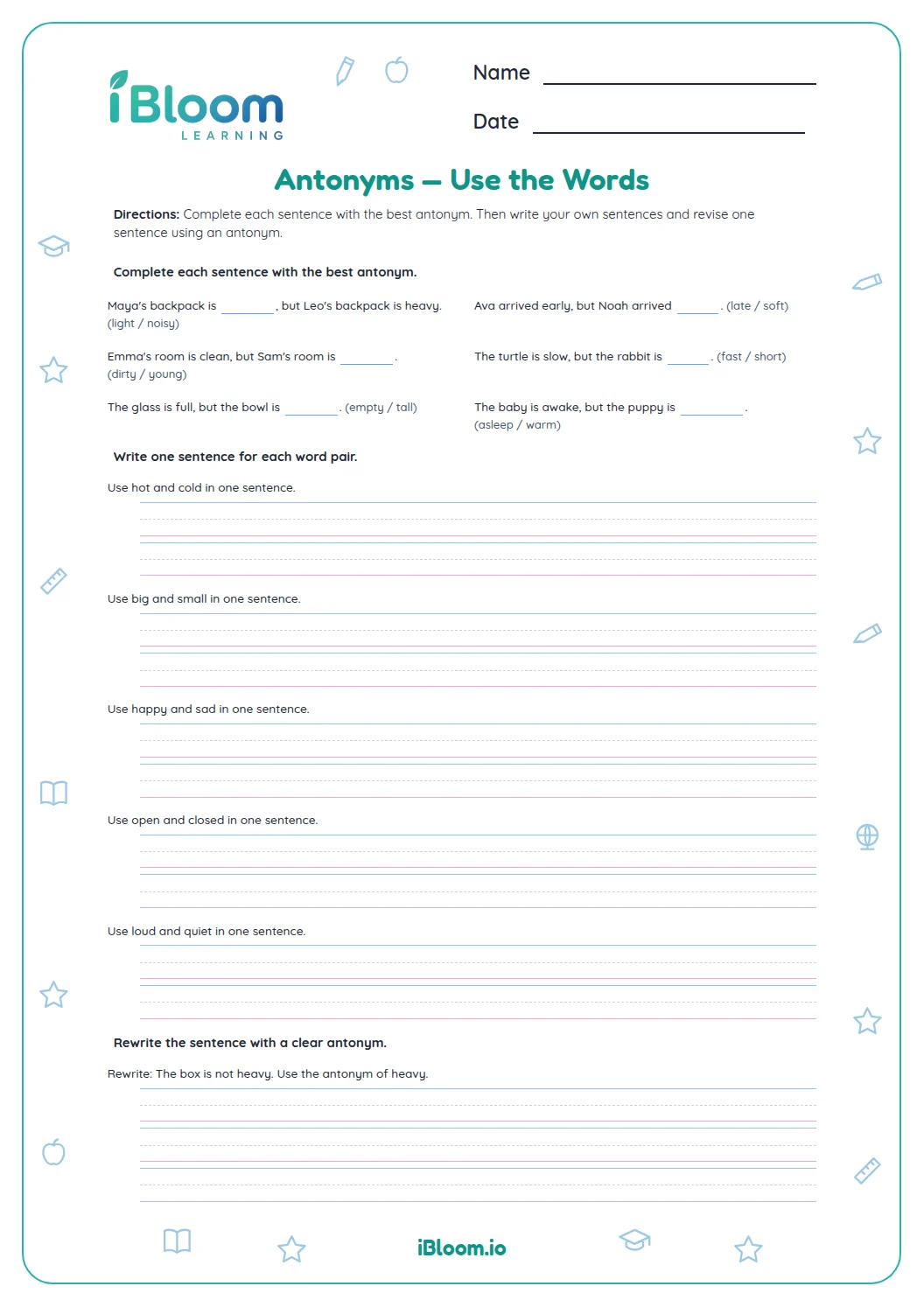 Antonyms — Use the WordsPrintable Grade 2 antonyms worksheets help children match, choose, and use opposite-meaning words in clear vocabulary activities. This use the words worksheet provides a distinct, age-appropriate way to practise the same lesson.Grade 2Free PDF preview
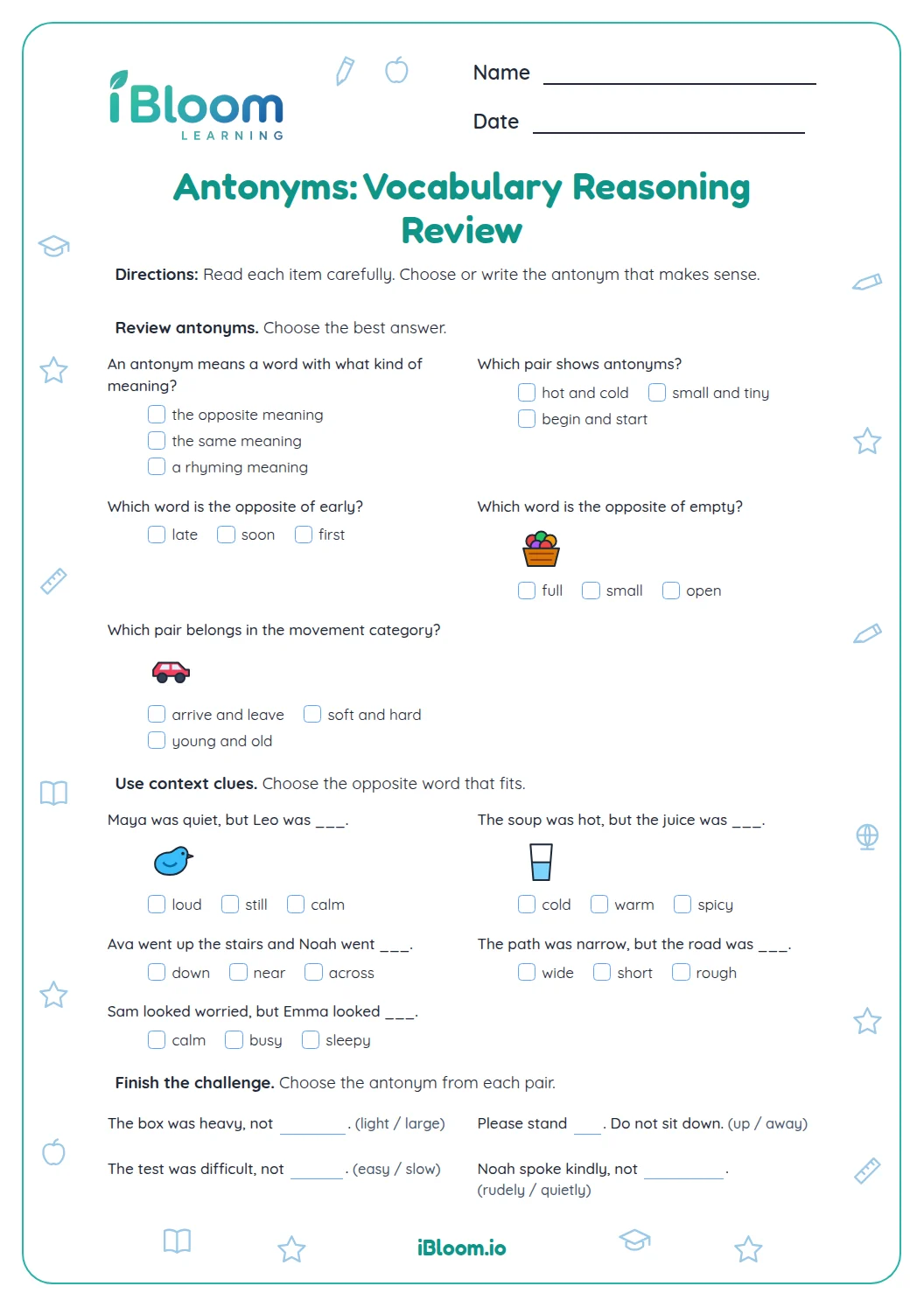 Antonyms — Vocabulary Reasoning ReviewPrintable Grade 2 antonyms worksheets help children match, choose, and use opposite-meaning words in clear vocabulary activities. This vocabulary reasoning review worksheet provides a distinct, age-appropriate way to practise the same lesson.Grade 2Free PDF preview
Practice that builds confidence
Understanding Antonyms
These Grade 2 antonyms practice activities help children build vocabulary by recognizing words with opposite meanings, such as hot/cold, early/late, and noisy/quiet. Students practise reading a word, thinking about its meaning, and selecting or writing a word that means the opposite.
The printable worksheets include child-friendly antonym tasks such as matching pairs, choosing the best opposite from answer choices, completing sentences, and sorting words by meaning. The activities support stronger word knowledge for reading, writing, and everyday conversation.
Antonyms are words with opposite or nearly opposite meanings. In Grade 2 vocabulary work, children move beyond simple pairs like big/small and begin thinking more carefully about words such as brave/cowardly, full/empty, and beginning/end. These worksheets give repeated practice with opposites in ways that feel clear and manageable.

Skill Progression
The activities usually begin with familiar word pairs, then move into choosing the correct antonym in a group of words. Children may match words, circle the opposite, fill in blanks, or use an antonym to complete a sentence. This progression helps students understand that antonyms are not just memorized pairs; they must make sense in context.
Parent Practice Routine
At home, choose one worksheet and read the first few words aloud together. Ask, “What would the opposite look like?” before your child answers. For example, if the word is “open,” they might imagine a door being closed. After the page, invite your child to find three opposites around the house, such as clean/dirty, light/dark, or upstairs/downstairs.

Classroom Uses
Teachers can use these printables for morning work, vocabulary centers, small-group reteaching, or quick review after a lesson on word relationships. They also work well as partner activities: one student reads the word, and the other explains the opposite before writing it. The sentence-based tasks are useful for connecting vocabulary practice to reading comprehension.

Common Errors to Watch For
Some children choose a related word instead of an opposite, such as picking “sun” for “hot” rather than “cold.” Others may confuse antonyms with synonyms. Encourage students to ask, “Does this word mean the opposite, or almost the same?” Watch for words with more than one possible opposite depending on context, such as “hard” meaning not soft or not easy.
Free printable PDF download
Use this grade 2 antonyms worksheet page to preview the activity, print it, or download it as a PDF for quick practice. It works well for homework, homeschool lessons, tutoring, morning work, revision, and classroom centers.
Answers and answer key support
After the child completes the worksheet independently, parents and teachers can use the answer support or answer key information to check the work, review mistakes, and choose the next practice step.
Why iBloom Worksheets Help
The iBloom antonyms worksheets are designed with clear directions, age-appropriate words, and varied response formats so children do not simply repeat one pattern. A helpful child-friendly strategy is: read the word, picture it, say “not that,” then choose the word that best shows the opposite idea.
Helpful answers
Frequently asked questions
What antonym skills do Grade 2 students practise on these worksheets?
They practise identifying opposite-meaning words, matching antonym pairs, choosing the best opposite from options, and using antonyms correctly in sentences.
Are these antonyms worksheets suitable for independent work?
Many children can complete the matching and multiple-choice activities independently, while sentence-based pages may benefit from a quick example or brief adult guidance.
How can I help my child understand a tricky antonym?
Ask your child to picture the word first, then describe what the opposite would look or feel like. Using real examples, such as full/empty or open/closed, makes the meaning clearer.
Do these worksheets help with reading comprehension?
Yes. Understanding antonyms strengthens word meaning, helps children notice contrasts in texts, and supports better understanding of descriptions, characters, and events.
What is a common mistake children make with antonyms?
A common mistake is choosing a related word instead of an opposite. For example, a child might connect 'rainy' with 'cloudy,' even though the opposite is closer to 'dry' or 'sunny' depending on the sentence.
Is this grade 2 antonyms worksheet free?
Yes. You can preview it for free and use the printable worksheet for home or classroom practice.
Can I download this grade 2 antonyms worksheet as a PDF?
Yes. Use the worksheet download option to save a printable PDF, or print the worksheet directly from the page.
Does this grade 2 antonyms worksheet include answers or an answer key?
When the activity has fixed answers, iBloom includes answer support so parents and teachers can check the completed worksheet.