





About this worksheet
This Grade 2 printable helps children choose between “there is” for one item and “there are” for more than one. The first part pairs short sentences with picture clues, the next part asks children to complete sentences, and the final part gives four more agreement phrases to finish. A separate answer key makes it easy to review the choices and discuss why the noun controls the verb phrase. The sheet practices standard English grammar in complete sentences.
Aligned to L.2.1
What does this worksheet practice?
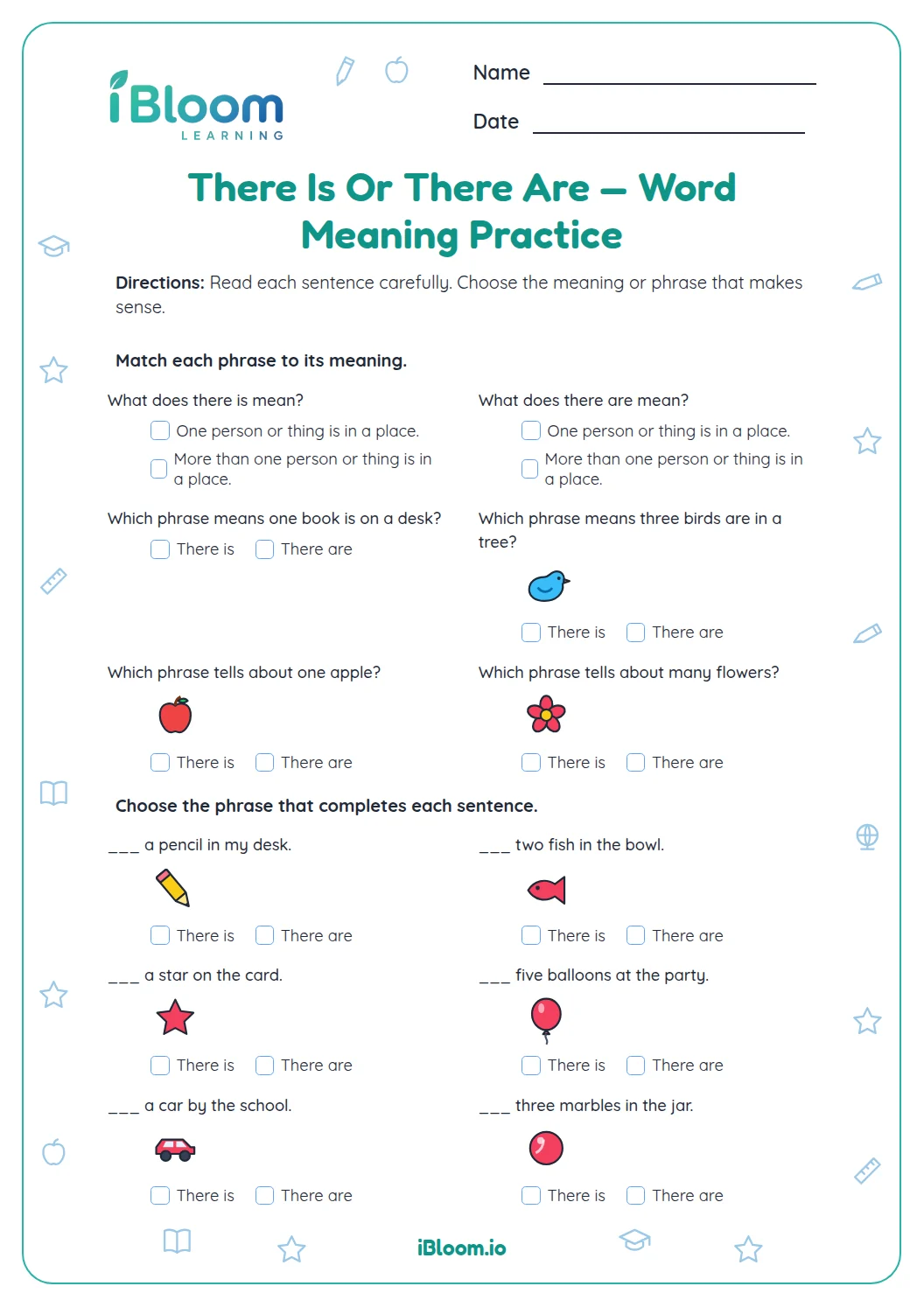
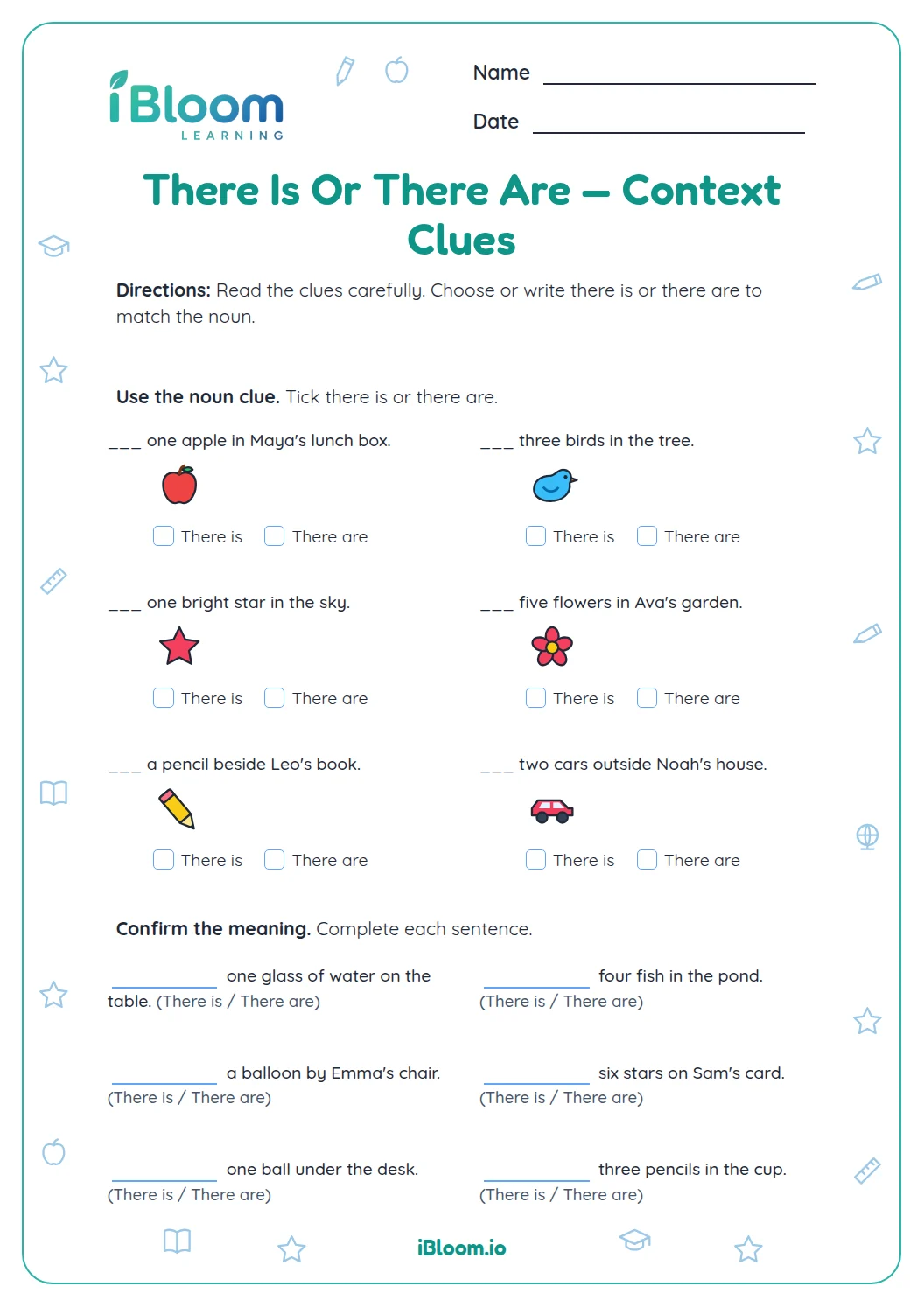
Six picture-supported sentences ask children to select the phrase that agrees with the number word. Six more remove the picture clue so the child must use the sentence itself. Four final items offer another chance to complete a phrase.
The key is to find the noun and decide whether the sentence names one item or several.
How can a child choose the right phrase?
Read the noun after the blank, then check for a number clue. In question 2, “four apples” names more than one, so the phrase is “There are.” In question 1, “one kite” names a single item, so it is “There is.”
The pictures support the meaning, while the words in the sentence provide the grammar clue.
Why repeat the phrase choice?
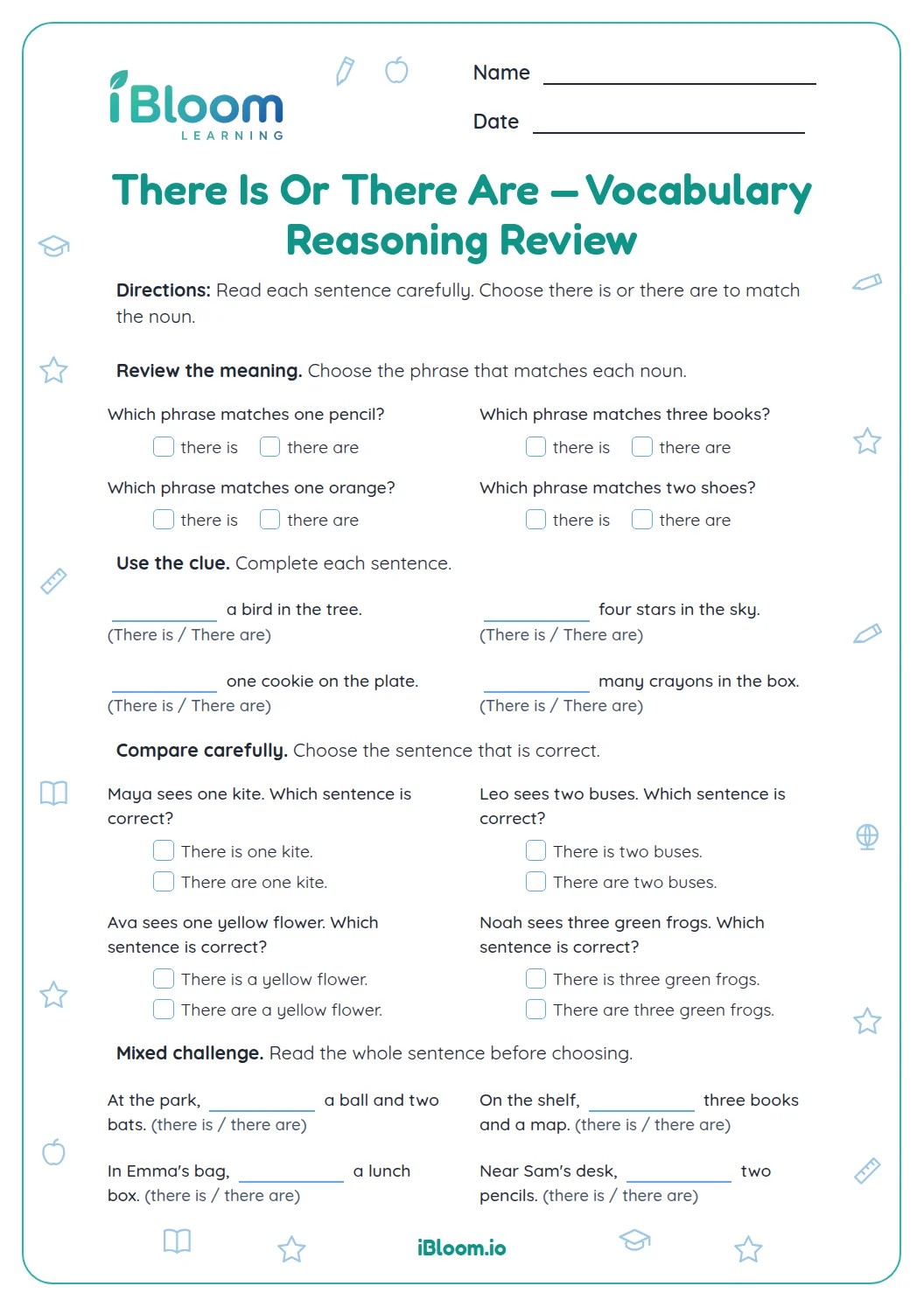
The final four blanks apply the agreement rule without picture clues. Use “There is” with one item and “There are” with more than one.
How to use this worksheet
- 1Read the sentence aloud and find the noun after the blank.
- 2Look for a number word such as “one,” “two” or “four.”
- 3Choose “There is” for one item and “There are” for more than one.
- 4For questions 7–12, use the sentence words without a picture clue.
- 5For the final four, write the phrase that agrees with the noun.
- 6Ask the child to explain which noun helped decide the phrase.
Common mistakes and quick fixes
The mistake
Using “there are” with one noun in question 1.
The fix
Point to “one kite.” Replace the phrase with “There is.”
The mistake
Choosing “there is” because the closest word is singular even when the subject is plural.
The fix
Find the noun that names what exists: in “There are two socks,” the subject is socks.
The mistake
Choosing a phrase without rereading the whole sentence.
The fix
Read the completed sentence aloud and make sure “there is” or “there are” agrees with the noun.
Common Core alignment
The page gives children repeated practice choosing a verb phrase that agrees with a singular or plural noun. This aligns with Grade 2 command of standard English grammar and usage.
Use standard English grammar and usage when writing or speaking.
On this sheet: Children choose and correct the phrase “there is” or “there are” in complete sentences.
Show the official wordingHide the official wording
Demonstrate command of the conventions of standard English grammar and usage when writing or speaking.
What to practice next
Make more practice
Further reading
Questions parents and teachers ask
When should a child use “there is”?
Use “there is” when the sentence names one person, place, or thing. Question 1 says “one kite,” so “There is” agrees. Have the child locate the noun after the blank first; that makes the choice about the sentence subject rather than about whichever word sounds familiar.
When should a child use “there are”?
Use “there are” when the sentence names more than one item. In question 2, “four apples” is plural, so “There are” is the matching phrase. The picture clue supports the count, and the words in the sentence confirm it clearly.
Are picture clues included on the worksheet?
Yes. Part A pairs six short sentences with simple picture clues, such as a kite, apples, or ducks. Children still read the number and noun in each sentence, so they practice connecting the picture’s meaning with the grammar choice in context.
What does the answer key include?
The key lists the correct phrase for all six picture-supported choices, all six sentence completions, and the four final phrases. Because every blank has one intended form, families can check the response quickly and talk about the singular or plural noun that controls it.
How can I help if my child mixes up the phrases?
Ask your child to cover the blank and say the noun phrase aloud: “one book” or “three boats.” Then ask, “Is that one or more than one?” The answer points to “There is” or “There are” before the child rereads the full sentence.
How long does this worksheet take?
Plan for about 15 minutes, including a quick review of the answer key. The first part moves quickly because the picture and number word reinforce each other. The later completions take longer because children must use the sentence itself to choose the phrase.