








About this worksheet
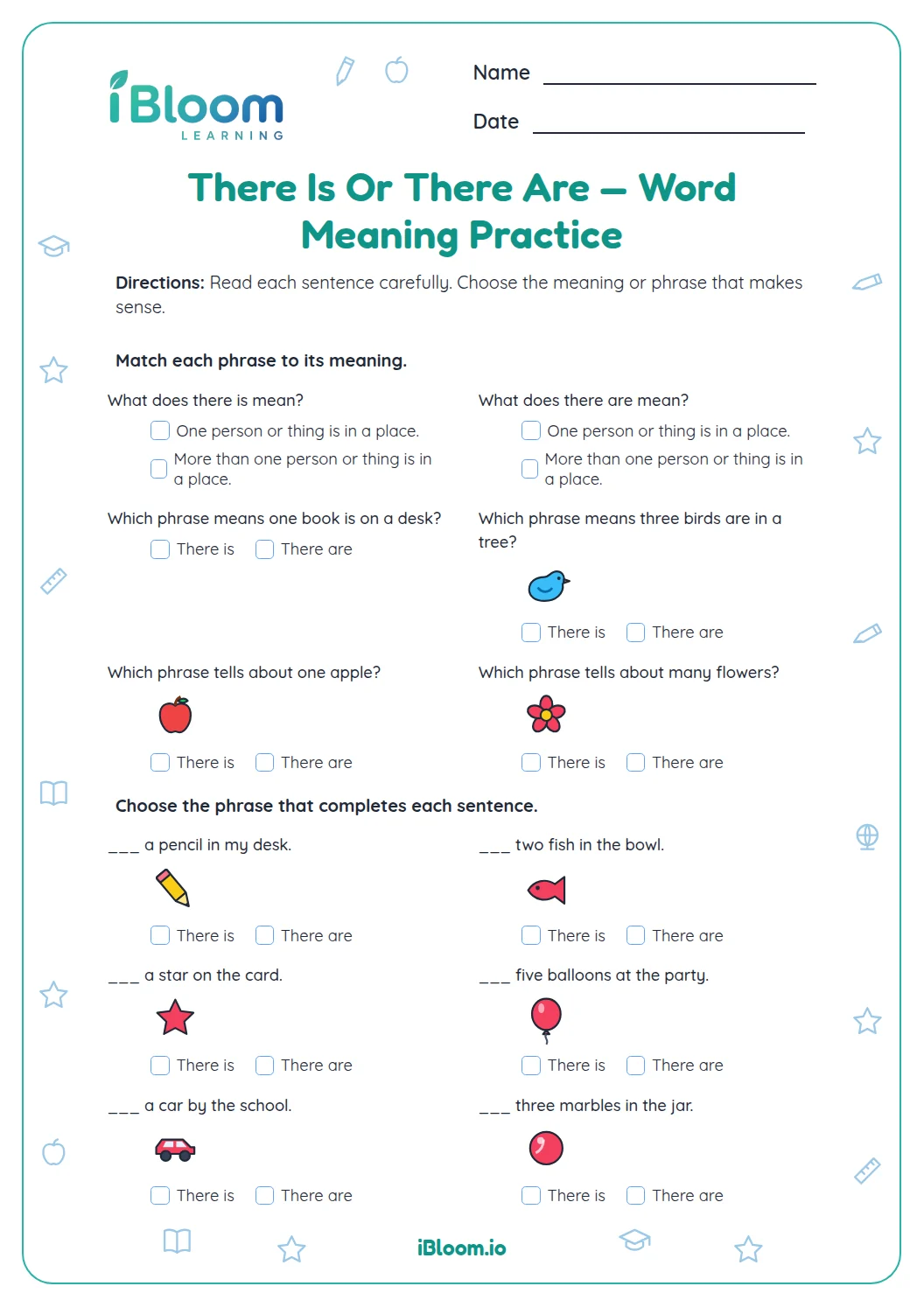
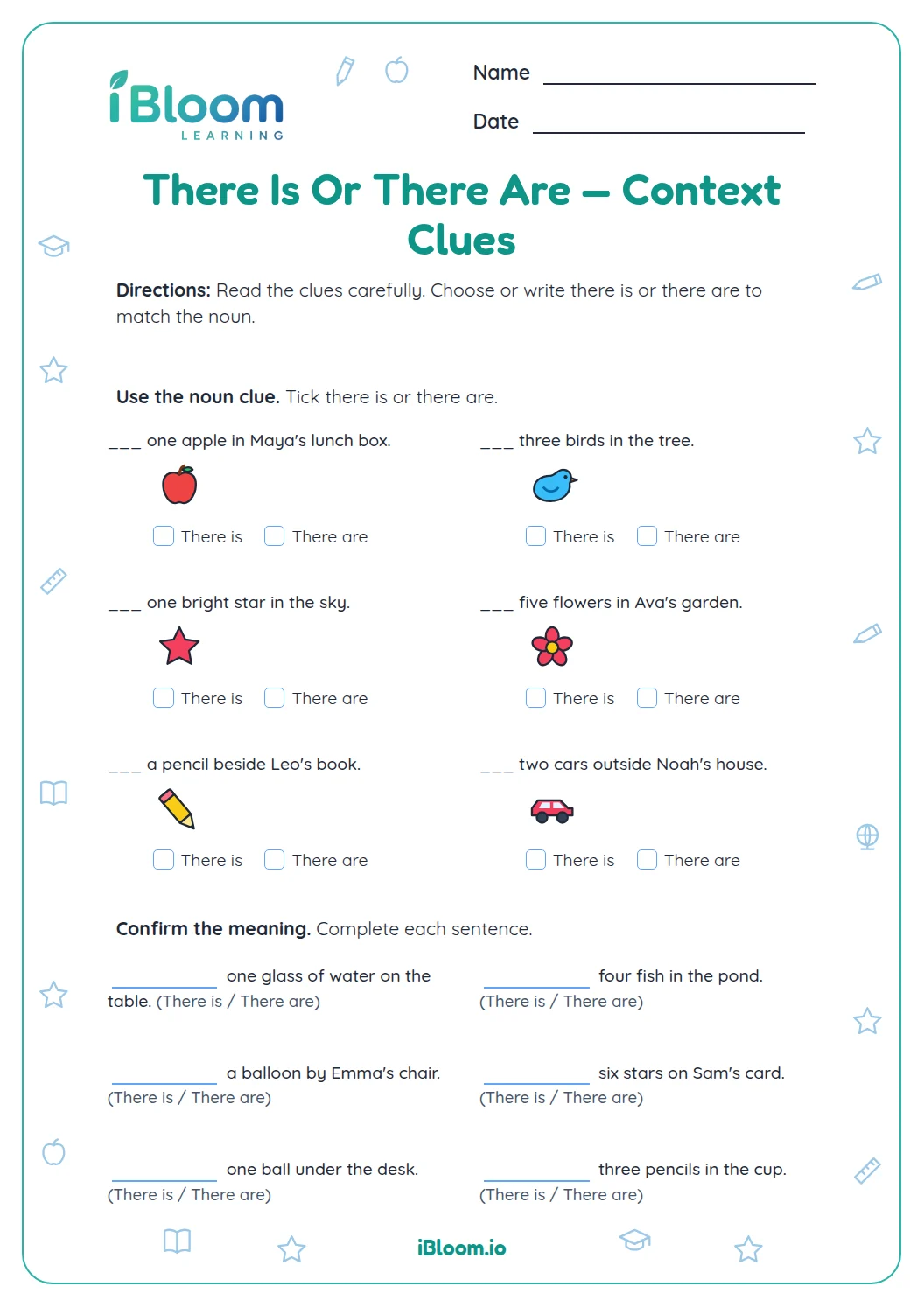
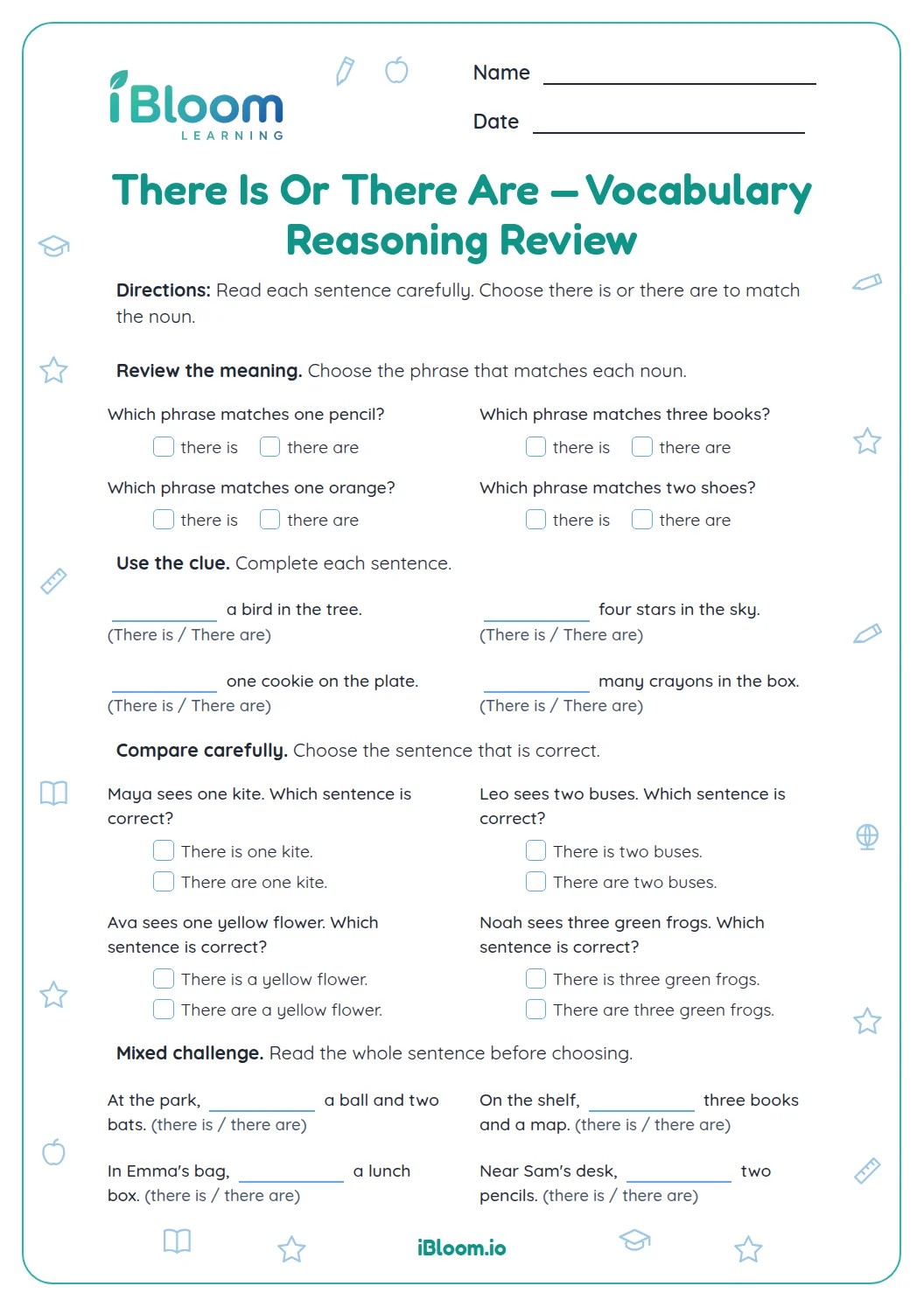
This Grade 2 worksheet helps children choose between “there is” and “there are” by checking the noun that follows. It includes 16 items: phrase choices, sentence completions, sentence checks, and a short writing application. The answer key provides the fixed answers and a sample sentence. The examples include singular nouns, plural nouns, and an amount of milk.
When do we use “there is”?
Use “there is” with one person, place, or thing, and with an amount treated as one.
- 1There is one cookie on the plate.
How does the noun help?
Look at the noun after the phrase. A plural noun such as “crayons” takes “there are.”
- 1There are four crayons beside the paper.
How can you check a sentence?
Read the complete sentence and make sure the phrase agrees with its noun. For your own sentence, choose a clear singular or plural noun.
- 1There are two hats by the door.
How to use this worksheet
- 1Read the direction at the start of each part.
- 2Work one item at a time and use the clue named in the prompt.
- 3Read the whole sentence or say the picture name aloud.
- 4Check the completed page with the answer key.
- 5Review any item that needs another try.
Common mistakes and quick fixes
The mistake
Choosing by the nearest word instead of the noun.
The fix
Find the noun after “there is/are.”
The mistake
Using “there are” for a single countable item.
The fix
Pair a single item with “there is.”
The mistake
Treating an amount like plural objects.
The fix
Use “there is” for an amount such as milk or rain.
What to practice next
Make more practice
Questions parents and teachers ask
What does this worksheet practice?
It gives 16 sentence examples for choosing between “there is” and “there are.” Learners use the noun that follows to decide whether the sentence refers to one thing, an amount, or several countable things. Ask the learner to name the clue that helped before moving on.
How many items are on the page?
There are 16 questions in three parts: phrase choices, sentence completions, and sentence checks or writing. The sequence starts with clear examples and ends by asking learners to apply the pattern in a sentence. Ask the learner to name the clue that helped before moving on.
How should we use the answer key?
Try each item before opening the answer key. Check the noun that follows the phrase, and read the full sentence aloud. The key includes a sample sentence for the open response; another clear sentence can also be correct. Ask the learner to name the clue that helped before moving on.
Can an adult use this in a small group?
Yes. Read an example together and ask learners to point out the noun. Then have them choose or write the matching phrase, explaining whether the noun names one thing, an amount, or more than one. Ask the learner to name the clue that helped before moving on.
What if an answer differs from the key?
Look at the noun after the phrase and decide whether it is singular or plural. For the writing item, check that the sentence begins with the requested phrase and that its noun agrees with that phrase. Ask the learner to name the clue that helped before moving on.