Free printable practice
Homophones Practice Activities
Grade 3 vocabulary worksheets for choosing, spelling, and using homophones correctly in sentences and short writing.
Free printable worksheet PDFs
Preview every available page, then download the free worksheet PDF for home, homeschool, tutoring, or classroom practice.
Preview the exact activity before downloading it.
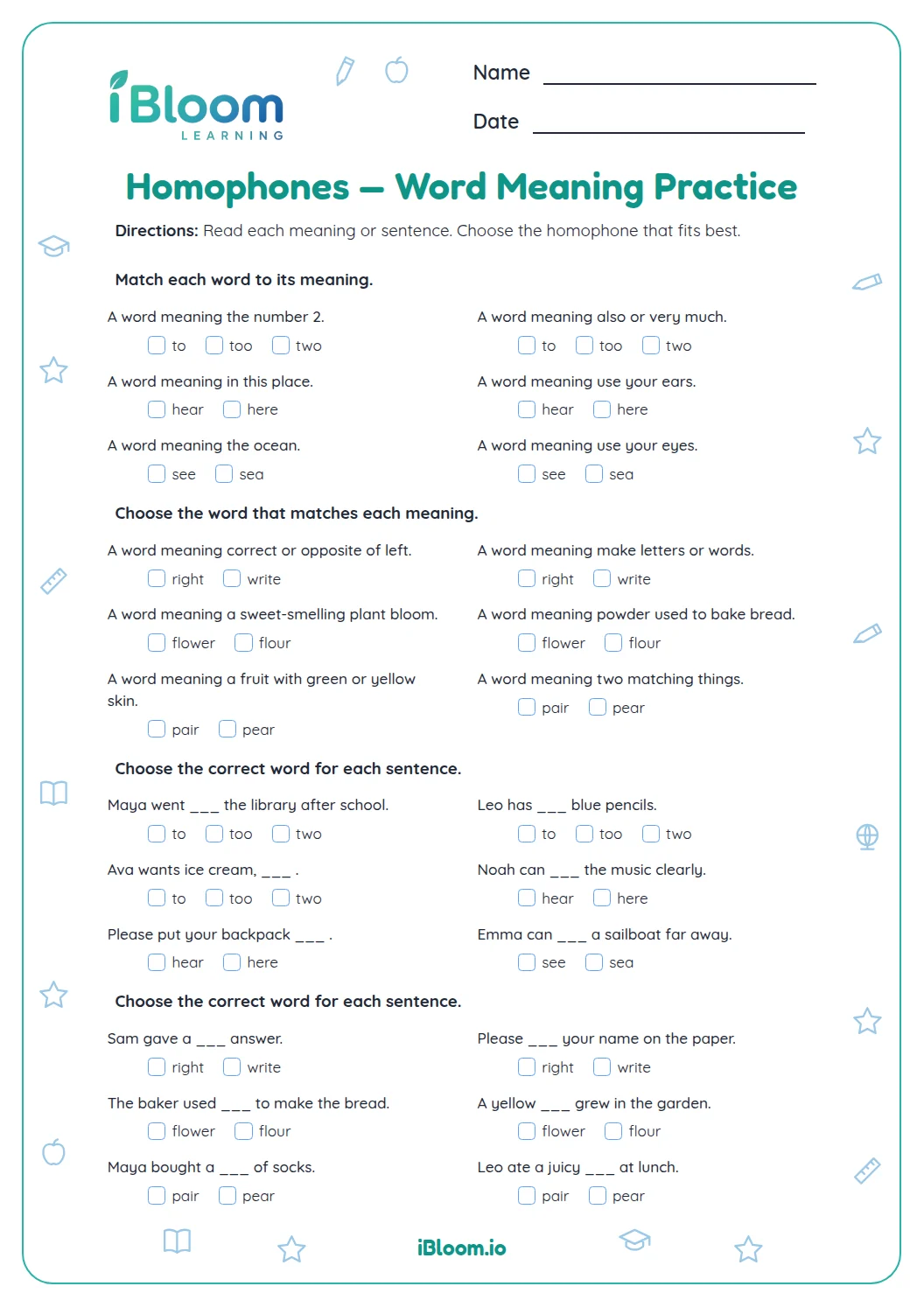 Homophones — Word Meaning PracticeGrade 3 vocabulary worksheets for choosing, spelling, and using homophones correctly in sentences and short writing. This word meaning practice worksheet provides a distinct, age-appropriate way to practise the same lesson.Grade 3Free PDF preview
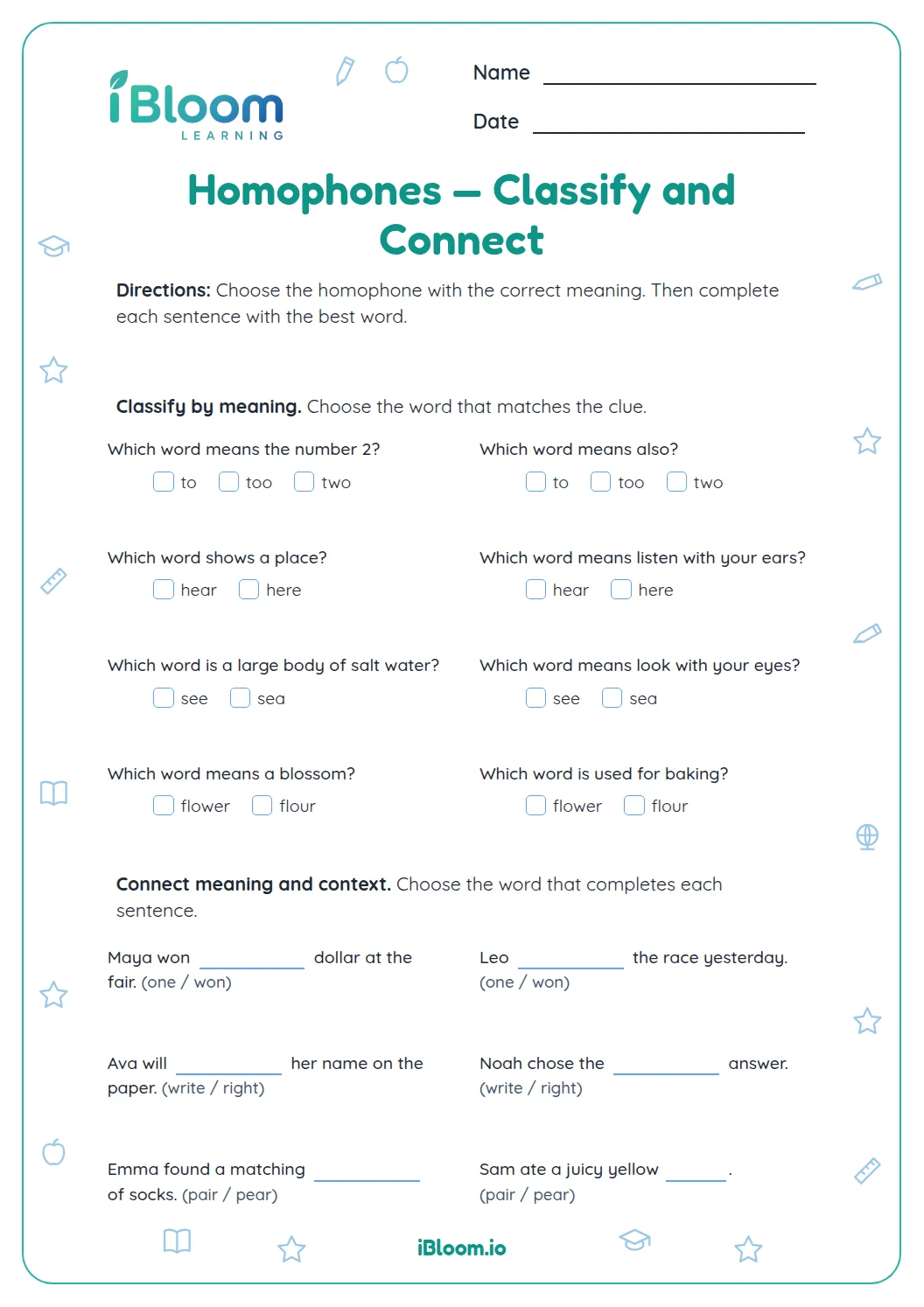 Homophones — Classify and ConnectGrade 3 vocabulary worksheets for choosing, spelling, and using homophones correctly in sentences and short writing. This classify and connect worksheet provides a distinct, age-appropriate way to practise the same lesson.Grade 3Free PDF preview
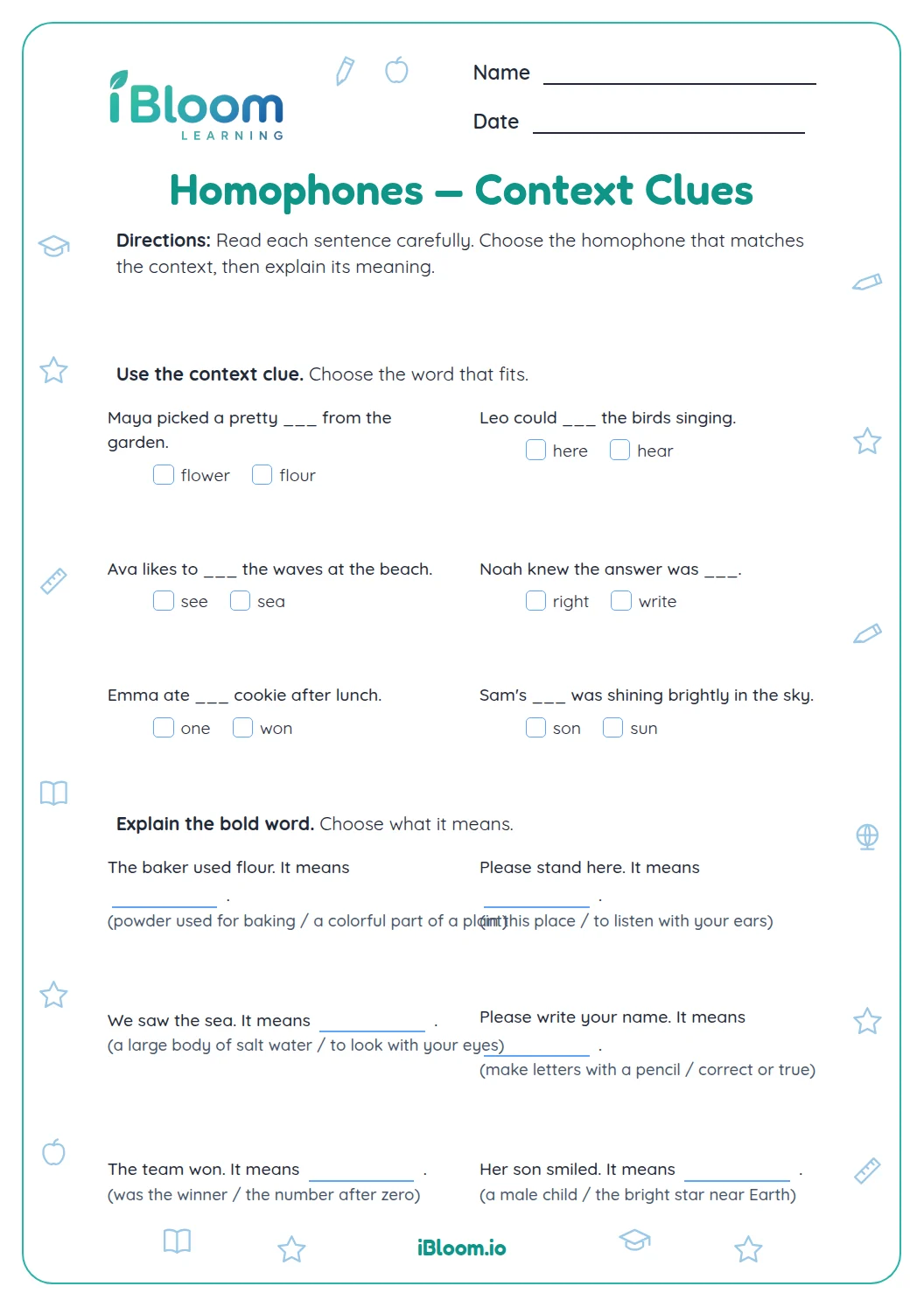 Homophones — Context CluesGrade 3 vocabulary worksheets for choosing, spelling, and using homophones correctly in sentences and short writing. This context clues worksheet provides a distinct, age-appropriate way to practise the same lesson.Grade 3Free PDF preview
 Homophones — Use the WordsGrade 3 vocabulary worksheets for choosing, spelling, and using homophones correctly in sentences and short writing. This use the words worksheet provides a distinct, age-appropriate way to practise the same lesson.Grade 3Free PDF preview4 pages
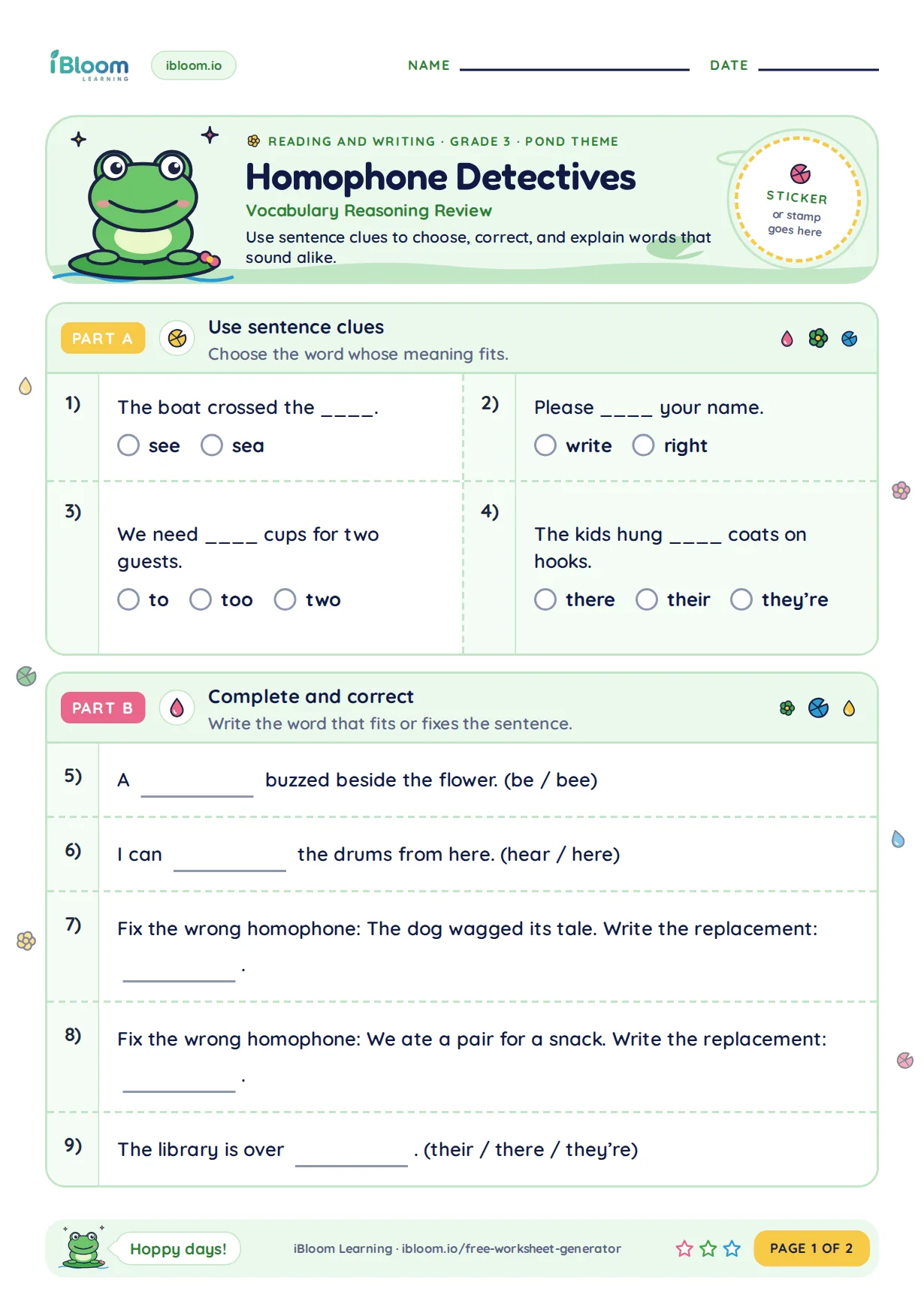 Homophones — Vocabulary Reasoning ReviewGrade 3 vocabulary worksheets for choosing, spelling, and using homophones correctly in sentences and short writing. This vocabulary reasoning review worksheet provides a distinct, age-appropriate way to practise the same lesson.Grade 3Free PDF preview
Practice that builds confidence
What Grade 3 learners practice
These Grade 3 vocabulary worksheets help children tell apart homophones—words that sound the same but have different spellings and meanings, such as their/there, to/two/too, and no/know. Students practice listening for meaning clues and choosing the word that fits a sentence.
Printable activities include sentence completion, matching pairs, picture-supported choices, short writing prompts, and proofreading items. The goal is not memorizing lists alone; children learn to use context, grammar, and meaning to spell the right word in everyday reading and writing.
Homophones are tricky because the ear hears one sound, while the page needs one exact spelling. These activities move children from recognizing familiar pairs to making careful choices in complete sentences. A student may know that sea and see sound alike, but still needs to decide which one belongs in We can see the moon or The boat crossed the sea.

How the worksheets build the skill
The collection starts with clear pairs and simple sentence clues, then adds sets such as to, too, and two, where grammar matters. Matching tasks help students connect each word with its meaning. Fill-in sentences require them to read before and after the blank. Proofreading questions ask children to spot a wrong homophone in context, which is especially useful for improving their own writing.
A simple parent routine
Choose five homophone pairs from one worksheet. Say each word pair aloud, then ask your child to explain both meanings and use each word in a sentence. Next, have your child complete a few printed items and underline the clue that helped. For example, in I ate two apples, the number clue points to two. End by asking your child to write one silly sentence that uses both words correctly.

Classroom uses for teachers
Teachers can use these pages in vocabulary lessons, literacy centers, morning work, small-group review, or as follow-up after reading. A quick partner check works well: one student reads the sentence, and the other explains why the chosen homophone is correct. The worksheets also support spelling instruction because students see that sound alone is not enough; meaning and sentence structure guide the spelling.

Common errors to watch for
Many third graders guess from memory instead of rereading the whole sentence. Others confuse a homophone with a contraction or possessive form, especially its and it is, or your and you are when those appear in writing. Encourage children to ask: Does this word name a number, a place, an action, or ownership? If the meaning does not match, the spelling should change.
Free printable PDF download
Use this grade 3 homophones worksheet page to preview the activity, print it, or download it as a PDF for quick practice. It works well for homework, homeschool lessons, tutoring, morning work, revision, and classroom centers.
Answers and answer key support
After the child completes the worksheet independently, parents and teachers can use the answer support or answer key information to check the work, review mistakes, and choose the next practice step.
Why iBloom worksheets help
iBloom homophones practice gives children repeated, varied encounters with the same idea without making the work feel like a word list. Clear directions, sentence-level context, and gradual challenge help students build accuracy. A child-friendly strategy is: hear it, read around it, name the meaning, then choose the spelling.
Helpful answers
Frequently asked questions
What are homophones for Grade 3 students?
Homophones are words that sound the same but have different spellings and meanings. Grade 3 students commonly practice pairs and sets such as see/sea, hear/here, to/too/two, and their/there/they're.
How do these worksheets help children choose the correct homophone?
The activities place homophones in sentences so children must use context clues, meaning, and sometimes grammar. This helps them move beyond simply hearing the word and focus on which spelling makes sense.
Are these worksheets useful for spelling as well as vocabulary?
Yes. Homophone practice strengthens vocabulary because students learn meanings, and it supports spelling because they must connect each meaning to the correct written form.
What is a good way to review wrong answers?
Ask the child to reread the full sentence, underline the clue, and explain what the chosen word means. Then compare it with the other homophone and rewrite the sentence correctly.
Can teachers use these homophones pages in literacy centers?
Yes. The worksheets work well for independent vocabulary centers, partner checking, small-group review, or a quick follow-up after a mini-lesson on commonly confused words.
Is this grade 3 homophones worksheet free?
Yes. You can preview it for free and use the printable worksheet for home or classroom practice.
Can I download this grade 3 homophones worksheet as a PDF?
Yes. Use the worksheet download option to save a printable PDF, or print the worksheet directly from the page.
Does this grade 3 homophones worksheet include answers or an answer key?
When the activity has fixed answers, iBloom includes answer support so parents and teachers can check the completed worksheet.