



About this worksheet
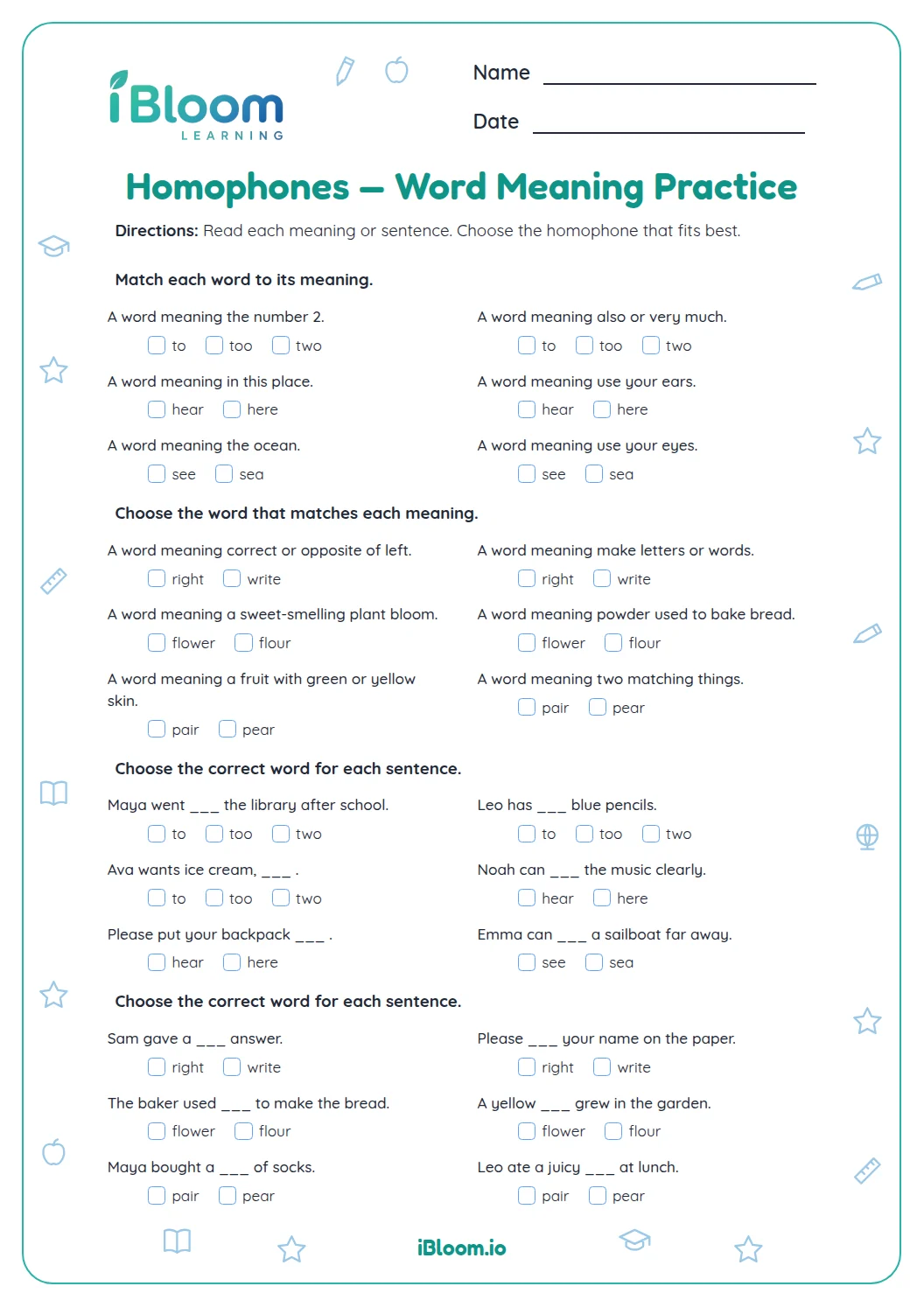
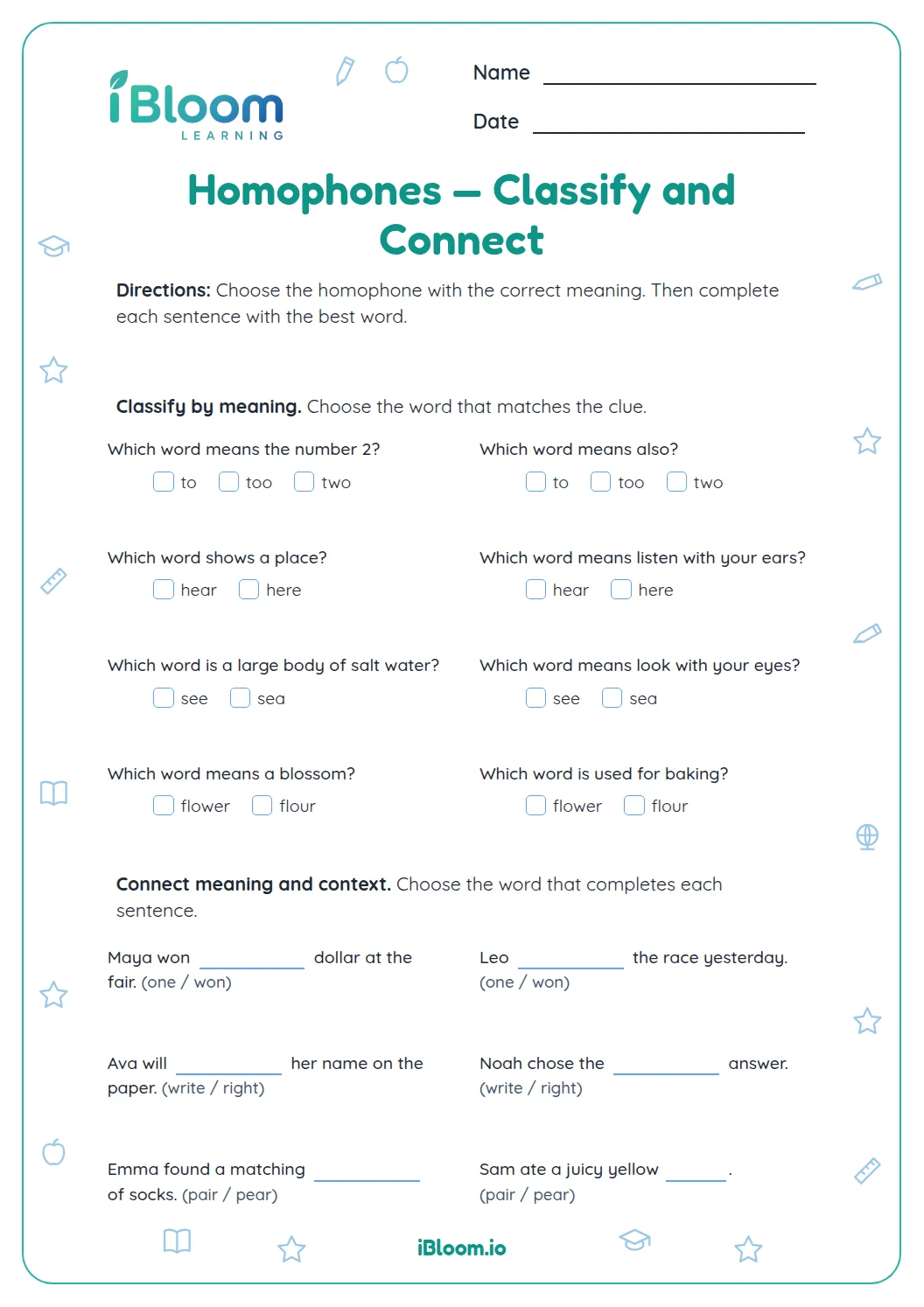
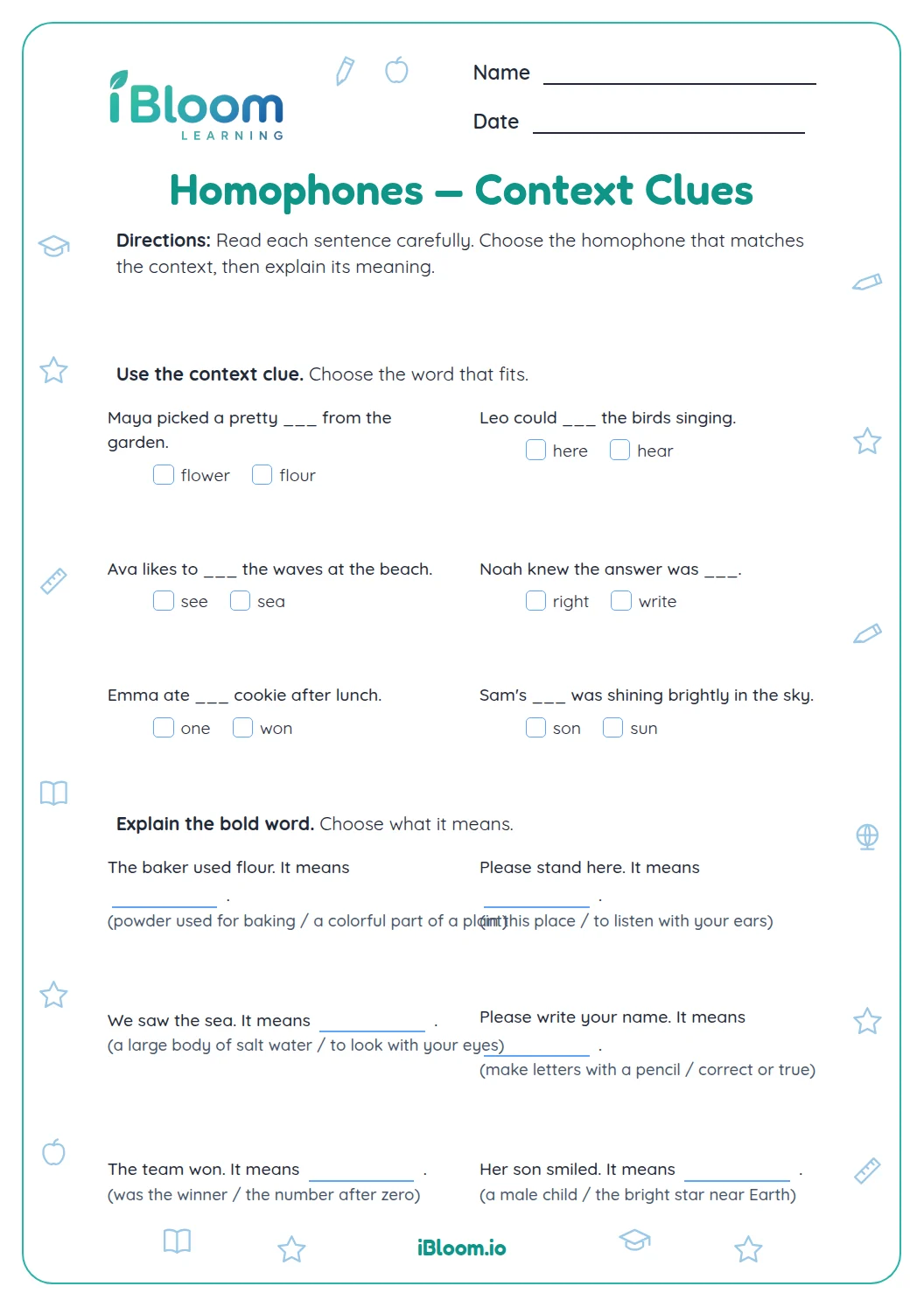
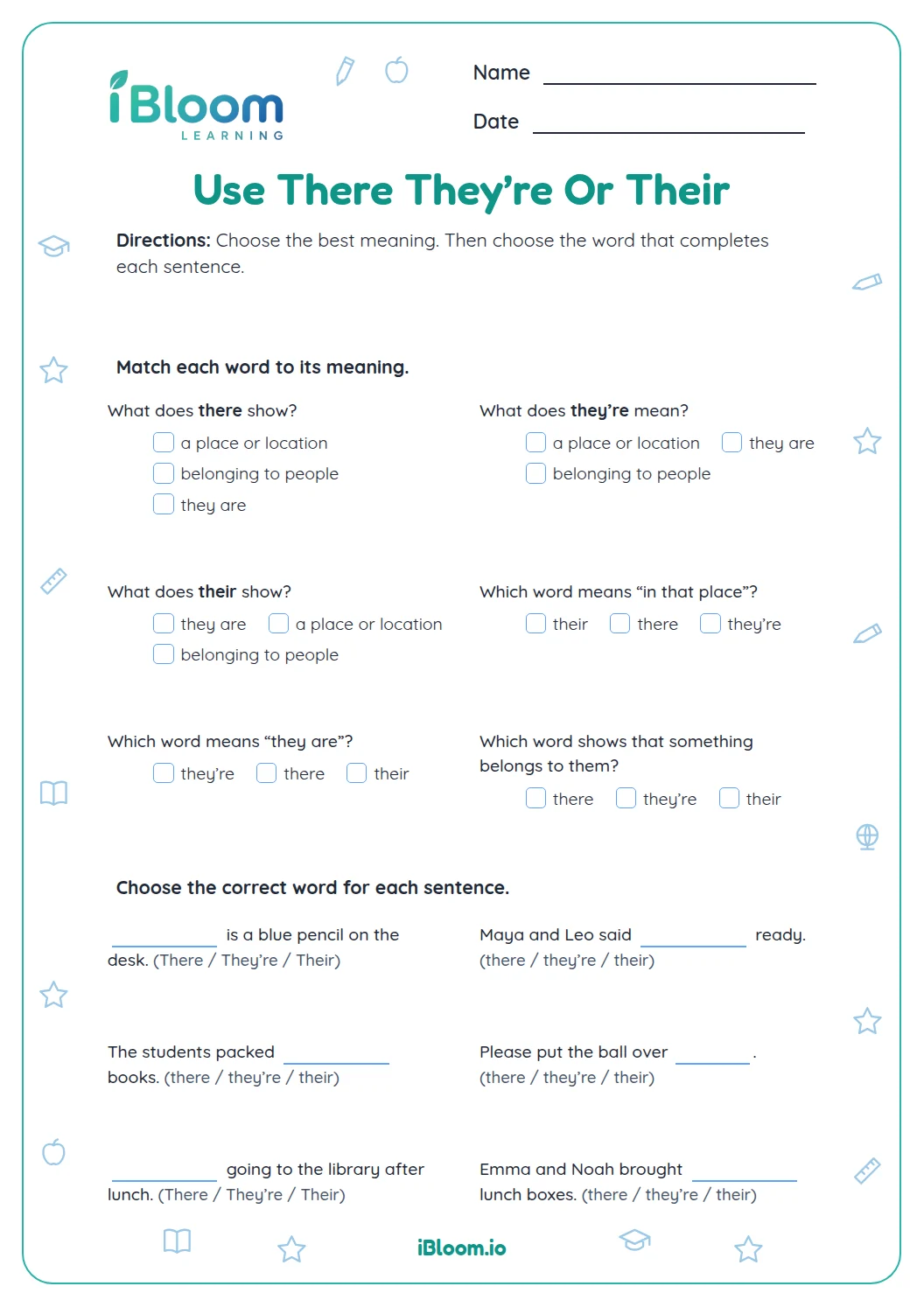
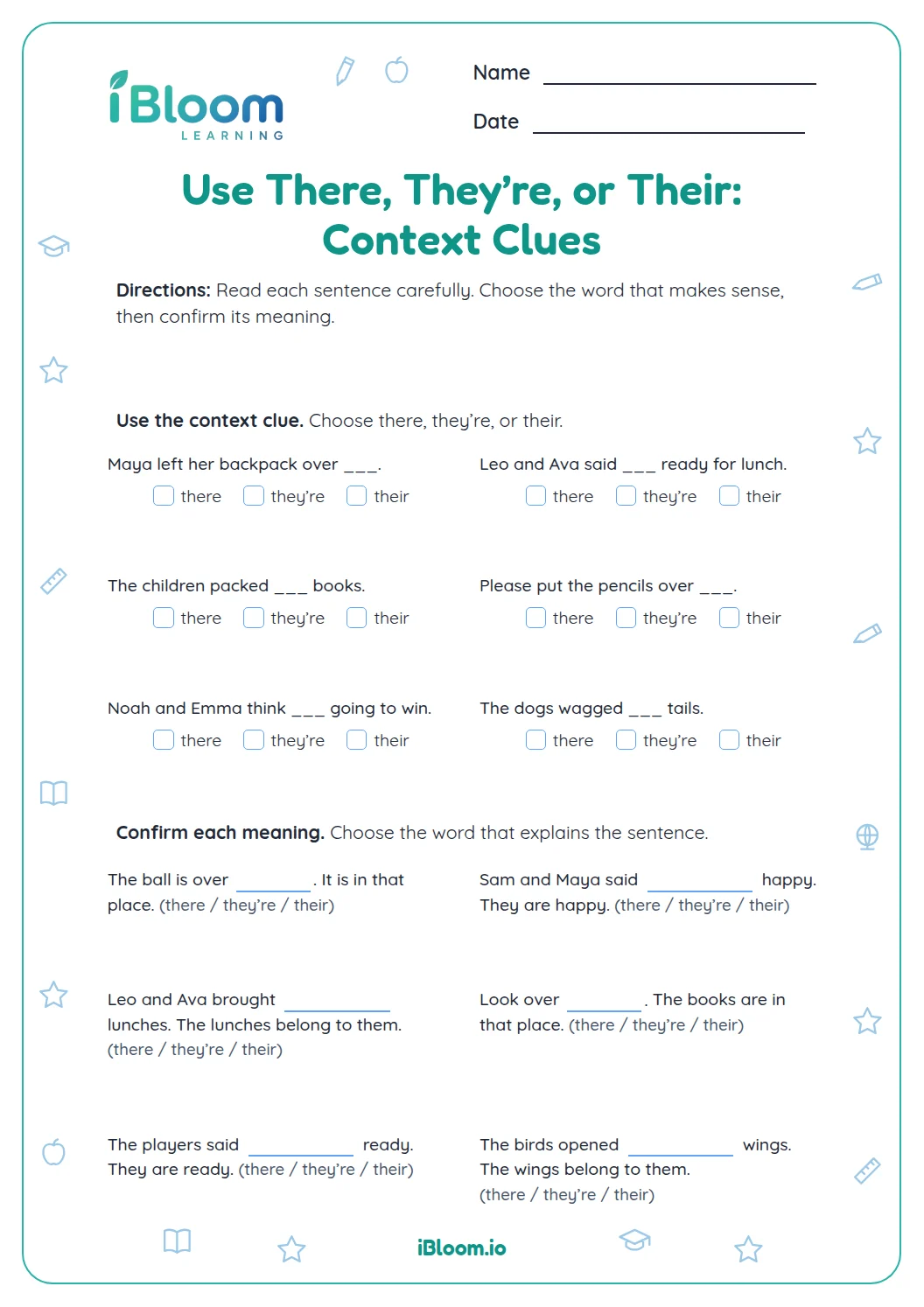
This free Grade 3 vocabulary worksheet asks students to use meaning to choose among words that sound alike. Sixteen questions move from choosing a homophone to completing and correcting sentences, identifying clues, and explaining a spelling choice. The pairs and groups include sea/see, write/right, to/too/two, and their/there/they’re. The work practices sentence-level context clues under CCSS L.3.4.a. A separate answer key gives the correct spellings and sample explanations for the final two responses.
Aligned to L.3.4.a
What makes homophones tricky?
Homophones sound alike but have different meanings and spellings, such as sea and see. Sound alone cannot select the spelling. Students need to connect the word to what the sentence says.
Part A provides sentence clues: a boat, writing a name, a number of cups, and coats belonging to children. Ask the student to name the clue instead of saying only that an answer sounds right. Part B also uses there for a place, they’re for they are, to for direction, and too for excess.
How should students fix the mixed-up words?
Questions 7 and 8 contain a real word in the wrong place. Students write only its replacement, then reread the sentence to check the meaning. The dog has a tail; the snack is a pear.
- 1Question 8: We ate a pair for a snack.
- 2Clues: ate and snack suggest food.
- 3Pair means two things together; pear is a fruit.
- 4Replacement: pear.
What counts as an explanation in the final part?
Question 15 asks students to explain why flour fits a sentence about a baker. An answer should connect flour with baking, then distinguish it from a flower. The sample key gives one concise way to make that contrast.
Question 16 asks for a sentence using too to mean also, followed by a meaning explanation. Substituting also is a useful check: “I want to play, too” can become “I also want to play.”
How to use this worksheet
- 1Say sea and see aloud, then discuss their different meanings.
- 2Read each Part A sentence completely before choosing a spelling.
- 3Fill the blanks and replace the two mistaken words in Part B.
- 4In Part C, identify the clue or meaning that justifies the choice.
- 5Write the Part D explanations and check that each connects spelling with meaning.
Mistakes to notice and fix
The mistake
Choosing see because it sounds right in the boat sentence.
The fix
Both choices sound right; use boat and crossed to identify the body of water.
The mistake
Writing there for coats that belong to the children.
The fix
Their signals ownership. Ask whose coats they are.
The mistake
Correcting pair to pear without knowing why.
The fix
Connect pear with the food clues ate and snack, then explain that a pair means two things.
Common Core alignment
Use clues in a sentence to choose and explain a homophone’s meaning.
On this sheet: Students use context to choose homophones, repair substitutions, and explain the intended meanings.
Show the official wordingHide the official wording
Use sentence-level context as a clue to the meaning of a word or phrase.
What to practice next
Make more practice
Further reading
Questions parents and teachers ask
Which homophones appear in the questions?
The questions use sea/see, write/right, to/too/two, their/there/they’re, be/bee, hear/here, tail/tale, pear/pair, won/one, paws/pause, and flour/flower. Students meet them in short sentences with concrete clues. The final task returns to too and asks students to use its meaning also in their own sentence.
Why does question 4 need their?
Their shows that the coats belong to the children. There points to a place, and they’re means they are. Read the sentence as “The children hung the coats belonging to them on hooks.” That meaning makes their the spelling that fits the blank in this question.
Should my child rewrite the whole incorrect sentence?
Only the replacement word is required in the two correction questions. Students write tail for tale and pear for pair, then reread the whole sentence aloud to check meaning. If you want an oral explanation, ask which surrounding words show that the replacement belongs in that sentence.
Can too have more than one meaning?
Yes, too can mean also or more than wanted. Question 12 uses too hot for soup that is hotter than someone can eat comfortably. The final question asks for also: “I want to play, too.” Ask the child to explain which meaning fits each sentence.
How should I score the two written responses?
Use the sample answers to check meaning rather than identical wording. The flour explanation should connect the word with baking and distinguish it from a flower. The final response should use too to mean also and explain that meaning. Discuss any unclear clue before asking for a revised answer.