






About this worksheet
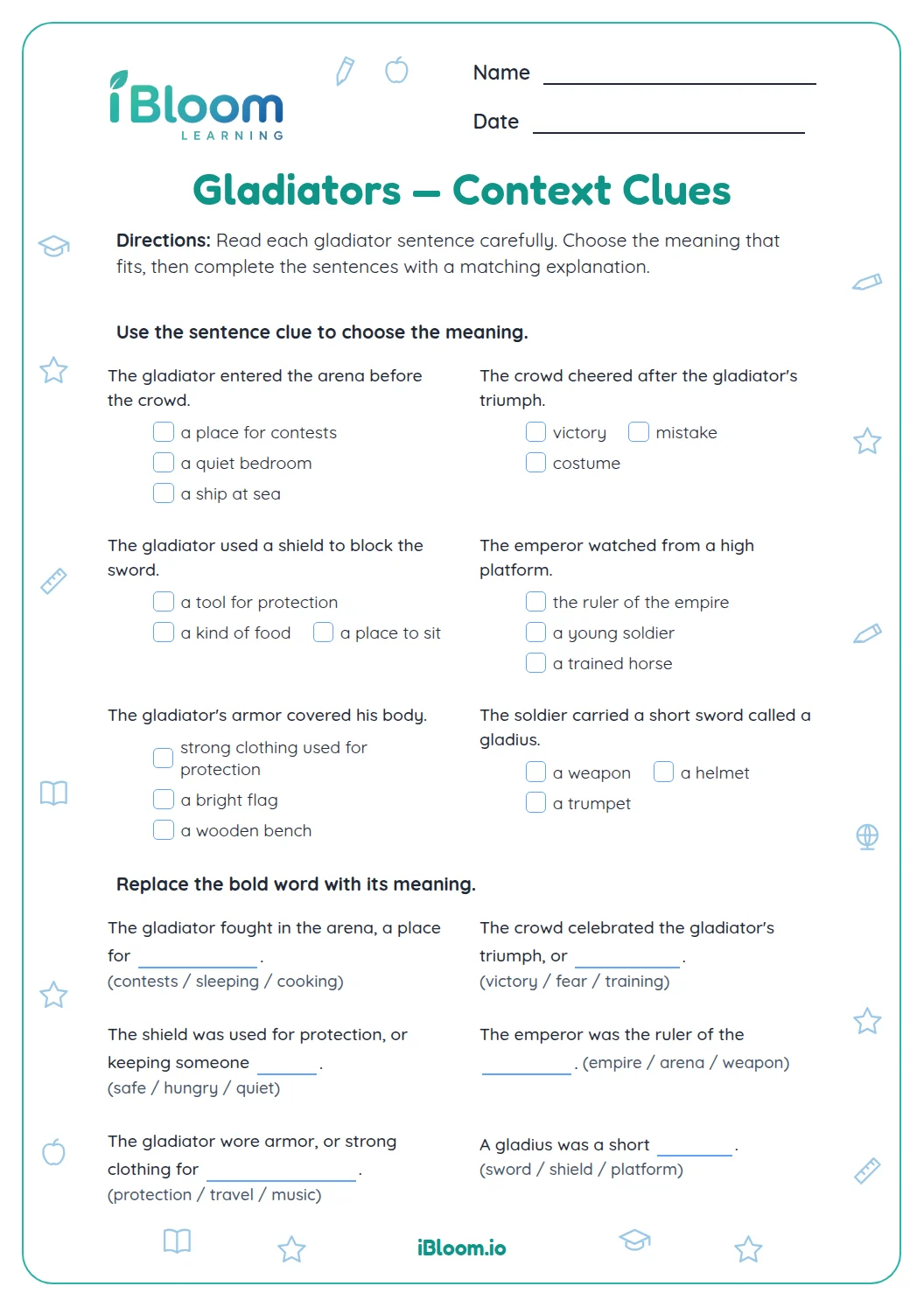
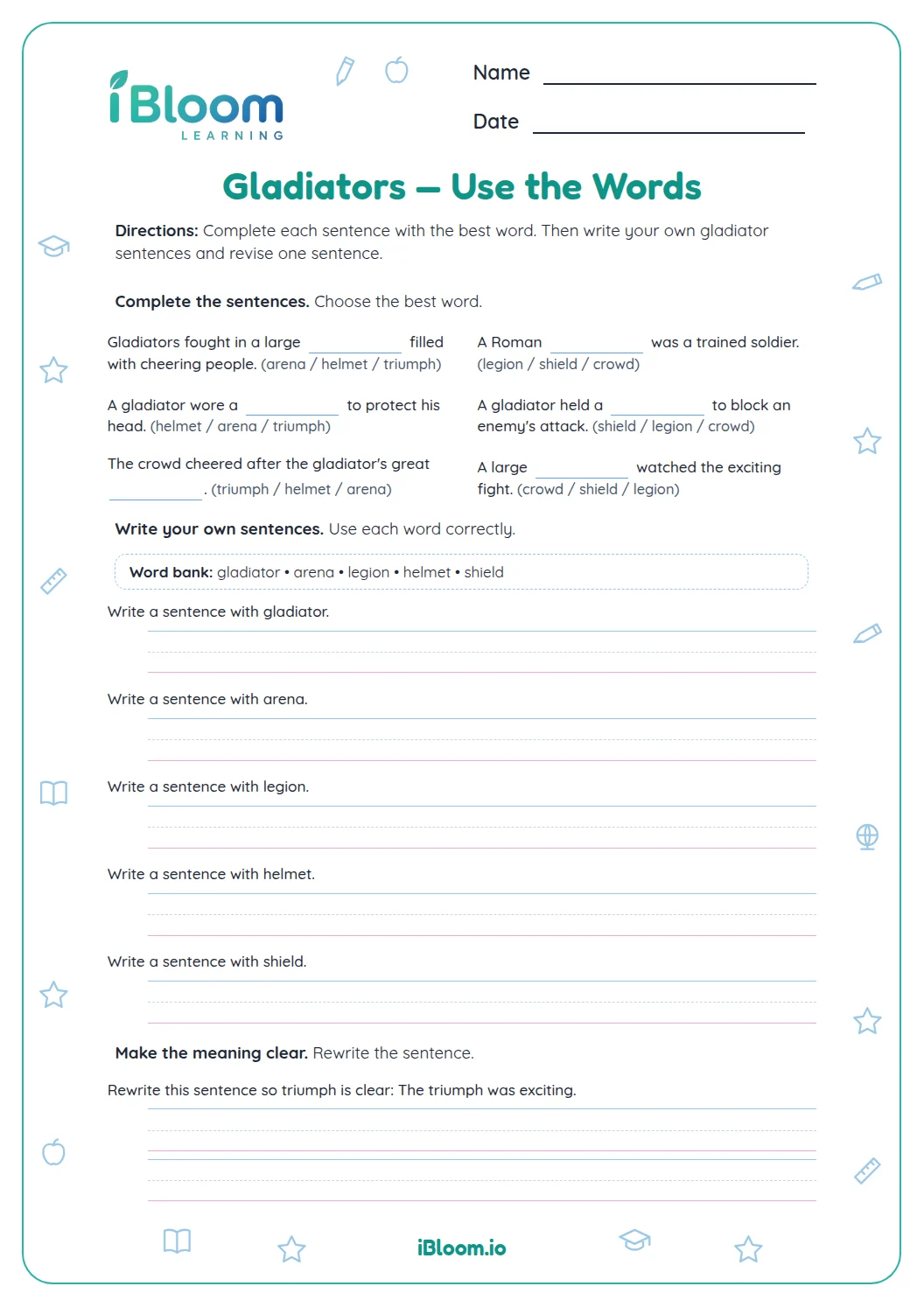
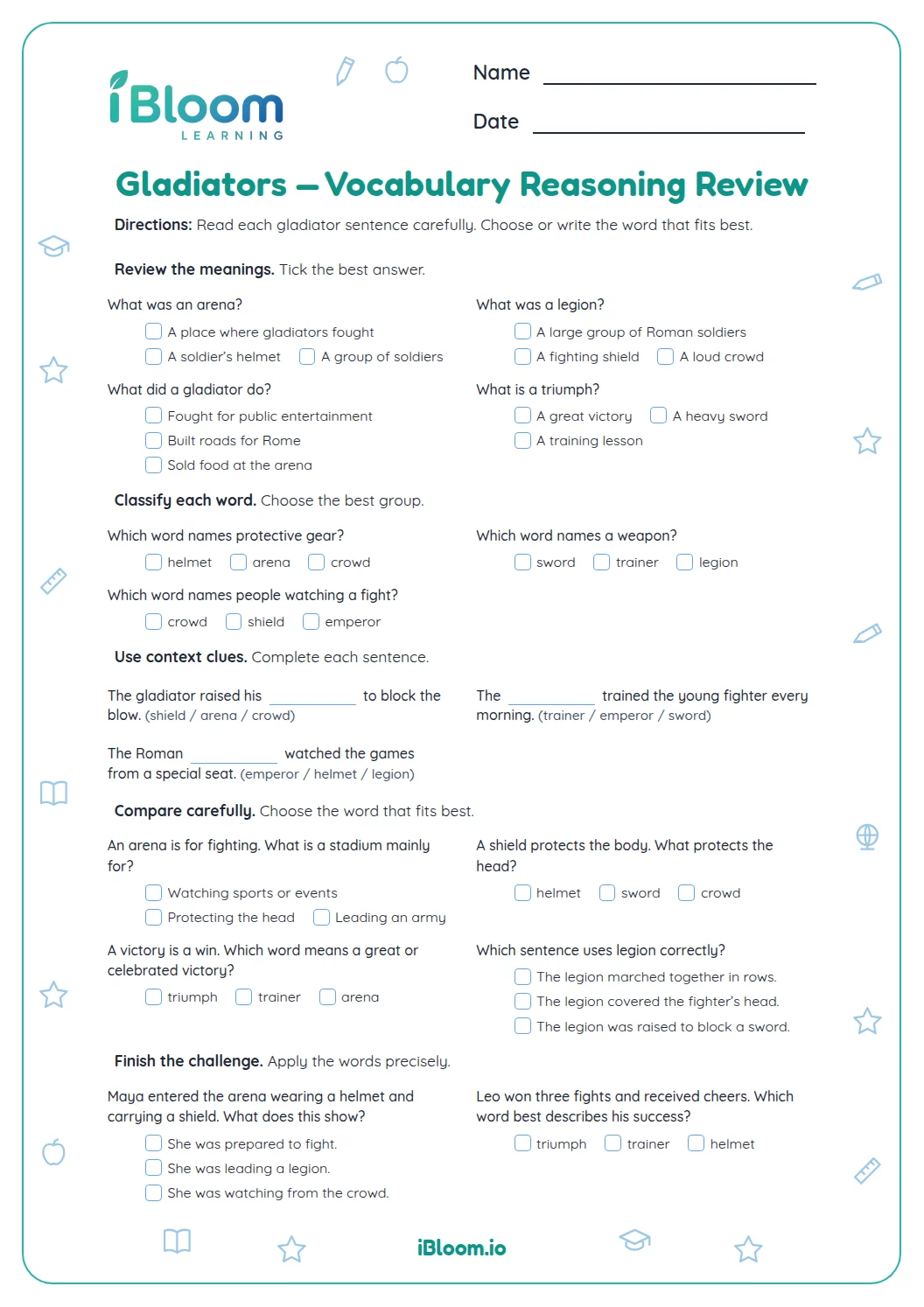
This Grade 3 vocabulary printable combines a themed word search with direct word-meaning practice. Students first find ten words connected to gladiators, then use short definitions to choose among the same topic words. The activity reinforces spelling patterns and precise vocabulary in one two-page worksheet. Meanings include arena, armor, helmet, and shield, with distinctions that require reading the full clue. A separate answer key lists the hidden words and the meaning answers.
Which words belong to the gladiator topic?
The search includes arena, armor, brave, crowd, fight, gladiator, helmet, shield, sword, and train. These words name people, objects, actions, and places connected to the theme.
- 1Meaning: A large open place where contests were held
- 2Identify the place where people gather to watch a contest.
- 3Answer: arena
How can you connect a meaning to a word?
Read the entire meaning before choosing. For “a protective covering for the head,” helmet fits; shield protects a different part of the body.
What is on this worksheet?
Part A is a 10-word grid. Part B has ten short definitions with three word choices each, so children use meaning rather than letter patterns alone.
How to use this worksheet
- 1Scan the word list and notice the range of word lengths.
- 2Search each row for a word, checking the letters in order.
- 3Mark a word only after matching every letter.
- 4Read each meaning in Part B from beginning to end.
- 5Check whether the chosen word matches the whole definition.
Common mistakes and quick fixes
The mistake
Marking a word after spotting only its first few letters.
The fix
Trace each remaining letter in the same order.
The mistake
Mixing up helmet and shield.
The fix
Use the definition: helmet protects the head; shield can guard the body.
The mistake
Choosing a word associated with the topic but not the definition.
The fix
Test the exact meaning of each choice.
What to practice next
Make more practice
Questions parents and teachers ask
Which words are hidden in the puzzle?
The grid contains arena, armor, brave, crowd, fight, gladiator, helmet, shield, sword, and train. The answer key lists all ten words and gives the matching meaning answers for the second part. All ten entries in the word list appear once in the grid, without diagonal or backwards placements.
Are the hidden words diagonal?
No. Every target word runs horizontally from left to right across a row. Students can check the letters in order against the printed word list, then mark a word after confirming its final letter. The grid uses left-to-right rows only, and no target is hidden vertically or diagonally.
What does “arena” mean here?
An arena is a large open place where contests or shows can take place. In the matching section, that meaning points to arena rather than a person, a weapon, or protective equipment. The other choices name a watcher and a piece of equipment, not a place for a contest.
How many questions are there?
There are 11 numbered items: one word-search activity containing ten target words and ten multiple-choice meaning questions. The answer key includes the hidden word list and each definition match. That count treats the word-search grid as one activity and each definition as its own question.
Can students use the word list while solving meanings?
Yes. The list gives the ten topic words, and Part B asks students to connect those same words to definitions. Students still need to read each definition carefully to distinguish the choices. The word list is a useful reference, but the definitions still require careful reading.
Is this page about real historical details?
The page focuses on vocabulary practice, not historical recall. It uses words such as arena, armor, and gladiator with short definitions, so students can concentrate on spelling and meaning. It is a themed language activity; students are not tested on dates, events, or other historical facts.