






About this worksheet
This Grade 3 printable starts with a six-word search and then asks readers to use sentence clues for impossible, unlikely, imaginary, unbelievable, ridiculous, and hopeless. Children identify meanings, compare close ideas such as impossible and unlikely, and use context to choose a precise word. The 15 questions include a separate answer key for checking.
Which six words are hidden in the grid?
The grid contains impossible, unlikely, imaginary, unbelievable, ridiculous, and hopeless. Finding each word gives children a quick look at the vocabulary before they read it in a sentence.
How do the sentences reveal each meaning?
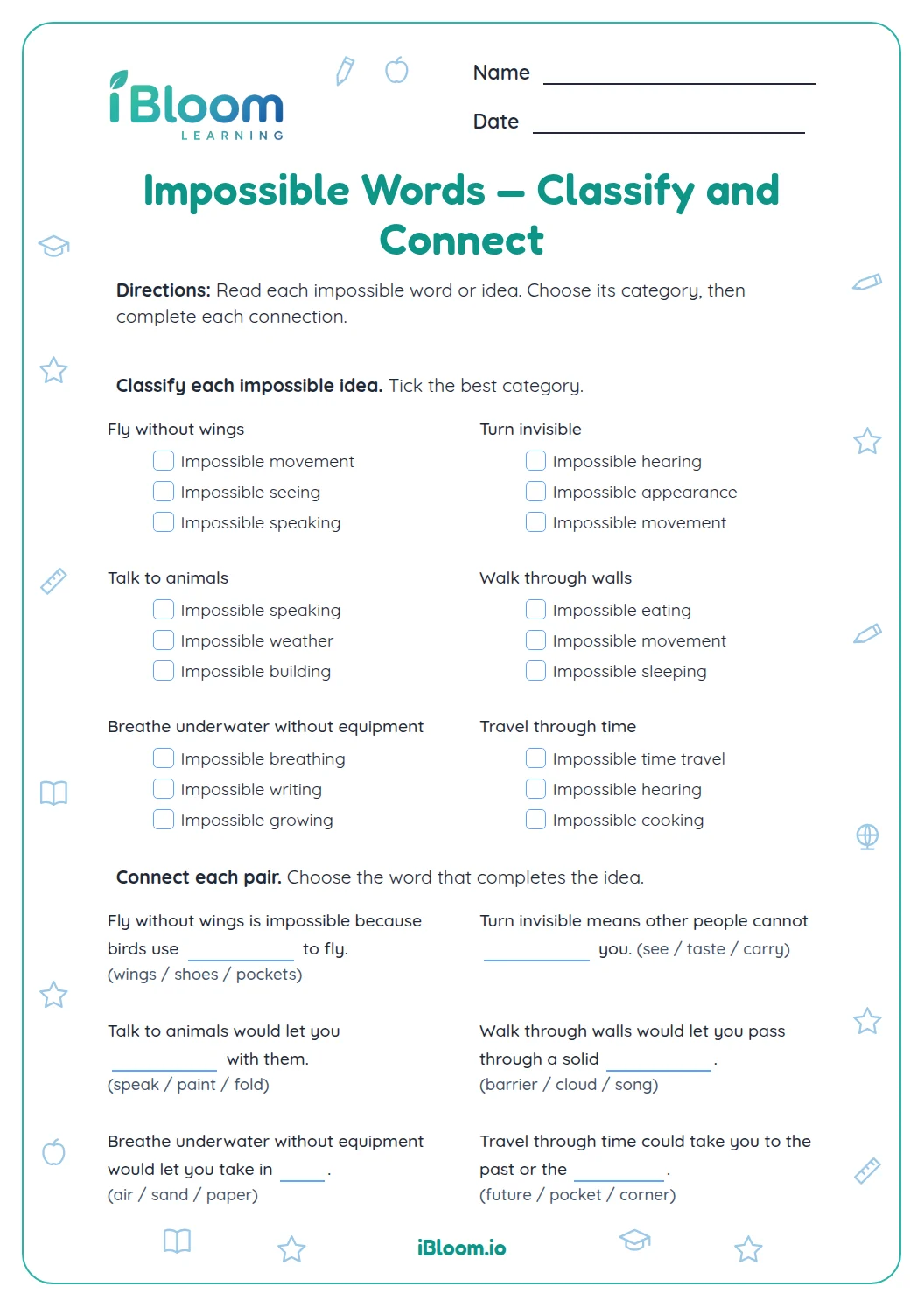
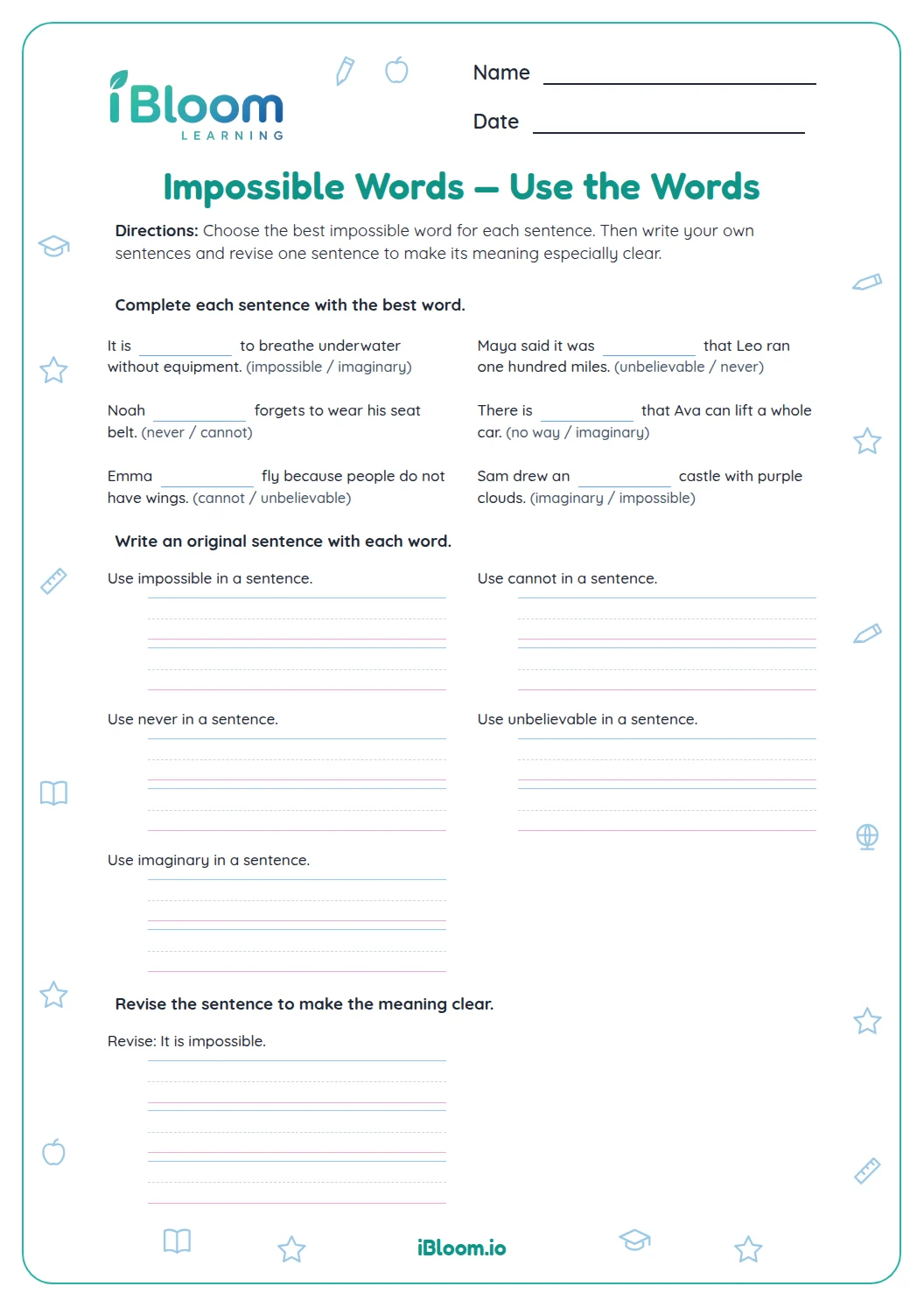
The sentence supplies a clue: a plan to fly without wings cannot happen, so it is impossible. Snow in July could happen but is not expected, so it is unlikely. A made-up castle is imaginary.
How are impossible and unlikely different?
Impossible means something cannot happen. Unlikely means it could happen, but people do not expect it. Question 14 asks children to explain that difference in their own words.
How to use this worksheet
- 1Find the six listed vocabulary words in the grid and mark them.
- 2Read each context sentence all the way through.
- 3Underline the clue that helps explain the bold vocabulary word.
- 4Use the meaning clue to answer the matching questions.
- 5Compare impossible with unlikely, then check the key.
Common vocabulary mix-ups
The mistake
Using impossible for something that is merely not expected.
The fix
Ask whether it could happen at all. If it could, but is not expected, use unlikely.
The mistake
Calling every strange story ridiculous.
The fix
Unbelievable means hard to believe; ridiculous means silly or unreasonable.
The mistake
Treating imaginary as another word for unbelievable.
The fix
Imaginary things are made up; unbelievable describes something difficult to accept as true.
What to practice next
Make more practice
Questions parents and teachers ask
What does impossible mean?
Impossible describes something that cannot happen. In the worksheet, Maya plans to fly to camp without a plane or wings, so the plan cannot happen. Children use that clue in the sentence rather than memorizing a list alone. Use the sentence clue to decide what can happen.
How are impossible and unlikely different?
Impossible means something cannot happen. Unlikely means it could happen, but people do not expect it. Snow in July is used as an unlikely guess; a plan to fly without wings is impossible. Question 15 asks children to state the difference.
Which words are hidden in the grid?
The six words are impossible, unlikely, imaginary, unbelievable, ridiculous, and hopeless. They appear across the rows. After finding them, children use sentence clues to explain the meanings and choose words that fit new examples. The words are listed below the grid as a search checklist.
What is the difference between imaginary and unbelievable?
Imaginary means made up and not real, like Ava’s castle in a story. Unbelievable means difficult to believe because something seems very strange. The worksheet gives one sentence for each word so children can compare the clues. One describes whether it is real; the other describes believability.
How should I use the answer key?
Let the learner search the grid and answer the sentence questions first. Then use the separate key to check the six words and the meaning responses. If a word does not fit, reread the whole sentence and point to the clue that supports a better choice.