



About this worksheet
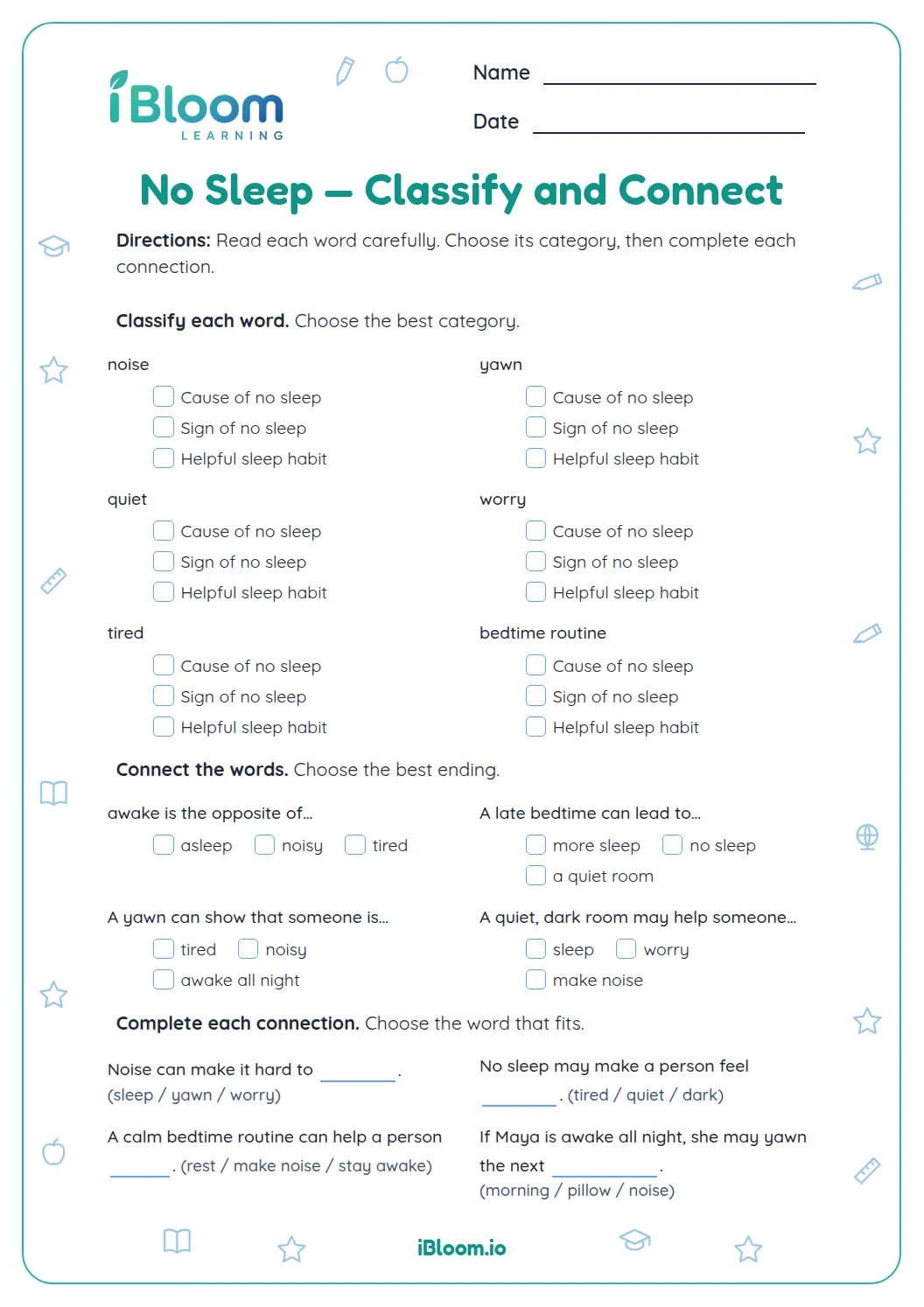
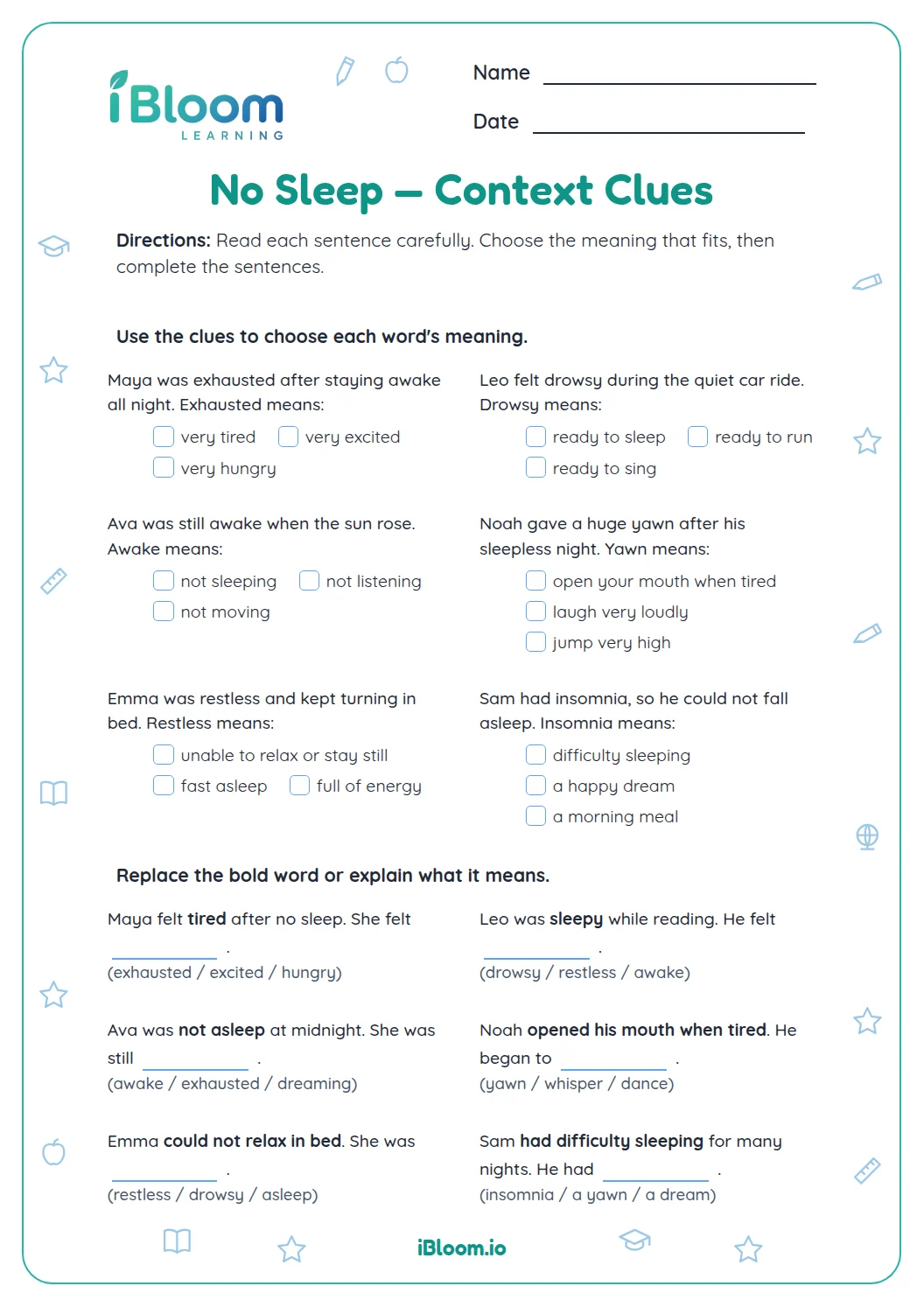
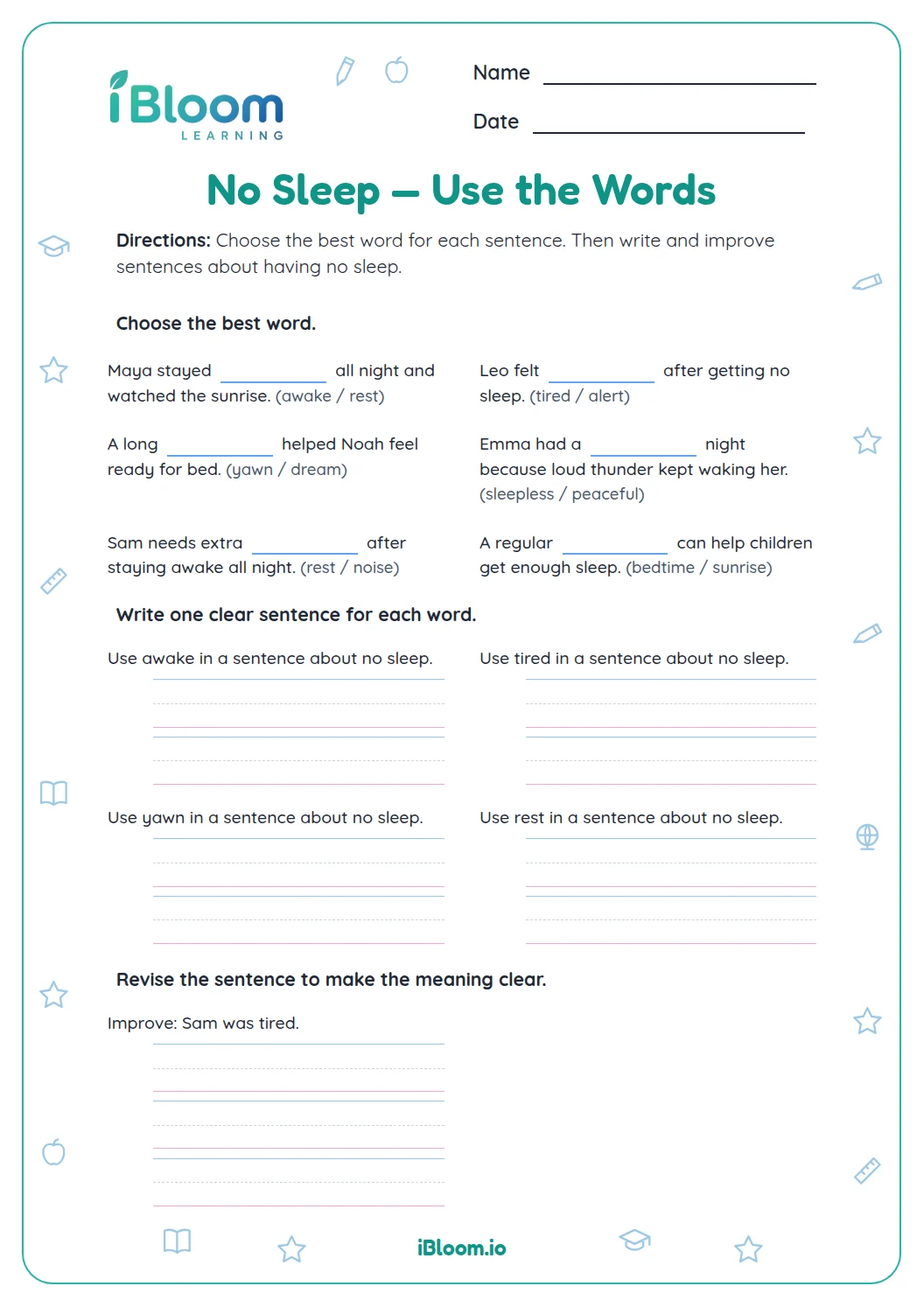
This free Grade 3 worksheet asks children to reason about words connected with sleep and wakefulness. Fifteen questions use familiar situations to distinguish awake, alert, sleepy, restless, rested, tired, and exhausted, along with nap and bedtime. Part A uses sentence clues, Part B completes meanings from a word bank, Part C compares nearby meanings, and Part D asks children to explain two choices. The practice supports Common Core L.3.4.a and L.3.5.b through sentence clues and connections between words and everyday situations. A separate answer key gives the selected words and sample explanations for the final responses.
Aligned to L.3.4.a and L.3.5.b
Which words in a sentence help children choose?
The useful clue is the detail that narrows the meaning. A short sleep on a sofa suggests a nap. Barely keeping eyes open suggests sleepy. Feeling fresh after a good rest suggests rested. Children should name the clue before marking a choice.
Part A gives six situations with three choices each. Some choices fit the general topic but not the sentence’s meaning. Reading the entire sentence prevents a child from choosing a word simply because it is connected to nighttime.
- 1Maya could not stay still.
- 2The clue is could not stay still.
- 3Restless means unable to settle or stay still.
- 4Answer: restless.
How do the related words differ?
Awake tells whether someone is sleeping. Alert adds the idea of attention: a person is ready to notice and respond. In question 11, Jo notices even a faint sound while listening for a kitten, so alert is the more precise choice.
Tired describes needing rest; exhausted means extremely tired. Question 12 includes very little energy to speak, so exhausted fits best. Question 13 compares tired with sleepy: sleepy specifically means needing sleep, while tired can describe low energy after effort.
What should children include in an explanation?
The final two questions ask for a word and a reason. Question 14 compares nap with bedtime: one is a short sleep, and the other is the usual time for going to bed. Question 15 gives a child who is awake but yawning and asks why awake fits better than alert.
Accept explanations in the child’s own words when they make the relevant distinction. A response that simply repeats the chosen word needs a little more: ask what that word tells the reader and which detail supports it.
How to use this worksheet
- 1Read the first sentence and identify the clue “not sleeping” before choosing awake.
- 2Complete Part A, pointing to a specific clue for each word choice.
- 3Use the four-word bank in Part B and reread each completed meaning aloud.
- 4In Part C, compare the two words by asking what extra meaning the more precise word carries.
- 5Write the two explanations in Part D, then compare the reasoning with the sample key.
Mistakes to watch for
The mistake
Treating awake and alert as exact synonyms.
The fix
Ask whether the sentence only says someone is not asleep or also shows careful attention. Question 15 separates the two meanings.
The mistake
Choosing rested when the sentence describes someone who cannot settle.
The fix
Look at the ending and the meaning. Rested means refreshed by rest; restless means unable to settle or stay still.
The mistake
Calling a short afternoon sleep bedtime.
The fix
Separate the sleep itself from its scheduled time. A nap is a short sleep; bedtime is when a person usually goes to bed.
Common Core alignment
Use clues such as drooping eyes or careful listening to choose a word.
On this sheet: Parts A and C ask children to connect each sentence’s details to a precise word.
Show the official wordingHide the official wording
Use sentence-level context as a clue to the meaning of a word or phrase.
Connect sleep and wakefulness words with everyday actions and feelings.
On this sheet: Children connect words such as alert, restless, and exhausted with listening, moving, and hiking situations.
Show the official wordingHide the official wording
Identify real-life connections between words and their use (e.g., describe people who are friendly or helpful).
What to practice next
Make more practice
Further reading
Questions parents and teachers ask
Which words does the worksheet review?
The review uses awake, alert, sleepy, restless, rested, tired, exhausted, nap, and bedtime. Children meet the words in short situations, complete four meanings from a bank, compare three pairs of nearby meanings, and write two explanations. The repeated encounters ask for meaning and reasoning in different forms.
How should I explain tired and exhausted?
Explain that exhausted is stronger than tired: it means extremely tired. Question 12 describes Ana after a long hike with barely enough energy to speak, so exhausted best matches those strong clues. Ask the child to identify the detail that makes the stronger word a better fit in that sentence.
Can someone be awake without being alert?
Yes; awake means not asleep, while alert means paying close attention and ready to notice things. Question 15 describes Sam yawning and missing what someone says. He is awake, but his actions do not show alert attention. Children explain that difference using the details given in the question.
Does Part B have a word bank?
Yes; the directions for Part B list nap, bedtime, restless, and exhausted, with each word used once. Children match those words to four short meanings. After filling the blanks, have them read each statement aloud and explain one difference, such as the difference between a nap and bedtime.
How should the written explanations be checked?
Check whether the answer gives the correct word meaning and connects it to the situation. Question 14 should distinguish a short sleep from a time for bed. Question 15 should distinguish being awake from paying close attention. The key supplies examples, but clear explanations in other words are equally useful.