





About this worksheet
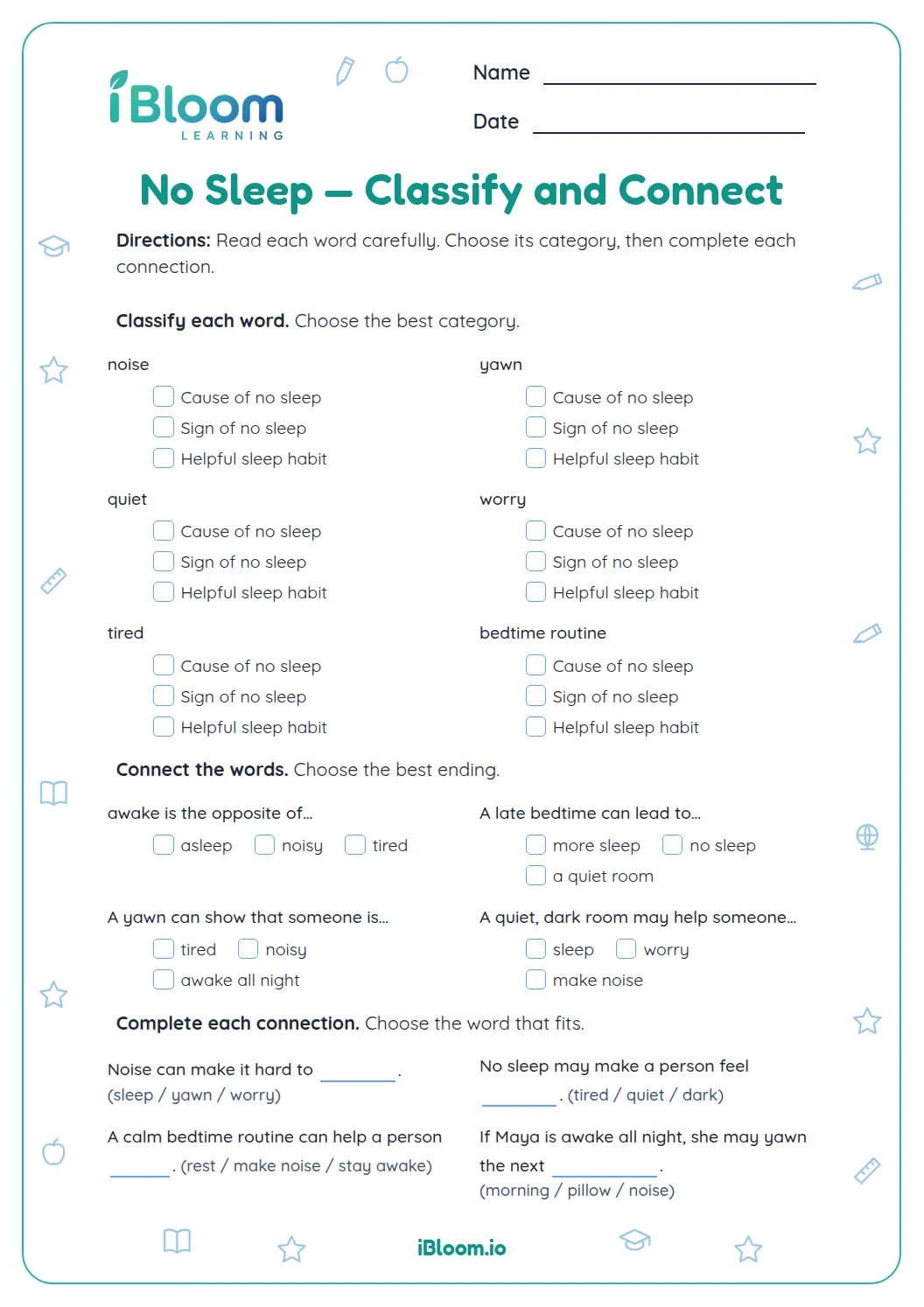
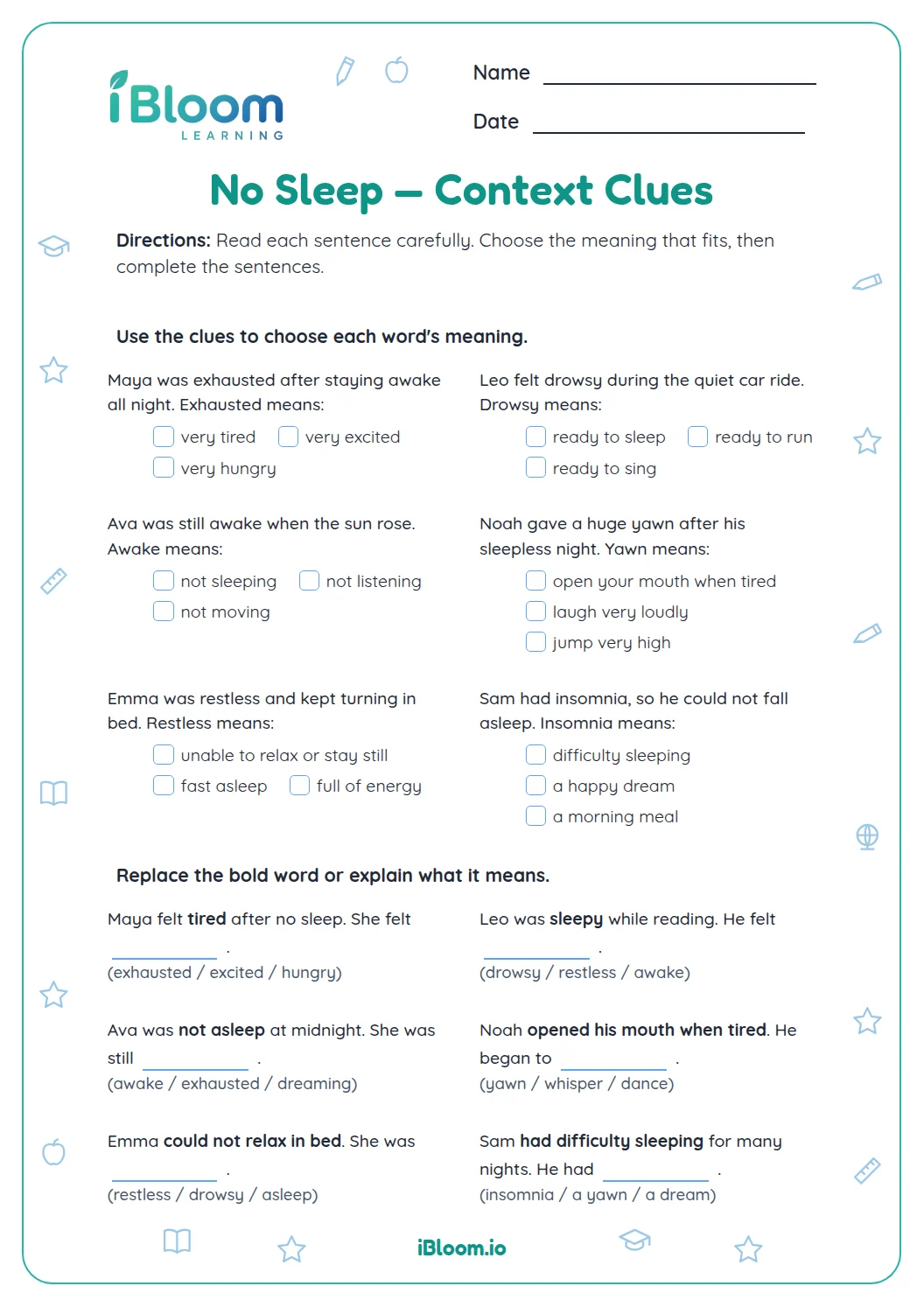
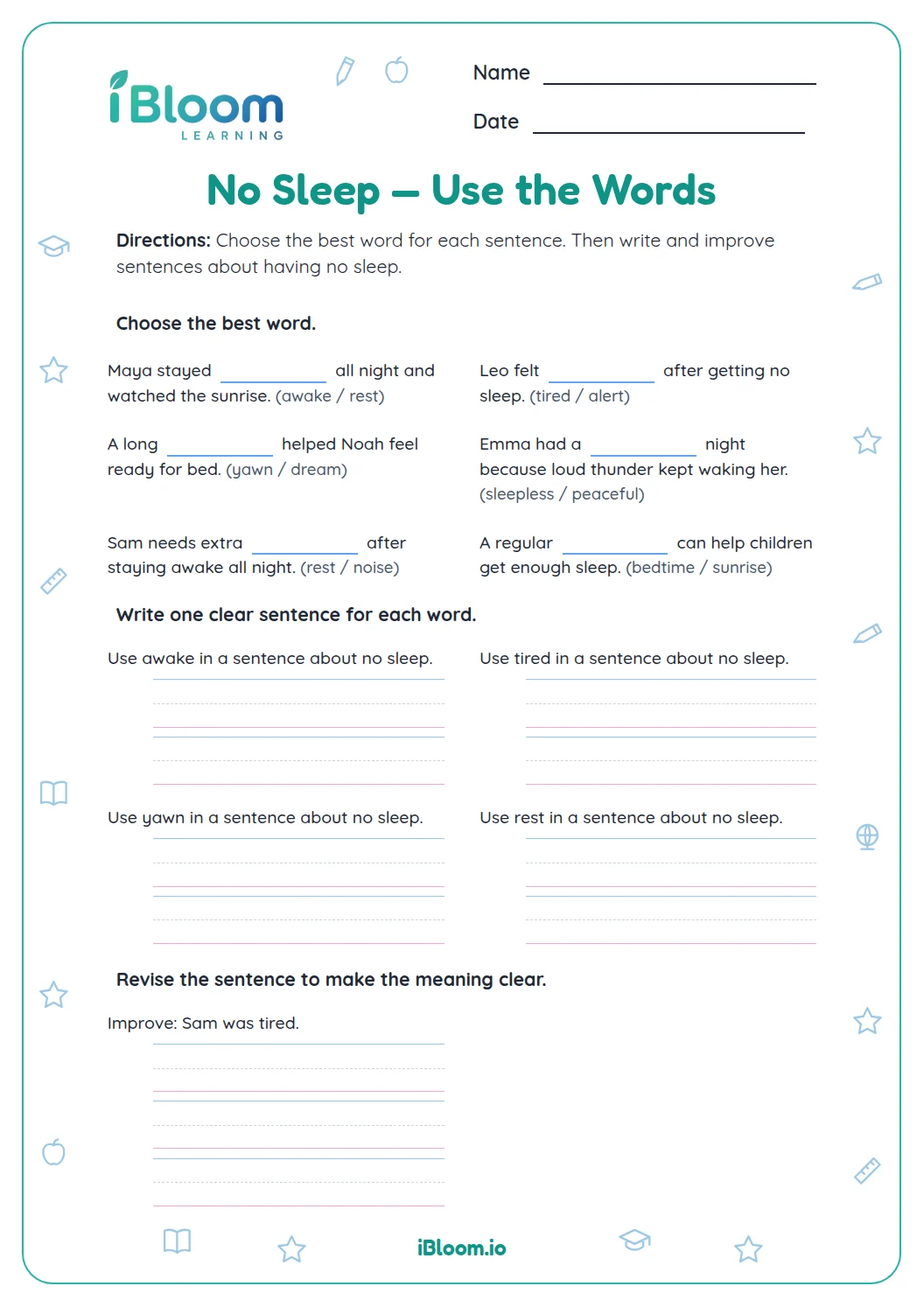
This Grade 3 vocabulary worksheet uses sleep-related words to practice meaning in context. Students find eight words in a compact word search, then use full sentences to choose meanings and connect related words. Fourteen items include a separate answer key.
Aligned to L.3.4.a
How can a sentence help explain a word?
A sentence may explain an unfamiliar word with an action, a description, or a result. Read the complete sentence and connect its details to the target word.
Question 2 says Max rubbed his sleepy eyes after a long bus ride. Those details point to drowsy meaning sleepy.
- 1Max felt drowsy and rubbed his sleepy eyes.
- 2The clue “sleepy eyes” points to sleepy.
What is the word search for?
The word search previews the eight words used in the worksheet: drowsy, yawn, rest, cozy, whisper, dream, snore, and awake. Finding a word gives students a chance to read it before interpreting it in a sentence.
What kinds of meanings do students practice?
After the grid, students use sentence clues to choose meanings and finish by connecting related sleep words. The choices vary in position so students must read each sentence rather than follow a pattern.
- Part A: locate eight words in the grid
- Part B: infer word meanings from sentence clues
- Part C: connect related sleep words
How can an adult guide the practice?
- 1Read the whole sentence before looking at the options.
- 2Notice an action or detail that hints at the target word.
- 3Try each meaning in the sentence and see which one makes sense.
- 4Return to the grid to check how the target word is spelled.
Common slips and helpful fixes
The mistake
Choosing a meaning from only one nearby word.
The fix
Read the entire sentence for the action or result that explains the target.
The mistake
Picking a word that matches the topic but not the sentence.
The fix
Check that the meaning fits every detail in the sentence.
The mistake
Mixing up related words such as drowsy and awake.
The fix
Say each meaning in your own words and compare whether it means sleeping or not sleeping.
Common Core alignment
This page practices using sentence clues to figure out word meanings.
Use the sentence around a word as a clue to its meaning.
On this sheet: Use the sentence around a word as a clue to its meaning.
Show the official wordingHide the official wording
Use sentence-level context as a clue to the meaning of a word or phrase.
What to practice next
Make more practice
Further reading
Questions parents and teachers ask
What vocabulary skill does this page practice?
Students use sentence-level context to decide what a word means. For example, a sentence about sleepy eyes helps explain drowsy, while a quiet baby nearby points to whisper. The word search introduces the same eight words before students work with them in context.
Which words appear in the word search?
The grid contains drowsy, yawn, rest, cozy, whisper, dream, snore, and awake. Each is also used in a sentence elsewhere on the worksheet, so students can connect word recognition with meaning. The grid gives a quick preview of the words students will meet in context.
How should a student use context clues?
Read the whole sentence, notice an action or description, and try a possible meaning in place of the target word. If the sentence still makes sense, that meaning is a strong choice. This routine helps avoid guessing from the topic alone.
Is this worksheet about the story No Sleep?
The saved page title names No Sleep, and this replacement keeps that sleep theme while rebuilding the activity around vocabulary. It uses independent sentences about sleep and rest rather than relying on a missing story passage. Students can point to the sentence clue before choosing.
How many items are on the worksheet?
There are 14 items: one word search activity and 13 questions about meanings and word relationships. Students move from direct sentence clues to related words. A separate answer key lists the eight words and the answers to each question. Students can look back at the context sentence to check each choice.
Does the worksheet have an answer key?
Yes. A separate key lists the eight words to find and the correct meaning or relationship for each question. It can be kept aside while the student completes both worksheet pages. A grown-up can ask the child to explain one clue aloud.