





About this worksheet
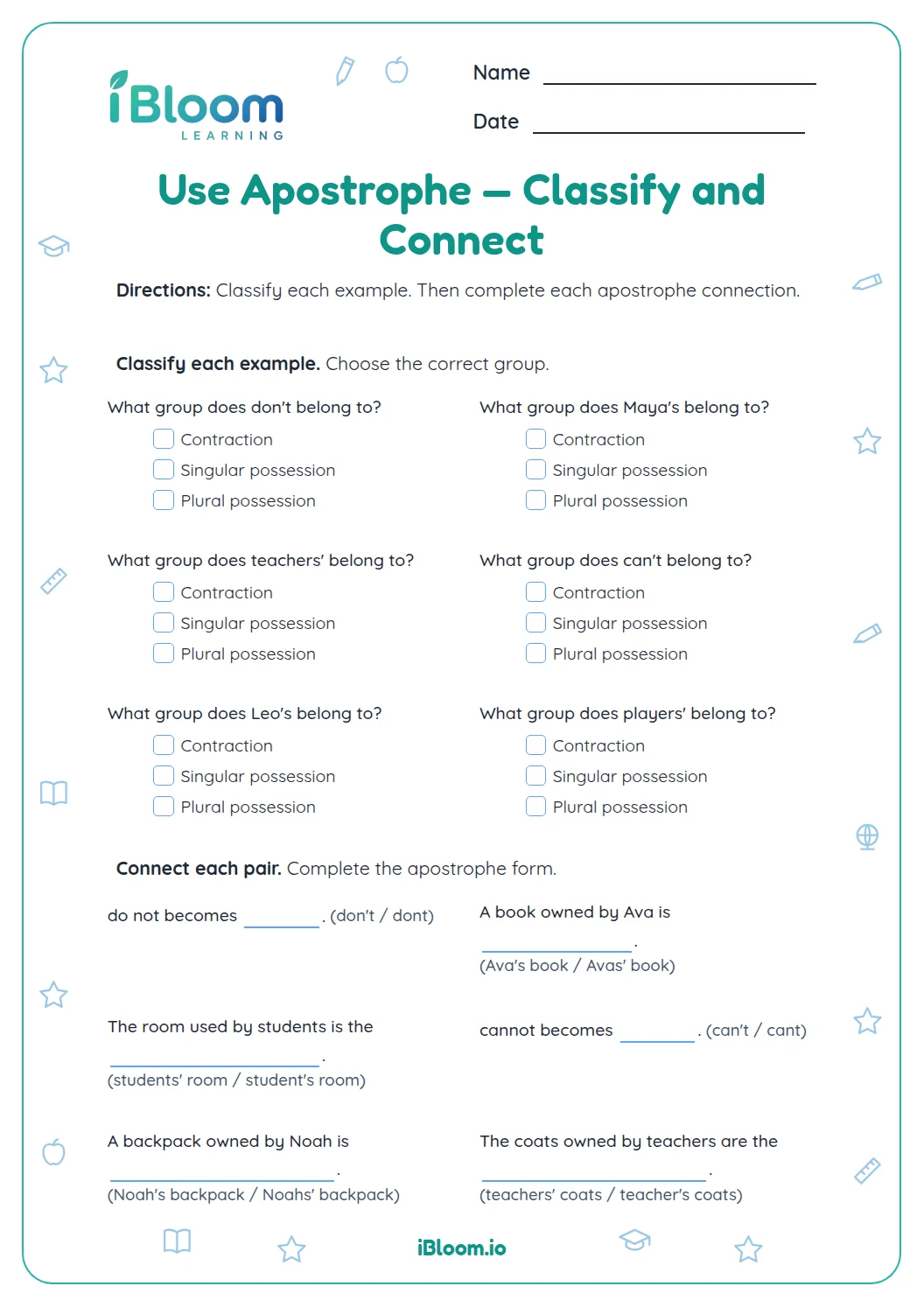
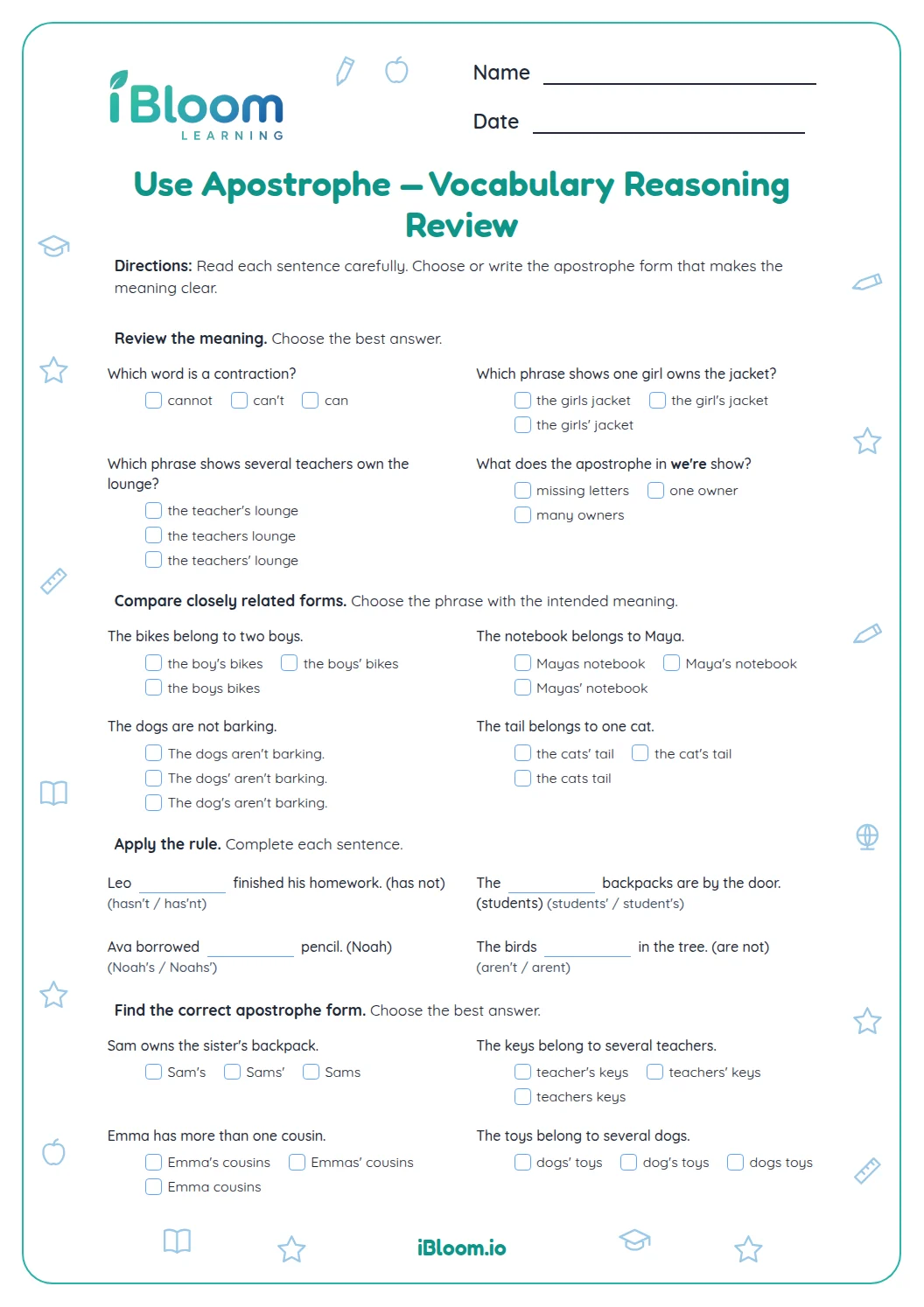
Read apostrophes in context: they mark ownership in singular and plural possessives, and omitted letters in contractions. The questions also distinguish possessive ’s from ’s meaning “is.” The worksheet has 16 questions, and the answer key is included.
What skill does this worksheet build?
Read apostrophes in context: they mark ownership in singular and plural possessives, and omitted letters in contractions. The questions also distinguish possessive ’s from ’s meaning “is.” The answer key gives a check for each item.
How can a learner solve one?
The apostrophe and s show that one bird owns the nest.
- 1In “the bird’s nest,” what does bird’s mean?
- 2The apostrophe and s show that one bird owns the nest.
- 3Answer: The nest belongs to one bird.
What is included on the pages?
The worksheet has 16 questions across 5 activity parts. The answer key gives a check for every response.
How to use this worksheet
- 1Read the whole phrase or sentence.
- 2Ask whether the apostrophe marks ownership or missing letters.
- 3For possession, check whether the owner is singular or plural.
- 4For a contraction, expand it to the two original words.
- 5Read ’s in context to tell possession from “is.”
Common mistakes and quick fixes
The mistake
Writing a plural owner without an apostrophe.
The fix
For plural nouns ending in s, put the apostrophe after the s: dogs’ bowls.
The mistake
Using an apostrophe to make a regular plural.
The fix
Use apostrophes for possession or omitted letters, not just more than one.
The mistake
Assuming every ’s shows ownership.
The fix
Read the sentence: in “Sam’s ready,” ’s means “is.”
What to practice next
Questions parents and teachers ask
What does an apostrophe show in a possessive?
It marks ownership. In “the bird’s nest,” one bird owns the nest; in “the dogs’ bowls,” more than one dog owns the bowls. The placement changes depending on whether the owner is singular or plural. Ask the learner to point to the clue in the question and explain how it supports the answer.
How is a contraction different?
A contraction joins two words and uses an apostrophe where letters are omitted. For example, can’t means cannot and they’ll means they will. The apostrophe takes the place of letters removed from the original words. Ask the learner to point to the clue in the question and explain how it supports the answer.
What does ’s mean in every sentence?
Its meaning depends on context. In “Mia’s book,” it shows possession; in “Mia’s ready,” it stands for “is.” Read the rest of the sentence to decide which meaning makes sense. Ask the learner to point to the clue in the question and explain how it supports the answer.
Why is children’s written with the apostrophe before s?
Children is an irregular plural that does not end in s. Add ’s to show possession: the children’s coats. The apostrophe comes before the s because the plural owner does not end with s. Ask the learner to point to the clue in the question and explain how it supports the answer.
Can written answers vary?
Yes. Questions 13 and 16 invite original examples. The key gives samples, such as “The cat’s toy is red” and “I’m means I am.” A different sentence is correct when it uses the apostrophe properly and explains its meaning. Ask the learner to point to the clue in the question and explain how it supports the answer.