


About this worksheet
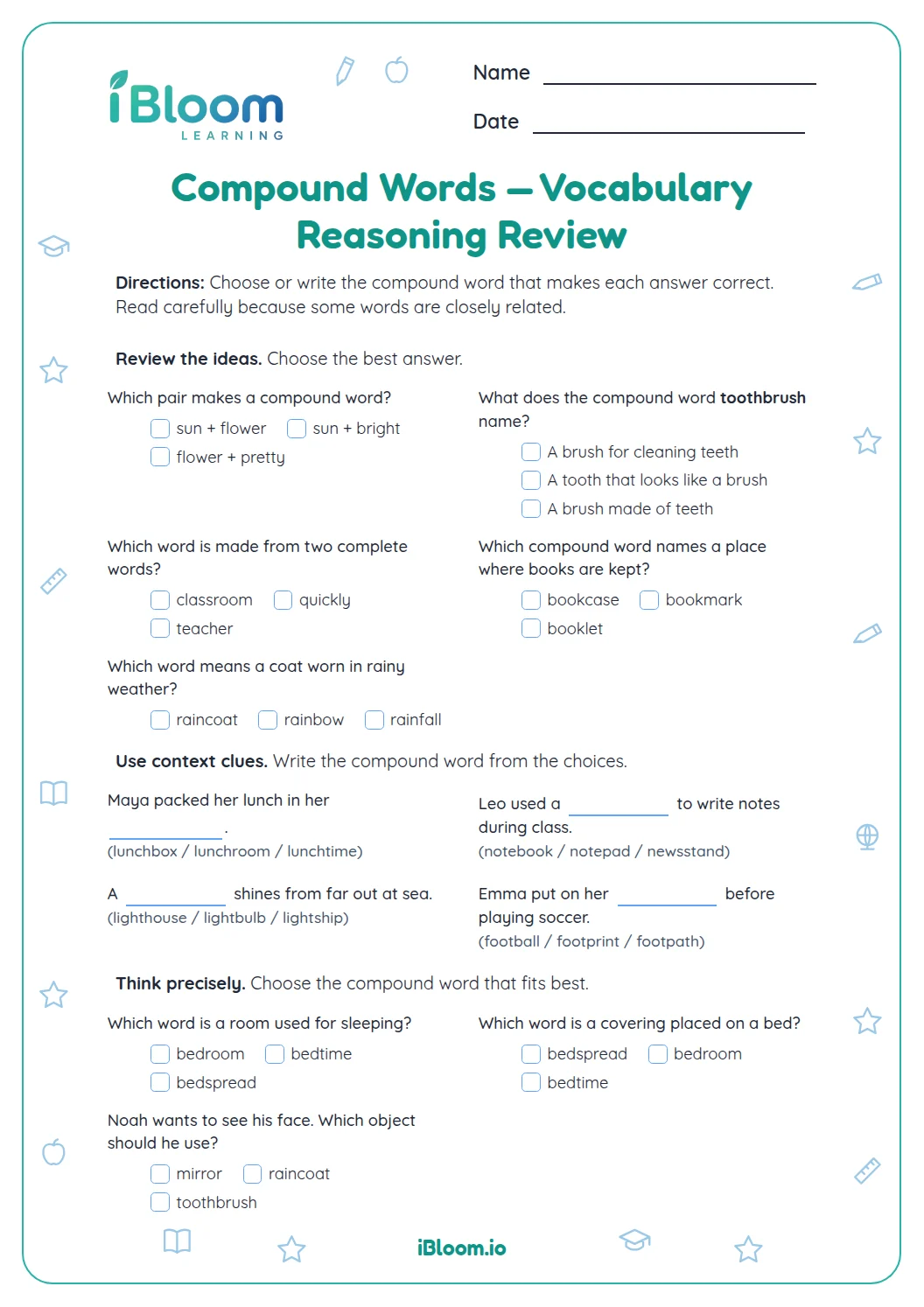
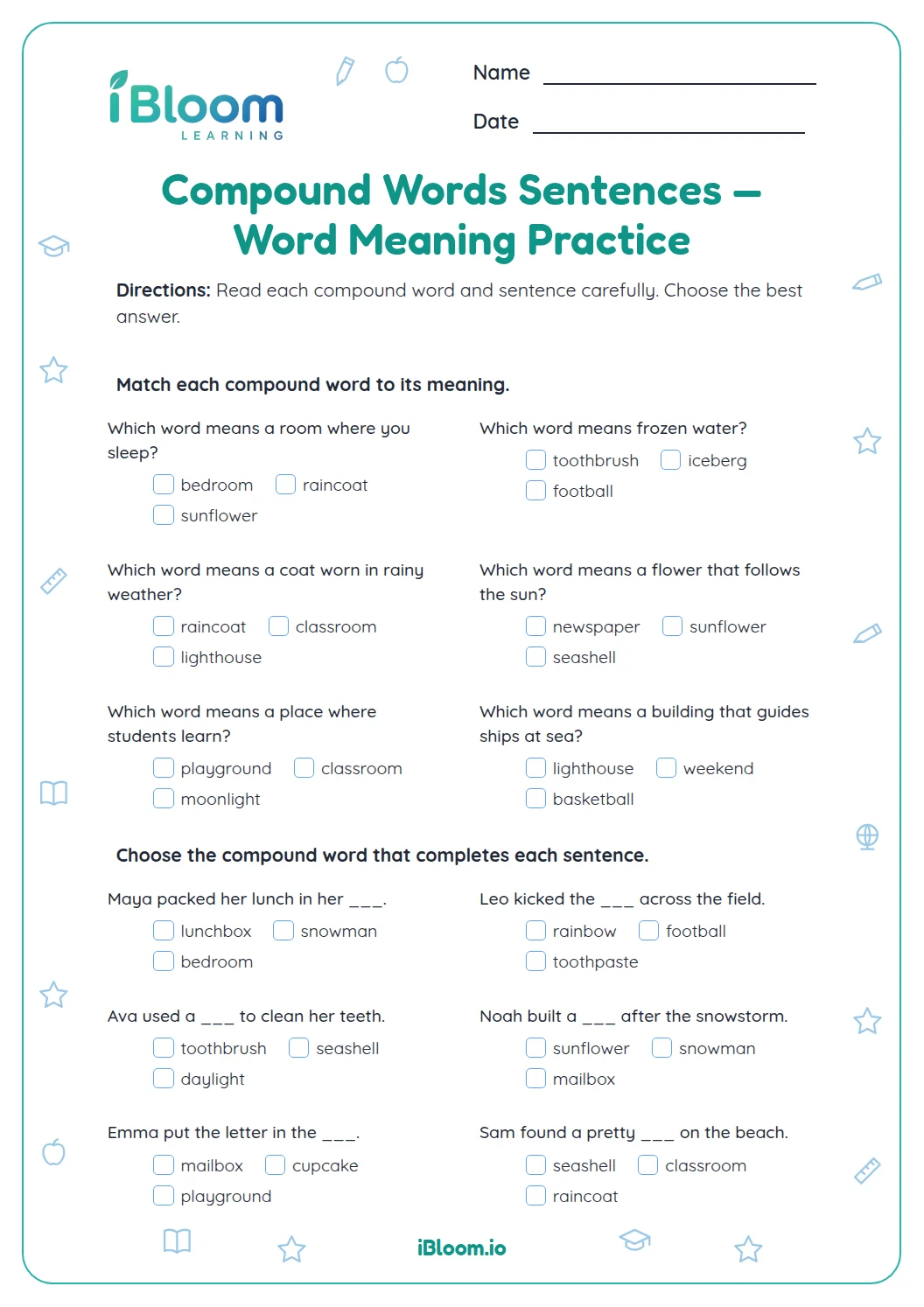
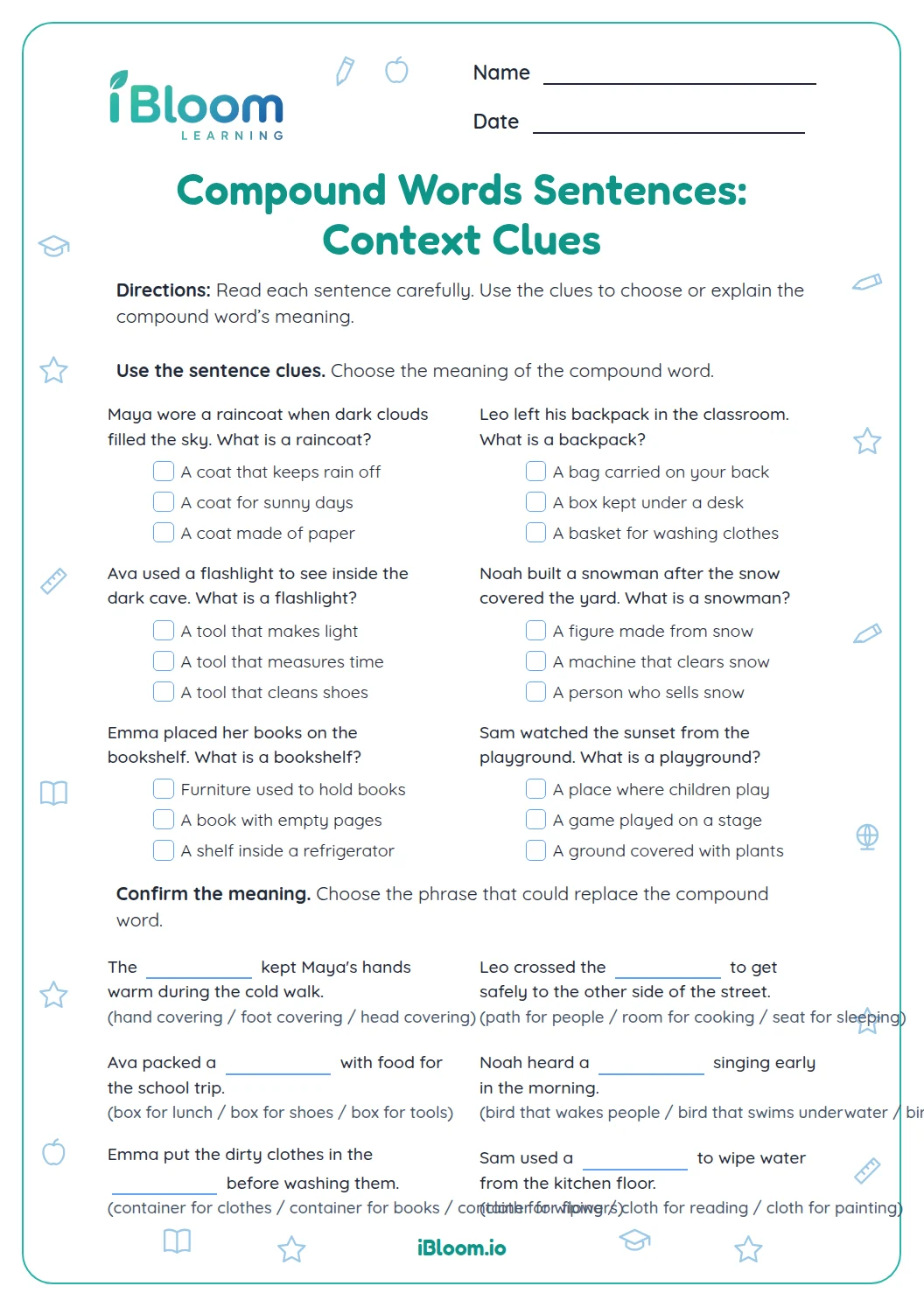
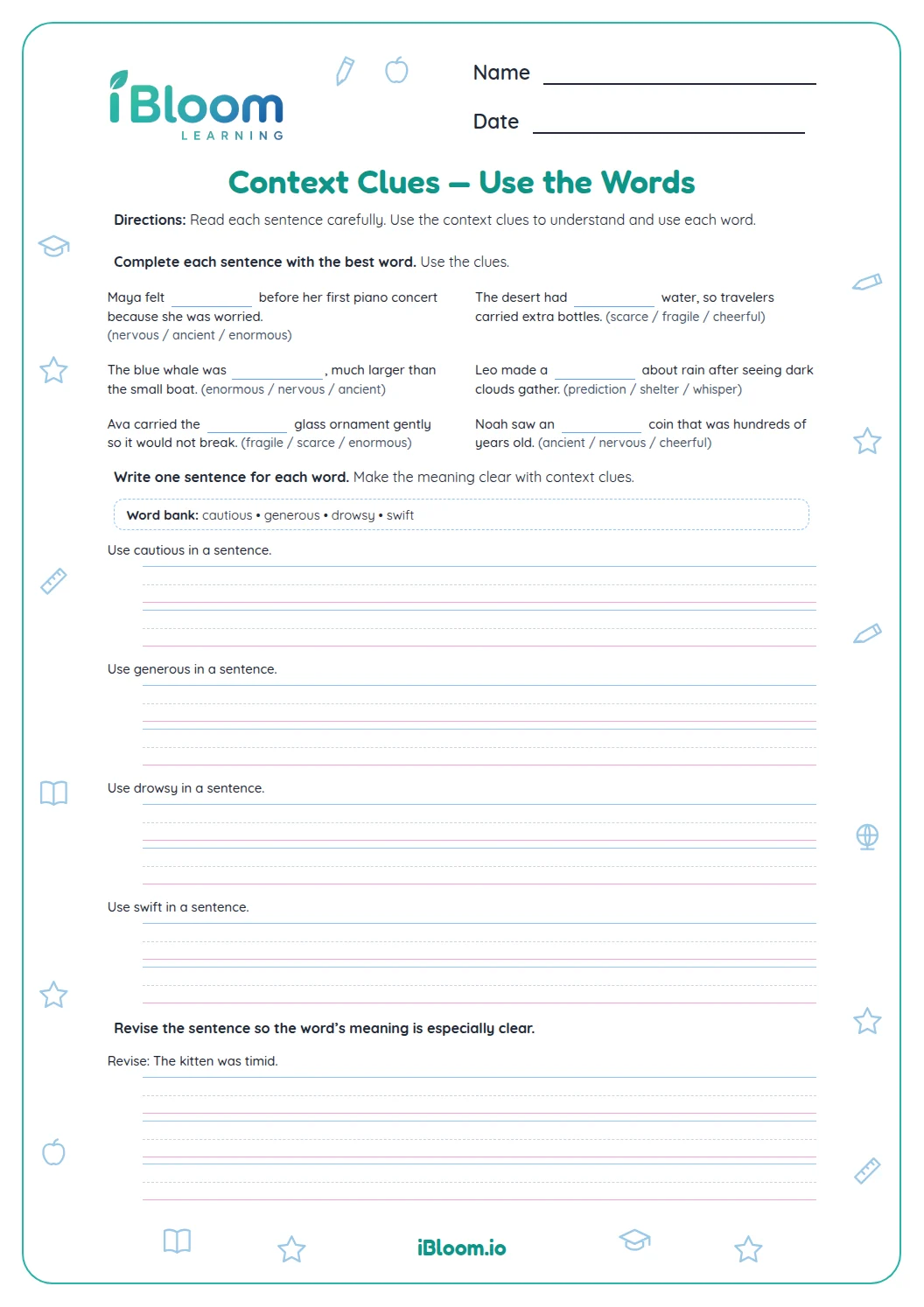
Knowing the two smaller words is a useful first clue, but compound meanings also need context. Students use both parts and sentence clues to interpret familiar compounds, including words whose meaning is not simply a literal description. This replaces a single happy-or-sad item with sixteen varied word-meaning decisions.
Aligned to L.4.4
How do word parts help with compound words?
A compound joins two smaller words, such as “rain” and “coat.” The parts often suggest the meaning, but not every compound is a literal object made from both things. A “daydream” is not a dream that lasts exactly one day.
Read the full question and ask what people commonly mean by the compound in that context.
When should I use a context clue?
Context matters when a compound could be read in more than one way. A lighthouse is not a house where people live; it is a tower with a light that helps ships. In question 4, the clue about ships helps confirm the meaning.
How do I check a compound’s whole meaning?
Say the whole word and use it in the sentence. Then see whether each smaller word gives a useful clue to the familiar meaning.
How to use this worksheet
- 1Read both parts of the compound word.
- 2Say the whole word and recall its familiar meaning.
- 3Use the sentence clue to choose the word that fits.
- 4Check the key and explain why the other choices do not fit.
Common mistakes and quick fixes
The mistake
Guessing from only the first word part.
The fix
Read both parts and the entire sentence.
The mistake
Taking every part literally.
The fix
Check the familiar meaning of the whole compound.
The mistake
Ignoring a sentence clue.
The fix
Use the situation to test which word makes sense.
Common Core alignment
Students use word parts and context to determine the meaning of compound words.
Determine or clarify word meaning using context and word analysis.
On this sheet: Questions use the parts of familiar compounds and sentence context to determine meaning.
Show the official wordingHide the official wording
Determine or clarify the meaning of unknown and multiple-meaning words and phrases based on grade 4 reading and content, choosing flexibly from a range of strategies.
What to practice next
Make more practice
Further reading
Questions parents and teachers ask
What does this compound-word worksheet cover?
The fourteen questions ask students to match familiar compounds with meanings and use sentence clues to choose a compound that fits. Examples include sunflower, raincoat, notebook, airport, and doghouse. The answer key lists each intended meaning or word. Ask the student to explain which word parts support the choice.
What is a compound word?
A compound word joins smaller words to make a word with its own meaning. Raincoat combines rain and coat to name clothing that helps keep someone dry in rain. Looking at both parts can help, and the sentence around the word can confirm the meaning.
Do the parts always tell the whole meaning?
The parts offer clues, but the whole word may have a meaning that is not a literal combination. A sunflower is not made of sunlight, and an airport is not a harbor. Read the answer choices and use familiar meaning and context together.
How do sentence clues help?
Sentence clues narrow down which compound makes sense in a situation. If someone waits for a flight, airport fits better than bedroom or sunflower. Have the student explain which part of the sentence rules out the other choices. Ask which detail in the sentence rules out the other choices.
How can we extend the practice?
Ask the student to choose a compound from the page, explain its two parts, and write a new sentence that makes its meaning clear. Then cover the compound and see whether a reader can infer the word from the clue.