


About this worksheet
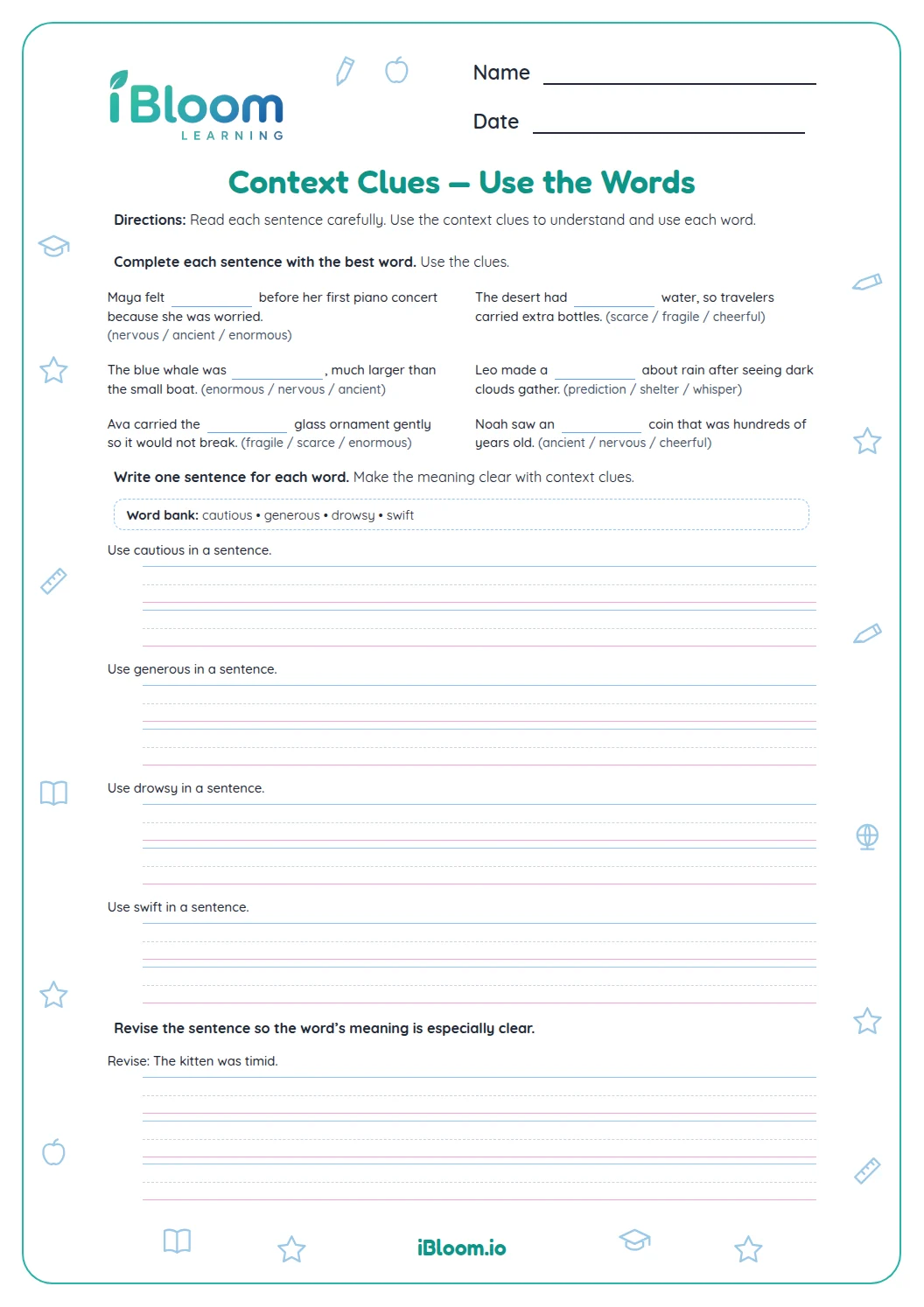
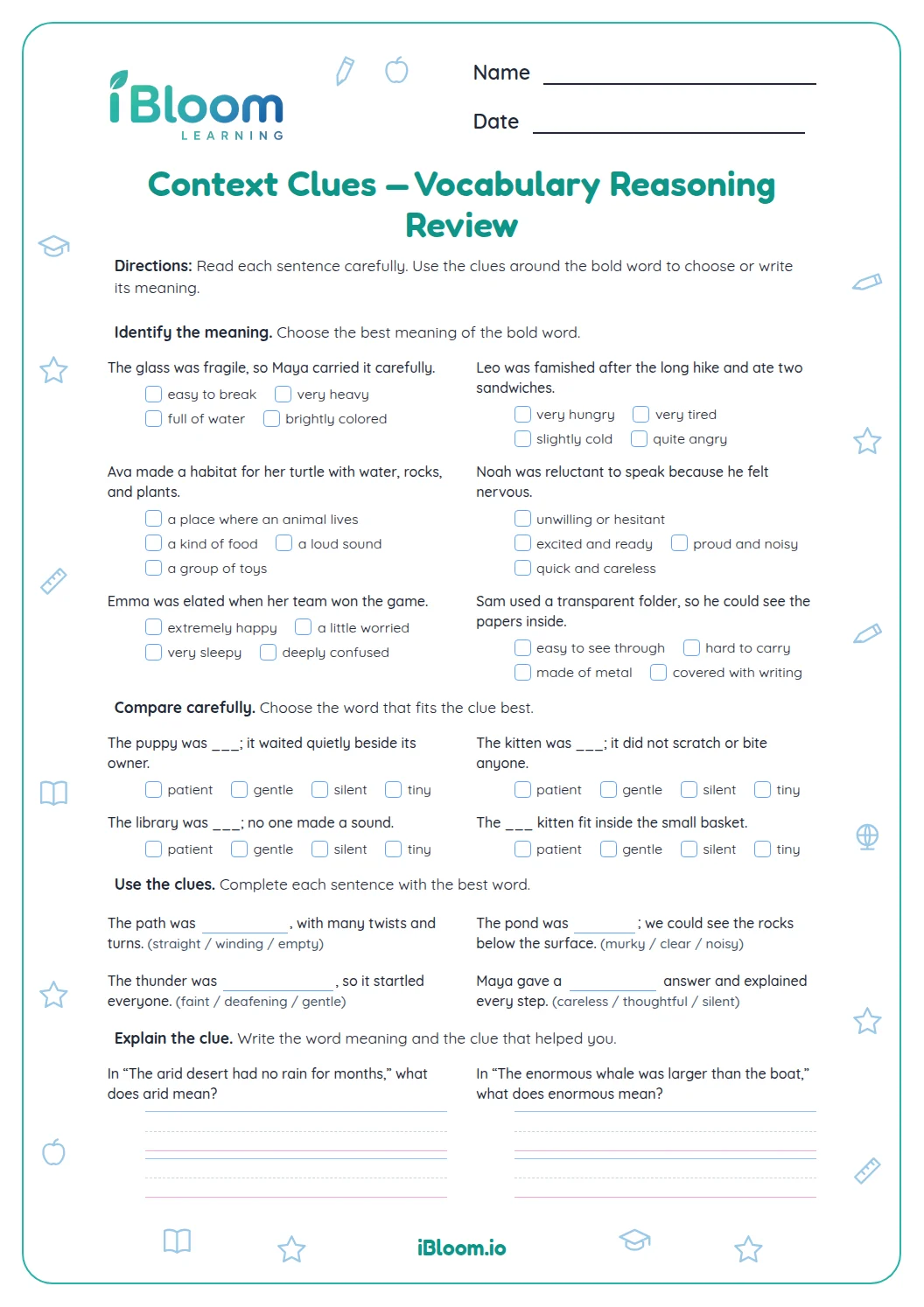
Use this Grade 4 vocabulary worksheet to infer word meanings from a sentence. Each item includes clue words that point to one best choice, such as an explanation, contrast, or result.
Aligned to L.4.4a
How do context clues help with an unfamiliar word?
Context clues are details around a word that help a reader infer its meaning. A reader can look for an example, a contrast, an explanation, or an action that makes the meaning clearer.
For instance, “Rain barely reached the dry, cracked field” gives clues that arid means very dry. The sentence does not define arid directly; its details point to the meaning.
- 1Clue details: “dry, cracked field” and little rain
- 2Try the choices in the sentence.
- 3“Very dry” fits the details.
- 4Answer: very dry
What kinds of words appear on the worksheet?
The 14 multiple-choice items use short sentences with one target word each. The sentences give clues through descriptions, actions, or contrasts; the answer choices offer three possible meanings.
Words include arid, reluctant, fragile, narrow, disperse, timid, shallow, brief, dim, sturdy, emerged, precise, lingered, and generous. The answer key lists the meaning supported by each sentence.
What should a reader do before choosing?
Read the whole sentence, notice which details describe or explain the target word, and test each answer choice in context. A useful choice should make sense with the sentence’s details.
If two options seem possible, reread the sentence and ask which one the clues support most directly. The goal is to use evidence in the sentence, not just recall a familiar definition.
How to use this worksheet
- 1Read the full sentence before looking closely at the choices.
- 2Find the details that describe the target word or what it causes.
- 3Put each choice into the sentence and check whether it fits.
- 4Choose the meaning best supported by the sentence clues.
- 5Use the separate answer key to review any uncertain choices.
Common mistakes and quick fixes
The mistake
Choosing a meaning from memory without checking the sentence.
The fix
Reread the details and test the familiar meaning against them.
The mistake
Focusing on one word while overlooking the rest of the clue.
The fix
Use the full sentence, including its action or contrast, as evidence.
The mistake
Picking a choice that is related but does not fit the sentence.
The fix
Substitute the choice into the sentence and ask whether all details still make sense.
Common Core alignment
This worksheet practices Grade 4 vocabulary strategies.
Use details in a sentence to infer the meaning of a vocabulary word.
On this sheet: Every item asks the learner to use sentence details as a clue to a target word’s meaning.
Show the official wordingHide the official wording
Use context (e.g., definitions, examples, or restatements in text) as a clue to the meaning of a word or phrase.
What to practice next
Make more practice
Further reading
Questions parents and teachers ask
What are context clues?
Context clues are words or details around an unfamiliar word that help a reader infer its meaning. In question 1, “dry, cracked field” and the lack of rain point to arid meaning very dry. Readers use those details as evidence before choosing an answer.
How many questions are on this worksheet?
The worksheet has 14 multiple-choice sentences across two pages. Each sentence includes one target vocabulary word and three possible meanings. The answer key gives the intended meaning for every question so students can review their choices after working independently.
What should students do if they do not know a target word?
They can still use the sentence. Read it carefully, identify descriptive details or actions, and test each possible meaning in place of the target word. Select the choice that best fits the evidence in the sentence, then explain which clue helped.
What is the answer to question 1?
Question 1 says that rain barely reached a dry, cracked field. Those details show that arid means very dry. Students can check the meaning by rereading the sentence with “very dry” in place of “arid” and seeing whether it makes sense.
Can this worksheet be used for independent practice?
Yes. Students can read each sentence, mark a clue, and choose a meaning on their own. An adult may read a sentence aloud if needed, then ask the student to point out which detail supports the selected answer before checking the separate answer key.